

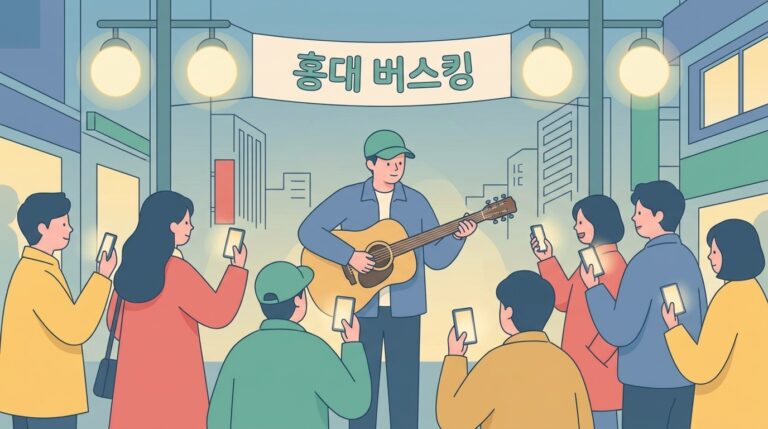
Mastering Hongdae Street Vibes: The Art of Korean Busking and Crowd Chemistry
안녕하세요! (Annyeonghaseyo!) I’m your lead editor at Daily Hangul, your trusty Korean language tutor and local culture guide. Over the years, I’ve walked through the neon-soaked, acoustic-filled streets of Seoul with hundreds of language learners. If you’ve ever wanted to truly blend into the local arts scene rather than just standing on the sidelines, you are in the right place.
Imagine this: You are walking down the vibrant lanes of Hongdae (홍대) on a crisp Friday evening. The air smells of sweet hotteok (호떡 – sweet griddle cakes) and spicy tteokbokki (떡볶이). Suddenly, a wave of cheering pulls you toward a tightly packed semicircle. A talented indie band is playing, and the vocalist makes direct, charismatic eye contact with the crowd. Everyone is clapping in unison. You want to cheer, show appreciation, or compliment their stage management in natural Korean—but you hesitate.
Learning how to talk about and engage with street performances (버스킹) isn’t just about memorizing words; it’s about understanding the subtle, rhythmic pulse of Korean crowd dynamics. Today, we’re diving deep into the performing arts and busking culture from a C1 (Advanced-Intermediate) perspective. This guide is crafted from real-world experiences and common friction points faced by foreign arts enthusiasts in Korea.
1. Deep Dive: 3 Essential Busking & Performance Expressions
To talk about street performing like an arts planner or a seasoned local, you need more than just “노래를 잘해요” (They sing well). Let’s master three highly nuanced expressions.
① 호응이 좋다 (Ho-eung-i jo-ta)
- Pronunciation: [ho-eung-i jo-ta] / ho-eung-ee-jo-tah (Rhymes with “go” + nasal “eung” + “e” + “jo-tah”)
- Meaning: Literal: The response is good. / Real-world Nuance: Great crowd chemistry, active audience participation, or highly responsive engagement.
- K-Culture Moment: Think of an indie artist who doesn’t just sing but gets the entire crowd clapping in perfect unison, turning a quiet street corner into an open-air concert.
- Editor’s Insight: “호응” (response/reaction) is the golden metric in Korean performing arts. If a performance has “호응이 좋다,” it means the audience is matching the artist’s energy with cheers, claps, and sing-alongs.
- Situation Spectrum:
- Friends/Casual: ✅
- Colleagues/Semi-formal: ✅
- Boss/Formal: ✅
- 🤔 Think About It: Why does Korean performance culture heavily emphasize collective response (like 떼창 – group sing-alongs) compared to the more quiet, individualistic appreciation often found in Western acoustic performances?
② 관객 소통 (Gwan-gaek so-tong)
- Pronunciation: [gwan-gaek so-tong] / gwan-gek-so-tong (“Gwan” + “gaek” like egg with a ‘g’ + “so” + “tong” like tongue)
- Meaning: Literal: Audience communication. / Real-world Nuance: Stage presence, interactive banter, and the ability to read the room.
- K-Culture Moment: A street dancer who pulls an embarrassed bystander into the circle for a playful 5-second dance battle, breaking the ice instantly.
- Editor’s Insight: For a performance planner, “소통” (communication) is a highly professional term. Saying a busker has “관객 소통 능력이 뛰어나다” (excellent audience communication skills) instantly elevates your Korean to a C1 professional level.
- Situation Spectrum:
- Friends/Casual: ⚠️ (A bit formal, but sounds very smart)
- Colleagues/Semi-formal: ✅
- Boss/Formal: ✅
- 🤔 Think About It: In Korean culture, communication is rarely just verbal. How do buskers use non-verbal cues (eye contact, bowing, hand gestures) to establish “소통” with a passing crowd?
③ 귀호강 (Gwi-ho-gang)
- Pronunciation: [gwi-ho-gang] / gwee-ho-gang (“Gwi” like we with a ‘g’ + “ho” + “gang” like gong)
- Meaning: Literal: Ear luxury / Pampering one’s ears. / Real-world Nuance: An absolute treat for the ears, hearing incredibly beautiful vocals or instrumentation.
- K-Culture Moment: Stumbling upon a hidden gem acoustic singer in a quiet alleyway of Sinchon whose voice sounds exactly like a studio-recorded OST.
- Editor’s Insight: This is a wonderfully expressive, modern slang term. Its counterpart is “눈호강” (visual treat). Writing “오늘 버스킹 덕분에 귀호강 하고 갑니다” (My ears were thoroughly pampered today thanks to your busking) on an artist’s social media page will make them smile instantly.
- Situation Spectrum:
- Friends/Casual: ✅
- Colleagues/Semi-formal: ✅
- Boss/Formal: 🚫 (A bit too casual for a strict business report, but acceptable in creative performance planning meetings)
- 🤔 Think About It: Korean slang often uses sensory-somatic compounds (like “호강” – luxury/pampering combined with body parts). What does this reveal about how Koreans express emotional and physical satisfaction?
2. Textbook Korean vs. Real-World Korean
When you study from standard textbooks, the language can sound incredibly stiff. Let’s bridge the gap between academic Korean and the organic language spoken on the streets of Seoul.
Scenario 1: Complimenting a Busker’s Sound
- 📖 Textbook Korean: “음악 소리가 매우 아름답고 훌륭합니다.” (The sound of the music is very beautiful and excellent.)
- 🗣️ Real Korean: “와, 목소리 톤이 완전 사기네요! 음색이 장난 아니에요.” (Wow, their vocal tone is unreal! Their timbre is no joke!)
- 💡 Why the difference? Calling someone’s tone “사기” (literally: fraud/cheat) is highly positive slang in modern Korea, implying that their talent is so unrealistically good it feels like a cheat code. “음색” (timbre) is also a much warmer, more specific word than “음악 소리” (music sound).
Scenario 2: Suggesting the Crowd Moves Closer
- 📖 Textbook Korean: “여러분, 조금 앞으로 다가오십시오.” (Everyone, please come forward a little.)
- 🗣️ Real Korean: “뒤에 계신 분들도 앞쪽으로 조금만 붙어주시면 감사하겠습니다!” (We’d appreciate it if those in the back could step up closer to the front!)
- 💡 Why the difference? Using “붙다” (to stick/cling to) in this context is the natural way to ask people to pack in closer to create a cozy performance circle. It sounds highly inviting, polite, and displays great crowd management.
3. K-Culture Deep Dive & Non-verbal Manners
To truly appreciate and organize street art in Korea, you must decode the unwritten rules of the pavement.
3-1. “Nunchi” (눈치) and Visual Etiquette
Korean crowds value collective harmony. Here is how you use your Nunchi (tact/situational awareness) while watching a street performance:
1. The Invisible Boundary: Keep a respectful physical distance. Never cross the chalk line or pavement seam where the artist has set up their gear. Respecting this space is crucial.
2. Tipping with Care: Traditional tipping boxes are common, but cash is becoming rare in Korea. Look closely at the banner nearby; you will almost always find a printed QR code or a bank account number (계좌번호). Yes, Koreans tip buskers via bank transfer!
3. The Phone Flashlight Wave (플래시 응원): During slower, emotional ballads, watch the crowd. If a few people turn on their phone flashlights and wave them slowly, it is your cue to join in. It’s a beautifully silent way to show solidarity.
3-2. Cultural Code: The Evolution of Hongdae Busking Zones
Street performance in Seoul has transformed from chaotic, unauthorized street noise into structured “Busking Zones” (버스킹 존). Managed by the local district offices (like Mapo-gu), performers must pre-register and book slots. This intersection of municipal administration and artistic freedom means that “공연 예술 기획” (performing arts planning) in Korea is highly systemized. Street artists are viewed as cultural assets that drive local tourism rather than mere street hustlers.
4. Interactive Roleplay: The Street Performance Pitch
Setting: A cool autumn evening in the middle of Hongdae’s Walking Street. Neon signs flicker overhead. Min-jun, a veteran street performance coordinator, is analyzing the crowd with you.
Cast:
* You (C1 Specialist): An aspiring international cultural planner visiting Seoul.
* Min-jun (민준): A passionate local busking organizer who wants to maximize crowd engagement.
- Min-jun: “오늘 확실히 금요일이라 그런지 유동 인구가 정말 많네요. 그런데 사람들이 그냥 지나치기만 하네요.”
(Today, perhaps because it’s Friday, there’s a lot of foot traffic. But people are just passing by.) - You: “맞아요. 🎭 (pointing at the empty space in front of the amp) 아티스트와 관객 사이의 물리적 거리가 너무 멀어서 그런 것 같아요. 거리 조절이 필요해 보여요.”
(True. I think it’s because the physical distance between the artist and the audience is too far. We need to adjust the distance.) - Min-jun: “그렇군요! 관객들이 선뜻 다가오기 어렵나 봅니다. 이럴 때는 어떤 방법이 좋을까요?”
(Ah, I see! It seems hard for the audience to readily approach. What would be a good method in this case?) - You: “🎭 (smiling warmly) 첫 곡은 누구나 알 만한 유명한 대중가요로 시작해서 호응을 유도하는 게 어떨까요? 자연스럽게 떼창이 나오면 발걸음을 멈출 거예요.”
(How about starting the first song with a famous popular song that everyone knows to draw a response? If a natural sing-along happens, they’ll stop in their tracks.) - Min-jun: “아, 떼창 유도! 아주 좋은 아이디어예요. 요즘 어떤 곡이 가장 호응이 좋을까요?”
(Ah, leading a sing-along! That’s a great idea. Which song would get the best response these days?) - You: “요즘 차트 역주행 중인 인디 밴드 곡이나 유명 드라마 OST가 제격이에요. 전주가 흐를 때 박수를 치며 참여를 유도해 보세요.”
(An indie band song that’s climbing back up the charts or a famous drama OST would be perfect. Try inviting participation by clapping when the intro plays.) - Min-jun: “확실히 기획자다운 안목이 있으시네요! 그럼 멘트는 어떻게 치는 게 자연스러울까요?”
(You definitely have the eye of a planner! Then, how should we phrase the announcement naturally?) - You: “🎭 (gesturing with hands) ‘뒤에 계신 분들도 조금만 앞으로 오셔서 저희랑 같이 귀호강 하고 가세요!’라고 친근하게 말해보세요.”
(Try saying warmly, ‘Those in the back, come a little closer and pamper your ears with us before you go!’) - Min-jun: “우와, ‘귀호강’이라는 표현까지 쓰시다니! 한국인보다 더 한국인 같으세요!”
(Wow, using the expression ‘gwi-ho-gang’! You sound more Korean than actual Koreans!) - You: “🎭 (giggling modestly) 과찬이십니다! 무엇보다 아티스트와 관객의 양방향 소통이 성공적인 버스킹의 핵심이니까요.”
(You flatter me! Above all, two-way communication between the artist and the audience is the key to successful busking.) - Min-jun: “맞습니다. 오늘 공연 기획은 대성공일 것 같은 느낌이 팍팍 드네요!”
(You’re right. I have a strong feeling today’s performance planning will be a massive success!)
🔀 Decision Point: The Crowds Stand Frozen. What’s Your Play?
If the crowd is staring blankly without responding, what advice do you give the performer?
- Option A: “여러분, 반응이 너무 조용하네요! 더 크게 소리 질러 주세요!” (Everyone, your response is too quiet! Please scream louder!)
- Option B: “추운 날씨에 가만히 계시기 힘들죠? 손발을 가볍게 풀면서 리듬을 같이 타볼까요?” (It’s hard to stand still in this cold weather, right? Shall we shake out our hands and feet and ride the rhythm together?)
- Option C: (Keep silent and let the artist continue singing without any comments.)
💡 Analysis
- Best Choice: Option B. It uses empathy (acknowledging the cold) and suggests a low-pressure physical action (shaking hands/feet) to break the tension. This exhibits elite Nunchi and sophisticated communication.
- Risk Choice: Option A. Demanding reaction when the crowd is already shy or cold can make Korean audiences feel highly self-conscious, leading to people slipping away from the circle.
- Passive Choice: Option C. Doing nothing fails to bridge the gap, leaving the performance feeling flat and disconnected.
5. 10-Second Emotional Shadowing Drill
Let’s put some soul into your pronunciation. Practice speaking these sentences using the pauses (/) and emotional cues below.
- [😊 Excited & Delighted]
“오늘 / 진짜 / 귀호강 / 제대로 하고 가네요! / 팬 됐어요!”
(O-neul / jin-jja / gwi-ho-gang / je-dae-ro ha-go ga-ne-yo! / paen dwaet-seo-yo!)
(Today, my ears were absolutely pampered! I’ve officially become a fan!) -
[🥺 Eager & Supportive]
“다음 주에도 / 같은 시간대에 / 여기서 / 공연하시나요?”
(Da-eum ju-e-do / gat-eun si-gan-dae-e / yeo-gi-seo / gong-yeon-ha-si-na-yo?)
(Are you performing here at the same time next week too?)
6. K-Culture Mini Dictionary
| Word | Romanization | English Translation | Cultural Insight |
|---|---|---|---|
| 떼창 | Dde-chang | Group sing-along | A staple of Korean concert and busking culture where the audience sings the chorus or whole song back to the artist. |
| 퇴근길 | Toe-geun-gil | Post-show exit greeting | Literally “the road home from work.” Fans wait in an orderly fashion after a street performance or theater show to hand over gifts and chat briefly. |
| 덕질 | Deok-jil | Fan activity / Fangirling | Actively supporting, filming, and promoting your favorite underground or street artist on social media. |
| 버스킹 존 | Beo-seu-king Jon | Busking Zone | Municipal-designated street performance zones designed to reduce noise complaints while fostering local art. |
7. Traveler’s Survival Kit
Top 3 Street Arts Survival Phrases
- “앵콜 부탁드려요!” (Aeng-kol bu-tak-deu-ryeo-yo!)
- Meaning: “Encore, please!”
- Pro Tip: Shouted loudly immediately after the final song ends to keep the magic alive.
- “인스타그램 계정 알려주실 수 있나요?” (In-seu-ta-geu-raem gye-jeong al-ryeo-ju-sil su in-na-yo?)
- Meaning: “Could you share your Instagram handle?”
- Pro Tip: Many buskers put up small signs, but asking directly shows deep artistic appreciation.
- “공연 너무 감동적이었어요.” (Gong-yeon neo-mu gam-dong-jeok-i-eot-seo-yo.)
- Meaning: “Your performance was deeply moving.”
- Pro Tip: Use this when slipping a cash tip or sending a DM after the show.
📌 Editor’s Travel Note
When looking for authentic busking zones, don’t rely on global search engines which often display outdated schedules. Use the Naver Map App to search for “홍대 걷고싶은거리” (Hongdae Walking Street) or “신촌 연세로” (Sinchon Yonsei-ro). Note: Outdoor schedules can vary depending on weather conditions, especially during freeze warnings in winter.
8. Deep Reflection — “One Step Deeper”
Street performance acts as a mirror to a society’s relationship with public spaces. In Korea, street art is a beautifully controlled chaos. While Western street performing often relies on impromptu setups and loud calls for attention, Korean busking exists within a framework of municipal order and extreme consideration for others (배려 – bae-ryeo). This balance of strict spatial management (booking systems, decibel limits) and raw, sentimental performance highlights a fascinating cultural paradox: a society that thrives on deep structural order, yet constantly yearns for emotional, collective release.
💬 Your Turn: How does the street performance culture in your country compare? Is it highly regulated like in Seoul, or more spontaneous? Let us know in the comments below!
9. FAQ & Common Mistakes
Q: Is it okay to take videos of buskers and post them online?
A: Yes, absolutely! In fact, street artists highly encourage this. It is their primary way of getting discovered. However, out of respect, always tag their social media handles so they can repost and gain followers.
Q: What is the etiquette for leaving money in the tip box?
A: Use two hands if possible. When tossing cash into the instrument case or tip box, crouch down gently, place the bill in with care, and give a slight bow of the head as you make eye contact. Throwing money from a standing position is considered highly impolite.
Q: Can I request a song during a street performance?
A: Depends. If the artist asks, “신청곡 받습니다” (I am taking song requests), go ahead! Otherwise, do not interrupt their planned setlist.
🚨 Common Mistakes Alert!
- Standing right in the artist’s performance lane: Blocked visual paths prevent the artist from executing their performance. Check where the line of sight is before standing.
- Loudly talking on the phone in the front row: Since buskers do not have high-end acoustic sound isolation, front-row noise is highly distracting.
- Tossing small coins aggressively: In Korea, tipping is a sign of support and respect. Small coins are often associated with charity or disposal; bills (typically 5,000 KRW or 10,000 KRW) or digital transfers are much preferred.
10. Action Mission
- 🥉 Bronze (At-Home Challenge): Record a voice note of yourself saying: “오늘 공연 최고였어요, 진짜 귀호강 했네요!” until it flows naturally.
- 🥈 Silver (Social Challenge): Find a video of a Korean street artist on YouTube or Instagram. Leave a polite, encouraging comment in Korean using at least one of today’s expressions.
- 🥇 Gold (On-Location Challenge): Visit the Hongdae Busking Zones on a weekend. Stand in the front row, clap with the beat, politely tip the artist, and say “호응이 정말 좋네요!” to a fellow spectator.
11. Interactive Quiz Challenge
Test your knowledge of Korean busking culture!
Q1. Situation Judgment: Which of the following is the most respectful way to tip a Korean busker?
Answer: Placing a folded bill into their instrument case with both hands while slightly bowing your head, or sending a digital transfer to the bank account displayed on their sign.
Explanation: Sliding money respectfully mimics the traditional Korean gesture of giving and receiving items with two hands.
Q2. Fill in the Blank: “오늘 공연 덕분에 정말 ( ) 하고 갑니다! 목소리가 너무 아름다워요.”
Answer: 귀호강
Explanation: “귀호강” (ear luxury) fits perfectly as a modern, trendy compliment for a beautiful vocal performance.
Q3. True or False: It is considered rude to sing along during a Korean street performance.
Answer: False!
Explanation: In fact, collective sing-alongs (떼창) are highly celebrated and indicate that the artist has excellent crowd response (호응이 좋다). Just make sure you aren’t screaming over the artist’s vocals!







