

Hit the Road in Korea: The Masterclass in Car Rentals and Driving Nuances
Phase 1: Empathy (Opening)
안녕하세요! Welcome back to another masterclass with your trusted guide from Daily Hangul.
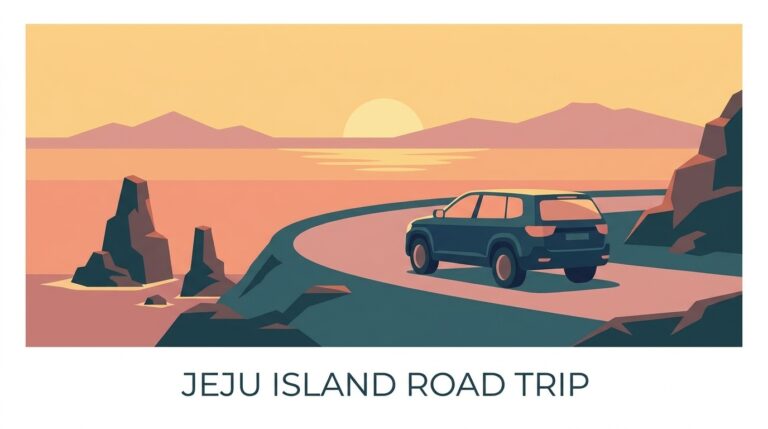
Imagine this: the late afternoon sun is painting the dramatic cliffs of Jeju Island’s Aewol Coastal Road in hues of burnt orange. You have meticulously planned this getaway. You can almost taste the grilled black pork (흑돼지구이) waiting at a remote seaside eatery. You step up to the car rental kiosk, international driving permit (IDP) in hand, ready to claim your keys.
But as the agent starts rattling off bureaucratic terms in rapid-fire, highly contextualized Korean—discussing wanjeon jacha (full coverage insurance) vs. ilban jacha (standard insurance) and the intricacies of returning the vehicle with a matching fuel level—you freeze. The polished, textbook Korean you practiced suddenly feels miles away from the practical, fast-paced jargon of the automotive industry.
Navigating the legalities of an International Driving Permit and securing a rental vehicle in a foreign country is a high-stakes endeavor. A single misunderstanding can transform a dream road trip into an insurance headache. By mastering this domain at a C2 level, you do not just secure a vehicle; you command respect, demonstrate impeccable situational awareness, and navigate the bureaucratic landscape with the absolute confidence of a Seoul native.
This guide is forged from the real-world experiences of advanced learners who, like you, sought to transition from passive passengers to active explorers of Korea’s breathtaking highway networks. Let’s get you in the driver’s seat.
Phase 2: Three Core Expressions Deep Dive
1. 국제운전면허증 (Guk-je-un-jeon-myeon-heo-jeung)
- Pronunciation: [guk-je-un-jeon-myeon-heo-jeung] / Sound-alike: “Gook-jeh-oon-jeon-myuhn-huh-jeung”
- Meaning: International Driving Permit (IDP)
- K-Culture Moment: In the classic travel-themed variety show 2 Days & 1 Night (1박 2일), cast members often scramble to check if guest stars brought their gukje-unjeon-myeonheojeung before embarking on spontaneous road trips to remote corners of the peninsula.
- Editor’s Insight: Note the distinction between a standard “English driver’s license” (영문 운전면허증) and a true IDP (국제운전면허증). While some major hubs in Korea now accept physical licenses with English printed on the back, most traditional rental agencies outside of major airports strictly require the physical booklet of the IDP stamped under the 1949 Geneva Convention. Do not conflate the two; always present both your original domestic license and the IDP.
- Situation Spectrum:
- Casual (Friends): ⚠️ (Unlikely to use unless planning a trip together)
- Semi-formal (Kiosk Agent): ✅
- Formal (Police/Official): ✅
- 🤔 Think About It: Consider how the compound word is structured: gukje (international) + unjeon (driving) + myeonheojeung (license/permit). This logical stacking of Hanja (Sino-Korean characters) is a hallmark of administrative Korean. How does your native language structure complex legal terms compared to this modular approach?
2. 완전 자차 (Wan-jeon Ja-cha)
- Pronunciation: [wan-jeon-ja-cha] / Sound-alike: “Wahn-juhn-jah-chah”
- Meaning: Super Collision Damage Waiver (CDW) / Full Coverage Self-Car Insurance
- K-Culture Moment: In K-Dramas, whenever characters rent a car for a dramatic escape or a romantic seaside getaway, a minor fender bender inevitably occurs. Experienced characters always sigh in relief when they verify they signed up for wanjeon jacha, saving them from paying astronomical repair costs out of pocket.
- Editor’s Insight: Rental insurance in Korea is broadly categorized into ilban jacha (일반 자차 – general coverage with a deductible limit) and wanjeon jacha (완전 자차 – zero deductible, full coverage). When dealing with local roads, narrow parking spaces, and the infamous “moon-kok” (door dings), demanding wanjeon jacha is not just a safety net; it is a psychological panacea.
- Situation Spectrum:
- Casual (Friends): ✅ (When discussing travel budgets)
- Semi-formal (Rental Agent): ✅
- Formal (Insurance Adjuster): ✅
- 🤔 Think About It: Jacha (자차) is a contraction of jagi charyang (자기 차량 – self-vehicle). The Korean linguistic tendency to contract four-character administrative compounds into sleek, two-syllable terms reflects the hyper-efficient, fast-paced nature of modern Korean consumer culture.
3. 인수하다 (In-su-ha-da) & 반납하다 (Ban-nap-ha-da)
- Pronunciation: [in-su-ha-da] / [ban-nap-ha-da] / Sound-alike: “In-soo-hah-dah” & “Bahn-nahp-hah-dah”
- Meaning: To take over/pick up (the vehicle) & To return (the vehicle)
- K-Culture Moment: These verbs are the bread and butter of the sharing economy in Korea. Whether you are picking up a car from a high-tech car-sharing app like Socar or returning a luxury sedan to a traditional depot in Jeju, you will see these terms prominently displayed on digital interfaces and signs.
- Editor’s Insight: Do not use basic verbs like batda (받다 – to receive) or juda (주다 – to give) in this context. Using insu (takeover of custody) and bannap (formal return of a borrowed item) signals that you understand the professional, contractual nature of the transaction.
- Situation Spectrum:
- Casual (Friends): ⚠️ (Slightly formal, but acceptable when detailing logistics)
- Semi-formal (Rental Staff): ✅
- Formal (Contractual Documentation): ✅
- 🤔 Think About It: Bannap (반납) uses the Hanja ban (반 – to return/revert) and nap (납 – to pay/deliver). It implies returning an asset to its rightful owner in its original state. How does using specific contractual verbs alter the power dynamic between you and a service provider?
Phase 3: Textbook Korean vs. Real Korean
Advanced fluency lies in the gap between what is technically correct and what is culturally natural. Let us look at how real-world driving transactions differ from textbook expectations.
Situation 1: Inquiring about Insurance Coverage
- 📖 Textbook Korean: “보험에 모든 사고 피해 보상이 포함되어 있습니까?” (Is compensation for all accident damages included in the insurance?)
- Why it’s off: It sounds like a legal draft or an artificial translation from an overseas travel manual. It lacks local commercial colloquialism.
- 🗣️ Real Korean: “이거 완전 자차 가입하면 단독 사고나 휠 파손까지 전부 커버되는 건가요?” (If I get full coverage, does it cover single-vehicle accidents or wheel damage as well?)
- Why it works: It cuts straight to the chase using standard industry terms like dandok sago (single-vehicle accident) and keobeo (cover), showing you know exactly what exclusions usually sneak into the fine print.
Situation 2: Asking about Fuel Policy upon Return
- 📖 Textbook Korean: “반납할 때 기름을 가득 채워야 합니까?” (Must I fill the oil fully when returning?)
- Why it’s off: While grammatically perfect, gireum (oil/fuel) sounds a bit colloquial, and the phrasing is overly rigid.
- 🗣️ Real Korean: “인수할 때 주유량만큼만 맞춰서 반납하면 되죠?” (I just need to match the fuel level to what it was at pickup when I return it, right?)
- Why it works: It utilizes juyuryang (fuel amount) and frames the question with ~myeon doejyo? (an expectant “right?”), showing confidence in local rental customs.
Phase 4: K-Culture Deep Dive & Non-Verbal Manners
4-1. Driving Nunchi and the Universal Apology Gesture
In Korea, driving is a highly coordinated dance governed by nunchi (눈치 – situational quick-wittedness). One of the most critical non-verbal codes on Korean roads is the strategic use of hazard lights (비상등 – bisangdeung).
While globally hazards are reserved for breakdowns, in Korea, flashing your hazards three times is a multi-purpose social lubricant. It means:
* “Thank you for letting me merge into this tight lane.”
* “My apologies for braking abruptly.”
* “Heads up, the traffic ahead is halting suddenly.”
If someone lets you cut in, and you fail to flash your hazards, it is considered incredibly rude—a direct blow to your driving nunchi. Conversely, a quick double-tap of the hazard button instantly diffuses road rage.
4-2. The Reality of the Korean Road Trip
K-Dramas often portray driving as a seamless, romantic endeavor on wide, empty highways. The reality is an ultra-dense, highly digitized environment. Korea’s speed cameras are highly advanced, utilizing sectional speed enforcement (구간 단속).
Furthermore, traditional GPS systems struggle with the rapid changes in Korean infrastructure. To survive, you must abandon overseas mapping services and adopt local navigation apps. This brings us to our next phase: navigating real-time digital systems.
Phase 5: Live Roleplay Scenario
The Setting
The bustling counter of “Daehan Rent-a-Car” at Jeju International Airport. The air is thick with the scent of the nearby ocean and the hum of terminal announcements. You are speaking with Mr. Min, a veteran rental agent who values efficiency but warms up instantly to customers who speak “real” Korean.
Cast
- You (Advanced Traveler): Confident, polite, and thoroughly prepared.
- Mr. Min (Rental Agent): Professional, slightly tired from a long shift, but highly attentive.
Mr. Min: 어서 오세요. 예약자 성함하고 면허증 제시 부탁드립니다.
(Welcome. Please state your reservation name and present your license.)

You: 네, 제 이름으로 예약했고요. 여기 한국 운전면허증이랑 국제운전면허증, 그리고 여권입니다.
(Yes, I reserved under my name. Here is my Korean driver's license, International Driving Permit, and passport.)

Mr. Min: (Checking documents) 아, 국제면허증 확인되었습니다. 제네시스 GV70 차량으로 완전 자차 포함 예약하신 것 맞으시죠?
(Ah, IDP verified. You reserved a Genesis GV70 with Super CDW included, correct?)

You: 맞습니다. 혹시 완전 자차 적용 범위가 어디까지인지 대략 설명해 주실 수 있나요?
(Correct. Could you briefly explain the scope of coverage for the Super CDW?)

Mr. Min: 저희 완전 자차는 대인, 대물, 자손 다 포함되지만, 고객 과실 100%인 혼유 사고나 타이어 파손은 제외됩니다.
(Our Super CDW covers personal injury, property damage, and driver injury, but misfueling due to 100% customer negligence or tire damage is excluded.)

You: 아, 타이어 파손이랑 휠 스크래치는 제외되는군요. 혹시 특약으로 추가할 수 있는 보장 상품이 따로 있나요?
(Ah, so tire damage and wheel scratches are excluded. Is there a separate rider or premium option I can add to cover those?)

Mr. Min: 네, 하루에 만 원 추가하시면 ‘단독사고 특약’으로 타이어랑 휠까지 전부 보장 가능합니다. 어떻게 하시겠어요?
(Yes, if you add 10,000 KRW per day, the 'Single-Vehicle Accident Rider' will cover both tires and wheels. What would you like to do?)

You: 그럼 여행하는 동안 신경 쓰고 싶지 않으니, 그 특약도 같이 추가해 주세요.
(Since I don't want to worry during my trip, please add that rider as well.)

Mr. Min: 알겠습니다. 추가 완료되었고요. 차량 인수는 3번 구역에서 직원 안내 받으시면 됩니다. 반납하실 때 주유는 처음 상태 그대로 맞춰서 오시면 됩니다.
(Understood. Addition complete. You can take over the vehicle in Zone 3 with our staff's guidance. For return, please match the fuel to its initial level.)

You: 네, 알겠습니다. 혹시 차량 인도받을 때 외관 사진이나 동영상 미리 찍어둬야 하죠?
(Yes, got it. By the way, I should take photos or videos of the exterior when picking up the vehicle, right?)

Mr. Min: 완전 자차를 가입하셔서 자잘한 스크래치는 저희가 일일이 확인하진 않지만, 그래도 만약을 위해 꼼꼼히 촬영해 두시는 게 좋습니다.
(Since you have Super CDW, we don't inspect minor scratches individually, but it's still wise to take detailed photos just in case.)
🔀 Decision Point
You walk out to Zone 3 to inspect the Genesis GV70. You notice a deep, albeit small, scratch on the undercarriage of the front bumper that wasn’t mentioned on the initial check sheet. How do you address the staff member preparing to hand over the keys?
- Option A: Ignore it since you purchased the comprehensive “Single-Vehicle Accident Rider.”
- Option B: Point at the bumper and say in a demanding tone: “이거 스크래치 있어요. 사기 치는 거 아니죠?” (There’s a scratch here. You’re not trying to scam me, right?)
- Option C: Politely yet precisely document it with the staff: “여기 범퍼 하단에 긁힌 자국이 좀 있는데, 인수증에 미리 표기해 두는 게 안전하겠죠?” (There’s a scratch under the bumper here; it would be safer to note this on the receipt beforehand, right?)
🏆 Best Choice: Option C
- Why: Option C demonstrates absolute linguistic professionalism and high emotional intelligence. Even with comprehensive insurance, documenting preexisting damage protects you against bureaucratic discrepancies when returning the car. Framed as a collaborative suggestion (~는 게 안전하겠죠?), it keeps the tone pleasant and professional.
- Risk Analysis of Others:
- Option A relies too heavily on administrative goodwill. If a dispute arises, not having it documented can stall your departure.
- Option B is culturally tone-deaf and overly combative. Assuming malicious intent (사기 치는 거 아니죠?) will instantly damage rapport with the staff.
Phase 6: 10-Second Shadowing Drill
To sound like a native driver, you need to master the natural pauses and authoritative, polite rhythm of someone who knows the rules. Practice this sentence, mimicking the emotional cue.
[😤 Professional & Firm – Clarifying Insurance Details]
“완전 자차로 / 가입해도 / 단독 사고 시에는 / 본인 부담금이 / 발생하는지 / 확인해 주세요.”
- Romanization: Wanjeon jacharo / gaiphaedo / dandok sago si-eneun / bonin budamgeumi / balsaenghaneunji / hwaginhae juseyo.
- Emotional Accent Guide: Put a slight stress on 완전 자차 (wanjeon jacha) and 본인 부담금 (bonin budamgeum). Keep the transitions smooth, dipping your voice slightly at each slash (/).
- Translation: “Even if I sign up for Super CDW, please confirm if there is still a deductible in the event of a single-vehicle accident.”
Phase 7: K-Culture Mini Dictionary
| Word | Pronunciation & English | Cultural Context & Usage |
|---|---|---|
| 초보운전 | Chobo Unjeon (Novice Driver) |
In Korea, beginners display creative stickers on their rear windows. Instead of standard signs, you will see humorous pleas like “I want to go home too” (저도 제가 무서워요) or “Patience is a virtue, please go around me.” |
| 하이패스 | Hi-pass (Electronic Toll Collection) |
Korea’s wireless toll-gate system. When renting, always ask if the vehicle has a Hi-pass card equipped (하이패스 단말기 장착 여부). If so, you can drive through the blue lanes smoothly and pay the accumulated fees at the end. |
| 문콕 | Mun-kok (Door Ding) |
A portmanteau of mun (door) and kok (the sound of a tiny poke). Because parking spaces in Korea are famously narrow, mun-kok disputes are incredibly common. It is why many drivers leave blue protective foam sponges on their car doors. |
| 비상등 | Bisang-deung (Hazard Lights) |
Literally “emergency light.” As discussed in Phase 4, this is the ultimate tool of social harmony on Korean expressways. |
Phase 8: Traveler’s Survival Kit
Survival Phrases TOP 3
- “네비게이션 언어 설정 영어로 어떻게 바꿔요?”
- Romanization: Nebigeisyeon eoneo seoljeong yeon-georo eotteoke bakkwoyo?
- Pro Tip: Most rental cars in Korea come with built-in screens. Ask the agent to switch the GPS language to English before you leave the lot, as navigating Korean menus while driving is highly dangerous.
- “이 차량 경유차인가요, 휘발유차인가요?”
- Romanization: I charyang gyeong-yuchain-gayo, hwibalyuchain-gayo?
- Pro Tip: Misfueling (혼유 사고) is a catastrophic mistake. Gyeong-yu (경유) is Diesel, and Hwibalyu (휘발유) is Gasoline. Gasoline pumps are usually yellow/red, and diesel pumps are blue/green, but always double-check with the staff.
- “주유구 레버 어디 있어요?”
- Romanization: Juyugu rebeo eodi isseoyo?
- Pro Tip: Fuel door release buttons/levers can be placed in unusual spots depending on the car model (especially domestic brands like Hyundai or Kia). Ask this before driving off.
📌 Editor’s Travel Note
- Essential App Navigation: Do not rely on overseas navigation apps, as they lack real-time local updates and offline routing due to national security laws. Instead, download the Naver Map App for iOS and Android or the KakaoNavi App for Real-time Navigation which offer English interfaces and highly accurate speed-camera warnings.
- Gas Station Etiquette: Many gas stations in Korea are self-service (셀프 주유소). When using these, select your fuel type carefully on the screen. If you need assistance, call out politely to the attendant: “사장님, 도와주실 수 있나요?” (Sir, could you help me?).
Phase 9: Think Deeply — “한 발 더 깊이”
Driving is a profound window into a nation’s collective psyche. In Korea, the road network represents a fascinating intersection of intense efficiency—the Ppalli-ppalli (fast-paced) culture—and strict hierarchical respect.
This is mirrored in the linguistic landscape of driving. When a driver makes a mistake, the language of apology must be swift and absolute. There is very little room for ambiguity. Navigating these spaces requires a high level of linguistic agility; one must know when to use the deferential honorifics to authority figures (like parking attendants or highway patrol) and when to use direct, technically precise terms with service technicians.
By understanding these unspoken road agreements, you are not merely operating machinery in a foreign country; you are participating in a highly coordinated social contract that keeps one of the world’s most densely populated nations moving smoothly.
💬 Your Turn: How does driving etiquette in your home country compare to Korea’s use of hazard lights as a social tool? Do you have unspoken non-verbal cues on your local roads? Let us know in the comments below!
Phase 10: FAQ & Common Mistakes
Q: Can I drive in Korea with just my native English driver’s license?
A: No. You must present a valid physical International Driving Permit (IDP) issued under the 1949 Geneva Convention alongside your original domestic license. Digital copies or unauthorized online translations are not legally recognized by standard Korean rental companies.
Q: What happens if I accidentally enter a Hi-pass toll lane without a card?
A: Do not panic or brake abruptly. This is a major hazard. Simply proceed through the toll gate. The system will photograph your license plate, and you can easily pay the toll fee when you return the rental car, or at any convenience store later by presenting your vehicle plate number.
Q: Is parking easily accessible in major cities like Seoul or Busan?
A: Generally, no. Parking in urban centers is highly congested and expensive. It is strongly recommended to park at designated public parking lots (공영 주차장 – gong-yeong juchajang), which offer standardized rates, rather than leaving your car on narrow alleys where you risk being towed or fined.
🚨 Common Mistakes Warning Board
- Mistaking Gas Types: Putting gasoline in a diesel car (or vice versa). Correction: Always check the fuel tank cap, which usually has the fuel type written (경유 or 휘발유).
- Ignoring the Black Box: Unplugging or turning off the dashcam (블랙박스) to save battery. Correction: Keep it on at all times; it is your primary legal defense in case of a dispute.
- Relying on Global Maps: Using mapping systems that are not optimized for Korea. Correction: Exclusively use localized Korean navigation apps to avoid getting lost in rapidly developing urban zones.
Phase 11: Action Missions
🥉 Bronze Mission (Mirror Training)
Stand in front of a mirror and practice asking for the rental car keys and clarifying the fuel policy:
“안녕하세요, 예약자 김철수입니다. 인수할 때 주유량만큼만 맞춰서 반납하면 되죠?”
🥈 Silver Mission (Digital Exploration)
Download the Naver Map application and search for a route from Jeju Airport to Seongsan Ilchulbong. Toggle the settings to find where the “Navigation” (내비게이션) option is located, and practice changing the voice settings to English.
🥇 Gold Mission (The Real Deal)
Next time you visit a car rental counter or interact with a Korean car rental customer service portal online, draft your inquiry using at least two advanced terms learned today (e.g., 완전 자차 특약, 국제운전면허증).
🎮 K-Culture Mission
Watch a road trip episode of your favorite Korean travel show (such as Traveler or Europe Outside the Tent). Spot the moment the cast members interact with GPS devices or gas station attendants, and write down the exact phrases they use when paying tolls or fueling up!
Phase 12: Interactive Quiz Challenge
Test your mastery of Korean road trip logistics with these advanced scenarios.
1. Situational Judgment
You are driving a rental car in Busan when another driver kindly slows down to let you merge into a heavily congested lane. What is the most culturally appropriate immediate action?
* A) Honk your horn twice.
* B) Roll down your window and bow.
* C) Turn on your hazard lights (비상등) for 2 to 3 flashes.
Click to reveal the correct answer and cultural context!
Correct Answer: C
- Why: Flashing your hazard lights (비상등) is the standard, polite way to say “thank you” or “sorry” on Korean roads. Honking (A) can be misinterpreted as aggressive, and rolling down your window (B) is highly impractical at highway speeds.
2. Fill-in-the-Blank
Complete the dialogue at the rental desk:
“사고 시 고객 부담금이 전혀 없는 ( _________ ) 상품으로 가입하고 싶습니다.”
(I would like to sign up for the _________ option, which has zero customer deductible in case of an accident.)
Click to reveal the correct answer!
Correct Answer: 완전 자차 (Super CDW / Full Coverage)
- Explanation: Wanjeon jacha (완전 자차) guarantees that you have no personal deductible (본인 부담금) for eligible damage, offering absolute peace of mind during your travels.
3. True or False K-Culture Trivia
Statement: When renting a car in Korea, a standard domestic physical driver’s license with English on the back is universally accepted by all local car rental agencies without needing an IDP.
Click to reveal the correct answer!
Correct Answer: FALSE
- Explanation: While some metropolitan branches are beginning to accept English-printed physical licenses, the vast majority of local and regional operators (especially in popular travel destinations like Jeju or Gangwon) strictly require the physical International Driving Permit (국제운전면허증) booklet. Always carry both to avoid being denied your vehicle!







