

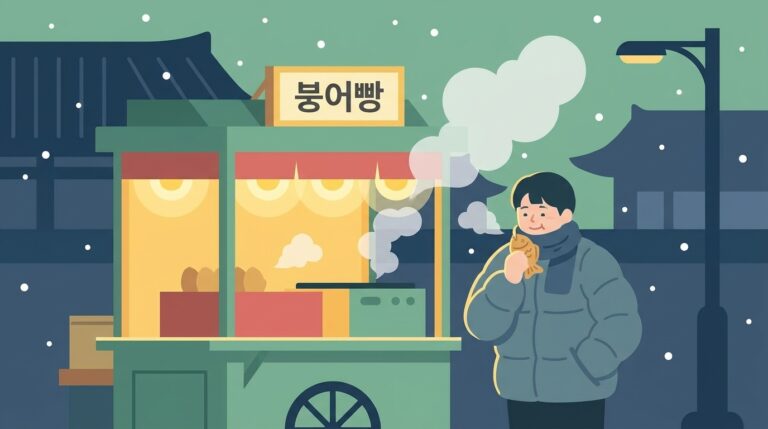
Phase 1: Empathy (Welcome to the Freezing Streets of Seoul)
Hello! I’m the Lead Editor at Daily Hangul. Imagine this: You are walking down the freezing streets of Seoul in December. The wind is biting your cheeks, and your hands are stuffed deep into your pockets. Suddenly, a sweet, warm scent hits you—it’s a mix of baked dough, sweet red bean, and hot soup. You look up and see a glowing little cart on the corner. It’s a Pojangmacha (포장마차) selling Bungeoppang (fish-shaped pastries)!
You run up, order three, and confidently pull out your credit card. But the vendor smiles apologetically and shakes their head. Panic sets in. You have no cash. You have to walk away empty-handed in the cold.
If you’ve watched K-Dramas, you’ve seen characters stopping at these carts for a late-night snack, laughing over a cup of Odeng (fish cake) broth. But what the subtitles don’t tell you is the unwritten rule of Korean winter survival: You must always carry 3,000 won in your heart (and pocket).
Today, we are diving into the delightful, urgent, and deeply cultural language of Korean winter street food. As B2 learners, we aren’t just going to learn how to say ‘How much is this?’—we are going to learn how to order like a true local who knows their way around a Bungeoppang cart.
Phase 2: Core Expressions Deep Dive
1. 가슴속에 3천 원을 품고 다녀야 해요.
- Pronunciation: [Gaseumsoge samcheon-woneul pumgo danyeoya haeyo.]
(Sound-alike: gah-seum-soh-geh / sahm-chun-won-eul / poom-go / dahn-yeo-yah / hae-yo) - Meaning:
- Literal: You must carry 3,000 won in your heart.
- Real nuance: You should always carry a little cash during winter, just in case you stumble upon a street food cart.
- K-Culture Moment: This is a famous Korean meme. Because food carts appear randomly in winter and often don’t accept credit cards, Koreans joke that keeping 3,000 won (about $2.50) in your winter coat is a matter of ‘survival.’ There is even a popular GPS app called ‘가슴속 3천원’ that tracks nearby street food carts based on user reports!
- Editor’s Insight: The use of the word ‘가슴속’ (inside the heart) instead of ‘주머니’ (pocket) adds a layer of dramatic, poetic desperation. It shows just how much Koreans love these winter snacks.
- Situation Spectrum:
- Casual with friends: ✅ (가슴속에 3천 원 품고 다니지?)
- Semi-formal (Co-workers): ✅
- Formal (Boss/Elders): ⚠️ (A bit too colloquial/meme-like for formal business)
- 🤔 Think About It: Why does a hyper-modern, cashless society like Korea still romantically cling to this cash-only street food culture? How does this nostalgia compare to street food in your country?
2. 사장님, 계좌이체 할게요.
- Pronunciation: [Sajangnim, gyejwa-iche halgeyo.]
(Sound-alike: gyeh-jwa-ee-cheh – ‘gye’ sounds like ‘gyeh’ in ‘baguette’ and ‘jwa’ sounds like ‘mwa’ with a J) - Meaning:
- Literal: Boss, I will do a bank transfer.
- Real nuance: Excuse me, I’m going to pay by bank transfer.
- K-Culture Moment: So, what happens if you don’t have 3,000 won in your pocket? Korea has a solution. Almost every street cart has a piece of cardboard with a bank account number written on it. You just open your banking app, send the money, and show the vendor the confirmation screen.
- Editor’s Insight: ‘사장님’ (Sajangnim) literally means ‘CEO’ or ‘President,’ but in Korea, we use it to respectfully address any business owner, including the lovely grandma running the Bungeoppang cart.
- Situation Spectrum:
- To vendor: ✅
- To friends: 🚫 (You wouldn’t say this to a friend unless you owe them money)
3. 팥 반, 슈크림 반 섞어주세요.
- Pronunciation: [Pat ban, syukeureem ban seokkeo-juseyo.]
- Meaning:
- Literal: Red bean half, choux cream half, please mix.
- Real nuance: I’d like half red bean and half custard cream, please.
- K-Culture Moment: The ultimate Korean winter debate: Red Bean (traditional, earthy, sweet) vs. Choux Cream (modern, custard-like, rich). Friendships are tested over this preference. Why choose? Just ask them to mix it!
- Editor’s Insight: The verb ‘섞다’ (to mix) is incredibly useful. You can use it when buying mixed flavors of anything, from snacks to banchan (side dishes).
- Situation Spectrum:
- To vendor: ✅
Phase 3: Textbook vs. Real Korean
[Ordering at the Cart]
* 📖 Textbook Korean: 붕어빵 세 개 주십시오. (Please give me three Bungeoppang.)
* 🗣️ Real Korean: 사장님~ 여기 팥 둘, 슈크림 하나요! (Boss~ Two red bean and one cream here!)
* 💡 Why the difference?: Real Korean is all about efficiency. Dropping verbs and using noun + 요 (yo) is the fastest, most natural way to order while keeping it polite.
[When You Have No Cash]
* 📖 Textbook Korean: 저는 현금이 없습니다. 카드로 계산해도 됩니까? (I do not have cash. May I pay by card?)
* 🗣️ Real Korean: 헉, 저 현금이 없는데… 계좌이체 되죠? (Gasp, I don’t have cash… Bank transfer is okay, right?)
* 💡 Why the difference?: Ending with ‘~되죠?’ (It works, right?) assumes a positive answer and shows you know how the local system works. The ‘헉’ (gasp) adds authentic emotional flavor!
Phase 4: Cultural Context — K-Culture Deep Dive
4-1. Non-Verbal Communication: The ‘Odeng’ Etiquette
When waiting for your Bungeoppang, you’ll see Koreans holding a paper cup of steaming hot Odeng (fish cake) broth.
* The unspoken rule: The broth is usually FREE if you buy something! You can just take a paper cup and scoop the soup yourself.
* Nunchi (눈치): Don’t double-dip your fish cake skewer into the communal soy sauce. Either brush the sauce on or use a spray bottle provided by the cart.
4-2. The K-Drama Trope: Sharing Warmth
Winter street food carts are a staple in Korean media. In K-Dramas, when a character is depressed or broke, they often sit at a Pojangmacha drinking Soju and eating Udon. But for sweet snacks, there is a classic romantic trope: The male lead buys a paper bag full of warm Hotteok or Bungeoppang and slips it into the female lead’s freezing hands.
- Critical View: In dramas, the street carts always look immaculately clean and empty, waiting just for the main characters. In reality, a famous ‘Bung-se-gwon’ (a neighborhood with a good cart) will have a line of 15 people shivering in padding jackets, fiercely guarding their spot in line!
Phase 5: Real-Life Roleplay Scenario
Setting: A freezing Friday evening, 7 PM, right outside Hongdae Station Exit 9. The wind is howling. You and your Korean colleague, Minsu, just got off work. You spot a small cart glowing in the dark, emitting the heavenly smell of baking batter.
Characters:
* YOU: An expat working in Seoul, craving something sweet.
* Minsu (32): Your friendly Korean coworker who knows all the local food spots.
* Vendor (Ajumma, 60s): Fast-moving, wearing a thick apron and winter ear muffs.
Dialogue:
YOU: 우와, 민수 씨! 저기 붕어빵 팔아요! 냄새 장난 아니에요.
(Uwa, Minsu ssi! Jeogi bungeoppang parayo! Naemsae jangnan anieyo.)
[Wow, Minsu! They’re selling Bungeoppang over there! The smell is no joke.]
Minsu: 오, 드디어! 겨울엔 역시 가슴속에 3천 원을 품고 다녀야 한다니까요. 먹고 갈까요?
(O, deudieo! Gyeouren yeoksi gaseumsoge samcheon-woneul pumgo danyeoya handanikkayo. Meokgo galkkayo?)
[Oh, finally! This is why you must carry 3,000 won in your heart in winter. Shall we eat?]
YOU: 네! (Running to the cart) 사장님, 안녕하세요!
(Ne! … Sajangnim, annyeonghaseyo!)
[Yes! … Boss, hello!]
Vendor: 어서 와요~ 날씨 춥지? 뭐 줄까?
(Eoseo wayo~ Nalssi chupji? Mwo julkka?)
[Welcome~ Weather’s cold, right? What can I give you?]
(🎭 Stage Direction: The vendor flips 10 fish pastries with lightning speed)
YOU: 붕어빵 3개에 얼마예요?
(Bungeoppang se gaee eolmayeyo?)
[How much is it for 3 Bungeoppang?]
Vendor: 3개에 2천 원이에요. 팥 할래, 슈크림 할래?
(Se gaee icheon wonieyo. Pat hallae, syukeureem hallae?)
[It’s 2,000 won for 3. Do you want red bean or choux cream?]
Minsu: OO(Your Name) 씨, 현금 있어요? 저 지갑을 두고 왔네요.
(OO ssi, hyeongeum isseoyo? Jeo jigabeul dugo wanneyo.)
[OO, do you have cash? I left my wallet behind.]
YOU: 헉, 저도 카드밖에 없는데…
(Heok, jeodo kadeubakke eomneunde…)
[Gasp, I only have my card too…]
🔀 Your Turn! How should you respond to the Vendor?
* A) “사장님, 카드 계산 됩니까?” (Boss, is card payment possible?)
* B) “사장님, 저 현금이 없는데 계좌이체 할게요!” (Boss, I have no cash, I’ll do a bank transfer!)
* C) “안녕히 계세요.” (Goodbye. walks away sadly)✅ Best Choice: B — This is the ultimate survival skill! Almost all carts accept transfers.
⚠️ Choice A Analysis: Most small street carts do not have credit card terminals. Asking this might result in a polite rejection.
Vendor: 그래, 거기 앞에 계좌번호 써 있으니까 거기로 보내요~
(Geurae, geogi ape gyejwabeonho sseo isseunikka geogiro bonaeyo~)
[Sure, the account number is written in front, just send it there~]
YOU: 네! 사장님, 팥 반 슈크림 반 섞어주세요!
(Ne! Sajangnim, pat ban syukeureem ban seokkeojuseyo!)
[Yes! Boss, please mix half red bean and half cream!]
Vendor: 아이고, 3개라서 반반이 안 되는데? 팥 2개, 슈크림 1개 줄게!
(Aigo, se gaeraseo banbani an doeneunde? Pat du gae, syukeureem han gae julge!)
[Oh my, it’s 3 pieces so half-and-half doesn’t work. I’ll give you 2 red bean and 1 cream!]
YOU: 아하, 네! 감사합니다. 잘 먹겠습니다!
(Aha, ne! Gamsahamnida. Jal meokgetseumnida!)
[Aha, yes! Thank you. I will eat it well!]
Phase 6: 10-Second Shadowing Drill
Practice your timing and intonation. Follow the slash (/) for pauses.
- 🥺 (A bit apologetic but confident):
사장님, / 저 현금이 없는데 / 계좌이체 / 할게요!
(sajangnim, / jeo hyeongeumi eomneunde / gyejwa-iche / halgeyo!) -
😊 (Bright and cheerful):
여기 / 팥 반, / 슈크림 반 / 섞어주세요!
(yeogi / pat ban, / syukeureem ban / seokkeojuseyo!)
Phase 7: K-Culture Mini Dictionary
1. 붕세권 (Bung-se-gwon)
* Romanization: bung-se-gwon
* English: Bungeoppang + Station area
* Context: A fun slang combining ‘Bungeoppang’ and ‘Yeoksegwon’ (an area close to a subway station). It refers to a neighborhood lucky enough to have a Bungeoppang cart nearby.
2. 겉바속촉 (Geot-ba-sok-chok)
* Romanization: geot-ba-sok-chok
* English: Crispy on the outside, soft on the inside
* Context: The ultimate compliment for Korean winter foods like Bungeoppang or Hotteok. It’s an abbreviation of “겉은 바삭, 속은 촉촉”.
3. 계좌이체 (Gyejwa-iche)
* Romanization: gyejwa-iche
* English: Bank transfer
* Context: Because Korea is incredibly digital, even if you don’t have physical cash, transferring money directly to the vendor’s bank account via mobile app is a daily norm.
4. 오뎅 국물 (Odeng gukmul)
* Romanization: odeng gukmul
* English: Fish cake broth
* Context: The savory, peppery soup that boils with fish cake skewers. It’s considered the ultimate hand-warmer and soul-soother on a freezing day.
Phase 8: Traveler Survival Kit (Street Food Edition)
🆘 Survival Phrases TOP 3
1. 🇰🇷 “이거 1인분에 얼마예요?” (igeo irinbune eolmayeyo?)
🗣️ Meaning: How much is this for one portion?
2. 🇰🇷 “계좌번호가 어떻게 되나요?” (gyejwabeonhoga eotteoke doenayo?)
🗣️ Meaning: What is your bank account number?
3. 🇰🇷 “국물 좀 마셔도 될까요?” (gungmul jom masyeodo doelkkayo?)
🗣️ Meaning: May I drink some broth?📌 Editor’s Travel Note:
* The App You Need: Search for “가슴속 3천원” in the app store. It’s a crowd-sourced map showing you exactly where street vendors are located, their opening hours, and prices!
* Cash is King Here: Korea is 99% a card/digital society. You can buy a 500 won candy with a credit card at a convenience store. But for Pojangmacha street food? You must have small bills (1,000 won notes are best) or a Korean bank account for transfers.
* No Tipping: Never tip the street vendor. They will just get confused and try to chase you down to return your change!
Phase 9: Critical Thinking — “One Step Deeper”
🧠 Think Deeper: Media vs. Reality (Hyper-Tech vs. Analog Nostalgia)
South Korea is renowned for its hyper-speed internet, tech giants, and a virtually cashless society where people pay for everything with their smartphones or smartwatches. Yet, every winter, millions of Koreans willingly step out into the freezing cold to hunt for cash-only, analog street carts. Why? Because winter snacks aren’t just food; they are nostalgia. They represent the ‘Jeong’ (정 – warm connection/affection) of the old days. The minor inconvenience of digging for coins or typing in a bank account number with freezing fingers is part of the romanticized winter experience.
💬 Your Turn: Does your country have a food culture that relies on nostalgia or ‘old-fashioned’ ways of purchasing, despite modern technology? Share your thoughts in the comments!
Phase 10: FAQ & Avoiding Common Mistakes
Q: Can I eat my snack right in front of the cart?
Yes! In fact, standing next to the cart, eating your hot snack, and drinking the free Odeng broth is part of the culture. Just step slightly to the side so others can order.
Q: Do these carts have set hours?
No, that’s the beauty and tragedy of it. Vendors open and close based on the weather, their mood, or when they run out of batter.
❌ Common Mistake #1: Handing the vendor a 50,000 won bill (Sin-saim-dang) for a 2,000 won snack.
✅ Do this instead: Break your large bills at a convenience store first. Street vendors often don’t have enough small change for a 50k bill, and it puts them in an awkward spot.
Phase 11: Summary & Action Items
- One-Liner Summary: To survive Korean winter like a local, carry small cash for Bungeoppang, know how to ask for a bank transfer (계좌이체), and customize your flavors (섞어주세요)!
Action Mission 3 Steps:
* 🥉 Bronze (Solo): Say “사장님, 계좌이체 할게요!” out loud 3 times in front of the mirror, matching the natural intonation.
* 🥈 Silver (Online): Look up “가슴속 3천원” on YouTube and watch a Korean vlogger finding a street cart. Listen for the phrases we learned today.
* 🥇 Gold (Real Life): Go to a local street cart in Korea, order half-red bean, half-cream, and ask to pay via bank transfer!
Phase 12: Quiz — Interactive Challenge
1. Situational Judgment: You want to buy Hotteok, but you only have your phone (no wallet). What is the most natural thing to say to the vendor?
* A) 사장님, 카드 되나요?
* B) 사장님, 계좌이체 할게요!
* C) 은행이 어디에 있습니까?
2. True or False – K-Culture Edition:
* “If you want to drink the Odeng broth at a street cart, you must pay an extra 1,000 won.” (T / F)
3. Fill in the Blank:
* 당신: 사장님, 붕어빵 팥 반, 슈크림 반 [ _________ ]!
(Boss, half red bean, half cream [ _________ ]!)
(Answers: 1. B – because carts usually don’t take cards, 2. False – it’s usually free if you are eating there! 3. 섞어주세요 – please mix it)
Frequently Asked Questions (FAQ)
Q: What does "가슴속에 3천 원을 품고 다녀야 해요." mean in Korean and how do you pronounce it?
A: In Korean, "가슴속에 3천 원을 품고 다녀야 해요." is pronounced [Gaseumsoge samcheon-woneul pumgo danyeoya haeyo.] and means: Literal: You must carry 3,000 won in your heart.
Q: What does "사장님, 계좌이체 할게요." mean in Korean and how do you pronounce it?
A: In Korean, "사장님, 계좌이체 할게요." is pronounced [Sajangnim, gyejwa-iche halgeyo.] and means: Literal: Boss, I will do a bank transfer.
Q: What does "팥 반, 슈크림 반 섞어주세요." mean in Korean and how do you pronounce it?
A: In Korean, "팥 반, 슈크림 반 섞어주세요." is pronounced [Pat ban, syukeureem ban seokkeo-juseyo.] and means: Literal: Red bean half, choux cream half, please mix.







