

Phase 1: Empathy
Greeting: Hello! I’m your Daily Hangul Editor.
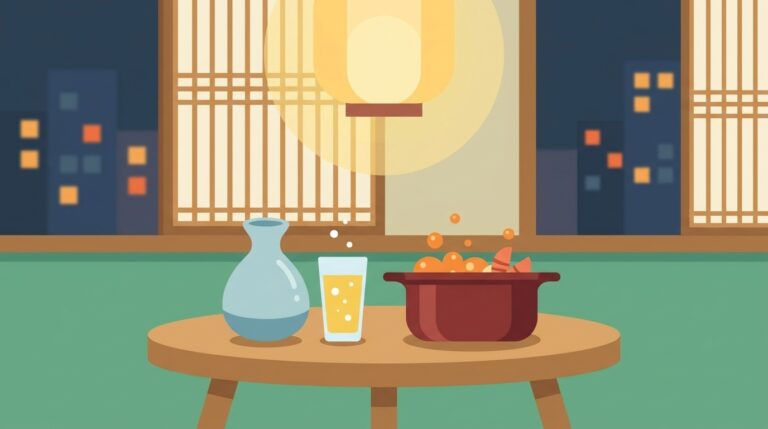
Picture this: It’s 8:00 PM on a chilly Friday night in Seoul. You step into a cozy, dimly lit pub with wooden sliding doors. Steam is rising from a massive pot of spicy seafood soup, and you hear the clinking of glasses. You know this scene from countless K-Dramas! But wait… isn’t this an ‘Izakaya’? Why are Koreans drinking Sake and Highballs in a Korean drama?
Welcome to the unique world of Korean ‘Izakayas’ (이자카야) and the local Japanese liquor culture. In Korea, Izakayas have been completely localized. It’s the go-to spot for second-round drinks (2차, i-cha) after a heavy Korean BBQ dinner. But here’s the catch: while the drinks might be Japanese, the drinking etiquette, the slang, and the vibe are 100% Korean.
If you try to order Sake here using a textbook phrase like “I would like to purchase Japanese alcohol,” the staff will be thoroughly confused. Today, we’re going to dive into the real, advanced expressions you need to confidently order warm Sake or a custom Highball, impress your Korean coworkers, and navigate the unspoken rules of Korean drinking culture like a true insider.
Transparency Note: This guide is crafted from real questions asked by advanced (C1) learners who found themselves lost at a Korean company dinner in a Gangnam Izakaya!
Phase 2: Core Expressions Deep Dive
1. 사케 하나 따뜻하게 데워주세요.
- Pronunciation: [sake hana ttatteutage dewojuseyo] (Sa-keh ha-na ttat-teut-ha-ge de-wo-ju-se-yo)
- Meaning: Can you warm up a sake for us? (Literal: Please warm up one sake warmly.)
- K-Culture Moment: You’re on a winter trip to Seoul. You and your friends duck into an Izakaya to escape the freezing wind. Ordering warm sake instantly marks you as someone who ‘knows’ how to drink in Korea.
- Editor’s Insight: For C1 learners, pay attention to the verb 데우다 (to heat/warm up). We don’t say ‘뜨겁게 해주세요’ (make it hot) for liquids like soup or alcohol; we say ‘데우다’. It implies bringing it to a pleasant, comforting temperature.
- Situation Spectrum:
- Casual with friends: ✅ (사케 하나 데워줘!)
- Semi-formal (Coworkers): ✅ (사케 따뜻하게 데워주실 수 있나요?)
- Formal (Boss/Elders): ⚠️ (Let the boss order, or ask: 데운 사케로 주문할까요?)
- 🤔 Think About It: Why do Koreans often order warm sake in winter, while cold beer is preferred in summer? How does this reflect the Korean philosophy of ‘이열치열’ (fighting heat with heat) and balancing body temperature? Does your culture change its alcohol preferences based on the season?
2. 목넘김이 부드럽고 끝맛이 깔끔하네요.
- Pronunciation: [mongneomgimi budeureopgo kkeunmasi kkalkkeumhaneyo] (Mong-neum-gim-i bu-deu-reop-go kkeut-ma-shi kkal-kkeum-ha-ne-yo)
- Meaning: It goes down smoothly and has a clean aftertaste.
- K-Culture Moment: You’re at a Hoesik (company dinner), and the boss pours you a premium sake. You take a sip. Instead of just saying “맛있어요” (It’s delicious), you drop this phrase. Your boss’s eyes will widen in pure admiration.
- Editor’s Insight: 목넘김 (the feeling in the throat when swallowing) and 깔끔하다 (clean/neat) are top-tier Korean tasting notes. Koreans evaluate alcohol heavily on how smoothly it glides down the throat without a harsh alcohol burn.
- Situation Spectrum:
- Casual with friends: ✅ (야, 이거 목넘김 장난 아니다!)
- Semi-formal (Coworkers): ✅
- Formal (Boss/Elders): ✅ (Perfect for impressing superiors)
- 🤔 Think About It: Korean food vocabulary is incredibly sensory and texture-focused (e.g., 쫄깃하다, 바삭하다). Why is describing the physical sensation of the throat (‘목넘김’) so important in Korean drinking culture?
3. 하이볼, 토닉워터 말고 탄산수로 타주세요.
- Pronunciation: [haibol, tonigwoteo malgo tansansuro tajuseyo] (Hi-bol, to-nik-wo-teo mal-go tan-san-su-ro ta-ju-se-yo)
- Meaning: Please make the Highball with sparkling water instead of tonic water.
- K-Culture Moment: Highballs are the trendiest drink in Korea right now! But Korean bars often use sweet tonic water by default. If you prefer the authentic, dry Japanese style, you must request ‘탄산수’ (carbonated/sparkling water).
- Editor’s Insight: The verb 타다 here means ‘to mix (a drink)’. It’s an essential C1 vocabulary word used for coffee (커피를 타다) and mixed drinks (술을 타다).
- Situation Spectrum:
- Casual with friends: ✅
- Semi-formal (Coworkers): ✅
- Formal (Boss/Elders): 🚫 (Don’t order for others this way unless asked)
- 🤔 Think About It: The Highball trend in Korea has led to crazy variations (Earl Grey Highball, Yuja Highball). How does the Korean tendency to quickly adapt and sweeten foreign food/drinks reflect its fast-paced, trend-sensitive society?
Phase 3: Textbook vs. Real Korean
[Ordering Sake at an Izakaya]
* 📖 Textbook Korean: 일본 술 한 병 주십시오. (Please give me one bottle of Japanese alcohol.)
* 🗣️ Real Korean: 여기 사케 하나 도쿠리로 주세요. (We’ll have one sake in a tokkuri, please.)
* 💡 Why the difference?: Koreans use the specific Japanese loanwords (사케, 도쿠리) heavily in this context. Using formal textbook words sounds like a robot in a relaxed pub setting.
[When your glass is empty]
* 📖 Textbook Korean: 제 잔이 비었습니다. 술을 더 주시겠습니까? (My glass is empty. Would you give me more alcohol?)
* 🗣️ Real Korean: 막잔 털고 일어납시다! (Let’s down this last glass and get going!)
* 💡 Why the difference?: Advanced learners should know slang like ‘막잔’ (마지막 잔 – the last glass) and ‘털다’ (to dust off/empty). It shows a sense of quick, efficient wrapping-up of the night, heavily valued in Korean ppalli-ppalli culture.
Phase 4: Cultural Context — K-Culture Deep Dive
4-1. The Unspoken Rules of Pouring (Non-verbal cues)
Even if you are drinking Sake or Highballs, the Korean hierarchy rules strictly apply.
– The Two-Handed Pour: When pouring sake for someone older or higher in rank, use both hands. (Hold the tokkuri with your right hand, and lightly support your right wrist or elbow with your left hand).
– The Turnaway: When drinking in front of a senior, turn your head slightly to the side, covering your glass with your hand. It’s a sign of deep respect. You’ll see this in every corporate K-Drama!
4-2. K-Food Connection: The Koreanized Izakaya
Why go to a Japanese-style pub in Korea? Because of the food! Korean Izakayas have evolved into a unique hybrid. You won’t just find delicate sashimi; you’ll find 나가사키 짬뽕 (Nagasaki Jjamppong) served in a massive, boiling iron pot right on your table, often made much spicier to suit the Korean palate. Koreans love ‘국물’ (broth) with their alcohol to soothe the stomach. Drinking Sake while sweating over a spicy, bubbling pot of seafood stew is a uniquely Korean K-Food experience!
Phase 5: Real-Life Roleplay Scenario
Setting: A bustling, dimly lit Izakaya in Gangnam. It’s 10:00 PM, the second round (2차) of your team’s dinner. You are sitting with your Korean coworker Minsu.
Characters:
– YOU: An expat working in Seoul, trying to impress your colleagues with your cultural knowledge.
– Minsu (32): Your friendly Korean coworker who just ordered a warm tokkuri of sake.
Dialogue:
Minsu: 1차에서 고기를 너무 먹었더니 배부르네요. 2차는 깔끔하게 사케 어때요?
(1-cha-eseo gogi-reul neomu meogeot-deoni baebureuneyo. 2-chaneun kkalkkeum-hage sake eottaeyo?)
[I’m so full from all the meat at the first round. How about something clean like sake for the second round?]
YOU: 완전 좋죠. 오늘 날씨도 추운데 따뜻하게 데운 사케 한잔하면 딱이겠네요.
(Wanjeon jot-jyo. Oneul nalssi-do chu-un-de ttatteut-hage de-un sake han-jan-hamyeon ttagi-get-ne-yo.)
[Absolutely. It’s cold today, so a glass of warm sake would be perfect.]
Minsu: 오, 한국 사람 다 됐네요! 여기요~ 사케 하나 도쿠리로 데워주세요!
(O, hanguk saram da dwaetneyo! Yeogiyo~ Sake hana dokuriro dewojuseyo!)
[Oh, you’re practically Korean now! Excuse me~ One warm sake in a tokkuri, please!]
(🎭 Stage Direction: The server brings the warm Tokkuri. Minsu picks it up and gestures to pour into your small ceramic cup.)
Minsu: 자, 한 잔 받으세요!
(Ja, han jan badeuseyo!)
[Here, let me pour you a glass!]
🔀 Your Turn! How do you respond?
– A) “감사합니다!” (Hold the cup with one hand flat on the table while he pours).
– B) “아닙니다, 제가 제 잔에 따를게요!” (No thanks, I will pour my own glass!).
– C) “감사합니다!” (Lift the cup with both hands slightly towards him).✅ Best Choice: C — In Korea, you must always lift your cup with both hands (or right hand supported by the left) when someone older/higher is pouring.
⚠️ Choice A Analysis: Leaving the cup on the table is considered rude when a senior pours.
⚠️ Choice B Analysis: Pouring your own drink (자첨 – Jacheom) is a big no-no in Korean drinking culture! Always pour for each other.
YOU: (Lifting cup with both hands) 감사합니다.
(Gamsahamnida.)
[Thank you.]
Minsu: 짠~합시다!
(Jjan~hapsida!)
[Let’s cheers!]
YOU: 이거 목넘김이 엄청 부드러운데요? 끝맛도 깔끔하고요!
(Igeo mongneomgimi eomcheong budeureoundeyo? kkeunmatdo kkalkkeumhagoyo!)
[This goes down so smoothly! The aftertaste is really clean too!]
Minsu: 와, ‘목넘김’이라는 단어를 알아요? 진짜 대박이네요!
(Wa, ‘mongneomgim’iraneun daneoreul arayo? Jinjja daebagineyo!)
[Wow, you know the word ‘mongneomgim’? That’s amazing!]
Phase 6: 10-Second Shadowing Drill
Practice your flow, intonation, and pauses! Read aloud focusing on the slash marks.
😊 이 집은 / 하이볼 비율이 / 기가 막히네요!
(i jibeun / haibol biyuri / giga makineyo!)
Translation: This place has an amazing Highball ratio!
Emotion Tag: 😊 Impressed and cheerful. Stress the ‘기가’ (gi-ga) to emphasize how surprisingly good it is!
Phase 7: K-Culture Mini Dictionary
1. 눈치
* Romanization: nunchi
* English: Social intuition / Reading the room
* Context: Essential in drinking settings. Knowing when your boss’s cup is empty and subtly pouring more without being asked is peak ‘nunchi’.
2. 회식
* Romanization: hoesik
* English: Company dinner / Staff party
* Context: The backbone of Korean corporate bonding. Often involves moving to multiple locations (1차 BBQ, 2차 Izakaya or Pub, 3차 Karaoke).
3. 콜키지 프리
* Romanization: kolkiji peuri
* English: Corkage free
* Context: Many high-end Korean BBQ or Izakaya spots allow you to bring your own Sake or Wine for free. Always ask: “혹시 콜키지 되나요?” (Do you offer corkage?).
4. 자첨 / 자작
* Romanization: jacheom / jajak
* English: Pouring alcohol for oneself
* Context: Highly discouraged in Korea. There’s a superstition that pouring your own drink brings bad luck (or that you’ll sit opposite your crush for 3 years!). Always pour for each other.
Phase 8: Traveler Survival Kit
🆘 Survival Phrases at a Korean Izakaya
– 🇰🇷 “오늘 추천해 주실 만한 사케 있나요?”
(oneul chucheonhae jusil manhan sake innayo?)
– 🗣️ English Translation: Do you have any sake you’d recommend today?
– 📍 Where to use: High-end Izakayas, Omakase spots.
– 💡 Pro Tip: Izakaya menus in Korea can be overwhelming with hundreds of items. Just ask the staff for the ‘Best’ (베스트) or ‘Chucheon’ (추천) to save time!📌 Editor’s Travel Note
– Call Bells: Most Korean Izakayas have a little bell on the table. Don’t yell across the room—just press the ‘Ding-dong’ bell!
– Free Sides (안주): You usually get basic snacks like boiled edamame or pickled radishes for free. You can ask for refills: “이거 리필 되나요?”
– No Tipping: Never tip your bartender or server in Korea! It will cause massive confusion.
Phase 9: Critical Thinking Corner — “A Step Deeper”
Global Era Korean: The Localization of Izakaya Culture
How did the Japanese Izakaya become a staple of Korean nightlife? It’s a fascinating example of cultural localization in the global era. While the aesthetic (wooden interiors, cherry blossom decor) and drinks (Sake, Highballs) are Japanese, the experience is deeply Korean. The food portions are enormous and meant for sharing (reflecting the Korean “Jeong” or communal spirit), the soups are intensely spicy, and the hierarchical drinking etiquette remains strictly Korean. This shows that when Korea adopts a foreign culture, it doesn’t just copy it; it merges it with its own identity to create something entirely hybrid.
🧠 Think Deeper:
The language reflects this hybridity. Koreans order Japanese sake but describe it using deep Korean sensory words like ‘목넘김’.💬 Your Turn: Are there foreign foods or cultural habits in your country that have been completely localized to fit your native culture? Share your thoughts in the comments!
Phase 10: FAQ & Mistake Prevention
Q: “Can I clink glasses (짠) with my boss?”
A: Yes, but with a rule! When clinking glasses with someone senior, your glass should slightly tap below the rim of their glass. It shows humility.
Q: “If I don’t drink alcohol, can I still go to an Izakaya?”
A: Absolutely. Just order a “논알콜 하이볼” (Non-alcoholic highball) or “콜라” (Cola). The focus is on the communal atmosphere, not just getting drunk.
❌ Common Mistake #1: Pouring your own drink at a table with other Koreans.
✅ Do this instead: If your glass is empty, pour a drink for someone else. They will naturally notice your glass is empty and pour for you in return. It’s the ultimate ‘Nunchi’ game!
Phase 11: Summary & Action Items
- One-Liner Summary: Mastering Izakaya vocabulary like ‘목넘김’ (smoothness) and ‘데우다’ (to warm up) will elevate your Korean drinking etiquette from a tourist to a Seoul local.
-
Action Mission 3 Stages:
- 🥉 Bronze (Solo): Read the shadowing sentence out loud 3 times, focusing on mimicking the emotional tone.
- 🥈 Silver (Online): Leave a comment below using the phrase “~목넘김이 좋네요” describing your favorite drink.
- 🥇 Gold (Real World): Visit a Korean bar or Izakaya and order your drink by specifying “탄산수로 타주세요” (Mix it with sparkling water).
- K-Culture Mission: Watch any Korean drama featuring a team dinner (Hoesik) scene. Count how many times the junior employees turn their heads to drink in front of the boss!
Phase 12: Interactive Quiz
1. Situational Judgment:
You are at a company dinner. The CEO is pouring sake for you. What is the correct way to hold your cup?
– A) Leave the cup on the table and bow your head.
– B) Lift the cup with one hand and smile.
– C) Lift the cup with both hands and slightly bow your head.
2. Fill in the Blank:
“이 사케는 너무 부드러워서 ___이 참 좋네요.”
(This sake is so smooth, the [feeling in the throat] is really good.)
– A) 눈치 (nunchi)
– B) 목넘김 (mongneomgim)
– C) 짠 (jjan)
3. True or False – K-Culture Edition:
At a Korean Izakaya, if your glass is empty, you should immediately grab the bottle and pour for yourself to show independence. (T/F)
(Answers: 1. C / 2. B / 3. False – Always let others pour for you in Korean culture!)
Frequently Asked Questions (FAQ)
Q: What does "사케 하나 따뜻하게 데워주세요." mean in Korean and how do you pronounce it?
A: In Korean, "사케 하나 따뜻하게 데워주세요." is pronounced [sake hana ttatteutage dewojuseyo] and means: Can you warm up a sake for us? (Literal: Please warm up one sake warmly.)
Q: What does "목넘김이 부드럽고 끝맛이 깔끔하네요." mean in Korean and how do you pronounce it?
A: In Korean, "목넘김이 부드럽고 끝맛이 깔끔하네요." is pronounced [mongneomgimi budeureopgo kkeunmasi kkalkkeumhaneyo] and means: It goes down smoothly and has a clean aftertaste.
Q: What does "하이볼, 토닉워터 말고 탄산수로 타주세요." mean in Korean and how do you pronounce it?
A: In Korean, "하이볼, 토닉워터 말고 탄산수로 타주세요." is pronounced [haibol, tonigwoteo malgo tansansuro tajuseyo] and means: Please make the Highball with sparkling water instead of tonic water.







