

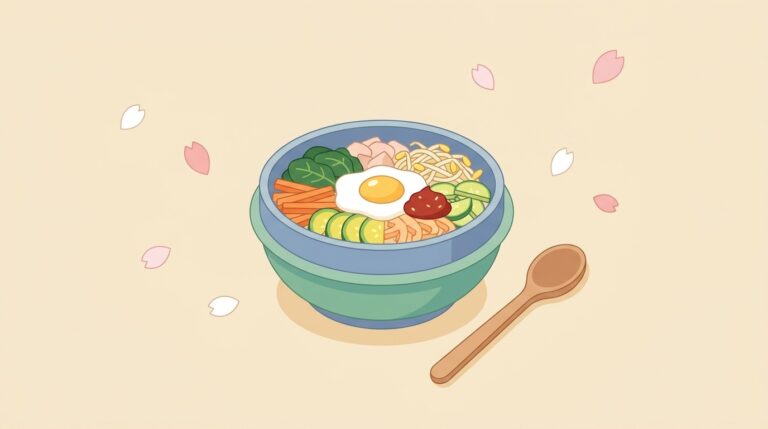
Phase 1: Empathy (Immersive Open)
Hello there! I’m the Chief Editor of Daily Hangul, your veteran tutor and local culture navigator.
Imagine this: It’s a dazzling spring day in Seoul. You’re watching a K-Drama, and the main characters are sitting around a giant silver bowl. They throw in colorful greens, a generous dollop of red paste, and a splash of dark oil. They mix it aggressively while venting about their day. Suddenly, your mouth is watering. That’s Bibimbap. But in spring, it’s not just any bibimbap—it’s 봄나물 비빔밥 (Bomnamul Bibimbap – Spring Greens Bibimbap).
If you walk into a traditional Korean restaurant in April, the menu changes. The regular veggies are replaced by fragrant, slightly bitter greens picked straight from the spring soil. But here’s the catch: Textbook Korean won’t teach you how to ask for the spicy sauce on the side, or how to compliment the “spring aroma” like a true local.
Don’t worry! This guide is built from the real struggles of my expat students who stared at a menu, confused by the word “Namul.” By the end of this post, you’ll be ordering and eating like you’ve lived in Seoul for a decade!
Phase 2: Deep Dive into Core Expressions
Let’s master the essential B1-level phrases you’ll need at a Korean restaurant this spring.
1. 고추장은 따로 주세요.
- Pronunciation: [Gochujangeun ttaro juseyo.]
- Tip: The ‘eo’ in jeong sounds like the ‘u’ in “uh-oh.”
- Meaning: (Literal) Please give the red pepper paste separately. / (Real nuance) Please put the spicy sauce on the side.
- K-Culture Moment: You’ll often see this in K-Dramas when someone is on a diet (reducing sodium) or when idols order food. It’s a lifesaver if your spice tolerance is low!
- Editor’s Insight: By default, Korean restaurants put a big scoop of gochujang right on top of your rice. If you want to control your destiny (and the fire in your mouth), you must use the word 따로 (ttaro – separately).
- Situation Spectrum:
- Casual with restaurant staff: ✅
- Formal/Polite request: ✅
- Rude: 🚫 (It’s a very normal request!)
- 🤔 Think About It: Why does Korean food often come pre-mixed or pre-seasoned by the chef? How does this reflect the culture’s approach to communal dining and trusting the “expert’s touch” (sonmat)?
2. 참기름 한 바퀴 둘러 주세요.
- Pronunciation: [Chamgireum han bakwi dulleo juseyo.]
- Meaning: (Literal) Please surround it with one circle of sesame oil. / (Real nuance) Please drizzle a little sesame oil over it.
- K-Culture Moment: Watch any Korean cooking show (like Culinary Class Wars or Youn’s Kitchen), and you’ll hear chefs say “한 바퀴 (han bakwi – one circle).” It’s the magical finishing touch that brings the bibimbap to life.
- Editor’s Insight: You could just say “참기름 주세요 (give me sesame oil),” but saying “한 바퀴 둘러 주세요” makes you sound incredibly fluent. It shows you understand the action of making the food delicious.
- Situation Spectrum:
- Ordering at a casual diner/market: ✅
- High-end fine dining: ⚠️ (They usually prep it perfectly for you.)
3. 봄 냄새가 향긋하네요!
- Pronunciation: [Bom naemsaega hyanggeuthaneyo!]
- Meaning: (Literal) The spring smell is fragrant! / (Real nuance) These spring greens smell amazing and so fresh!
- K-Culture Moment: When Korean elders (or your K-Korean friends) eat seasonal food, they always vocalize their appreciation. Saying this to a restaurant owner will instantly earn you VIP status and maybe extra side dishes!
- Editor’s Insight: The word 향긋하다 (hyanggeuthada) is specifically used for pleasant, fresh, earthy, or floral scents. You wouldn’t use it for a greasy hamburger, but it’s perfect for herbs and tea.
- Situation Spectrum:
- Talking to friends: ✅ (Drop the ‘yo’: 향긋하네!)
- Complimenting the chef/owner: ✅
Phase 3: Textbook vs. Real Korean
Let’s upgrade your textbook Korean to “Seoul street-smart” Korean.
[Ordering Your Food]
* 📖 Textbook Korean: 비빔밥 한 그릇 주십시오. (Please give me one bowl of bibimbap.)
* 🗣️ Real Korean: 사장님, 여기 봄나물 비빔밥 하나요! (Boss, one spring greens bibimbap here!)
* 💡 Why the difference?: Using “사장님 (Sajangnim – Boss/Owner)” gets their attention politely, and ending with “하나요 (hana-yo – one, please)” is the fast, efficient way Koreans order in busy restaurants.
[Asking for Refills]
* 📖 Textbook Korean: 반찬을 더 주시겠어요? (Would you give more side dishes?)
* 🗣️ Real Korean: 이 나물 좀 더 주실 수 있나요? (Can you give me a little more of these greens?)
* 💡 Why the difference?: Rather than a vague “side dishes,” pointing out exactly what you want (이 나물 – these greens) with “좀 (a little)” softens the request, making it sound much more natural and polite.
Bottom Note: At a B1 level, you want to sound polite but conversational. Using
-요instead of the rigid-습니다in casual dining situations is the sweet spot.
Phase 4: Cultural Context — K-Culture Deep Dive
4-1. Non-Verbal Cues: The Art of Mixing
When your Bomnamul Bibimbap arrives, do not lift the bowl! In Korea, keeping your bowl on the table is proper etiquette (unlike in Japan or China, where lifting the bowl is standard).
Also, use your chopsticks, not your spoon, to mix the bibimbap! Why? Chopsticks separate the rice grains and greens without mashing them into a paste. It’s a pro-level K-Food secret.
4-2. The “Spring Fatigue” (K-Food Connection)
In Korea, as winter turns to spring, many people experience 춘곤증 (Chungonjeung – Spring Fatigue). You feel sleepy, lethargic, and lose your appetite. The cultural remedy? 봄나물 (Bomnamul – Spring Greens).
Herbs like naengi (shepherd’s purse) and dallae (wild chive) are slightly bitter, which Koreans believe “wakes up” your dormant digestive system and gives you energy. So, eating this dish isn’t just a meal; it’s considered natural medicine. When you understand this, you understand why Koreans are so obsessed with eating foods 제철에 (jecheol-e – in their proper season).
Phase 5: Real-Life Roleplay Scenario
Let’s put you in the scene.
Setting: A bustling, steam-filled alley in Gwangjang Market on a breezy April afternoon. The smell of toasted sesame oil is in the air.
Characters:
– YOU: An expat who loves Korean food but can’t handle extreme spice.
– Ajumma (아줌마): The friendly, fast-moving stall owner who calls everyone “Student” or “Aigoo.”
Ajumma: 어서 와요! 뭐 줄까? 🥢
(Eoseo wayo! Mwo julkka?)
[Welcome! What can I get you?]
(🎭 Stage Direction: She wipes the counter rapidly with a cloth)
YOU: 안녕하세요! 봄나물 비빔밥 하나 주세요.
(Annyeonghaseyo! Bomnamul bibimbap hana juseyo.)
[Hello! One spring greens bibimbap, please.]
Ajumma: 네~ 고추장 팍팍 넣어서 맛있게 해줄게!
(Ne~ Gochujang pakpak neo-eoseo masitge haejulge!)
[Okay~ I’ll put lots of red pepper paste and make it delicious!]
🔀 Your Turn! How do you reply?
– A) 네, 감사합니다! (Yes, thank you!)
– B) 헉! 고추장은 조금만 따로 주세요. (Gasp! Please give me a little bit of gochujang on the side.)
– C) 고추장 싫어요! (I hate gochujang!)✅ Best Choice: B — If you can’t eat spicy food, you must speak up now! Option A means you will eat a fiery bowl. Option C is too blunt and slightly rude.
YOU: (Choosing B) 사장님, 고추장은 조금만 따로 주세요. 제가 매운 걸 잘 못 먹어서요.
(Sajangnim, gochujangeun jogeumman ttaro juseyo. Jega maeun geol jal mot meogeoseoyo.)
[Boss, please give me a little gochujang on the side. Because I can’t eat spicy food well.]
Ajumma: 아유, 그래? 알았어. 참기름은 듬뿍 넣어줄게!
(Ayu, geurae? Arasseo. Chamgireumeun deumppuk neo-eojulge!)
[Oh, really? Got it. I’ll put plenty of sesame oil for you!]
YOU: 우와, 봄 냄새가 향긋하네요. 잘 먹겠습니다!
(Uwa, bom naemsaega hyanggeuthaneyo. Jal meokgetseumnida!)
[Wow, the spring smell is so fragrant. I will eat well!]
Phase 6: 10-Second Shadowing Drill
Practice this sentence to sound incredibly natural when asking for that essential sesame oil!
🥺 사장님, / 여기 / 참기름 / 한 바퀴만 / 더 둘러 주세요!
(Sa-jang-nim, / yeo-gi / cham-gi-reum / han ba-kwi-man / deo dul-leo ju-se-yo!)
Boss, / here / sesame oil / just one circle / more drizzle please!
Phase 7: K-Culture Mini Dictionary
Here are 4 keywords related to Korean spring dining you must know:
1. 춘곤증
* Romanization: chungonjeung
* English: Spring fatigue/lethargy
* Context: The sleepy, tired feeling Koreans get when the weather warms up. Spring greens are the ultimate cure.
2. 제철 음식
* Romanization: jecheol eumsik
* English: Seasonal food
* Context: Food eaten at the peak of its season. Koreans highly value jecheol food for its health benefits and superior taste.
3. 손맛
* Romanization: sonmat
* English: Taste of the hands (Homemade touch)
* Context: The unique, delicious flavor that comes from a person’s experience and touch, often used to describe an older generation’s cooking.
4. 밥심
* Romanization: bapsim
* English: The power of rice
* Context: The belief that Koreans get their strength and energy from eating a hearty rice meal.
Phase 8: Traveler Survival Kit
Heading to a Korean traditional market or local diner this spring? Save these cards!
🆘 Survival Expression #1: Specifying Allergies/Dislikes
– 🇰🇷 “은/는 빼주세요.” (-eun/neun ppaejuseyo.)
– 🗣️ English guide: “Please take out [ingredient].”
– 📍 Where to use: Any restaurant.
– 💡 Pro Tip: If you are vegetarian, say “고기는 빼주세요 (Please take out the meat).”🆘 Survival Expression #2: Asking for Refills
– 🇰🇷 “반찬 좀 더 주실 수 있나요?” (Banchan jom deo jusil su innayo?)
– 🗣️ English guide: “Could you give us some more side dishes?”
– 📍 Where to use: Dine-in restaurants (Most side dishes in Korea are free to refill!).📌 Editor’s Travel Note
– Navigating: Use Naver Map or KakaoMap. Google Maps doesn’t provide walking directions well in Korea.
– Payment: Korea is a cashless society, but at traditional markets (like for our bibimbap), having a 10,000 KRW bill is highly appreciated, and sometimes gets you a discount or bigger portion!
– Tipping: NO TIPPING! Leaving money on the table will result in the owner chasing you down the street thinking you forgot your change.
Phase 9: Critical Thinking Corner — “One Step Deeper”
🧠 Think Deeper: Food & Identity
Bibimbap literally means “mixed rice.” But culturally, the act of 비빔 (Bibim – mixing) reflects the Korean philosophy of 어울림 (Eoullim – harmony). In a bowl of bibimbap, individual ingredients lose their independent form to create a unified, complex flavor. This mirrors Korean society, which traditionally values the collective community (Uri – “Us”) over extreme individualism. Sharing side dishes and mixing food in one giant bowl during festivals is a way of saying, “We are one family.”💬 Your Turn: Does your culture have a dish where everything is mixed together? Or do you prefer eating ingredients separately? Let me know in the comments!
Phase 10: FAQ & Avoiding Misunderstandings
Q: “Can I ask for infinite refills of the spring greens?”
* Maybe. While kimchi and bean sprouts are usually unlimited, expensive seasonal greens (bomnamul) might not be freely refilled. It’s best to ask politely: “나물 조금만 더 주실 수 있나요? (Could I have just a little more greens?)”. If they say no, don’t be offended!
Q: “Is it rude to leave leftover rice?”
* No, but… In the past, leaving rice was seen as wasteful. Today, people understand portion control. However, leaving all the rice and only eating the meat/veggies might get you a worried look from the Ajumma asking, “맛이 없어요? (Does it taste bad?)”.
❌ Common Mistake #1: Pouring the soup (guk) into your bibimbap.
✅ Do this instead: Drink the soup separately on the side! Bibimbap should be moist from the sesame oil and vegetable juices, not soggy from soup.
Phase 11: Summary & Action Items
One-Liner Summary: To enjoy spring in Korea like a local, order Bomnamul Bibimbap, ask for the spicy sauce on the side if needed, and praise the fragrant spring aroma!
Action Mission:
– 🥉 Bronze (Solo): Look in the mirror and practice saying, “고추장은 따로 주세요!” 3 times.
– 🥈 Silver (Online): Go to a K-Drama or K-Food YouTube video featuring Bibimbap and leave a comment using “봄 냄새가 향긋하네요!”
– 🥇 Gold (Real Life): Visit a Korean restaurant, order a Bibimbap, and ask them for “참기름 한 바퀴 더” (One more circle of sesame oil) in Korean!
🌸 K-Culture Mission:
Find a K-Drama scene where characters are eating Bibimbap from a large bowl (Hint: Reply 1988 or My Name is Kim Sam-soon). Notice how they eat it with a spoon, but mix it with what? Observe their actions closely!
Phase 12: Quiz — Interactive Challenge
1. Situational Judgment:
You love sesame oil and want a little extra on your bibimbap. What is the most natural way to ask the chef?
– A) 기름이 필요해요. (I need oil.)
– B) 참기름 한 바퀴 둘러 주세요. (Please drizzle one circle of sesame oil.)
– C) 참기름 너무 좋아요. (I like sesame oil too much.)
2. True or False — K-Culture Edition:
In Korea, it is considered polite to lift your heavy bibimbap bowl off the table and bring it close to your mouth to eat.
– [ True / False ]
👀 Click here for Answers!
1. B (A is too literal and unnatural. C is just stating a fact, not making a request. B uses the very natural culinary phrase ‘한 바퀴’.)
2. False (Unlike Japan or China, bowls in Korea should remain flat on the table while eating!)
Loved this lesson? Share your bibimbap experiences in the comments below! Don’t forget to bookmark this page for your next spring trip to Seoul. Happy eating!
Frequently Asked Questions (FAQ)
Q: What does "고추장은 따로 주세요." mean in Korean and how do you pronounce it?
A: In Korean, "고추장은 따로 주세요." is pronounced [Gochujangeun ttaro juseyo.] and means: a key conversational Korean expression covered in this lesson.
Q: What does "참기름 한 바퀴 둘러 주세요." mean in Korean and how do you pronounce it?
A: In Korean, "참기름 한 바퀴 둘러 주세요." is pronounced [Chamgireum han bakwi dulleo juseyo.] and means: (Literal) Please surround it with one circle of sesame oil. / (Real nuance) Please drizzle a little sesame oil over it.
Q: What does "봄 냄새가 향긋하네요!" mean in Korean and how do you pronounce it?
A: In Korean, "봄 냄새가 향긋하네요!" is pronounced [Bom naemsaega hyanggeuthaneyo!] and means: (Literal) The spring smell is fragrant! / (Real nuance) These spring greens smell amazing and so fresh!







