

Phase 1: Empathy & The K-Culture Cold Open
Hello! I’m your Daily Hangul Editor.
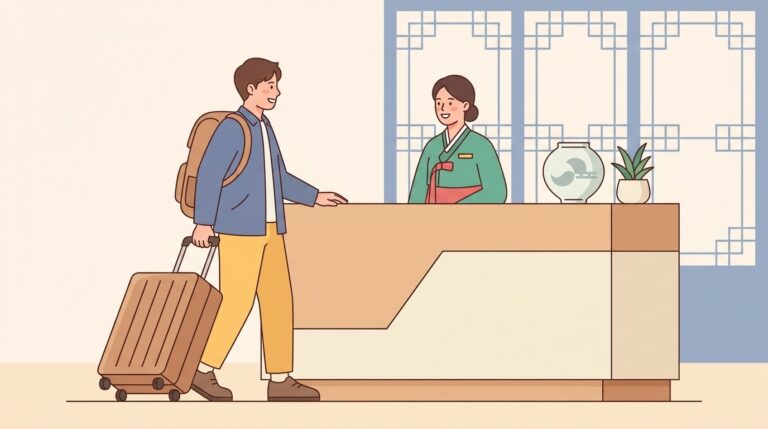
Picture this: It’s the first episode of a K-Drama. The protagonist just flew into Seoul, dragging a suitcase half their size through the hilly streets of Itaewon. They finally reach their hotel lobby, sweaty and completely exhausted, only to realize… it’s 11:00 AM. Check-in isn’t until 3:00 PM.
In the subtitles, they might simply say, “I’m early.” But what did they really say to the receptionist to magically get their bags safely stored while they go out to eat some comforting tteokbokki?
If you’ve ever traveled to Korea, you know this pain point. You arrive at Incheon Airport early in the morning, take the Airport Railroad (AREX) to your hotel, and you’re stuck with your luggage for hours. You want to ask for an early check-in, or at least drop off your heavy bags, but you don’t want to sound rude or demanding.
Today, we’re going to learn the absolute best, most natural Korean phrases for arriving at a hotel before check-in time. This guide is built from the real experiences of my students who used to nervously wait in hotel lobbies for hours because they were too shy to ask! Let’s turn you into a confident, savvy traveler.
Phase 2: Deep Dive into Key Expressions
1. 제가 체크인 시간보다 좀 일찍 왔는데요.
- Pronunciation: je-ga che-keu-in si-gan-bo-da jom il-jjik wat-neun-de-yo. (The ‘eu’ sounds like the disgusted sound you make when stepping in gum; ‘wat’ rhymes with ‘hot’.)
- Meaning: Literal: “I arrived a bit earlier than the check-in time, so…” / Real nuance: “I know I’m early, can you help me figure out my options?”
- K-Culture Moment: You’ll hear this trailing “~는데요 (~neun-de-yo)” everywhere in Korea. It’s the verbal equivalent of a polite, hopeful smile. In dramas, a character says this while scratching the back of their head, waiting for the receptionist to offer a solution.
- Editor’s Insight: This is arguably the most “Korean” way to state a problem. Instead of making a direct demand, you state your situation and trail off. It gives the listener the power to generously offer a solution, making the interaction smooth and harmonious.
- Situation Spectrum:
- Casual (Friends): 🚫 (Too formal for friends)
- Semi-formal (Hotel Staff, Clerks): ✅
- Formal (Strict business): ✅
- 🤔 Think About It: Why do Koreans prefer to trail off their sentences instead of asking a direct question? Does your native language have a similar way of leaving the ball in the other person’s court to be polite?
2. 혹시 얼리 체크인 되나요?
- Pronunciation: hok-si eol-ri che-keu-in doe-na-yo? (‘hok-si’ sounds like ‘hoke-shee’)
- Meaning: Literal: “By any chance, does early check-in become?” / Real nuance: “Is there any possibility I could check in early?”
- K-Culture Moment: “혹시 (hok-si)” is the magic word in Korean hospitality. It’s the ultimate softener. If you watch K-Pop idols doing reality shows where they have to complete missions, they always approach strangers with “Hoksi…!” to politely interrupt and ask a favor.
- Editor’s Insight: English speakers often just say “Can I check in early?” In Korean, using “혹시” before a request drastically lowers the pressure on the listener. It acknowledges that the answer might be no, but you’re asking anyway.
- Situation Spectrum:
- Casual: ✅ (Can use ‘돼?’ instead of ‘되나요?’)
- Semi-formal: ✅
- Formal: ⚠️ (A bit casual, but acceptable in hospitality)
- 🤔 Think About It: “얼리 체크인” is ‘Konglish’ (Korean-English). Why do you think modern Korean hospitality uses so many English loan words instead of native Korean terms?
3. 짐 먼저 맡겨도 될까요?
- Pronunciation: jim meon-jeo mat-gyeo-do doelkka-yo? (‘jim’ sounds like the name Jim; ‘mat-gyeo’ is tricky, say ‘maht-gyuh’)
- Meaning: Literal: “Is it okay if I entrust my luggage first?” / Real nuance: “Can I leave my bags here for now?”
- K-Culture Moment: You’ll use this not only at hotels but also at restaurants. Picture a crowded Korean BBQ place in Myeongdong. The tables are packed, and you have a huge backpack. You might ask the owner, “사장님, 짐 좀 맡겨도 될까요? (Boss, can I leave my bag somewhere?)” and they’ll put it in a giant plastic bag to protect it from the meat smell!
- Editor’s Insight: This is a survival phrase. The verb 맡기다 (to entrust/leave something with someone) shows that you trust them with your belongings.
- Situation Spectrum:
- Casual: ✅ (짐 먼저 맡겨도 돼?)
- Semi-formal: ✅
- Formal: ✅
Phase 3: Textbook vs. Real Korean
[Stating You Arrived Early]
* 📖 Textbook Korean: 저는 1시에 도착했습니다. 체크인을 하고 싶습니다. (I arrived at 1 o’clock. I want to check in.)
* 🗣️ Real Korean: 제가 좀 일찍 와서요… (I came a bit early, so…)
* 💡 Why the difference?: The textbook version sounds like a military report. Real Korean uses “~아/어서요 (because/so…)” to softly explain the reason for bothering the staff.
[Asking to Store Bags]
* 📖 Textbook Korean: 제 가방을 여기에 보관해 주십시오. (Please store my bags here.)
* 🗣️ Real Korean: 짐 좀 맡길 수 있을까요? (Could I possibly leave my luggage?)
* 💡 Why the difference?: “보관해 주십시오” is too commanding. Using “~ㄹ 수 있을까요? (could it be possible…)” is the standard polite way to ask for a service.
Phase 4: Cultural Context — K-Culture Deep Dive
4-1. Non-Verbal Elements: The Art of “Nunchi” (눈치)
When you approach the front desk early, don’t just march up and slam your passport down. Approach with a slight, apologetic smile. When handing over your passport or booking confirmation, use two hands (or support your right elbow with your left hand). This instantly signals respect. Using “Nunchi” (reading the room) here means assessing if the front desk looks incredibly busy; if they are, wait patiently and use a softer tone.
4-2. The K-Travel Connection
In Korea, hotel check-in cultures vary greatly depending on where you stay.
* Luxury/Boutique Hotels: They usually have strict 3:00 PM check-ins but excellent luggage storage services.
* Motels (모텔): Very popular for budget travelers in Korea, but their check-in times can be incredibly late (sometimes 6:00 PM or 8:00 PM!) because they sell “day use” rooms (대실). If you arrive at a motel at 1:00 PM, they likely won’t let you in, but almost all will let you leave your bags at the front desk.
* Survival Tip: If you’re staying at an Airbnb (에어비앤비) with a self-check-in keypad, there might not be a front desk. In this case, you need to use Subway Lockers (물품보관함)!
Phase 5: Real-World Roleplay Scenario
Setting: It’s 12:30 PM. You just arrived at a trendy boutique hotel in Hongdae. The lobby smells like expensive sandalwood. You have a heavy backpack and a rolling suitcase.
Characters:
* YOU: An excited but tired traveler on day 1 of your Korea trip.
* Ji-eun (28, Front Desk Agent): Very polite, professional, and speaks a little English, but you want to practice your Korean.
Dialogue:
Ji-eun: 어서 오십시오. 체크인 도와드릴까요? 😊
(eoseo osipsio. chekeuin dowadeurilkkayo?)
[Welcome. Shall I help you with check-in?]
(🎭 Stage Direction: Ji-eun smiles and gestures toward the counter.)
YOU: 안녕하세요. 예약했는데요… 제가 체크인 시간보다 좀 일찍 왔는데요.
(annyeonghaseyo. yeyakaenneundeyo… je-ga che-keu-in si-gan-bo-da jom il-jjik wat-neun-de-yo.)
[Hello. I made a reservation… I arrived a bit earlier than the check-in time…]
Ji-eun: 아, 네! 성함이 어떻게 되시나요?
(a, ne! seonghami eotteoke doesinayo?)
[Ah, yes! May I have your name?]
YOU: [Your Name]입니다.
([Your Name]imnida.)
[It’s [Your Name].]
Ji-eun: 네, 예약 확인되셨습니다. 그런데 고객님, 체크인은 오후 3시부터 가능합니다. 지금은 객실 청소 중이라서요.
(ne, yeyak hwagindoesyeotseumnida. geureonde gogaengnim, chekeuineun ohu sesibuteo ganeunghaminda. jigeumeun gaeksil cheongso jungiraseoyo.)
[Yes, your reservation is confirmed. However, sir/ma’am, check-in is available from 3 PM. The room is currently being cleaned.]
YOU: 아, 그렇군요. 혹시 얼리 체크인 되나요?
(a, geureokunyo. hok-si eol-ri che-keu-in doe-na-yo?)
[Ah, I see. Is early check-in possible by any chance?]
Ji-eun: 잠시만요… (Typing on keyboard) 죄송합니다. 어제 만실이어서 얼리 체크인은 어렵습니다.
(jamsimanyo… joesonghamnida. eoje mansirieoseo eolli chekeuineun eoryeopseumnida.)
[Just a moment… I’m sorry. We were fully booked yesterday, so early check-in is difficult.]
🔀 Your Turn! How should you respond?
* A) “그럼 3시까지 로비에서 기다릴게요.” (Then I’ll wait in the lobby until 3 PM.)
* B) “아, 괜찮습니다! 그럼 짐 먼저 맡겨도 될까요?” (Ah, it’s okay! Then can I leave my luggage first?)
* C) “왜 안 돼요? 방 하나 주세요!” (Why not? Give me a room!)✅ Best Choice: B — Reason: It’s the most practical and polite response. You acknowledge her refusal graciously (“괜찮습니다”) and pivot to the next best option.
⚠️ Choice A Analysis: You can do this, but you’ll waste 2.5 hours of your precious vacation sitting in a lobby!
🚫 Choice C Analysis: Absolutely do not do this unless you want to become the villain in a K-Drama.
YOU: 아, 괜찮습니다! 그럼 짐 먼저 맡겨도 될까요?
(a, gwaenchanseumnida! geureom jim meonjeo matgyeodo doelkkayo?)
[Ah, it’s okay! Then can I leave my luggage first?]
Ji-eun: 네, 당연하죠! 이쪽에 두시면 번호표 드리겠습니다.
(ne, dangyeonhajyo! ijjoge dusimyeon beonhopyo deurigetseumnida.)
[Yes, of course! If you leave it here, I’ll give you a number tag.]
🎭 Bonus K-Culture Roleplay: The Cafe Trust Test
You left your bags at the hotel and went to a nearby cafe. You ordered an Iced Americano, but you urgently need to use the restroom. In Korea, it is incredibly common to leave your laptop or bag on the table, but if you want to be extra safe, you can ask the person next to you:
YOU: 저기요… 혹시 제 가방 좀 잠깐 봐주실 수 있나요?
(jeogiyo… hoksi je gabang jom jamkkan bwajusil su innayo?)
[Excuse me… Could you possibly watch my bag for just a moment?]
Korean Stranger: 네? 아, 네네! 다녀오세요.
(ne? a, nene! danyeo-oseyo.)
[Pardon? Ah, yes yes! Go ahead.]
Phase 6: 10-Second Shadowing Drill
Practice these lines out loud. Pay attention to the pauses (/) and the emotion tags!
- 🥺 (Apologetically) 제가 / 체크인 시간보다 / 좀 일
찍 왔는데요.jjik wat-neun-de-yo.)
(je-ga / che-keu-in si-gan-bo-da / jom il - 🙏 (Politely hoping) 혹시 / 얼리 체크인 / 되나요?
(hok-si / eol-ri che-keu-in / doe-na-yo?) - 😊 (Friendly & Brightly) 그럼 / 짐 먼저 / 맡겨도 될까요?
(geu-reom / jim meon-jeo / mat-gyeo-do doelkka-yo?)
Phase 7: K-Culture Mini Dictionary
Here are 4 keywords you absolutely must know for Korean hotel stays.
1. 호캉스
* Romanization: hokangseu
* English: Hotel + Vacance (Staycation at a hotel)
* Context: A huge trend in Korea. Instead of traveling far, Koreans love booking a nice hotel in the city just to relax, order room service, and swim.
2. 프런트
* Romanization: peureonteu
* English: Front desk / Reception
* Context: Koreans rarely say ‘reception’ (리셉션). They usually say ‘front’ to refer to the front desk.
3. 보관
* Romanization: bogwan
* English: Storage / Keeping
* Context: Look for this word on subway lockers (물품보관함) or when asking a hotel to keep your items safe.
4. 눈치
* Romanization: nunchi
* English: Social awareness / Reading the room
* Context: Having “quick nunchi” means you know when to ask for a favor and when to wait patiently. It’s the secret to thriving in Korean society.
Phase 8: Traveler Survival Kit
Since you’re dropping off your bags and heading out into the city, you need these survival phrases right now!
🆘 Survival Phrases for the Wanderer
- 🇰🇷 “이 근처에 카페 있어요?” (i geuncheoe kape isseoyo?)
- 🗣️ Pronunciation: ee geun-cheo-eh kah-peh isseoyo?
- 📍 Meaning: Is there a cafe nearby?
🇰🇷 “화장실은 어디예요?” (hwajangsireun eodiyeyo?)
- 🗣️ Pronunciation: hwa-jang-shil-eun uh-dee-yeh-yo?
📍 Meaning: Where is the restroom?
🇰🇷 “와이파이 비밀번호가 뭐예요?” (waipai bimilbeonhoga mwoyeyo?)
- 🗣️ Pronunciation: wa-ee-pa-ee bee-meel-beon-ho-ga mwo-yeh-yo?
- 📍 Meaning: What is the Wi-Fi password?
📌 Editor’s Travel Note
* Maps in Korea: Google Maps doesn’t work well for walking directions in Korea due to security laws. You MUST download Naver Map or KakaoMap.
* Subway Lockers: If your Airbnb won’t hold your bags, look for “T-Locker” (Happy Box) machines inside almost every subway station in Seoul. You can pay with a credit card!
* Tipping: Do NOT tip the hotel bellboy or front desk staff. Korea is a strictly no-tip culture. Handing them cash will just cause confusion and panic!
Phase 9: Critical Thinking Corner — “A Step Deeper”
🧠 Think Deeper: Korean in the Global Era (Konglish in Hospitality)
Have you noticed how many English words we just used? Check-in, Early check-in, Front, Vacance. As the Korean hospitality industry modernized rapidly in the late 20th century, it adopted global hotel standards and the English terminology that came with it.
However, these words have been fully “Koreanized” in their pronunciation and usage. Some language purists argue that Korea should use native terms for these concepts to preserve the language. But practically, using English loanwords makes the hospitality industry feel “modern” and “premium” to locals, while simultaneously making it slightly easier for foreign tourists to guess the meaning.
💬 Your Turn: Does your country use a lot of English loanwords in hotels and tourism, or do you have strict native words for things like “check-in” and “reception”? Share in the comments!
Phase 10: FAQ & Avoiding Common Mistakes
Q: Can I use these phrases with older staff members or Airbnb hosts?
* Yes! The phrases using “~요 (~yo)” are polite (존댓말) and are perfectly safe and respectful to use with anyone, regardless of age.
Q: Is it rude to ask for an early check-in if I didn’t pay for it?
* No, as long as you use “혹시 (hok-si)”. It shows you know it’s a special request. If they say no, just smile and ask to store your bags.
❌ Common Mistake #1: Saying “방 주세요” (Give me a room) like a command.
✅ Do this instead: Always frame it as a question: “들어갈 수 있을까요?” (Could I go in?) or “체크인 되나요?” (Is check-in possible?).❌ Common Mistake #2: Tipping the staff for letting you check in early.
✅ Do this instead: A sincere “너무 감사합니다!” (Thank you so much!) and a slight bow is worth a million times more than a $5 bill in Korea.
Phase 11: Summary & Action Items
One-Liner Summary: Soften your requests by trailing off (“~왔는데요”) and using the magic word “혹시”, and you’ll master Korean hotel interactions like a local.
Action Mission 3 Steps:
* 🥉 Bronze (Solo): Stand in front of your mirror and practice the “apologetic smile” while saying, “제가 좀 일찍 왔는데요…”
* 🥈 Silver (Online): Post a photo of your luggage on a Korean learning forum or social media and caption it with “짐 좀 맡겨도 될까요?”
* 🥇 Gold (Real Life): Use the luggage storage phrase at your hotel or a restaurant during your next trip to Korea!
🎬 K-Culture Mission:
Next time you watch a K-Drama, look closely at scenes set in hotel lobbies or company front desks. Notice the body language—how characters hold their hands and the angle of their slight bows when making a request.
Did you find this helpful? What other hotel or travel situations make you nervous? Let me know in the comments below!
Phase 12: Interactive Challenge Quiz
1. Situational Judgment: You arrive at your hotel at 1:00 PM (Check-in is 3:00 PM). You just want to leave your heavy suitcase and go eat. What is the BEST thing to say to the front desk?
* A) 제 가방을 지켜주세요. (Please protect my bag.)
* B) 짐 먼저 맡겨도 될까요? (Can I leave my luggage first?)
* C) 왜 얼리 체크인 안 돼요? (Why can’t I check in early?)
2. Fill in the Blank: To politely soften a request or ask “by any chance,” you should start your sentence with: “( _______ ) 얼리 체크인 되나요?”
* A) 빨리 (Ppal-li)
* B) 당장 (Dang-jang)
* C) 혹시 (Hok-si)
3. True or False – K-Culture Edition:
If a Korean hotel staff member kindly lets you check in 2 hours early, you should give them a 10,000 KRW tip to show your gratitude. (T / F)
🚨 Click here for the Answers!
1. B (A sounds like you are ordering a bodyguard. C is very rude!)
2. C (Hoksi is the magic word for polite requests.)
3. False! (Korea does not have a tipping culture. Giving cash can make the staff uncomfortable. Just bow and say a warm “감사합니다!”)
Frequently Asked Questions (FAQ)
Q: What does "제가 체크인 시간보다 좀 일찍 왔는데요." mean in Korean and how do you pronounce it?
A: In Korean, "제가 체크인 시간보다 좀 일찍 왔는데요." is pronounced [je-ga che-keu-in si-gan-bo-da jom il-jjik wat-neun-de-yo. (The 'eu' sounds like the disgusted sound you make when stepping in gum; 'wat' rhymes with 'hot'.] and means: Literal: "I arrived a bit earlier than the check-in time, so..." / Real nuance: "I know I'm early, can you help me figure out my options?"
Q: What does "혹시 얼리 체크인 되나요?" mean in Korean and how do you pronounce it?
A: In Korean, "혹시 얼리 체크인 되나요?" is pronounced [hok-si eol-ri che-keu-in doe-na-yo? ('hok-si' sounds like 'hoke-shee'] and means: Literal: "By any chance, does early check-in become?" / Real nuance: "Is there any possibility I could check in early?"
Q: What does "짐 먼저 맡겨도 될까요?" mean in Korean and how do you pronounce it?
A: In Korean, "짐 먼저 맡겨도 될까요?" is pronounced [jim meon-jeo mat-gyeo-do doelkka-yo? ('jim' sounds like the name Jim; 'mat-gyeo' is tricky, say 'maht-gyuh'] and means: Literal: "Is it okay if I entrust my luggage first?" / Real nuance: "Can I leave my bags here for now?"







