

Phase 1: Empathy (The K-Culture Cold Open)
Hello! This is the Lead Editor of Daily Hangul.
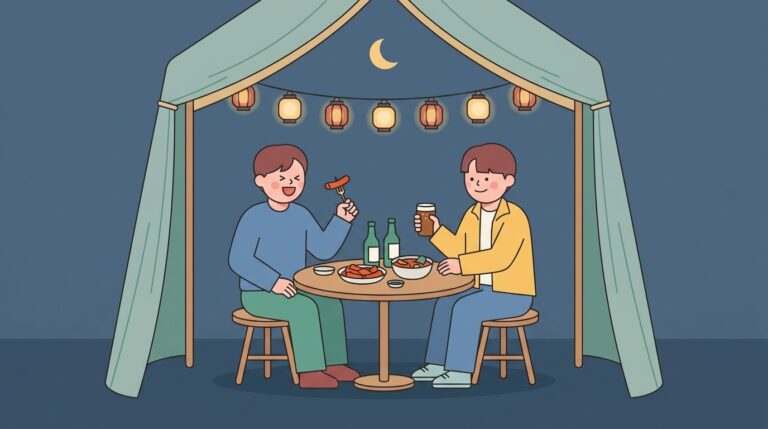
Picture this: You are watching your favorite K-Drama. The main characters just had a terrible day at work. They don’t go home to meditate in silence. Instead, they end up at a Pojangmacha (orange street tent) or a noisy BBQ restaurant, clinking green Soju glasses, and suddenly, their voices get louder. The subtitles might just say, ‘I’m so stressed’ or ‘He’s so mean.’
But if you listen closely, what they are actually saying is a vibrant, deeply cultural ritual of ‘venting’—what we call 스트레스 풀기 (seuteureseu pulgi, relieving stress) in Korea.
When living or traveling in Korea, you will quickly realize that grabbing some spicy food or a cold beer with a friend and just letting it all out is the ultimate social bonding experience. If you only use textbook phrases like ‘I am sad’ or ‘That is unfortunate,’ you’ll sound like a news anchor. To truly connect and get that ‘Insider (인싸)’ reaction from your Korean friends, you need to know how to vent—and how to react when they vent to you.
Everything in this guide comes from real tutoring sessions with B2-level students who wanted to sound less like a textbook and more like a true friend. Let’s dive in!
Phase 2: Core Expressions Deep Dive
Here are the top three expressions you need when chatting and venting with friends.
1. 나 오늘 진짜 열받았잖아.
- Pronunciation: na oneul jinjja yeolbadatjana (Think of yeol-ba-dat like a quick, heavy punch, stressing the ‘ba’)
- Meaning:
- Literal: I received real heat today, as you know.
- Real Nuance: I got so pissed off today, let me tell you!
- K-Culture Moment: You sit down at a cafe, slam your iced americano on the table, take a deep sip, and drop this line. It immediately signals to your friend: ‘Tea is about to be spilled.’
- Editor’s Insight: The word 열 (yeol) means heat, and 받다 (batda) means to receive. When Koreans are furious, we literally feel the heat rising in our bodies! The ending -잖아 (jana) is a B2 grammar point meaning ‘you know’ or ‘let me tell you this fact.’ It draws the listener in.
- Situation Spectrum:
- Casual (Friends): ✅
- Semi-formal (Close Co-workers): ⚠️ (Only if you are very close)
- Formal (Boss/Elders): 🚫
- 🤔 Think About It: Why do Koreans relate anger to ‘heat’ or ‘fire’ (like 홧병 – fire illness)? Does your native language also use temperature to describe emotions?
2. 아, 진짜 어이없어.
- Pronunciation: a, jinjja eoieopseo (uh-ee-up-suh—say it with a deep sigh)
- Meaning:
- Literal: I have no ‘eoi’ (reason/logic).
- Real Nuance: This is so ridiculous. / I’m speechless.
- K-Culture Moment: Your boss asks you to work over the weekend on a Friday at 5:50 PM. You text your friend this exact phrase. It’s the ultimate expression of disbelief.
- Editor’s Insight: This isn’t just about being angry; it’s about a situation being so unfair or illogical that you’ve lost your words.
- Situation Spectrum:
- Casual (Friends): ✅
- Semi-formal (Close Co-workers): ✅ (Usually whispered at the water cooler)
- Formal (Boss/Elders): 🚫
- 🤔 Think About It: Koreans value logic and fairness in professional settings. When that unspoken rule is broken, ‘어이없다’ is the go-to phrase.
3. 그니까 내 말이!
- Pronunciation: geunikka nae mari! (geu-ni-kka sounds like a rapid, excited realization)
- Meaning:
- Literal: Therefore, my words!
- Real Nuance: That’s exactly what I’m saying! / Totally agree!
- K-Culture Moment: When your friend complains about a mutual acquaintance and says exactly what you were thinking. You point at them and shout this.
- Editor’s Insight: Venting is a two-way street. If you just sit there quietly, your friend will think you don’t care. You MUST react aggressively to show support. This phrase is the golden key to validation.
- Situation Spectrum:
- Casual (Friends): ✅
- Semi-formal (Close Co-workers): ⚠️
- Formal (Boss/Elders): 🚫
- 🤔 Think About It: Why is strong verbal agreement so important in Korean friendships? It’s heavily tied to ‘눈치 (Nunchi)’ and collective empathy.
Phase 3: Textbook vs. Real Korean
When you complain or react, throw away the textbook. Here is how people actually speak on the streets of Hongdae.
[Situation 1: Expressing your frustration]
* 📖 Textbook: 오늘 회사 일이 너무 힘듭니다. (Work is very hard today.)
* 🗣️ Real Korean: 아, 스트레스 장난 아니야. (Ah, the stress is no joke.)
* 💡 Why the difference?: Using ‘장난 아니야 (It’s no joke)’ is a vivid, slightly dramatic way millennials and Gen Z emphasize the severity of a situation without sounding overly formal.
[Situation 2: Reacting to a friend’s terrible date story]
* 📖 Textbook: 정말 슬프시겠어요. (You must be really sad.)
* 🗣️ Real Korean: 헐, 대박. 완전 짜증 났겠다. (Omg, wow. You must have been so annoyed.)
* 💡 Why the difference?: ‘헐 (Heol)’ and ‘대박 (Daebak)’ are essential reaction markers. Koreans prefer to empathize with the specific emotion (짜증 – annoyance) rather than a generic ‘sadness.’
Bottom Note: As a
B2 (Upper-Intermediate)learner, you should know that adding ‘-겠다’ (must have been) at the end of an adjective shows high emotional intelligence and empathy!
Phase 4: Cultural Context — K-Culture Deep Dive
4-1. Non-Verbal Cues: ‘폭풍 리액션’ (Stormy Reactions)
Language is only 50% of the game. In Korea, when a friend vents, you must perform 폭풍 리액션 (Stormy Reactions). This means leaning in, maintaining intense eye contact, nodding vigorously, and making sounds like ‘아~~~ (Ah…)’ or ‘진짜? (Really?)’ even before they finish their sentence. A lack of reaction means a lack of 눈치 (Nunchi)—you’re failing to read the room and support their mood.
4-2. The K-Food Connection: Eating Away the Pain
In Korea, stress relief is inextricably linked to food. When stressed, Koreans instinctively crave two things: Super spicy food (like Tteokbokki or Buldak ramen) to ‘sweat out’ the anger, or 단 거 (sweet things) like massive café desserts to spike dopamine.
* Critical View: Why must Koreans eat together to relieve stress? Historically, sharing a meal from a communal pot reinforces the concept of ‘우리’ (We). By sharing spicy food and alcohol, you aren’t just complaining; you are rebuilding your social armor together.
Phase 5: Real-Life Roleplay Scenario
Scenario A: The Friday Night BBQ Vent
- Setting: Friday night, 7:30 PM. A noisy, smoke-filled Samgyeopsal (pork belly) restaurant near Gangnam Station. Green Soju bottles line the table.
- Characters:
- YOU: An expat working in Seoul, navigating corporate life.
- Minsu (30): Your Korean coworker and work bestie. Funny but highly stressed today.
Minsu: 아, 오늘 부장님 때문에 진짜 열받아 죽겠어. 🤬
(a, oneul bujangnim ttaemune jinjja yeolbada jukgesseo.)
[Ah, I am going to die from being so pissed off because of the manager today.]
(🎭 Stage Direction: Minsu aggressively flips a piece of pork belly with his tongs)
YOU: 왜요? 부장님이 또 이상한 일 시켰어요?
(waeyo? bujangnimi tto isanghan il sikyeosseoyo?)
[Why? Did the manager make you do something weird again?]
Minsu: 어! 내일 주말인데 월요일 아침까지 보고서 쓰라잖아. 어이없어 진짜.
(eo! naeil jumarinde woryoil achimkkaji bogoseo sseurajana. eoieopseo jinjja.)
[Yeah! It’s the weekend tomorrow but he told me to write a report by Monday morning. It’s so ridiculous.]
🔀 Your Turn! How should you reply?
– A) “그것은 매우 부당한 일입니다.” (Too robotic and textbook!)
– B) “헐, 대박. 미친 거 아니에요? 완전 짜증 나겠다!” (Sympathetic, slightly strong slang)
– C) “아이고, 어떡해요… 그니까 내 말이!”✅ Best Choice: B or a slightly softer C. In a casual setting with a close coworker, showing strong, slightly dramatic empathy (B) proves you are entirely on his side! ‘미친 거 아니에요?’ (Isn’t that crazy?) is a very common B2-level casual reaction.
YOU: 헐, 대박. 완전 짜증 났겠다! 그니까 내 말이!
(heol, daebak. wanjeon jjajeung natgetda! geunikka nae mari!)
[Omg, wow. You must have been so annoyed! That’s exactly what I’m saying!]
Minsu: 그치? 아, 스트레스 받아. 우리 오늘 소주나 한잔 찐하게 하자!
(geuchi? a, seuteureseu bada. uri oneul sojuna hanjan jjinhage haja!)
[Right? Ah, I’m so stressed. Let’s drink some soju intensely today!]
Scenario B: Bonus Roleplay — The Spicy Tteokbokki Cure
- Setting: You and a friend just bombed an exam. You enter a famous spicy Tteokbokki place.
- Clerk: 주문하시겠어요?
- YOU: 네, 여기 세트 1번 주시고요. 제일 매운맛으로 주세요! (Yes, Set 1 please. Make it the spiciest level!)
- Friend: 오~ 오늘 좀 달리는데? (Oh~ you’re going hard today?)
- YOU: 오늘 스트레스 풀고 죽자! (Let’s relieve our stress and die today! – a common hyperbole)
Phase 6: 10-Second Shadowing Drill
Listen to the rhythm! Korean stress phrases sound best when you stretch the emotional words.
😤 나 오늘 / 진짜 / 열~~~받았잖아! (na oneul / jinjja / yeol~~~badatjana!)
Tip: Put the emphasis and a slight pause before ‘열’.
🥺 헐... 대박. / 완전 짜증 났겠다... (heol... daebak. / wanjeon / jjajeung natgetda...)
Tip: Say ‘heol’ with a sharp intake of breath. Drop your tone to sound genuinely sorry.
Phase 7: K-Culture Mini Dictionary
1. 눈치
* Romanization: nunchi
* English: Social sense / Reading the room
* Context: The quintessential Korean social skill. If you just nod silently while a friend vents, you lack ‘nunchi’. You must actively validate them.
2. 뒷담화
* Romanization: dwitdamhwa
* English: Talking behind someone’s back / Venting about someone
* Context: Often happens at cafes or pubs. A necessary evil for office workers to relieve stress.
3. 치맥
* Romanization: chimaek
* English: Chicken and Beer (Maekju)
* Context: The holy grail of Friday night stress relief.
4. 맵부심
* Romanization: maepbusim
* English: Pride in eating spicy food
* Context: When stressed, friends might challenge each other’s maepbusim by going to the spiciest restaurant in town.
Phase 8: Traveler’s Survival Kit
Even if you’re just visiting Korea, you’ll need to know how to order the ultimate stress-relief combo at a local pub or late-night eatery.
🆘 Survival Phrases for the Pub/Pocha
– 🇰🇷 “여기 생맥주 오백 두 잔이요!” (yeogi saengmaekju obaek du janiyo!)
– 🗣️ Meaning: Two 500cc draft beers here, please!
– 📍 Where: Pubs, BBQ spots, Chicken joints.
- 🇰🇷 “이거 엄청 맵나요?” (igeo eomcheong maem나요?)
- 🗣️ Meaning: Is this super spicy?
- 📍 Where: Tteokbokki shops, late-night food stalls.
📌 Editor’s Travel Note
– Calling the staff: Don’t wait for eye contact! Confidently press the call button (벨) on the table, or raise your hand and say “저기요! (Excuse me!)”.
– Splitting the bill: In casual settings, Koreans usually take turns paying for the whole round rather than going Dutch (더치페이), but going Dutch is becoming more common among younger generations.
Phase 9: Critical Thinking Corner — “한 발 더 깊이”
Food & Identity: Why Do We Eat to Complain?
🧠 Think Deeper:
Have you noticed that in K-Dramas, characters rarely vent in an empty room? They are always eating heavily seasoned food (spicy or salty) and drinking. In Korean society, eating together is deeply tied to the concept of 정 (Jeong – deep emotional bond). Sharing a boiling pot of stew or grilling meat from the same grill breaks down social barriers. Venting over food isn’t just about complaining; it’s a collaborative ritual to reaffirm that you are part of an “in-group” that supports each other against the harsh outside world.💬 Your Turn: How do people in your culture relieve stress together? Do you have a specific “comfort food” for bad days? Share it in the comments!
Phase 10: FAQ & Avoiding Misunderstandings
Q: Can I say “열받았잖아” to my boss if I am angry at a client?
No! Even if you are on the same side, “열받다” is too casual and slangy for a boss. Instead, use a polite alternative: “오늘 OOO 때문에 많이 속상했습니다.” (I was very upset today because of OOO.)
Q: My Korean friend keeps using strong words like ‘미쳤어’ (crazy) when I tell them a sad story. Are they mad at me?
No! They are aggressively empathizing with you! In Korea, getting angry on behalf of your friend is a sign of deep affection.
❌ Common Mistake #1: Trying to solve the problem logically.
✅ Do this instead: When a Korean friend vents, they usually don’t want a solution. They want you to say, “그니까 내 말이! (That’s what I’m saying!)” Just agree first, solve later.
Phase 11: Summary & Action Items
- One-Liner Summary: To master Korean stress-relief chats, you need to use casual, emotion-heavy phrases (열받아, 어이없어) and back them up with stormy reactions (폭풍 리액션)!
🔥 Action Mission 3 Steps:
– 🥉 Bronze: Stand in front of a mirror, take a deep sigh, and say “아, 진짜 어이없어.” with maximum drama.
– 🥈 Silver: Leave a comment on this blog using “그니까 내 말이!” in a sentence.
– 🥇 Gold: Next time a Korean friend sighs, ask them “무슨 일 있어? 스트레스 장난 아니지?” (What’s wrong? Stress is crazy right?)
🎬 K-Culture Mission:
Turn on a K-Drama set in an office (like Misaeng or Business Proposal). Skip to a scene where they are drinking after work. Can you catch them saying ‘스트레스’, ‘어이없어’, or ‘열받아’?
Phase 12: Quiz — Interactive Challenge
Q1. (Situational) Your friend just told you their laptop crashed and they lost all their files. What is the most natural B2-level reaction?
A) 그것은 참 슬픈 일입니다.
B) 헐, 대박. 완전 짜증 났겠다! 어떡해!
C) 나 오늘 진짜 열받았잖아.
👉 Click to see the answer
Answer: B. A is too robotic (textbook). C is talking about yourself being angry, which doesn’t fit here. B shows perfect empathy and uses natural phrasing!
Q2. (True or False) When a friend is venting, it is polite in Korean culture to sit quietly, nod once in a while, and offer a logical solution at the end.
👉 Click to see the answer
Answer: False. You need ‘폭풍 리액션’ (Stormy reactions)! Interrupt them with “진짜?” and “헐!” to show you are fully engaged.
Frequently Asked Questions (FAQ)
Q: What does "나 오늘 진짜 열받았잖아." mean in Korean and how do you pronounce it?
A: In Korean, "나 오늘 진짜 열받았잖아." is pronounced [na oneul jinjja yeolbadatjana (Think of yeol-ba-dat like a quick, heavy punch, stressing the 'ba'] and means: Literal: I received real heat today, as you know.
Q: What does "아, 진짜 어이없어." mean in Korean and how do you pronounce it?
A: In Korean, "아, 진짜 어이없어." is pronounced [a, jinjja eoieopseo (uh-ee-up-suh—say it with a deep sigh] and means: Literal: I have no 'eoi' (reason/logic).
Q: What does "그니까 내 말이!" mean in Korean and how do you pronounce it?
A: In Korean, "그니까 내 말이!" is pronounced [geunikka nae mari! (geu-ni-kka sounds like a rapid, excited realization] and means: Literal: Therefore, my words!







