

Phase 1: Empathy
Hello! I’m your Daily Hangul Editor.
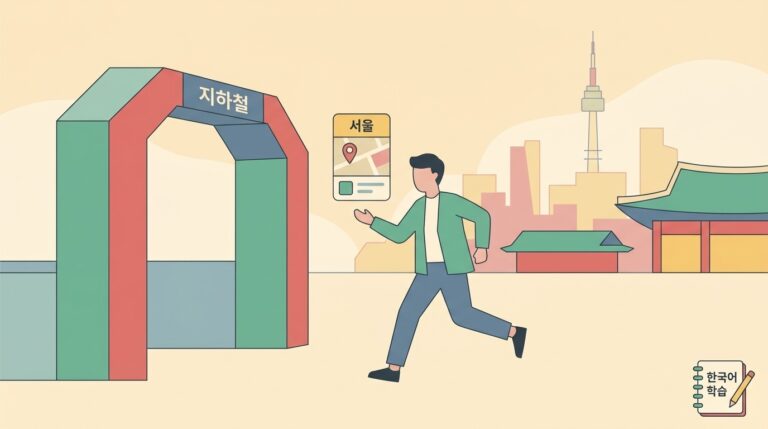
Imagine this: You are waiting at Gangnam Station Exit 11, the most crowded meeting spot in Seoul. Your Korean friend texts you, “거의 다 왔어” (I’m almost there!). Ten minutes pass. Fifteen minutes pass. You start wondering… did they get lost in the subway transfer?
If you’ve watched K-Dramas, you’ve probably seen the main character running breathlessly to a cafe, apologizing to their date. But look closely—they rarely just say “I’m sorry.” They explain when they are arriving and why they are late.
Navigating Korean appointments is more than just reading the clock. Korea’s famous 빨리빨리 (Ppalli-ppalli / Hurry-hurry) culture means time is precious, but paradoxically, being slightly late happens all the time due to Seoul’s wild traffic. If you don’t know how to state your Estimated Time of Arrival (ETA), you might accidentally offend someone or leave them waiting in the cold.
Don’t worry! This guide is based on real SOS messages from my students who panicked when their taxi got stuck in traffic. Let’s learn how to update your ETA like a true local!
Phase 2: Deep Dive into Core Expressions
1. 5분 뒤에 도착해요 (I’ll arrive in 5 minutes)
- Pronunciation: o-bun dwi-e dochakaeyo [Sound-alike: oh-boon dwee-eh doe-chak-hae-yo]
- Tip: The ‘o’ is short and round, like the ‘o’ in “old”.
- Meaning: I will arrive in 5 minutes. (Literal: 5 minutes after arrive.)
- K-Culture Moment: This is the text you send when you are literally walking up the stairs of the subway station. It is a promise. If you say 5 minutes in Korea, they will start the mental countdown!
- Editor’s Insight: You can change “5분” (5 minutes) to “10분” (10 minutes) or “15분” (15 minutes). It sounds responsible and precise.
- Situation Spectrum:
- Friends (Casual): ✅ (Say: 5분 뒤에 도착해!)
- Coworkers (Semi-formal): ✅ (5분 뒤에 도착해요)
- Boss/Elders (Formal): ⚠️ (Better to say: 5분 내로 도착할 것 같습니다)
- 🤔 Think About It: Why do Koreans love exact numbers like 5 or 10 minutes instead of just saying “I’ll be there soon”? How does this reflect the “Ppalli-ppalli” culture?
2. 거의 다 왔어요 (I’m almost there)
- Pronunciation: geo-ui da wasseoyo [Sound-alike: guh-ee dah wa-ssuh-yo]
- Tip: ‘eo’ (어) sounds like the ‘u’ in “uh-oh”.
- Meaning: I’m almost there. (Literal: Almost all came.)
- K-Culture Moment: Ah, the greatest white lie in Korean modern history! Sometimes, “I’m almost there” means “I just got off the bus.” Other times, it means “I am currently putting on my shoes at home.”
- Editor’s Insight: This phrase is extremely common, but use it carefully! If you say this and arrive 30 minutes later, your friend might playfully scold you.
- Situation Spectrum:
- Friends (Casual): ✅
- Coworkers (Semi-formal): ✅
- Boss/Elders (Formal): 🚫 (Too vague for strict business)
- 🤔 Think About It: Do you have a phrase in your native language that people use to pretend they are closer than they actually are?
3. 조금 늦을 것 같아요 (I think I’ll be a little late)
- Pronunciation: jo-geum neujeul geot gat-a-yo [Sound-alike: joe-geum noo-jeul guht gah-tah-yo]
- Tip: ‘eu’ (으) sounds like the disgusted sound you make when stepping in gum (ugh).
- Meaning: I think I’ll be a little late. (Literal: A little late it seems like.)
- K-Culture Moment: You are in a taxi. The Kakao T app shows a sea of red lines (heavy traffic). You realize you won’t make it. You quickly type this to soften the blow.
- Editor’s Insight: Notice the ending “~것 같아요” (it seems like / I think). Koreans rarely say “I WILL be late” (늦을 거예요). Instead, they soften the statement to sound less aggressive and more apologetic.
- Situation Spectrum:
- Friends (Casual): ✅
- Coworkers (Semi-formal): ✅
- Boss/Elders (Formal): ✅ (Add ‘죄송하지만’ – I’m sorry but… at the beginning)
- 🤔 Think About It: Why does softening the language (saying “I think” instead of “I am”) show politeness in Korean culture?
Phase 3: Textbook vs. Real Korean
[Situation 1: You are running 10 minutes late]
* 📖 Textbook Korean: 저는 10분 늦을 것입니다. (I will be 10 minutes late.)
* 🗣️ Real Korean: 헉! 미안해요 ㅠㅠ 10분 정도 늦을 것 같아요. (Heok! Mianhaeyo TT 10bun jeongdo neujeul geot gatayo.)
* 💡 Why is it different?: The textbook sounds like an AI robot reporting an error. Real Koreans use “헉” (gasp) and “ㅠㅠ” (crying face) to show genuine panic and empathy for keeping you waiting.
[Situation 2: Asking your friend where they are]
* 📖 Textbook Korean: 당신은 지금 어디에 있습니까? (Where are you right now?)
* 🗣️ Real Korean: 어디쯤이에요? (Eodijjeumieyo? – Whereabouts are you?)
* 💡 Why is it different?: Using “당신” (you) sounds confrontational. Adding “쯤” (around/about) to “어디” (where) makes the question gentle and polite.
Phase 4: K-Culture Deep Dive
4-1. Non-verbal Cue: The “Map Screenshot” Method
When Koreans say “I’m almost there” or “I’m running late,” they often back it up with evidence. It is extremely common to take a screenshot of your subway app (like KakaoMetro) or map app showing your exact location and ETA, and send it via KakaoTalk. It’s the ultimate form of “Korean Nunchi” (reading the room)—you proactively show exactly when you’ll arrive so the other person doesn’t have to stress.
4-2. K-Travel Link: The Hyper-Accurate Public Transit
In Seoul, public transportation isn’t just a way to move; it’s a clock. Because the buses and subways are incredibly punctual, Koreans often state their ETA using transit milestones.
Instead of “I’ll be there in 5 minutes,” you will frequently hear:
* “이번 역에서 내려요” (I’m getting off at this station.)
* “두 정거장 남았어요” (I have two stops left.)
If you travel to Korea, learning to read the bus/subway apps will instantly make your ETA communication native-level!
Phase 5: Interactive Roleplay Scenario
Setting: Friday night, 6:50 PM. Hongdae Station Exit 9. It is packed with people. You are supposed to meet your Korean friend, Minji, for a famous K-BBQ dinner at 7:00 PM. But your subway was delayed, and you are 3 stops away.
Characters:
* YOU: A foreign traveler who loves K-Food, currently stressing out in the subway.
* Minji (28): Your Korean friend, super friendly but very punctual.
Dialogue:
Minji: 9번 출구 앞이에요! 어디쯤이에요? 👀
(Gubeon chulgu apieyo! Eodijjeumieyo?)
[I’m in front of Exit 9! Whereabouts are you?]
YOU: 헉, 미안해요! 지하철을 놓쳤어요.
(Heok, mianhaeyo! Jihacheoleul nochyeosseoyo.)
[Gasp, I’m sorry! I missed the subway.]
Minji: 아, 정말요? 언제쯤 도착해요?
(Ah, jeongmalyo? Eonjejjeum dochakaeyo?)
[Ah, really? Around when will you arrive?]
🔀 Your Turn! How should you reply?
* A) “저는 약속에 15분 늦을 것입니다.” (I will be 15 minutes late to the appointment.)
* B) “15분 정도 늦을 것 같아요 ㅠㅠ 미안해요!”
* C) “거의 다 왔어요!” (When you are actually 15 minutes away)✅ Best Choice: B — It uses “~것 같아요” to soften the bad news, includes an apology, and gives a realistic timeframe.
⚠️ Choice A Analysis: Too robotic. You sound like a news anchor reporting the weather.
⚠️ Choice C Analysis: The classic white lie. Minji might stand outside in the cold for 15 minutes waiting for you. Bad Nunchi!
YOU (Choosing B): 15분 정도 늦을 것 같아요 ㅠㅠ 미안해요!
(15bun jeongdo neujeul geot gatayo ㅠㅠ mianhaeyo!)
[I think I’ll be about 15 minutes late ㅠㅠ I’m sorry!]
Minji: 괜찮아요! 천천히 오세요~ 너무 뛰지 마시고요!
(Gwaenchanayo! Cheoncheonhi oseyo~ Neomu ttwiji masigoyo!)
[It’s okay! Come slowly~ Don’t run too hard!]
(🎭 Stage Direction: Minji goes into a nearby Olive Young to stay warm while waiting.)
Phase 6: 10-Second Shadowing Drill
Practice speaking aloud with the right pacing and emotion!
- 🥺 Apologetic & Urgent:
헉! 미안해요 / 10분 정도 / 늦을 것 같아요!
(Heok! mianhaeyo / sip-bun jeong-do / neujeul geot gat-a-yo!) -
😊 Bright & Reassuring:
다 왔어요! / 5분 뒤에 / 도착해요!
(Da wasseoyo! / o-bun dwi-e / dochakaeyo!)
Phase 7: K-Culture Mini Dictionary
1. 빨리빨리
* Romanization: ppalli-ppalli
* English: Hurry, hurry / Fast-paced
* Context: The cornerstone of modern Korean society. From internet speeds to food delivery and walking paces, everything is fast. Making someone wait goes against the “Ppalli-ppalli” spirit!
2. 눈치
* Romanization: nunchi
* English: Social sense / Reading the room
* Context: If you are running late, good nunchi means letting the person know before they ask you where you are.
3. 코리안 타임
* Romanization: korian taim
* English: Korean Time
* Context: A slang term referring to the cultural habit of arriving 10-15 minutes late to casual social gatherings. While mostly a thing of the past, friends still joke about it when someone is late.
4. 핑계
* Romanization: pinggye
* English: Excuse
* Context: When you are late, the most common pinggye in Seoul is “차가 너무 막혀요” (The traffic is too heavy).
Phase 8: Traveler’s Survival Kit
If you are navigating Korea, these phrases will save you when changing plans or updating your ETA.
🆘 Survival Phrase #1: 길이 막혀요
* 🇰🇷 “길이 막혀요.” (Giri makyeoyo.)
* 🗣️ Sound guide: gee-ree mah-kyuh-yo
* 📍 When to use: When you are in a taxi or bus and stuck in traffic.
* 💡 Literal meaning: The road is blocked.🆘 Survival Phrase #2: 길을 잃었어요
* 🇰🇷 “길을 잃었어요.” (Gireul ileosseoyo.)
* 🗣️ Sound guide: gee-reul eel-uh-ssuh-yo
* 📍 When to use: When the map app says you’ve arrived, but you are completely lost.🆘 Survival Phrase #3: 천천히 오세요
* 🇰🇷 “천천히 오세요.” (Cheoncheonhi oseyo.)
* 🗣️ Sound guide: chun-chun-hee oh-seh-yo
* 📍 When to use: When your friend is running late and apologizing. It means “Take your time / Come safely.”
📌 Editor’s Travel Note:
* Essential Apps: Google Maps doesn’t work well for walking/driving in Korea. Download Naver Map or KakaoMap for highly accurate ETAs.
* Subway Exits: Always meet at a specific Exit Number (출구). Gangnam Station is huge; saying “Let’s meet at the station” could leave you walking for 20 minutes to find each other!
Phase 9: Critical Thinking — “One Step Deeper”
🧠 Think Deeper: Language & Power in Korean Apologies
Notice how Koreans say “조금 늦을 것 같아요” (I think I will be late) instead of “늦어요” (I am late)? In Korean culture, direct statements can sometimes feel aggressive or arrogant. By using the “~것 같아요” (it seems like) grammatical form, you are softening the impact of your mistake. You are showing humility and prioritizing the listener’s feelings over absolute factual accuracy. It’s not about being unsure of your arrival time; it’s an act of linguistic care and politeness.💬 Your Turn: Does your culture value direct honesty (“I am going to be 10 minutes late”) or softened apologies when changing an appointment? Share in the comments!
Phase 10: FAQ & Avoiding Misunderstandings
Q: Can I text “거의 다 왔어” (I’m almost there – casual) to my boss?
A: NO! Never use casual language (반말) with your boss. Even adding “요” (거의 다 왔어요) is a bit too casual for a strict workplace. Instead, use: “거의 도착해 갑니다” (I am arriving soon) or simply give an exact ETA.
Q: If my Korean friend says they are 5 minutes away, do they mean exactly 5 minutes?
A: Usually, yes! Unlike “Korean Time” in the past, young Koreans today value punctuality. If they say 5 minutes, they are likely just around the corner.
❌ Common Mistake #1: Confusing Hours (시간) and O’clock (시).
If you want to say “I’ll arrive in 1 hour,” say “1시간 뒤에 도착해요.”
If you say “1시에 도착해요,” it means “I will arrive at 1:00 PM!”
Phase 11: Summary & Action Items
- One-Liner Summary: To smoothly update your ETA in Korea, give a precise time using “~분 뒤에 도착해요” or soften your lateness with “~늦을 것 같아요.”
Action Mission 3 Steps:
* 🥉 Bronze (Solo): Look at your clock right now. Say “5분 뒤에 도착해요” out loud to your mirror.
* 🥈 Silver (Online): Text your language exchange partner or comment below: “저는 약속에 늦으면 (I’ll be late) 이라고 말해요!”
* 🥇 Gold (Real World): Next time you meet a Korean friend, try using “어디쯤이에요?” to ask where they are.
K-Culture Mission:
Download Naver Map or KakaoMap. Search for “Hongdae Station” and “N Seoul Tower.” Check the estimated time by public transit and imagine texting your friend: “45분 뒤에 도착해요!”
Phase 12: Quiz — Interactive Challenge
1. Situational Judgment: You are 15 minutes late for dinner with your Korean friend because of traffic. What is the most natural text to send?
A) 저는 15분 늦을 것입니다.
B) 차가 막혀서 15분 정도 늦을 것 같아요 ㅠㅠ
C) 거의 다 왔어요.
2. Fill in the Blank:
“I will arrive in 10 minutes.”
→ 10분 ____에 도착해요.
3. True or False – K-Culture Edition:
In Seoul, people rarely use public transit delays as an excuse because the subway is almost never late. (T/F)
(Answers: 1. B / 2. 뒤 (dwi) / 3. True. Seoul subways are highly punctual, so traffic (차가 막혀서) is a much safer excuse if you are taking a bus or taxi!)
Frequently Asked Questions (FAQ)
Q: What does "5분 뒤에 도착해요 (I'll arrive in 5 minutes)" mean in Korean and how do you pronounce it?
A: In Korean, "5분 뒤에 도착해요 (I'll arrive in 5 minutes)" is pronounced [o-bun dwi-e dochakaeyo [Sound-alike: oh-boon dwee-eh doe-chak-hae-yo] and means: a key conversational Korean expression covered in this lesson.
Q: What does "거의 다 왔어요 (I'm almost there)" mean in Korean and how do you pronounce it?
A: In Korean, "거의 다 왔어요 (I'm almost there)" is pronounced [geo-ui da wasseoyo [Sound-alike: guh-ee dah wa-ssuh-yo] and means: a key conversational Korean expression covered in this lesson.
Q: What does "조금 늦을 것 같아요 (I think I'll be a little late)" mean in Korean and how do you pronounce it?
A: In Korean, "조금 늦을 것 같아요 (I think I'll be a little late)" is pronounced [jo-geum neujeul geot gat-a-yo [Sound-alike: joe-geum noo-jeul guht gah-tah-yo] and means: a key conversational Korean expression covered in this lesson.







