

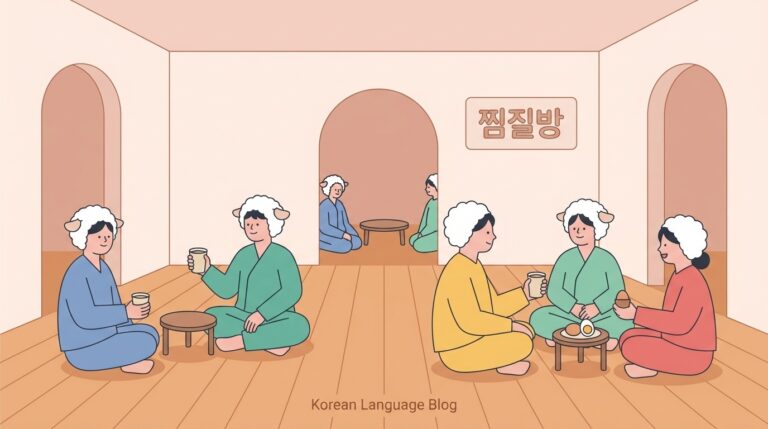
Phase 1: Empathy — Welcome to the Warmth of the Jjimjilbang!
Hello there! It’s your Daily Hangul Editor.
Have you ever watched a K-Drama where the main characters are sitting on a warm wooden floor, wearing cute towels shaped like sheep heads, and cracking boiled eggs on each other’s foreheads? That magical place is the Jjimjilbang (Korean traditional sauna/spa).
Imagine this: You and your Korean friends finally decide to go to a Jjimjilbang to sweat out the stress of the week. But here’s the tricky part—a Jjimjilbang is huge. It has different floors, separate locker rooms for men and women, and various sauna rooms. How do you coordinate where to meet? If you just say “Let’s meet inside,” you might be wandering around for an hour!
Don’t worry. Today, I’ll teach you exactly how to gather your friends at a Jjimjilbang like a true Korean insider. All the phrases here are based on the real struggles of my A2-level students who ended up lost in the spa lobby. Let’s dive in!
Phase 2: Core Expressions Deep Dive
1. 찜질방 로비에서 만나요. (Let’s meet at the Jjimjilbang lobby.)
- Pronunciation: jjimjilbang robieseo mannayo. [jjim-jil-bang ro-bi-eh-seo man-na-yo]
- Meaning: Let’s meet at the Jjimjilbang lobby.
- K-Culture Moment: Before entering the actual sauna, you usually buy a ticket at the lobby. This is the safest place to gather before everyone gets naked and goes to their separate locker rooms!
- Editor’s Insight: The word ‘로비’ (lobby) is a lifesaver. Instead of just saying ‘at the Jjimjilbang’, specifying ‘the lobby’ ensures nobody goes inside without the group.
- Situation Spectrum:
- Casual (Friends): ✅ (Drop the ‘요’: 로비에서 만나!)
- Semi-formal (Coworkers): ✅
- Formal (Boss/Elders): ⚠️ (Use ‘만나요’ or ‘뵙겠습니다’)
- 🤔 Think About It: Why do Koreans often prefer meeting at the venue rather than traveling there together? It respects everyone’s busy schedules, a concept deeply tied to the fast-paced ‘빨리빨리 (Bbali-bbali)’ culture.
2. 먼저 들어갈게요. (I’ll go in first.)
- Pronunciation: meonjeo deureogalgeyo. [mun-juh deu-ruh-gal-geh-yo]
- Meaning: Literal: I will enter first. / Real nuance: I’m going ahead, catch up with me inside!
- K-Culture Moment: Someone is running late? No problem. In Korea, it’s very common to buy your ticket, say “먼저 들어갈게요,” and wait comfortably inside.
- Editor’s Insight: ‘먼저’ (first) is an incredibly useful word in Korea. It shows consideration—you are informing them of your action so they don’t rush or worry about you waiting in the cold.
- Situation Spectrum:
- Casual (Friends): ✅ (먼저 들어갈게!)
- Semi-formal (Coworkers): ✅
- Formal (Boss/Elders): 🚫 (Better to wait for them out of respect!)
- 🤔 Think About It: In your culture, is it rude to enter a venue before your friends arrive? In Korea, it’s often seen as practical!
3. 옷 갈아입고 매점 앞에서 봐요. (Let’s change clothes and see each other in front of the snack bar.)
- Pronunciation: ot garaipgo maejeom apeseo bwayo. [ot ga-ra-ip-go mae-jum ap-eh-suh bwa-yo]
- Meaning: Change into the spa clothes and meet me at the snack bar.
- K-Culture Moment: This is the most crucial Jjimjilbang phrase. Men and women go to separate bathhouses to shower and change into the ‘찜질복’ (Jjimjilbang uniform). You need a rendezvous point in the unisex common area. The ‘매점’ (snack bar) is the perfect landmark!
- Editor’s Insight: ‘봐요’ (see you) is a very natural, conversational alternative to ‘만나요’ (meet).
- Situation Spectrum:
- Casual (Friends): ✅ (매점 앞에서 봐!)
- Semi-formal (Coworkers): ✅
- Formal (Boss/Elders): ⚠️
- 🤔 Think About It: Food is the center of Korean socializing. Why do you think the snack bar is the most common meeting point? (Hint: Sikhye and eggs!)
Phase 3: Textbook vs. Real Korean
Let’s see how native speakers actually text each other when gathering at the Jjimjilbang.
[Situation 1: Informing you’ve arrived]
* 📖 Textbook Korean: 저는 찜질방에 도착했습니다. (I have arrived at the Jjimjilbang.)
* 🗣️ Real Korean: 나 로비야! (I’m at the lobby!) or 나 도착! (Arrived!)
* 💡 Why the difference?: Koreans love efficiency in texting. Dropping the verbs and just stating the location is the ultimate ‘insider’ texting style.
[Situation 2: Telling a friend to hurry]
* 📖 Textbook Korean: 빨리 오세요. (Please come quickly.)
* 🗣️ Real Korean: 언제 와? 나 먼저 들어간다~ (When are you coming? I’m going in first~)
* 💡 Why the difference?: Asking “When are you coming?” is the friendly, indirect way of saying “Hurry up!”
Bottom Note: At the A2 level, try using ‘도착했어요!’ (I arrived!) instead of the robotic ‘도착했습니다’. It sounds much warmer and natural.
Phase 4: Cultural Context — K-Culture Deep Dive
4-1. The “Invisible Wall” of Jjimjilbangs (Non-verbal cues)
When you buy a ticket, the staff will hand you a key (usually an electronic bracelet) and a set of clothes. Do not follow your opposite-gender friend to the locker room! Men go to the “남탕” (Men’s bath) and women to the “여탕” (Women’s bath). You must shower, change into your Jjimjilbang clothes, and then walk out to the “공용 공간” (Common Area) to meet your friends.
4-2. The K-Drama Jjimjilbang Trope
If you’ve watched K-Dramas like Crash Landing on You or Legend of the Blue Sea, you’ve seen characters hiding out or sleeping at a Jjimjilbang. Because they operate 24/7 and are very cheap (usually around 10,000 to 15,000 KRW), they are portrayed as a safe haven.
Critical View: While dramas make it look peaceful, weekend Jjimjilbangs in reality are often packed with running children and snoring uncles! Finding a quiet spot requires serious Nunchi (situational awareness).
Phase 5: Practical Roleplay Scenario
Setting: Saturday afternoon. You are standing at the bustling entrance of ‘Spa Land’. You have your towel and uniform in your hand. Your Korean friend, Min-su, just texted you that he is stuck in traffic.
Characters:
* YOU: An expat surviving your first Korean winter, ready to sweat it out.
* Min-su (32): Your funny and easy-going Korean language exchange partner.
(Text Message Exchange)
Min-su: 미안! 나 차가 막혀서 15분 늦을 것 같아. ㅠㅠ
(mian! na chaga makyeoseo sibobun neujeul geot gata.)
[Sorry! Traffic is bad, I think I’ll be 15 mins late. T_T]
YOU: 괜찮아요. 천천히 오세요!
(gwaenchanayo. cheoncheonhi oseyo!)
[It’s okay. Take your time!]
Min-su: 로비에서 기다리지 말고 먼저 들어가!
(robieseo gidariji malgo meonjeo deureoga!)
[Don’t wait in the lobby, go in first!]
🔀 Your Turn! How should you respond?
* A) 싫어요. 밖에서 기다릴게요. (No. I will wait outside.)
* B) 네, 먼저 갈게요! 옷 갈아입고 매점 앞에서 봐요. (Okay, I’ll go first! Let’s change clothes and meet at the snack bar.)
* C) 어디예요? 빨리 오세요! (Where are you? Come quickly!)✅ Best Choice: B — Reason: This is the most practical and natural response. You accept his suggestion to go in, and clearly set the rendezvous point (the snack bar) so you won’t lose each other inside.
⚠️ Choice A Analysis: While loyal, waiting outside in the cold will make Min-su feel incredibly guilty! In Korea, accepting the offer to go inside is actually more polite.
YOU: 네, 먼저 갈게요! 옷 갈아입고 매점 앞에서 봐요.
(ne, meonjeo galgeyo! ot garaipgo maejeom apeseo bwayo.)
[Okay, I’ll go first! Let’s change clothes and meet at the snack bar.]
Min-su: 오케이! 내가 식혜 쏠게!
(okei! naega sikhye ssolge!)
[Okay! I’ll treat you to Sikhye!]
Phase 6: 10-Second Shadowing Drill
Practice speaking like a local! Pay attention to the pauses (/) and the emotion tags.
- 😊 밝게 (Brightly):
저 / 먼저 / 들어갈게요! (jeo / meonjeo / deureogalgeyo!)
(I will go in first!) -
🤙 쿨하게 (Coolly):
옷 갈아입고 / 매점에서 / 봐요! (ot garaipgo / maejeomeseo / bwayo!)
(Change clothes and see you at the snack bar!)
Phase 7: K-Culture Mini Dictionary
1. 양머리 (Yangmeori)
* Pronunciation: yangmeori
* English: Sheep head
* Context: The iconic way Koreans fold Jjimjilbang towels to look like Princess Leia buns or sheep horns. It keeps your head cool in the sauna and looks adorable in selfies.
2. 찜질복 (Jjimjilbok)
* Pronunciation: jjimjilbok
* English: Spa uniform
* Context: The matching T-shirt and shorts provided by the Jjimjilbang. You must wear this in the common areas.
3. 식혜 (Sikhye)
* Pronunciation: sikhye
* English: Sweet rice punch
* Context: The official drink of the Jjimjilbang. Served icy cold, it perfectly cools your body down after a hot sauna session.
4. 매점 (Maejeom)
* Pronunciation: maejeom
* English: Snack bar / Kiosk
* Context: The food stall inside the Jjimjilbang. It’s the ultimate gathering spot for friends and families.
Phase 8: Traveler Survival Kit
Navigating a Korean spa can be intimidating for travelers. Here are the survival phrases you need at the counter!
🆘 Survival Expression #1: Buying a ticket
* 🇰🇷 “성인 두 명, 찜질방이요.” (seongin du myeong, jjimjilbangiyo.)
* 🗣️ Sound-alike: [sung-in doo myung, jjim-jil-bang-ee-yo]
* 📍 Where: At the ticket counter.
* 💡 Meaning: “Two adults for the Jjimjilbang, please.” (Note: Sometimes saunas offer ‘Sauna only’ tickets vs ‘Jjimjilbang (Sauna + Common area)’ tickets. Always specify!)🆘 Survival Expression #2: Finding the meeting spot
* 🇰🇷 “공용 공간은 몇 층이에요?” (gongyong gongganeun myeot cheungieyo?)
* 🗣️ Sound-alike: [gong-yong gong-gan-eun myut cheung-ee-eh-yo?]
* 📍 Where: Inside the locker room/elevator.
* 💡 Meaning: “Which floor is the common area?”📌 Editor’s Travel Note
* Cash vs Card: Jjimjilbangs are completely cashless inside! You pay for food and massages using the electronic bracelet you get at the entrance. You pay the final bill when you leave.
* Tattoos: Unlike some hot springs in Japan, most Korean Jjimjilbangs are very accepting of tattoos.
Phase 9: Critical Thinking Corner — “One Step Deeper”
🧠 Think Deeper: Social Armor and the Jjimjilbang
Why do Koreans, who usually highly value social hierarchy and formal attire, love the Jjimjilbang so much? In a Jjimjilbang, everyone wears the exact same baggy, slightly faded uniform (Jjimjilbok). Whether you are a wealthy CEO or a college student, you look identical. Stripping away outside clothes means taking off your ‘social armor’. It acts as a great equalizer where Koreans can truly relax, be informal, and bond with friends and family without the pressures of societal status.
💬 Your Turn: Does your country have a place where people go to “strip away” their social status and just relax as equals? Share it in the comments!
Phase 10: FAQ & Common Mistakes
- Q: Can I wear a swimsuit in the baths?
- A: NO! In the gender-separated bath areas (남탕/여탕), you must be completely nude. Don’t worry, everyone is, and no one is looking at you. However, you must wear the Jjimjilbok in the common unisex areas.
- Q: Can I meet my opposite-gender friend in the bath?
- A: No! Baths are strictly separated. You must meet them in the 공용 공간 (Common Area).
❌ Common Mistake #1: Walking out to the common area in just a towel.
✅ Do this instead: Towels are only for the locker room/bath area. You must be fully dressed in your Jjimjilbok before stepping into the common hall to meet your friends!
Phase 11: Summary & Action Items
- One-Liner Summary: Use “먼저 들어갈게요” (I’ll go in first) and “매점에서 봐요” (See you at the snack bar) to navigate the Jjimjilbang maze like a pro!
Action Mission 3 Steps:
* 🥉 Bronze (Solo): Say “옷 갈아입고 매점 앞에서 봐요” out loud three times while imagining you are holding a cold Sikhye.
* 🥈 Silver (Online): Message a Korean learning friend: “주말에 찜질방 로비에서 만나요!” (Let’s meet at the Jjimjilbang lobby this weekend!)
* 🥇 Gold (Real Life): Visit a Jjimjilbang in Korea (or a Korean spa in your country) and successfully meet your friend at the snack bar!
🛀 K-Culture Mission:
Search “Korean Jjimjilbang Vlog” on YouTube and try to spot the ‘매점’ (snack bar). Notice what people are eating!
Phase 12: Quiz — Interactive Challenge
1. Situational Judgment:
You arrive at the Jjimjilbang lobby, but your friend is running 20 minutes late. What is the most natural text to send?
* A) 왜 안 와요? (Why aren’t you coming?)
* B) 저 먼저 들어갈게요. 안에서 봐요! (I’ll go in first. See you inside!)
* C) 찜질방 싫어요. (I hate Jjimjilbang.)
2. True or False – K-Culture Edition:
* In the common sleeping and hanging-out areas of a Jjimjilbang, you are allowed to wear a swimsuit instead of the provided Jjimjilbok. (T/F)
(Answers: 1: B – It’s considerate and common. 2: False – You must wear the Jjimjilbok uniform in all common areas!)
Frequently Asked Questions (FAQ)
Q: What does "찜질방 로비에서 만나요. (Let's meet at the Jjimjilbang lobby.)" mean in Korean and how do you pronounce it?
A: In Korean, "찜질방 로비에서 만나요. (Let's meet at the Jjimjilbang lobby.)" is pronounced [jjimjilbang robieseo mannayo. [jjim-jil-bang ro-bi-eh-seo man-na-yo] and means: Let's meet at the Jjimjilbang lobby.
Q: What does "먼저 들어갈게요. (I'll go in first.)" mean in Korean and how do you pronounce it?
A: In Korean, "먼저 들어갈게요. (I'll go in first.)" is pronounced [meonjeo deureogalgeyo. [mun-juh deu-ruh-gal-geh-yo] and means: Literal: I will enter first. / Real nuance: I'm going ahead, catch up with me inside!
Q: What does "옷 갈아입고 매점 앞에서 봐요. (Let's change clothes and see each other in front of the snack bar.)" mean in Korean and how do you pronounce it?
A: In Korean, "옷 갈아입고 매점 앞에서 봐요. (Let's change clothes and see each other in front of the snack bar.)" is pronounced [ot garaipgo maejeom apeseo bwayo. [ot ga-ra-ip-go mae-jum ap-eh-suh bwa-yo] and means: Change into the spa clothes and meet me at the snack bar.







