

How to Politely Hang Up in Korean: The Magic “Call You Later” Phrase!
Phase 1: Empathy (The K-Culture Cold Open)
Hello! I’m your Daily Hangul Editor.
Have you ever watched a K-Drama and seen that intense moment? The main character is sitting in a pojangmacha (street food tent), downing a shot of soju, when their phone rings. They look at the screen, sigh, pick it up, and whisper something before hanging up immediately. The subtitles just say, “I’ll call you later.” But what are they actually saying?
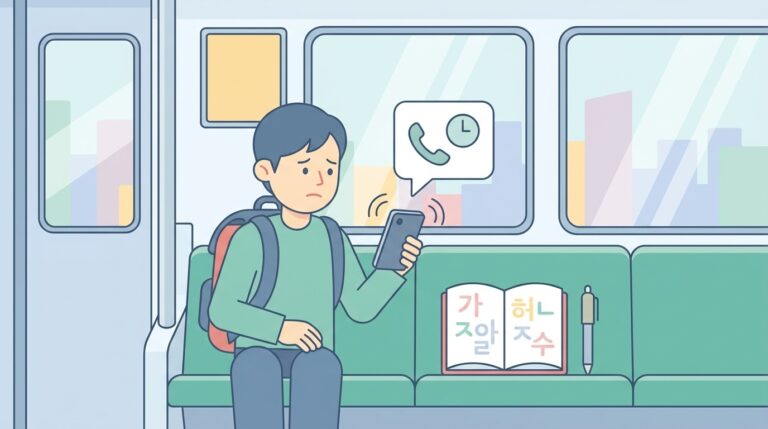
Or imagine this: You’re traveling in Seoul. You’re riding the famously quiet Seoul Metro, and suddenly your phone blasts your ringtone. You panic, pick up, and want to politely tell your Korean friend, “I can’t talk right now, I’ll call you back!” If you don’t know the right phrase, you might end up nervously shouting “No English!” or just hanging up on them. Yikes!
Don’t worry. As someone who has taught hundreds of beginners, I know exactly what phrases you need. Let’s learn how to hang up gracefully like a true Seoulite. (Note: This guide is based on real struggles from my A1 beginner students!)
Phase 2: Deep Dive into Core Expressions
1. 나중에 다시 걸게요
- Pronunciation: na-jung-e da-si geol-ge-yo [nah-joong-eh dah-shee guhl-geh-yo]
- Meaning: I’ll call you back later. (Literal: Later again I will hang the phone).
- K-Culture Moment: You are in a crowded Olive Young store, carrying a basket full of K-beauty face masks, when the cashier calls the next customer. Your friend calls you at that exact moment. You whisper this into the phone.
- Editor’s Insight: This is your golden, all-purpose survival phrase. It feels polite and respectful because it ends in “요 (yo)”, so you can safely use it with acquaintances, store clerks, or colleagues.
- Situation Spectrum:
- Casual (Friends): ✅ (But a bit formal)
- Semi-formal (Co-workers): ✅
- Formal (Boss/Elders): ⚠️ (Better to add “I’m sorry, I’m busy right now.”)
- 🤔 Think About It: Why do Koreans say “다시 걸게요 (I will hang it again)” instead of “전화할게요 (I will telephone you)”? It’s a linguistic habit left over from the old days of hanging the telephone receiver on the wall hook! Does your language have old tech words that survived?
2. 이따가 전화할게
- Pronunciation: i-tta-ga jeon-hwa-hal-ge [ee-ttah-gah juhn-hwa-hal-geh]
- Meaning: I’ll call you later.
- K-Culture Moment: The classic K-Drama school scene! A student gets caught texting in class, answers a quick call under the desk, and whispers this to their best friend to avoid getting caught by the teacher.
- Editor’s Insight: Notice there is NO “요 (yo)” at the end. This is strictly “반말 (banmal)” – casual speech. It feels very intimate and friendly. Only use this with close friends or people younger than you!
- Situation Spectrum:
- Casual (Friends): ✅
- Semi-formal (Co-workers): 🚫
- Formal (Boss/Elders): 🚫
- 🤔 Think About It: Dropping the “요 (yo)” instantly changes the power dynamic and intimacy level. How do you show intimacy in your native language when you are in a rush?
3. 지금 좀 바빠요
- Pronunciation: ji-geum jom ba-ppa-yo [jee-geum johm bah-ppah-yo]
- Meaning: I’m a bit busy right now.
- K-Culture Moment: Perfect for rejecting spam calls politely, or when you are trying to order street food in Myeongdong and really need to focus on your spicy rice cakes.
- Editor’s Insight: The magic word here is “좀 (jom – a little)”. Koreans use “좀” to soften the blow. Even if you are incredibly busy and stressed, saying “I’m a little busy” sounds much more considerate and gentle.
- Situation Spectrum:
- Casual (Friends): ✅ (Say: 지금 좀 바빠!)
- Semi-formal (Co-workers): ✅
- Formal (Boss/Elders): ⚠️
- 🤔 Think About It: Why do Koreans try to soften their rejections with words like “좀 (a little)”? This ties directly to the culture of maintaining social harmony and not hurting the other person’s feelings.
Phase 3: Textbook vs Real Korean
[When you are in a quiet place and can’t talk]
* 📖 Textbook Korean: 저는 지금 전화를 받을 수 없습니다. (I cannot answer the phone right now.)
* 🗣️ Real Korean: 앗, 나중에 걸게요! (Ah, I’ll call later!) or 이따 톡할게! (I’ll KakaoTalk you later!)
* 💡 Why the difference?: Textbooks teach full, robotic sentences, but modern Koreans prefer speed and efficiency. “톡할게 (Tok-hal-ge)” comes from KakaoTalk, Korea’s #1 messaging app!
[When rejecting a sales call]
* 📖 Textbook Korean: 아니요, 관심 없습니다. 안녕히 계세요. (No, I have no interest. Goodbye.)
* 🗣️ Real Korean: 아, 지금 좀 바빠서요. 죄송합니다~ (Ah, I’m a bit busy right now. Sorry~) Click
* 💡 Why the difference?: Direct rejection feels too harsh in Korean culture. Giving a gentle excuse (“I’m busy”) is the polite, face-saving way to say “leave me alone.”
Bottom Note: For A1 beginners, don’t worry about complex grammar. Just memorize “나중에 다시 걸게요” as one solid block. It’s safe, polite, and makes you sound like a local!
Phase 4: Cultural Context — K-Culture Deep Dive
4-1. Non-Verbal Elements: The Hand Cover
Language isn’t just about words; it’s about body language! When you have to say “나중에 다시 걸게요” in a public place, cover your mouth with your hand while speaking into the phone. This is a huge part of Korean etiquette to block your voice from bothering others. It shows you have high Nunchi (awareness of your surroundings).
4-2. K-Travel Connection: The Silent Subway
If you visit Korea, you will notice something shocking: the subway is incredibly quiet. People are glued to their screens, but rarely talking. If a phone rings, it’s considered rude to have a loud, long conversation. If your friend calls you while you are on the train, you must act fast. You pick up, cover your mouth, use your new survival phrase: “지금 지하철이에요. 나중에 다시 걸게요!” (I’m on the subway. I’ll call you back later!) and hang up immediately. It’s not rude to the caller; it’s respectful to the 50 people sitting around you!
Phase 5: Real-Life Roleplay Scenario
Scenario A: The Subway Panic
- Setting: Friday afternoon, Line 2 of the Seoul Subway. It’s packed but completely silent. Everyone is watching videos with earphones. You are heading to Gangnam.
- Characters:
- YOU (The Reader): A traveler in Korea, trying not to stand out.
- Min-su: Your friendly Korean language partner (age 28), who is calling to confirm dinner plans.
Min-su: 여보세요? 어디쯤이야? 📞
(yeoboseyo? eodijjeumiya?)
(English) Hello? Where are you?
(🎭 Stage Direction: Your ringtone echoes in the silent train car. Three people look at you.)
YOU: 어, 민수 씨! 저 지금 지하철이에요.
(eo, minsu ssi! jeo jigeum jihacheorieyo.)
(English) Uh, Min-su! I’m on the subway right now.
Min-su: 아 진짜? 강남역에서 내리는 거 맞지?
(a jinjja? gangnamyeogeseo naerineun geo matji?)
(English) Oh really? You’re getting off at Gangnam Station, right?
YOU: 네, 맞아요. 그런데…
(ne, majayo. geureonde…)
(English) Yes, that’s right. But…
(🎭 Stage Direction: The person next to you shifts uncomfortably because you are talking.)
🔀 Your Turn! How should you respond?
– A) “저 지금 전화를 받을 수 없습니다.” (I cannot answer the phone right now.)
– B) “지금 좀 바빠서요, 끊을게요!” (I’m busy, hanging up!)
– C) “지하철이라서요. 나중에 다시 걸게요!” (Because I’m on the subway. I’ll call you back later!)✅ Best Choice: C — Reason: You state the reason briefly and politely offer to call back. You showed excellent Nunchi!
⚠️ Choice A Analysis: Too robotic, sounds like an automated machine.
⚠️ Choice B Analysis: A bit too harsh to a friend.
Scenario B: K-Pop Fan Meeting Bonus
Imagine you win a video call fan event with your favorite K-Pop idol! The timer rings, meaning your 1 minute is up.
– Idol: 아쉽지만, 우리 다음에 또 봐요! (It’s a shame, but let’s meet again next time!)
– YOU: 네! 제가 꼭 나중에 다시 걸게요! (Yes! I will definitely call you back later!)
– Idol: (Laughs because fans can’t actually call them back, but loves your cute Korean mistake!)
Phase 6: 10-Second Shadowing Drill
Let’s practice the rhythm and intonation! Read out loud in 10 seconds. The slashes (/) show you where to pause.
- 😊 밝게 (Brightly): 앗! / 제가 지금 / 좀 바빠서요~ (at! / je-ga ji-geum / jom ba-ppa-seo-yo~)
- 🥺 미안하게 (Apologetically): 죄송해요! / 나중에 / 다시 걸게요! (joe-song-hae-yo! / na-jung-e / da-si geol-ge-yo!)
- 🤫 속삭이며 (Whispering): 지금 지하철이라서… / 이따가 전화할게! (ji-geum ji-ha-cheol-i-ra-seo… / i-tta-ga jeon-hwa-hal-ge!)
Phase 7: K-Culture Mini Dictionary
Here are 4 words you must know when dealing with phones in Korea!
1. 눈치
* Romanization: nunchi
* English: Situational awareness / Reading the room
* Context: Knowing you need to hang up the phone quickly on a quiet bus requires good nunchi. It’s the core social sense in Korea.
2. 매너모드
* Romanization: maeneomodeu
* English: Silent mode / Vibrate mode
* Context: Konglish for “Manner mode.” In public spaces, Koreans almost always put their phones on manner mode.
3. 카톡
* Romanization: katok
* English: KakaoTalk message
* Context: The standard way to communicate. Instead of calling back, people often say “이따 톡할게” (I’ll Katok you later).
4. 부재중 전화
* Romanization: bujaejung jeonhwa
* English: Missed call
* Context: What you see on your screen when you are too busy to answer and plan to “다시 걸게요” (call back).
Phase 8: Traveler’s Survival Kit
If you are traveling in Korea and need to manage your phone, these are lifesavers!
🆘 Survival Phrase #1
– 🇰🇷 “와이파이 비밀번호 뭐예요?” (waipai bimilbeonho mwoyeyo?)
– 🗣️ English Sound-alike: [wa-ee-pa-ee bee-mil-bun-ho mwo-yeh-yo?]
– 📍 Where to use: Cafes, restaurants, hotels
– 💡 Pro Tip: Need to make an internet call home? Korea has fast, free WiFi almost everywhere. Just ask this!🆘 Survival Phrase #2
– 🇰🇷 “핸드폰 충전할 수 있어요?” (haendeupon chungjeonhal su isseoyo?)
– 🗣️ English Sound-alike: [han-deu-pon choong-jeon-hal soo is-suh-yo?]
– 📍 Where to use: Restaurants, convenience stores
– 💡 Pro Tip: If your phone dies and you can’t call your friend back! Many cafes have free outlets, or you can buy a cheap battery at a convenience store.📌 Editor’s Travel Note
– Useful Apps: Download KakaoTalk. It is essential for texting anyone in Korea.
– Public Etiquette: Do not take phone calls on the bus or subway. If you must, whisper, keep it under 10 seconds, and tell them you’ll call back!
Phase 9: Critical Thinking Corner — “A Step Deeper”
🧠 Think Deeper: Media vs Reality
If you watch K-Dramas, you might think Koreans are constantly shouting on their phones, fighting with their lovers on the street, or loudly revealing company secrets in cafes. But this is purely for TV! In reality, Korea is an incredibly densely populated country where public etiquette is highly valued. Speaking loudly on the phone in a shared space is considered a huge lack of manners. Drama characters lack nunchi for the sake of an exciting plot, but real Seoulites are masters of the quick, polite hang-up.💬 Your Turn: “In your culture, is it acceptable to have long, loud phone conversations on public transport? Let us know in the comments!”
Phase 10: FAQ & Avoiding Misunderstandings
- Q: Can I use “이따가 전화할게 (i-tta-ga jeon-hwa-hal-ge)” to my boss or teacher?
- A: ABSOLUTELY NO! 🚫 It lacks the polite “요 (yo)”. Your boss will think you are treating them like a child. Always use “나중에 다시 걸게요 (na-jung-e da-si geol-ge-yo)”.
- Q: Can I just hang up without saying bye?
- A: In English, sometimes we just say “Okay, call you later” and click. In Korean, you usually wait for the other person to acknowledge, often with a drawn-out “네~ (ne~)” or “어~ (eo~)” before pressing end.
- Q: Is it rude to text instead of calling back?
- A: Not at all! In Korea, texting (KakaoTalk) is often preferred over phone calls, especially among Millennials and Gen Z. It’s seen as less intrusive.
❌ Common Mistake #1: Saying “나중에 전화할게요” (I’ll call you later) abruptly without any context. It can sound dismissive.
✅ Do this instead: Always give a tiny reason first! “지금 좀 바빠서… 나중에 걸게요” (I’m a bit busy so… I’ll call later). It sounds 100x softer!
Phase 11: Summary & Action Items
- One-Liner Summary: When you are busy or in a quiet public space, soften the blow with a gentle excuse and promise to call back: “지금 좀 바빠서요. 나중에 다시 걸게요!”
-
Action Mission 3 Steps:
- 🥉 Bronze (Solo): Stand in front of a mirror, pretend your phone is ringing, and whisper “나중에 다시 걸게요” while covering your mouth.
- 🥈 Silver (Online): Comment below on this blog with the Korean phrase you want to use when you get a spam call!
- 🥇 Gold (Real-world): Next time your Korean friend calls you, try answering and politely telling them you’ll call back using today’s phrase!
- K-Culture Mission: Watch an episode of your favorite K-Drama today. Pay close attention to how the characters answer the phone and hang up. Do they use “요 (yo)” or not? Did they have good nunchi?
-
Engagement: What was your favorite phrase today? Are you ready to use it on the Seoul subway? Drop a comment below!
Phase 12: Quiz — Interactive Challenge
1. Situational Judgment:
You are in a quiet cafe in Seoul and your Korean teacher calls you. What is the BEST thing to whisper before hanging up?
A) 이따가 전화할게! (i-tta-ga jeon-hwa-hal-ge)
B) 나중에 다시 걸게요! (na-jung-e da-si geol-ge-yo)
C) 뭐예요? (mwo-ye-yo?)
(Check answer below!)
2. True or False — K-Culture Edition:
“It is totally fine to have a 10-minute phone call on the Seoul Metro as long as you use polite Korean.”
3. Fill in the Blank:
To soften your sentence and sound more polite, use the word ____ (meaning ‘a little’) before saying you are busy.
Answers:
1. B (A is casual/impolite to a teacher, C means “What is it?” and is rude!)
2. False (Always keep it under 10 seconds or text instead! Silence is golden.)
3. 좀 (jom)
Happy studying, and I’ll catch you in the next lesson! 😊
Frequently Asked Questions (FAQ)
Q: What does "나중에 다시 걸게요" mean in Korean and how do you pronounce it?
A: In Korean, "나중에 다시 걸게요" is pronounced [na-jung-e da-si geol-ge-yo [nah-joong-eh dah-shee guhl-geh-yo] and means: I'll call you back later. (Literal: Later again I will hang the phone).
Q: What does "이따가 전화할게" mean in Korean and how do you pronounce it?
A: In Korean, "이따가 전화할게" is pronounced [i-tta-ga jeon-hwa-hal-ge [ee-ttah-gah juhn-hwa-hal-geh] and means: I'll call you later.
Q: What does "지금 좀 바빠요" mean in Korean and how do you pronounce it?
A: In Korean, "지금 좀 바빠요" is pronounced [ji-geum jom ba-ppa-yo [jee-geum johm bah-ppah-yo] and means: I'm a bit busy right now.






