

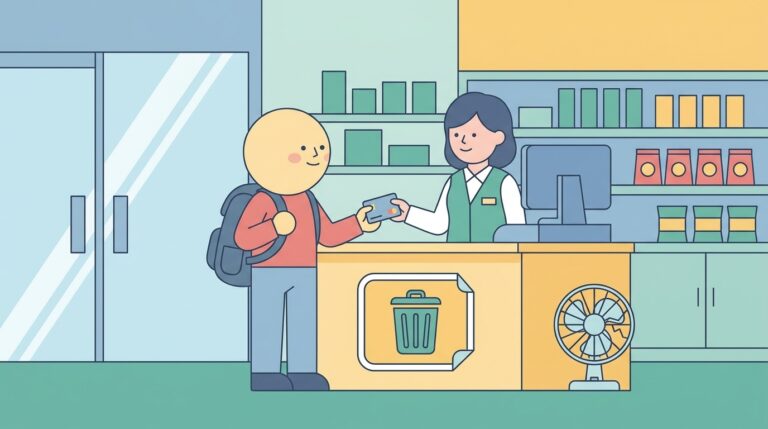
Phase 1: Empathy (The K-Culture Cold Open)
Hello! I am the lead editor of Daily Hangul, your local culture navigator and veteran tutor.
Imagine this: You are watching a classic K-Drama where the main character, after a heartbreaking breakup, decides to throw away everything her ex-boyfriend gave her. She drags a giant teddy bear out to the street. But wait! Before she walks away, she carefully slaps a small piece of paper on the bear’s forehead.
What was that paper? A final love letter? A curse?
Nope. It was an ‘Oversized Garbage Sticker’ (대형폐기물 스티커).
If you live in Korea, or are planning to stay for a while, you will eventually need to throw away something big—a broken fan, a cheap chair, or a suitcase that didn’t survive your K-Travel adventures. In Korea, you cannot just leave big trash on the street. You must pay for a special sticker to put on it!
For absolute beginners (A1), buying this sticker at a local convenience store can feel like a scary mission. But don’t worry! I’ll teach you exactly what to say, and you’ll handle it like a true local.
Phase 2: Core Expressions Deep Dive
Here are the top 3 life-saving phrases you need to buy a garbage sticker.
1. 폐기물 스티커 주세요. (Please give me a garbage sticker.)
- Pronunciation: [Pye-gi-mul seu-ti-keo ju-se-yo] / Pye sounds like ‘py’ in ‘pyramid’ + e, gi like ‘key’, mul like ‘mool’.
- Meaning: Literal: Please give me an oversized waste sticker. / Real nuance: “I need to throw away a big item, please sell me a sticker.”
- K-Culture Moment: You walk into a GS25 or CU (Korean convenience stores). The cashier is listening to the latest K-Pop hit. You approach the counter and say this. The cashier immediately knows you understand Korean rules!
- Editor’s Insight: ‘주세요 (ju-se-yo)’ is the magic word in Korea. It means “Please give me.” Just put the noun in front of it!
- Situation Spectrum:
- Casual with friends: 🚫 (You don’t buy things from friends!)
- Cashier at Convenience Store: ✅
- Government Office: ✅
- 🤔 Think About It: Why does Korea use ‘주세요’ (please give me) so often instead of ‘I want to buy’? In Korean culture, transactions are often framed as a polite request to the other person rather than demanding your own desire.
2. 이거 버릴 거예요. (I am going to throw this away.)
- Pronunciation: [I-geo beo-ril geo-ye-yo] / I-geo (Ee-guh – ‘uh’ like in ‘up’), beo-ril (buh-reel), geo-ye-yo (guh-yeh-yo).
- Meaning: I will throw this away.
- K-Culture Moment: When you ask for a sticker, the cashier will ask WHAT you are throwing away, because the price changes depending on the item! If you don’t know the Korean word for your broken suitcase, just point to a picture on your phone and say, “이거 버릴 거예요!”
- Editor’s Insight: ‘이거 (i-geo)’ means ‘this’. It’s the ultimate survival word for beginners. Don’t know the name? Just say ‘이거’!
- Situation Spectrum:
- Cashier/Landlord: ✅
- Formal/Boss: ⚠️ (A bit too direct, but okay for a beginner)
- 🤔 Think About It: Koreans point with their whole hand or nod toward the object, rather than pointing with one index finger. It’s considered softer and more polite!
3. 얼마예요? (How much is it?)
- Pronunciation: [Eol-ma-ye-yo?] / Eol sounds like ‘ull’ in ‘hull’, ma like ‘ma’, ye-yo like ‘yeah-yo’.
- Meaning: How much is it?
- K-Culture Moment: You will use this phrase at Dongdaemun Market, at street food stalls buying Tteokbokki, and yes… buying garbage stickers!
- Editor’s Insight: Garbage stickers usually range from 2,000 KRW to 15,000 KRW depending on the size.
- Situation Spectrum:
- Street vendor/Cashier: ✅
- Department store: ✅
Phase 3: Textbook vs. Real Korean
[Situation: Asking for the sticker at the store]
* 📖 Textbook Korean: 대형 폐기물 스티커 한 장 주십시오. (Please give me one sheet of oversized waste sticker.)
* 🗣️ Real Korean: 스티커 하나 주세요. (Sticker, please. / Seu-ti-keo ha-na ju-se-yo.)
* 💡 Why the difference?: ‘대형 폐기물’ (Oversized waste) is too long! Locals just say ‘sticker’ at the convenience store. The cashier knows what you mean unless you are at a stationary shop!
[Situation: Explaining what you are throwing away]
* 📖 Textbook Korean: 저는 의자를 버릴 예정입니다. (I am planning to dispose of a chair.)
* 🗣️ Real Korean: 의자 버릴 거예요. (Throwing away a chair. / Uija beoril geoyeyo.)
* 💡 Why the difference?: Koreans drop the subject “I” (저는) almost all the time. It makes the sentence faster and more natural.
Phase 4: Cultural Context — K-Culture Deep Dive
4-1. Non-Verbal Nunchi (눈치)
When handing your credit card to the cashier to pay for the sticker, try to use two hands, or gently support your right arm with your left hand. This non-verbal gesture shows deep respect in Korea. If you do this, the cashier might think, “Wow, this foreigner really knows our culture!”
4-2. The K-Drama Connection: The ‘Moving Out’ Scene
Have you noticed in K-Dramas like Because This Is My First Life or Reply 1988, when someone moves to a new house, the alleys are filled with old furniture? In Korea, you can’t just leave it there. If you don’t put a sticker on it, you get a massive fine (up to 1 Million KRW!). Sometimes, neighbors will use their Nunchi to see if your thrown-away table is still usable. If they want it, they might take it before the garbage truck arrives. We call this ‘득템’ (Deuk-tem – getting a great item for free)!
Phase 5: Real-Life Roleplay Scenario
Setting: Tuesday night, 8 PM. You are at the local CU Convenience store near your Airbnb in Hongdae. You need to throw away a broken electric fan (선풍기 – seon-pung-gi). The cashier is a university student working part-time.
Characters:
– YOU: A traveler/expat who wants to follow the rules.
– Ji-hoon: The friendly cashier (22 years old).
Dialogue:
YOU: 안녕하세요! (An-nyeong-ha-se-yo! / Hello!)
Ji-hoon: 어서오세요~ (Eo-seo-o-se-yo~ / Welcome!)
(🎭 Stage Direction: Ji-hoon scans a barcode for another customer and looks at you)
YOU: 폐기물 스티커 주세요. (Pye-gi-mul seu-ti-keo ju-se-yo. / Garbage sticker, please.)
Ji-hoon: 네, 어떤 거 버리세요? (Ne, eo-tteon geo beo-ri-se-yo? / Yes, what are you throwing away?)
🔀 Your Turn! How do you answer?
– A) 저는 선풍기를 버릴 예정입니다. (Textbook style)
– B) 이거 버릴 거예요. (Showing a photo of the fan on your phone)
– C) 스티커 줘! (Give me sticker!)✅ Best Choice: B — For A1 beginners, showing a picture and saying “이거 버릴 거예요” (I’ll throw this away) is the smartest, most natural survival skill!
⚠️ Choice C Analysis: This is 반말 (casual language). Never use this to a cashier, or they will be very shocked!
YOU: (Showing photo) 이거 버릴 거예요. 선풍기요. (I-geo beo-ril geo-ye-yo. Seon-pung-gi-yo. / I’m throwing this away. A fan.)
Ji-hoon: 아, 선풍기요. 2,000원입니다. (Ah, seon-pung-gi-yo. I-cheon-won-im-ni-da. / Ah, a fan. That’s 2,000 won.)
YOU: 카드 돼요? (Ka-deu dwae-yo? / Do you take cards?)
Ji-hoon: 네, 꽂아주세요. (Ne, kko-ja-ju-se-yo. / Yes, please insert it.)
Phase 6: 10-Second Shadowing Drill
Let’s practice! Speak out loud with emotion. Follow the slashes (/) for brief pauses.
- 😊 Brightly (Entering the store):
안/녕/하/세/요!
(An / nyeong / ha / se / yo!) -
🥺 Politely asking:
폐기물 스티커 / 주/세/요.
(Pye-gi-mul seu-ti-keo / ju / se / yo.) -
📱 Showing your phone:
이거 / 버릴 거예요.
(I-geo / beo-ril geo-ye-yo.)
Phase 7: K-Culture Mini Dictionary
1. 편의점
* Romanization: Pyeon-ui-jeom
* English: Convenience Store
* Context: In Korea, convenience stores (GS25, CU, 7-Eleven) are life hubs. You can buy food, charge transit cards, mail packages, and buy garbage stickers here!
2. 분리수거
* Romanization: Bun-ri-su-geo
* English: Recycling / Separating trash
* Context: Korea has one of the strictest recycling systems in the world. You must separate plastic, paper, glass, and food waste.
3. 자취
* Romanization: Ja-chwi
* English: Living alone (usually as a student or young worker)
* Context: Throwing away broken furniture and buying stickers is a classic ‘Ja-chwi’ struggle often shown on K-Vlogs.
4. 눈치
* Romanization: Nun-chi
* English: Social sense / Reading the room
* Context: Figuring out where to place your oversized trash by looking at where neighbors put theirs requires good Nunchi!
Phase 8: Traveler Survival Kit
Even if you are staying in an Airbnb for a week, you might accidentally break your luggage. Here is what you need!
🆘 Survival Phrase #1
– 🇰🇷 “이거 버릴 거예요.” (I-geo beo-ril geo-ye-yo. / I will throw this away.)
– 📍 Where to use: Convenience stores, asking your Airbnb host.
– 💡 Pro Tip: Take a picture of the item! The cashier has a big list of items (chairs, fans, suitcases) with different prices. A picture saves 1,000 words.📌 Editor’s Travel Note
– Cash vs. Card: Korean convenience stores accept cards for almost everything, including garbage stickers! Apple Pay works at major convenience stores too.
– Trash Bins: You will notice there are very few public trash cans on Korean streets. This is to encourage people to take their trash home and recycle properly!
Phase 9: Critical Thinking Corner — “A Step Deeper”
🧠 Think Deeper: Global Era & Social Responsibility
Why is the Korean garbage system so strict? Korea is a small peninsula with a large population, mostly living in high-rise apartments. Space is very limited! Therefore, the culture of ‘shared responsibility’ is strong. Charging money for large trash (via stickers) and strictly separating recycling is a way to protect the limited environment. It shows that in Korean society, the community’s well-being is often prioritized over individual convenience.💬 Your Turn: How do you throw away big items like a bed or a desk in your home country? Is it free, or do you have to call a special service? Share in the comments!
Phase 10: FAQ & Mistake Prevention
Q: Can I just write “Garbage” on a post-it note and put it on the item?
No! The official sticker is proof that you paid the local city district. Without it, the trash collectors will ignore it, and you will get a fine.
Q: Do I need to speak formally to the convenience store cashier?
Yes! Always use “~요 (yo)” at the end of your sentences (e.g., 주세요 – ju-se-yo). Using casual language (반말) to a stranger is considered very rude.
❌ Common Mistake #1: Saying “다꾸 스티커 (Da-kku sticker)” instead of “폐기물 스티커 (Pye-gi-mul sticker)”.
✅ How to fix: ‘Da-kku’ means diary decoration. If you just say “sticker,” they might point you to the cute Pikachu stickers. Always say “버릴 거예요” (I will throw away) so they understand the context!
Phase 11: Summary & Action Items
One-Liner Summary:
When throwing away big items in Korea, take a photo, go to the convenience store, and say “스티커 주세요. 이거 버릴 거예요!”
Action Mission:
– 🥉 Bronze (Solo): Look around your room right now. Point to a big item and say, “이거 버릴 거예요” (I-geo beo-ril geo-ye-yo).
– 🥈 Silver (Online): Comment below with what item you would hypothetically throw away today! (e.g., “My old suitcase!”)
– 🥇 Gold (Real Life): Next time you visit a Korean convenience store, see if you can spot the price list for ‘Oversized Waste Stickers’ taped near the cashier counter!
K-Culture Mission:
Search “나 혼자 산다 대형폐기물” (I Live Alone oversized waste) on YouTube to see Korean celebrities struggling to carry huge items and attaching these exact stickers!
Phase 12: Interactive Quiz
1. Fill in the Blank:
You want to ask the cashier for a sticker.
“폐기물 스티커 _______.”
(Hint: “Please give me”)
2. True or False — K-Culture Edition:
“In Korea, you can leave an old chair on the street for free as long as it is after midnight.” (T/F)
3. Situational Judgment:
The cashier asks what you are throwing away, but you don’t know the Korean word for ‘microwave’. What is your best move?
– A) Run out of the store.
– B) Say “이거 버릴 거예요” and show a photo on your phone.
– C) Give the cashier 50,000 won and hope it’s enough.
(Answers: 1. 주세요(ju-se-yo), 2. False! You always need a paid sticker, 3. B! A picture is your best friend.)
Frequently Asked Questions (FAQ)
Q: What does "폐기물 스티커 주세요. (Please give me a garbage sticker.)" mean in Korean and how do you pronounce it?
A: In Korean, "폐기물 스티커 주세요. (Please give me a garbage sticker.)" is pronounced [Pye-gi-mul seu-ti-keo ju-se-yo] and means: Literal: Please give me an oversized waste sticker. / Real nuance: "I need to throw away a big item, please sell me a sticker."
Q: What does "이거 버릴 거예요. (I am going to throw this away.)" mean in Korean and how do you pronounce it?
A: In Korean, "이거 버릴 거예요. (I am going to throw this away.)" is pronounced [I-geo beo-ril geo-ye-yo] and means: I will throw this away.
Q: What does "얼마예요? (How much is it?)" mean in Korean and how do you pronounce it?
A: In Korean, "얼마예요? (How much is it?)" is pronounced [Eol-ma-ye-yo?] and means: How much is it?







