

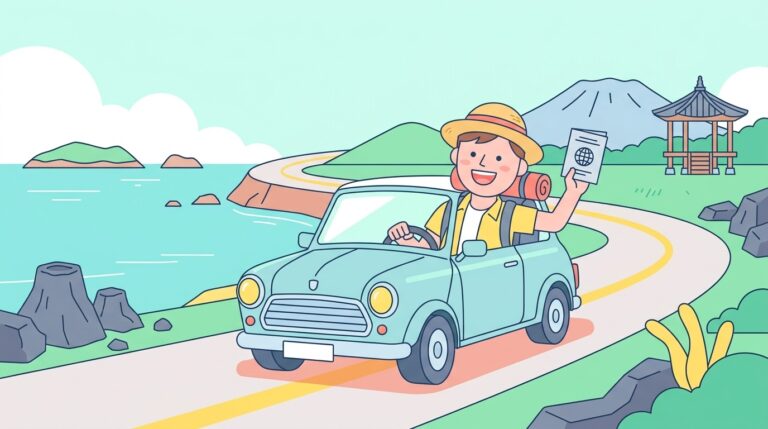
Hit the Road in Korea: Mastering Rental Car & IDP Expressions Like a Local
Phase 1: Empathy & The K-Culture Cold Open
Hello! I’m the Lead Editor at Daily Hangul.
Imagine this: You’ve finally arrived in Jeju Island. The ocean breeze is hitting your face, and you’re about to embark on that iconic K-Drama coastal road trip. The playlist is queued up with your favorite K-Pop summer anthems. But before you can roll the windows down, you’re standing at the rental car counter, sweating. The clerk is rapidly firing off terms like “Ilban-jacha,” “Wanjeon-jacha,” and “Hyucha-bosangryo.” Your textbook taught you how to say “I want to rent a car,” but it definitely didn’t prepare you for Korean car insurance jargon.
As a C2-level learner, you already know the basics of getting around. But dealing with contracts, insurance, and the fast-paced efficiency of Korean administrative services requires a different tier of vocabulary. If you don’t know these terms, you might end up paying for insurance you don’t need—or worse, paying out of pocket for a scratch you didn’t cause.
This guide is crafted from the real, slightly panicked questions of my advanced students who wanted to rent a car in Korea without feeling like a lost tourist. Let’s get you ready for that perfect road trip!
Phase 2: Deep Dive into Core Expressions
To survive the rental desk, you need to speak the language of Korean car insurance. Let’s break down the most crucial advanced expressions.
1. 완전자차로 업그레이드할 수 있을까요?
- Pronunciation: wanjeonjacha-ro eopgeureideuhal su isseulkkayo? (wan-jeon-ja-cha-ro / eop-geu-re-i-deu-hal-su / i-sseul-kka-yo?)
- Meaning: Literal: Can I upgrade to complete own-car? / Real nuance: Can I upgrade to the Super Collision Damage Waiver (Super CDW)?
- K-Culture Moment: In Korea, basic insurance often leaves you liable for deductibles and loss-of-use fees. When you say this at the counter, the clerk will visibly relax, knowing they don’t have to explain the complex penalty structures to you. You instantly become the “hassle-free customer.”
- Editor’s Insight: 자차 (Ja-cha) is short for 자기차량손해 (damage to one’s own vehicle). Koreans love abbreviating terms. 완전 (Wanjeon) means ‘complete’ or ‘full’. If you only get 일반자차 (Ilban-jacha / General CDW), you’re on the hook for a deductible. Asking for 완전자차 shows you know how the system works.
- Situation Spectrum:
- Rental desk staff (Formal/Business): ✅
- Asking a Korean friend for advice (Casual): ✅
- 🤔 Think About It: Why do Koreans abbreviate legal and insurance terms so heavily in everyday speech (like 자차)? Does your native language also simplify legal jargon for everyday consumers, or is it strictly kept formal?
2. 반납할 때 기름은 원래 칸에 맞춰서 채워오면 되나요?
- Pronunciation: bannaphal ttae gireumeun wonlae kane matchwoseo chae-woo-myeon doenayo?
- Meaning: Literal: When returning, should I fill the gas to match the original block? / Real nuance: Do I just return it with the same amount of gas it has now?
- K-Culture Moment: You’re doing the pre-inspection with the staff. They point to the dashboard, showing the digital fuel gauge (the ‘칸’ or blocks). Confirming this prevents any extra charges when you drop the car off in a rush to catch your flight.
- Editor’s Insight: Textbooks teach “연료를 가득 채워 주세요” (Please fill the tank). But in Korea, rental cars are rarely given to you with a full tank. You must return it exactly as you received it. The word 칸 (kan) refers to the digital bars on the fuel gauge.
- Situation Spectrum:
- Rental desk staff (Formal/Business): ✅
- Co-workers planning a trip (Semi-formal): ✅
- 🤔 Think About It: The concept of exactly matching what you consumed reflects a strict but fair adherence to ‘jeongsan’ (settling accounts). How is rental car fueling handled in your country?
3. 휴차보상료도 면제되는 조건인가요?
- Pronunciation: hyuchabosangryodo myeonjedoeneun jogeoningayo?
- Meaning: Literal: Is the loss-of-use compensation fee also a condition that is exempted? / Real nuance: Does this insurance cover the loss-of-use fee if the car is in the shop?
- K-Culture Moment: This is the ultimate C2 flex. Even many Koreans forget to check this. If you get into an accident, you don’t just pay for repairs; you pay the rental company for the days the car can’t be rented out (휴차보상료). Asking this makes you look like a seasoned legal eagle.
- Editor’s Insight: 면제 (myeonje) means exemption. This phrase is highly formal and shows absolute mastery of consumer rights in Korea.
- Situation Spectrum:
- Reading the fine print / Contract negotiation (Formal): ✅
- Casual chatting: 🚫 (Too formal and specific)
- 🤔 Think About It: The existence of a “loss-of-use fee” highlights the fast turnover and high demand in the Korean rental market. Time is money, literally.
Phase 3: Textbook vs. Real Korean
At the C2 level, it’s all about shedding robotic phrasing and adopting the sleek, efficient rhythm of actual Korean adults.
[Renting the Car]
* 📖 Textbook Korean: 자동차 보험에 가입하고 싶습니다. (I would like to sign up for car insurance.)
* 🗣️ Real Korean: 완전자차 포함된 거죠? (The full coverage is included, right?)
* 💡 Why the difference?: Koreans prioritize speed (빨리빨리). Stating “I want to sign up” takes too long. Confirming “It’s included, right?” skips a step and gets right to the point.
[Checking Fuel]
* 📖 Textbook Korean: 연료가 얼마나 남아 있습니까? (How much fuel is left?)
* 🗣️ Real Korean: 기름 몇 칸 남았어요? 원래대로 채워오면 되죠? (How many bars of gas are left? Just fill it back to how it was, right?)
* 💡 Why the difference?: 기름 (oil/gas) is the everyday word for fuel, and referring to the visual gauge (칸) is much more practical than asking for an abstract volume.
[Taking Photos for Evidence]
* 📖 Textbook Korean: 차량의 흠집을 기록하겠습니다. (I will record the scratches on the vehicle.)
* 🗣️ Real Korean: 스크래치 미리 찍어둘게요. (I’ll take pictures of the scratches just in case.)
* 💡 Why the difference?: Adding ~어 둘게요 implies doing something in advance for future benefit. It’s the standard phrasing for capturing evidence.
Bottom Note: At the C2 level, you shouldn’t use overly slangy terms like “만땅” (Japanese-derived slang for full tank) in formal contracts. Stick to natural, efficient business-casual phrases like the real Korean examples above.
Phase 4: Cultural Context — K-Culture Deep Dive
4-1. Non-verbal Nuances at the Rental Desk
When handing over your Passport and International Driving Permit (IDP), do not slide them across the counter with one hand. Present them with both hands or with your right hand supported by your left. The rental staff are processing dozens of tourists an hour; a polite nod, handing the documents properly, and answering with crisp, quick Korean (“네, 완전자차요.”) shows highly refined Nunchi (situational awareness). You’re helping them help you faster.
4-2. The K-Travel Connection: Jeju Island & The Navi Culture
If you’re renting a car, 90% of the time, it’s in Jeju Island. But here is the biggest culture shock for foreign drivers: Google Maps does not work for driving navigation in Korea due to national security laws.
You MUST use Korean apps like Kakao Navi or T Map. And the moment you start driving, the GPS will talk to you constantly:
“전방에 과속방지턱이 있습니다.” (There is a speed bump ahead.)
“500미터 앞 50km 시속 단속 구간입니다.” (50km/h speed enforcement zone 500 meters ahead.)
Korean roads are saturated with speed cameras (단속카메라). While K-Dramas show chaebols drifting sports cars through empty streets, the reality is a chorus of GPS chimes warning you to slow down. If you don’t, the rental company will forward the traffic fines (과태료) to you weeks later!
Phase 5: Real-Life Roleplay Scenario
Setting: Friday, 10:00 AM. The massive Rental Car House at Jeju International Airport. It’s crowded, noisy, and the shuttle buses are lined up outside. You step up to Counter 4.
Characters:
* YOU: An experienced expat taking a weekend trip. You want zero stress on this vacation.
* Ji-hoon (28): The rental desk agent. He’s polite but processing his 50th customer of the morning. He speaks at 1.5x speed.
Dialogue:
Ji-hoon: 안녕하세요! 예약자분 성함이 어떻게 되시나요? 💻
(annyeonghaseyo! yeyakjabun seonghami eotteoke doesinayo?)
[Hello! What is the name under the reservation?]
YOU: 제 이름으로 예약했어요. 여기 국제 운전 면허증이랑 여권, 그리고 제 나라 면허증입니다. 🛂
(je ireumeuro yeyakhaesseoyo. yeogi gukje unjeon myeonheojeung-irang yeogwon, geurigo je nara myeonheojeung-imnida.)
[I booked it under my name. Here is my IDP, passport, and my home country license.]
(🎭 Stage Direction: You hand them over with both hands. Ji-hoon nods appreciatively.)
Ji-hoon: 네, 확인되셨고요. 지금 일반자차로 예약하셨는데, 혹시 완전자차로 업그레이드 하시겠어요? 면책금이 아예 없거든요.
(ne, hwagindoesyeotgoyo. jigeum ilbanjacharo yeyakhasyeonneunde, hoksi wanjeonjacharo eopgeureideu hasigesseoyo? myeonchaekgeumi aye eopgeodeunyo.)
[Yes, confirmed. You currently booked General CDW, would you like to upgrade to Super CDW? There is absolutely no deductible.]
YOU: 아, 완전자차로 하면 휴차보상료도 면제되나요?
(a, wanjeonjacharo hamyeon hyuchabosangryodo myeonjedoenayo?)
[Ah, if I do Super CDW, is the loss-of-use fee also waived?]
Ji-hoon: 네, 전부 면제입니다! 휠이나 타이어 파손만 제외하고요.
(ne, jeonbu myeonje-imnida! hwil-ina taieo pasonman jewehagoyo.)
[Yes, everything is waived! Except for wheel and tire damage.]
YOU: 그럼 완전자차로 변경해 주세요.
(geurom wanjeonjacharo byeongyeonghae juseyo.)
[Then please change it to Super CDW.]
Ji-hoon: 결제 도와드리겠습니다. 아, 그리고 완전자차 하시면 외관 사진은 따로 안 찍으셔도 되는데, 같이 한 바퀴 둘러보실까요?
(gyeolje dowadeurigetseumnida. a, geurigo wanjeonjacha hasimyeon oegwan sajineun ttaro an jjigeusyeodo doeneunde, gachi han bakwi dulleobosilkayo?)
[I’ll help with the payment. Oh, and if you have Super CDW you don’t really need to take exterior photos, but shall we take a walk around the car together?]
🔀 Your Turn! How do you respond?
– A) “아니요, 안 찍어도 되면 그냥 갈게요. 빨리 출발하고 싶어요!” (No, if I don’t have to, I’ll just go. I want to leave fast!)
– B) “그래도 나중을 위해서 제가 스크래치 미리 찍어둘게요. 기름 칸도 확인해야 하니까요.”
– C) “대박! 사진 안 찍어도 돼요? 짱이네요!” (Jackpot! I don’t have to take pictures? Awesome!)✅ Best Choice: B — Reason: Never skip the inspection, even with Super CDW. Documenting the fuel gauge (기름 칸) and any major dents is standard practice and protects you. Choice B is assertive, polite, and shows C2-level foresight.
⚠️ Choice C Analysis: Way too casual for a legal/business transaction. “대박” and “짱” belong in a pojangmacha with friends, not a rental desk.
YOU: (Choosing B) 그래도 나중을 위해서 제가 스크래치 미리 찍어둘게요. 기름 칸도 같이 확인해 주세요. 📸
(geuraedo najungeul wihaeseo jega seukeuraechi miri jjigeodulgeyo. gireum kando gachi hwaginhae juseyo.)
[Even so, for later, I’ll take pictures of the scratches in advance. Please verify the fuel gauge with me as well.]
Ji-hoon: 네, 알겠습니다. 기름은 지금 6칸 있으니까요, 반납하실 때 똑같이 맞춰서 오시면 됩니다. 안전운전 하세요! 🚗
(ne, algetseumnida. gireumeun jigeum yeoseot kan isseunikkayo, bannaphasil ttae ttokgachi matchwoseo osimyeon doemnida. anjeonunjeon haseyo!)
[Yes, understood. There are 6 bars of gas right now, so please bring it back matched exactly when you return it. Drive safely!]
Phase 6: 10-Second Shadowing Drill
Let’s practice the rhythm. In Korean, confidence sounds like smooth, uninterrupted phrasing.
😤 Firmly but politely:
완전자차로 / 업그레이드 할게요. / 휴차보상료도 / 면제되는 거죠?
(wanjeonjacha-ro / eopgeureideu halgeyo. / hyuchabosangryodo / myeonjedoeneun geojyo?)
😊 Brightly, at the car:
나중을 위해서 / 제가 / 미리 / 찍어둘게요!
(najungeul wihaeseo / jega / miri / jjigeodulgeyo!)
Phase 7: K-Culture Mini Dictionary
1. 눈치 (Nunchi)
* Romanization: nunchi
* English: Situational awareness / Reading the room
* Context: The quintessential Korean social skill. At the rental desk, good nunchi means having your IDP, passport, and credit card already out of your bag before they even ask.
2. 자차 (Ja-cha)
* Romanization: jacha
* English: Own-vehicle insurance
* Context: Short for 자기차량손해. The most critical word when renting a car. Always aim for 완전자차 (Super CDW).
3. 과속방지턱 (Gwasok-bangjiteok)
* Romanization: gwasok-bangjiteok
* English: Speed bump
* Context: You will hear your GPS say this hundreds of times. Korea uses speed bumps aggressively in school zones and residential areas.
4. 단속카메라 (Dansok-kamera)
* Romanization: dansok-kamera
* English: Speed enforcement camera
* Context: Unlike police pull-overs in the US, Korea relies heavily on automated speed cameras. The GPS will ping to warn you to slow down.
Phase 8: Traveler Survival Kit
🆘 Survival Phrases for the Road
– 🇰🇷 “여기서 공항 가는 셔틀은 어디서 타나요?” (yeogiseo gonghang ganeun syeoteureun eodiseo tanayo?)
– 🗣️ English: Where do I catch the shuttle to the airport from here?
– 📍 Where to use: After returning your car at the rental house.
– 💡 Pro Tip: Rental car houses in Jeju are usually 10-15 mins away from the airport. Always factor in shuttle waiting times!📌 Editor’s Travel Note: The IDP Holy Trinity
– Must-haves: To rent a car in Korea, you strictly need THREE physical documents: 1) Your Passport, 2) The physical International Driving Permit booklet (digital copies are strictly rejected), and 3) Your original home-country driver’s license.
– Apps: Download Naver Map or Kakao Navi before arriving. Google Maps will not give you driving directions in Korea.
– Tolls: Most rental cars come with a “Hi-Pass” (하이패스) device. You can use the blue Hi-Pass lanes on highways, and the rental company will charge your card for the tolls when you return the car.
Phase 9: Critical Thinking — “One Step Deeper”
Media vs. Reality (미디어와 현실의 차이)
🧠 Think Deeper:
If you watch K-Dramas, you might think Korean roads are a playground for rich protagonists zooming down highways in imported sports cars without a care in the world. The reality of driving in Korea is starkly different. It is a highly regulated ecosystem characterized by ubiquitous speed cameras (단속카메라), strict 30 km/h school zones, and a society that relies heavily on dashcams (블랙박스) for absolute accountability. The Korean driving culture sits at a fascinating intersection: the deep-rooted cultural desire for efficiency and speed (빨리빨리) clashing with an incredibly dense, heavily surveilled, and strictly enforced road system. This is why rental insurance contracts are so meticulously detailed—in a country where every minor scratch can be proven by a 4K dashcam, liability is paramount.💬 Your Turn: Does media in your country accurately portray the reality of driving and traffic laws? Share your thoughts in the comments!
Phase 10: FAQ & Avoiding Misunderstandings
- Q: “Can I just show them a photo of my International Driving Permit on my phone?”
- A: Absolutely NO. Korean rental companies are legally bound by strict regulations. If you do not have the physical booklet, they will cancel your reservation on the spot with no refund.
- Q: “I am from the US/UK. Can I just use my home license since it’s in English?”
- A: No. Only the official IDP (issued under the 1949 Geneva Convention or 1968 Vienna Convention) is accepted.
- Q: “If I get a parking ticket, do I pay it online?”
- A: Usually, no. The ticket goes to the rental company. They will contact you and charge the credit card you left on file.
❌ Common Mistake #1: Assuming you can just use Apple Maps or Google Maps to navigate Jeju.
✅ Do This Instead: Download Kakao T or Naver Map. Type in the destination using the phone number of the restaurant/hotel (a very common Korean navi trick!).
Phase 11: Summary & Action Items
One-Liner Summary: Renting a car in Korea requires you to master insurance abbreviations (완전자차), document everything (미리 찍어둘게요), and adapt to the highly regulated, Navi-guided Korean roads.
Action Mission:
* 🥉 Bronze (Solo): Say “완전자차로 업그레이드 할게요” out loud 3 times confidently.
* 🥈 Silver (Online): Go to a Korean travel forum or Reddit and explain the difference between 일반자차 and 완전자차 to a confused traveler.
* 🥇 Gold (Real Life): On your next trip to Korea, confidently rent a car using only Korean, and make sure to confirm the gas level (기름 칸) before driving off!
K-Culture Mission:
Go to a Korean rental car website (like Lotte Rent-a-car or SK Rent-a-car). Switch the language to Korean and try to find the words 자차 and 면책금 in the vehicle descriptions!
Drop a comment below: Have you ever driven in a foreign country? What was the biggest culture shock?
Phase 12: Interactive Quiz
1. Situational Judgment:
You return the rental car, and the agent notices the fuel is lower than when you got it. What is the most natural thing they might say?
* A) “자동차 보험을 취소합니다.”
* B) “연료를 모두 소비하셨군요.”
* C) “기름 원래 칸대로 안 채워오셨네요. 추가 결제 도와드릴게요.”
2. True or False — K-Culture Edition:
“Google Maps is the best app for driving navigation on a Jeju Island road trip.” (T / F)
3. Fill in the Blank:
To avoid paying out of pocket for the time the car is in the repair shop, you should check if the [ __________ ] is waived. (Hint: Loss-of-use fee)
(Answers: 1. C – They will note it’s not at the original ‘kan’ and charge you. / 2. False – You must use Naver or Kakao Navi. / 3. 휴차보상료)
Frequently Asked Questions (FAQ)
Q: What does "완전자차로 업그레이드할 수 있을까요?" mean in Korean and how do you pronounce it?
A: In Korean, "완전자차로 업그레이드할 수 있을까요?" is pronounced [wanjeonjacha-ro eopgeureideuhal su isseulkkayo? (wan-jeon-ja-cha-ro / eop-geu-re-i-deu-hal-su / i-sseul-kka-yo?] and means: Literal: Can I upgrade to complete own-car? / Real nuance: Can I upgrade to the Super Collision Damage Waiver (Super CDW)?
Q: What does "반납할 때 기름은 원래 칸에 맞춰서 채워오면 되나요?" mean in Korean and how do you pronounce it?
A: In Korean, "반납할 때 기름은 원래 칸에 맞춰서 채워오면 되나요?" is pronounced [bannaphal ttae gireumeun wonlae kane matchwoseo chae-woo-myeon doenayo?] and means: Literal: When returning, should I fill the gas to match the original block? / Real nuance: Do I just return it with the same amount of gas it has now?
Q: What does "휴차보상료도 면제되는 조건인가요?" mean in Korean and how do you pronounce it?
A: In Korean, "휴차보상료도 면제되는 조건인가요?" is pronounced [hyuchabosangryodo myeonjedoeneun jogeoningayo?] and means: Literal: Is the loss-of-use compensation fee also a condition that is exempted? / Real nuance: Does this insurance cover the loss-of-use fee if the car is in the shop?






