

Phase 1: Empathy & The Cold Open
Greeting! 안녕하세요! I am your Daily Hangul Editor, your local friend and guide to navigating life in Korea.
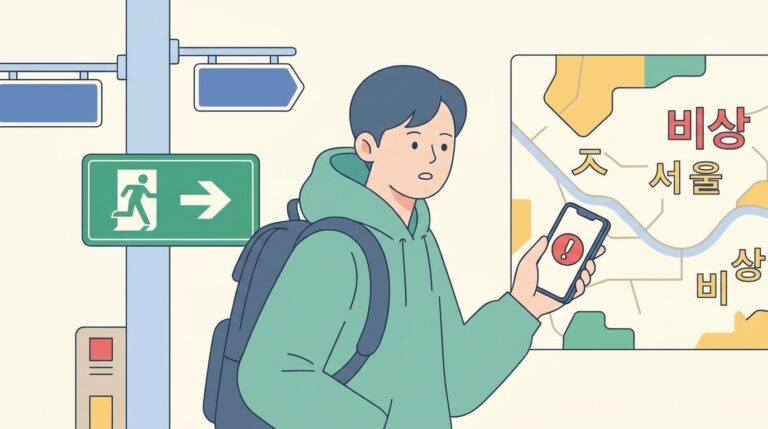
Picture this: You are sitting in a cozy, trendy cafe in Seongsu-dong. You just took the first sip of your perfectly brewed Iced Americano. Suddenly, BEEEEEP! BEEEEEP! BEEEEEP! Every single smartphone in the cafe erupts with a terrifying, loud siren. You freeze. Your heart is pounding. Is it an invasion? The end of the world? You look around, ready to run… but the Korean students next to you just casually glance at their phones, swipe the screen, and go back to studying.
What just happened?
You just experienced the famous Korean 재난문자 (jaenan munja – Emergency Alert Text). Often, it’s just a warning about heavy rain or a very minor tremor. But what if it is a real earthquake?
As a traveler or an expat, facing a disaster like an earthquake in a foreign country is one of the most terrifying things imaginable. You don’t need a textbook full of complicated grammar. You need to know how to ask for help, read the room, and survive. This guide is based on real questions from our expat students who experienced the 2016 Gyeongju and 2017 Pohang earthquakes. Let’s make sure you’re prepared!
Phase 2: Core Expressions Deep Dive
Here are the absolute basic survival phrases you need when the ground starts shaking.
1. 지진 (Earthquake)
- Pronunciation: ji-jin [Sounds like: jee-jeen]
- Meaning: Earthquake
- K-Culture Moment: If you’ve watched Korean disaster movies like Concrete Utopia or Exit, you’ll hear people shouting this word when things start crumbling.
- Editor’s Insight: This isn’t just a noun; it’s an alarm. If you feel the ground shaking, just yelling “지진!” or “지진이에요?” (Is it an earthquake?) will instantly get people’s attention and confirm your suspicions.
- Situation Spectrum:
- Casual: ✅
- Semi-formal: ✅
- Formal: ✅ (In emergencies, survival beats politeness!)
- 🤔 Think About It: Why do you think Korea relies so heavily on loud digital alerts for even minor weather events compared to your home country? How does it reflect the ‘hyper-connected’ IT culture of Korea?
2. 도와주세요 (Please help me)
- Pronunciation: do-wa-ju-se-yo [Sounds like: doh-wah-joo-seh-yo]
- Meaning: Please help me (Literal: Please give me help)
- K-Culture Moment: In K-Dramas, when the main character is trapped or in danger, this is the desperate plea they scream out.
- Editor’s Insight: This is the most important survival phrase in Korean. The “~주세요” (ju-se-yo) part means “please give.” You use it to order food (커피 주세요), but here, you are literally begging for assistance.
- Situation Spectrum:
- Casual: ✅
- Semi-formal: ✅
- Formal: ✅
- 🤔 Think About It: Even when begging for their lives, Koreans naturally use the polite suffix “~yo” (요). What does this tell you about the deep-rooted hierarchy and politeness in Korean language?
3. 대피소 (Evacuation Shelter)
- Pronunciation: dae-pi-so [Sounds like: deh-pee-soh]
- Meaning: Shelter / Safe Zone
- K-Culture Moment: During civil defense drills (민방위 훈련 – minbangwi hunryeon) which happen periodically in Korea, you’ll see people being guided to subway stations, which act as underground shelters.
- Editor’s Insight: If you need to evacuate, add “어디예요?” (eo-di-ye-yo? – Where is it?) to ask: “대피소가 어디예요?” (Where is the shelter?).
- Situation Spectrum:
- Casual: ✅
- Semi-formal: ✅
- Formal: ✅
Phase 3: Textbook vs. Real Korean
When disaster strikes, nobody has time for long sentences.
[Situation 1: Asking for help]
* 📖 Textbook Korean: 저를 도와주시겠습니까? (jeo-reul do-wa-ju-si-get-seum-ni-kka? – Would you please help me?)
* 🗣️ Real Korean: 도와주세요! (do-wa-ju-se-yo! – Help me!) or 살려주세요! (sal-lyeo-ju-se-yo! – Save my life!)
* 💡 Why the difference?: In emergencies, efficiency is survival. Koreans drop all the fancy honorifics and stick to the fastest, clearest verbs.
[Situation 2: Asking what is happening]
* 📖 Textbook Korean: 지금 무슨 일이 일어나고 있습니까? (ji-geum mu-seun ir-i i-reo-na-go it-seum-ni-kka? – What is happening right now?)
* 🗣️ Real Korean: 왜 이래요? (wae i-rae-yo? – Why is it like this?) or 지진이에요? (ji-jin-i-e-yo? – Is it an earthquake?)
* 💡 Why the difference?: “왜 이래요?” is the ultimate versatile phrase. You can use it when your computer freezes, when your friend acts weird, or when the building shakes!
Bottom Note: As an A1 beginner, don’t worry about perfect grammar. In a disaster, just saying one word loudly (like “지진!” or “도움!”-Help!) is enough.
Phase 4: Cultural Context — K-Culture Deep Dive
4-1. The Non-Verbal Survival Skill: Nunchi (눈치)
Korea’s famous non-verbal communication skill, 눈치 (Nunchi – the ability to read the room), is literally a lifesaver. If that loud emergency alert goes off on your phone and nobody in the cafe stops drinking their coffee, your Nunchi should tell you: “It’s a minor alert. Don’t panic.” However, if Koreans suddenly drop their belongings and head for the stairs, DO NOT hesitate. Follow them immediately!
4-2. K-Culture Connection: The Green Signs
Have you ever watched the hit Korean disaster movie Exit (엑시트)? The main characters survive by desperately looking for the glowing green 비상구 (bisanggu – Emergency Exit) signs. In Korea, building safety codes are incredibly strict. No matter where you are—a dark K-Pop concert hall, an underground subway maze, or a smoky BBQ restaurant—look up. You will always find a bright green running man sign. If an earthquake hits, don’t use elevators. Follow the green running man!
Phase 5: Real-life Roleplay Scenario
Scenario A: The Main Roleplay
- Setting: Friday evening, 7 PM. You are on the 5th floor of a crowded BBQ restaurant in Gangnam. The meat is sizzling. Suddenly, the pendant lights above the table start swinging wildly. The table shakes.
- Characters:
- YOU: An expat who arrived in Korea a month ago.
- Min-su (32): Your local Korean coworker, usually very relaxed.
YOU: 민수 씨! 이거 지진이에요? 😨
(min-su ssi! i-geo ji-jin-i-e-yo?)
[English] Min-su! Is this an earthquake?
(🎭 Stage Direction: You grab the edge of the table)
Min-su: 어? 네, 그런 것 같아요! 빨리 책상 밑으로 가요!
(eo? ne, geu-reon geot ga-ta-yo! ppal-li chaek-sang mi-teu-ro ga-yo!)
[English] Huh? Yes, I think so! Quickly go under the desk (table)!
YOU: (Hiding under the table) 무서워요!
(mu-seo-wo-yo!)
[English] I’m scared!
Min-su: 괜찮아요. 머리를 보호하세요.
(gwaen-cha-na-yo. meo-ri-reul bo-ho-ha-se-yo.)
[English] It’s okay. Protect your head.
(🎭 Stage Direction: The shaking stops after 20 seconds)
Min-su: 흔들림이 멈췄어요. 밖으로 나가요.
(heun-deul-rim-i meom-chwo-sseo-yo. ba-kkeu-ro na-ga-yo.)
[English] The shaking stopped. Let’s go outside.
YOU: 엘리베이터 타요?
(el-ri-be-i-teo ta-yo?)
[English] Do we take the elevator?
Min-su: 안 돼요! 계단으로 가야 해요!
(an dwae-yo! gye-dan-eu-ro ga-ya hae-yo!)
[English] No! We have to use the stairs!
🔀 Your Turn! What do you do next?
– A) Pack up your heavy backpack, laptop, and leftovers.
– B) Grab only your phone, wallet, and follow Min-su immediately.
– C) Run to the bathroom to wash your hands first.✅ Best Choice: B — In Korean disaster protocols, you must evacuate immediately using stairs. Leave heavy items behind.
Scenario B: Bonus K-Culture Roleplay (The Convenience Store)
- Setting: After evacuating safely, you realize you need some water. You go to a nearby GS25 convenience store, but the power is out.
YOU: 사장님, 물 있어요?
(sa-jang-nim, mul is-seo-yo?)
[English] Boss (Store owner), do you have water?
Owner: 네, 있어요. 그런데 정전이라서 카드 결제가 안 돼요.
(ne, is-seo-yo. geu-reon-de jeong-jeon-i-ra-seo ka-deu gyeol-je-ga an dwae-yo.)
[English] Yes, we do. But there’s a blackout, so credit cards don’t work.
YOU: 아, 현금 여기 있어요. 감사합니다!
(a, hyeon-geum yeo-gi is-seo-yo. gam-sa-ham-ni-da!)
[English] Ah, here is cash. Thank you!
Phase 6: 10-Second Shadowing Drill
Practice this sentence so it comes out naturally if you ever need it!
😨 저기요! / 대/피/소가 / 어/디/예/요?
(jeo-gi-yo! / dae-pi-so-ga / eo-di-ye-yo?)
[Excuse me! Where is the shelter?]
- Tone & Emotion: Urgent but clear. Pause slightly at the slashes (
/) so the listener catches the keywords.
Phase 7: K-Culture Mini Dictionary
Here are 4 essential disaster-related K-Culture keywords:
1. 재난문자
* Romanization: jaenan munja
* English: Emergency Alert Text message
* Context: The loud, screeching alarm you get on your phone. Korea has an incredibly fast disaster reporting system. You’ll get these for COVID updates, missing persons, heavy snow, and earthquakes.
2. 눈치
* Romanization: nunchi
* English: Reading the room / Social sense
* Context: Essential for survival. If an alarm goes off, use your Nunchi to see how the locals are reacting before you panic.
3. 비상구
* Romanization: bisanggu
* English: Emergency Exit
* Context: Look for the green running man sign. Korean buildings are legally required to have highly visible emergency exits.
4. 생존가방
* Romanization: saengjon gabang
* English: Survival Bag / Go-bag
* Context: After the 2016 Gyeongju earthquake, many Koreans started packing “survival bags” at home, filled with water, ramen, and flashlights, just like you see in movies.
Phase 8: Traveler Survival Kit
Even if you’re just visiting Korea for a week, you MUST know these.
🆘 Survival Phrases TOP 3
1. 🇰🇷 119 불러주세요! (il-il-gu bul-leo-ju-se-yo!)
– 🗣️ Sound: eel-eel-goo bool-luh-joo-seh-yo!
– 🇬🇧 Meaning: Please call 119!
2. 🇰🇷 다쳤어요. (da-chyeot-seo-yo.)
– 🗣️ Sound: dah-chyut-suh-yo.
– 🇬🇧 Meaning: I am hurt/injured.
3. 🇰🇷 대피소가 어디예요? (dae-pi-so-ga eo-di-ye-yo?)
– 🗣️ Sound: deh-pee-soh-gah uh-dee-yeh-yo?
– 🇬🇧 Meaning: Where is the shelter?📌 Editor’s Travel Note
– Emergency Numbers in Korea: Do NOT dial 911! In Korea, 119 is for Fire and Ambulance (Medical emergencies), and 112 is for the Police. 119 has English translation services available!
– Cash is King in a Blackout: Korea is a “card-only” society 99% of the time, but if an earthquake causes a power outage, card machines fail. Always carry a 10,000 KRW bill in your passport case.
– Emergency App: Download the ‘Emergency Ready App’ (안전디딤돌). It translates those scary Korean emergency texts into English for foreigners!
Phase 9: Critical Thinking Corner — “A Step Deeper”
Media vs Reality: The Korean Disaster Narrative
If you watch K-Dramas like Happiness or movies like Train to Busan and Exit, you might think Korean society instantly collapses into complete chaos and zombie-like panic during a crisis. But the reality is shockingly different.
Thanks to Korea’s hyper-connected IT infrastructure, real-life emergencies are managed with highly organized digital systems. The Jaenan Munja (Emergency texts) pinpoint your exact GPS location to warn you. People are generally very compliant with rules and will quietly follow the crowd during an evacuation. The media exaggerates the chaos for dramatic effect, but real Korea is incredibly safe and structured.
💬 Your Turn: Does your country have an emergency text alert system that goes straight to your phone? How do people usually react to it? Share in the comments!
Phase 10: FAQ & Common Mistakes
- Q: “Is it rude to yell ‘도와주세요’ (Help me) to an older person?”
- A: Absolutely NOT. In life-or-death situations, nobody cares about strict age hierarchy. “도와주세요” is already a polite form anyway. If you are truly desperate, just screaming “사람 살려!” (Save me!) is completely fine.
- Q: “Can I use an elevator if I’m on the 20th floor?”
- A: Never. Earthquakes cause power outages. You will get trapped. Take the stairs.
❌ Common Mistake #1: Calling 911.
✅ Do this instead: Memorize 119 (Fire/Ambulance) and 112 (Police).❌ Common Mistake #2: Running outside while the ground is still shaking.
✅ Do this instead: Korean safety guidelines say: Hide under a sturdy table first. When the shaking stops, then evacuate outside using stairs.
Phase 11: Summary & Action Items
- One-Liner Summary: In an earthquake, drop under a table, wait for the shaking to stop, follow the green Bisanggu (exit) signs, and shout “도와주세요!” if you need help.
-
Action Mission 3 Steps:
- 🥉 Bronze (Solo): Say “대피소가 어디예요?” out loud 3 times right now.
- 🥈 Silver (Online): Download the ‘Emergency Ready App’ on your phone and set the language to English.
- 🥇 Gold (Real-world): Next time you enter a cafe or restaurant in Korea, find the glowing green ‘비상구’ (Emergency Exit) sign before you sit down.
- K-Culture Mission: Watch the trailer for the Korean movie Exit (엑시트) on YouTube and see how many green emergency signs you can spot!
Phase 12: Quiz — Interactive Challenge
Test your survival skills!
1. Situational Judgment: The table starts shaking violently in a cafe. What is the FIRST thing you should say/do?
– A) “아메리카노 주세요!”
– B) 책상 밑으로 숨는다 (Hide under the table) and say “지진이에요!”
– C) 엘리베이터를 탄다 (Take the elevator)
(Answer: B. Hide first, confirm the earthquake.)
2. Fill in the Blank: You twisted your ankle while evacuating. You see a Korean person.
“저기요, ( )주세요!”
– A) 김치
– B) 비상
– C) 도와
(Answer: C. 도와주세요 – Please help me!)
3. True or False — K-Culture Edition:
If you get a loud siren text (재난문자) on your phone in Korea, it means the world is ending and you must run outside instantly.
(Answer: FALSE. Use your Nunchi! Often it’s just a warning about rain or missing persons. Read it first (or use a translator app) before panicking!)
4. Roleplay Application: In Phase 5, Min-su told you to leave your heavy bags behind. Why?
(Answer: Heavy bags will slow you down and can block the narrow stairwells for others escaping. Grab only essentials like your phone and passport/wallet!)
Frequently Asked Questions (FAQ)
Q: What does "지진 (Earthquake)" mean in Korean and how do you pronounce it?
A: In Korean, "지진 (Earthquake)" is pronounced [ji-jin [Sounds like: jee-jeen] and means: Earthquake
Q: What does "도와주세요 (Please help me)" mean in Korean and how do you pronounce it?
A: In Korean, "도와주세요 (Please help me)" is pronounced [do-wa-ju-se-yo [Sounds like: doh-wah-joo-seh-yo] and means: Please help me (Literal: Please give me help)
Q: What does "대피소 (Evacuation Shelter)" mean in Korean and how do you pronounce it?
A: In Korean, "대피소 (Evacuation Shelter)" is pronounced [dae-pi-so [Sounds like: deh-pee-soh] and means: Shelter / Safe Zone







