

Phase 1: Empathy (The “Wait, This Isn’t What I Ordered!” Moment)
Hello! I’m the Lead Editor at Daily Hangul.
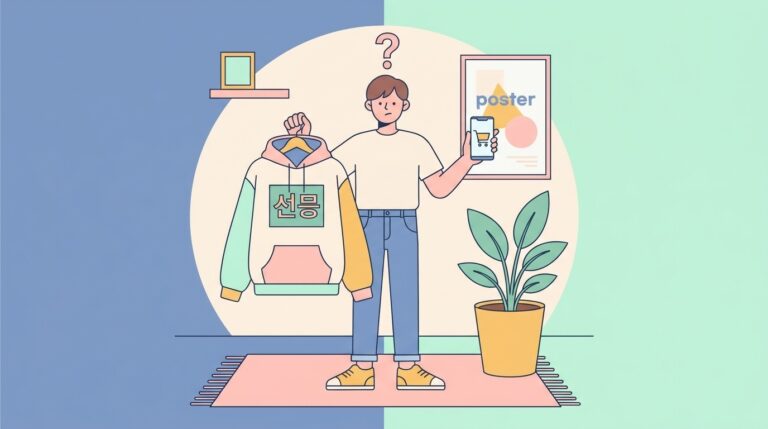
Imagine this: You’ve just ordered that trendy oversized K-fashion hoodie you saw your favorite K-Pop idol wearing at the airport. You’ve been tracking the delivery app every hour. The box finally arrives! You tear it open, put it on, and… you look less like an idol and more like a walking blanket. It’s way too big.
In your home country, returning or exchanging an item might be as simple as clicking a button or tossing it back in the mail. But in Korea? How do you tell the seller, “Hey, I need a different size” without sounding rude or causing a misunderstanding?
If you don’t know the right expressions, you might end up keeping clothes that don’t fit or makeup that isn’t your shade. But don’t worry! This guide is built from the real struggles of my beginner students. Today, we’re going to learn how to request an exchange for your online shopping smoothly and politely—just like a true local.
Phase 2: Core Expressions Deep Dive
Here are the top 3 magic phrases you need when your online order isn’t quite right.
1. 이거 교환하고 싶어요. (I want to exchange this.)
- Pronunciation: igeo gyohwanhago sipeoyo. [ee-geo / gyo-hwan-ha-go / shi-po-yo]
- Sound guide: ‘gyo’ sounds like the start of ‘gyoza’, and ‘hwan’ rhymes with ‘swan’.
- Meaning: Literal: I want to exchange this. / Real nuance: I’d like to get an exchange for this item, please.
- K-Culture Moment: Picture a busy Olive Young store. A customer walks up to the counter with a sealed face cream, sliding their receipt across the desk while saying this phrase. It’s polite, direct, and gets the job done instantly.
- Editor’s Insight: The word 교환 (gyohwan) means ‘exchange’. If you just want your money back, you would say 환불 (hwanbul – refund). This phrase is the absolute standard. It’s polite enough for any store clerk or customer service chat.
- Situation Spectrum:
- Casual (Friends): ✅ (Say: 이거 교환하고 싶어)
- Semi-formal (Clerks/CS): ✅
- Formal (Boss): 🚫 (You wouldn’t ask your boss for a shopping exchange!)
- 🤔 Think About It: Why do Koreans prefer saying “I want to exchange” rather than “Give me a different one”? Korean culture values indirectness and expressing your desire (싶어요) rather than making a direct command. Does your language use similar soft requests?
2. 사이즈가 안 맞아요. (The size doesn’t fit.)
- Pronunciation: saijeuga an majayo. [sa-ee-jeu-ga / ahn / ma-ja-yo]
- Sound guide: ‘an’ sounds like ‘on’, ‘ma-ja-yo’ sounds like ‘ma-jah-yo’.
- Meaning: Literal: The size is not correct. / Real nuance: It doesn’t fit me.
- K-Culture Moment: You’re trying on clothes in Hongdae. You step out of the fitting room, shake your head at the clerk, and use this phrase. They will immediately nod and run to get you a bigger or smaller option.
- Editor’s Insight: Notice how Koreans use the English word “Size” (사이즈). It makes online shopping incredibly easy for English speakers! 안 맞아요 (doesn’t fit) is a super versatile phrase. You can use it for clothes, shoes, or even when your schedule “doesn’t fit” with a friend’s!
- Situation Spectrum:
- Casual: ✅ (사이즈가 안 맞아)
- Semi-formal: ✅
- Formal: ✅
- 🤔 Think About It: In Korean, the subject of the sentence is the size (“The size doesn’t fit”), not you (“I don’t fit into this”). How does this subtle shift take the blame away from the person’s body?
3. 다른 색상으로 변경 가능할까요? (Is it possible to change to a different color?)
- Pronunciation: dareun saegsangeuro byeongyeong ganeunghalkkayo? [da-reun / saek-sang-eu-ro / byun-gyung / ga-neung-hal-kka-yo?]
- Sound guide: ‘ga-neung’ sounds like ‘gah-nung’.
- Meaning: Literal: Is changing to a different color possible? / Real nuance: Can I swap this for another color?
- K-Culture Moment: This is the ultimate “polite customer service text” you would write on a Q&A board on a shopping app like Musinsa or Zigzag.
- Editor’s Insight: 가능할까요? (Is it possible?) is a legendary phrase in Korea. It is the most polite, non-confrontational way to ask for a favor. If you use this, customer service agents will love you.
- Situation Spectrum:
- Casual: 🚫 (Too formal for friends)
- Semi-formal/CS Texting: ✅ (Perfect for apps)
- Formal: ✅
Phase 3: Textbook vs. Real Korean
Let’s see how language changes from the textbook to the real streets of Seoul or the chat windows of Korean shopping apps.
[Asking for an Exchange]
* 📖 Textbook Korean: 이것을 교환해 주시겠습니까? (Would you please exchange this?)
* 🗣️ Real Korean: 이거 교환 되나요? (Can this be exchanged?)
* 💡 Why the difference?: Koreans love efficiency. “되나요?” (Does it work? / Is it possible?) is the universal shortcut for asking if a service is available.
[Explaining It’s Too Big]
* 📖 Textbook Korean: 옷이 저에게 너무 큽니다. (The clothes are too big for me.)
* 🗣️ Real Korean: 핏이 너무 커요. (The fit is too big.) OR 사이즈 미스예요. (It’s a size miss.)
* 💡 Why the difference?: Modern K-Fashion culture incorporates a lot of English slang. “사이즈 미스” (Size miss) is a trendy online term to say you accidentally bought the wrong size.
Bottom Note: As an A2 learner, sticking to “너무 커요” (It’s too big) or “너무 작아요” (It’s too small) is perfectly natural and highly recommended!
Phase 4: Cultural Context — K-Culture Deep Dive
4-1. Non-Verbal Cues: The Art of the ‘Unboxing’
In Korea, returning or exchanging online items is incredibly fast, but there is one golden rule: Do not cut the tags! (택을 자르지 마세요). Also, when chatting with customer service online, Koreans use a lot of polite endings like “~요” and sometimes add a gentle “~ㅠㅠ” (crying emoji) to show they are sad the item didn’t fit, rather than angry. It softens the mood. You don’t need intense Nunchi (reading the room) to get an exchange online, but being polite speeds up the process!
4-2. K-Culture Connection: The World of K-Fashion Apps
If you watch K-Dramas, you might see characters getting huge boxes delivered overnight. Korea’s delivery system is famously called “Bullet Delivery” (총알배송). Apps like Coupang, Musinsa, and Zigzag dominate the market.
When exchanging an item, you often don’t even need to speak to anyone! You just click “Exchange” (교환) on the app, leave the box outside your apartment door, and the delivery driver magically swaps it while you sleep. However, if you bought something from a smaller Instagram boutique, you will need to DM them using the exact polite phrases we learned in Phase 2!
Phase 5: Real-Life Roleplay Scenario
Scenario A: The Customer Service Chat
* Setting: A Tuesday afternoon. You ordered a limited-edition K-Pop concert t-shirt online, but they sent you a Large instead of a Small. You open a chat with the customer service (CS) bot/agent.
* Characters:
* YOU: A big K-pop fan who just wants the right shirt for the concert next week.
* CS Agent (상담원): Friendly, professional, types very fast.
[Chat Window Opens]
CS Agent: 안녕하세요! 무엇을 도와드릴까요? 🎧
(annyeonghaseyo! mueoseul dowadeurilkkayo?)
[Hello! How can I help you?]
YOU: 안녕하세요. 이거 교환하고 싶어요.
(annyeonghaseyo. igeo gyohwanhago sipeoyo.)
[Hello. I want to exchange this.]
CS Agent: 네, 고객님. 어떤 문제가 있으신가요?
(ne, gogaengnim. eotteon munjega isseusingayo?)
[Yes, customer. What seems to be the problem?]
YOU: 사이즈가 안 맞아요. 작은 사이즈로 변경 가능할까요?
(saijeuga an majayo. jageun saijeuro byeongyeong ganeunghalkkayo?)
[The size doesn’t fit. Is it possible to change to a small size?]
CS Agent: 확인했습니다. 새 상품은 내일 출발합니다. 기존 상품은 박스에 넣어주세요.
(hwaginhaetseumnida. sae sangpumeun naeil chulbalhamnida. gijon sangpumeun bakseue neoeojuseyo.)
[Confirmed. The new item will depart tomorrow. Please put the original item in the box.]
🔀 Your Turn! How should you say goodbye?
– A) “감사합니다! 수고하세요~” (Thank you! Keep up the good work~)
– B) “네, 안녕히 계세요.” (Yes, goodbye.)
– C) “사랑해요!” (I love you!)✅ Best Choice: A — “수고하세요” (Keep up the good work) is the ultimate, natural way to end a transaction or chat with a worker in Korea. It shows appreciation for their effort.
⚠️ Choice B Analysis: Not wrong, but a bit too formal and stiff for a chat.
Bonus Scenario: Dropping it off at the Convenience Store
Sometimes, you have to drop the return box at a CU or GS25 convenience store (편의점 택배).
* YOU: “안녕하세요, 반품 택배 접수하려고요.” (Hello, I’m here to drop off a return package.)
* Clerk: “네, 저기 기계에 올려주세요.” (Yes, please put it on that machine over there.)
Phase 6: 10-Second Shadowing Drill
Practice speaking like a local! Pay attention to the pauses (/) and the mood.
- 🥺 Politely asking:
저기요… / 이거 / 교환하고 싶은데요…
(jeogiyo… / i-geo / gyohwanhago sipeundeyo…)
Excuse me… I would like to exchange this… -
😢 Explaining the issue:
옷이 / 예쁜데 / 사이즈가 / 안 맞아요. ㅠㅠ
(osi / yeppeunde / saijeuga / an majayo. ㅠㅠ)
The clothes are pretty, but the size doesn’t fit.
Phase 7: K-Culture Mini Dictionary
Master these keywords to navigate any Korean shopping app!
1. 반품 (Return / Refund)
* Romanization: banpum
* Meaning: Returning the item for your money back.
* Context: If you don’t want an exchange (교환), you look for the ‘반품’ button.
2. 품절 (Sold Out)
* Romanization: pumjeol
* Meaning: Sold out / Out of stock.
* Context: The saddest word in K-shopping. If an item is 품절, you cannot get an exchange for it!
3. 무료배송 (Free Shipping)
* Romanization: muryobaesong
* Meaning: Free shipping.
* Context: Also shortened to ‘무배’ (mubae). Often, exchanges require a small shipping fee unless the seller made a mistake.
4. 장바구니 (Shopping Cart)
* Romanization: jangbaguni
* Meaning: Shopping cart / basket.
* Context: Used both online (your digital cart) and offline in supermarkets.
Phase 8: Traveler Survival Kit
If you are traveling in Korea and shopping at physical stores in Myeongdong or Hongdae, you MUST know these phrases!
🆘 Survival Phrases for Shoppers
– 🇰🇷 “입어봐도 돼요?” (ibeobwado dwaeyo?)
– 🗣️ Meaning: Can I try this on?
– 📍 Where to use: Clothing stores. (Note: Many Korean stores do not allow you to try on white shirts!)
– 🇰🇷 “영수증 드릴까요?” (yeongsujeung deurilkkayo?)
– 🗣️ Meaning: Would you like the receipt?
– 📍 Where to use: The cashier will ask YOU this. Answer “네 (Yes)” if you think you might need to exchange it later!
– 🇰🇷 “이거 스몰(S) 사이즈 있어요?” (igeo seumol saijeu isseoyo?)
– 🗣️ Meaning: Do you have this in a small size?
– 📍 Where to use: Finding the right fit before buying to avoid needing an exchange!📌 Editor’s Travel Note
– Receipts: In Korea, you absolutely need the paper receipt or the digital receipt to make an exchange offline.
– Tags: If you rip the price tag off, a refund or exchange is almost impossible. Leave the tag on until you are 100% sure!
– Sizes: Korean “Free Size” (프리사이즈) often fits like a standard M or S. Don’t be surprised if it doesn’t fit everyone freely!
Phase 9: Critical Thinking — “One Step Deeper”
🧠 Think Deeper: Korean in the Global Era (Konglish in Fashion)
Have you noticed how many English words Koreans use when shopping? ‘Size’ (사이즈), ‘Color’ (컬러), ‘Fit’ (핏), ‘Design’ (디자인). Because modern fashion culture developed heavily alongside Western influences, English vocabulary became the standard for trendy shopping. Some language purists argue we should use native Korean words like ‘크기’ (size) or ‘색깔’ (color). However, in the fast-paced world of online shopping, Konglish is seen as more efficient and stylish.💬 Your Turn: Does your language borrow English words for fashion and shopping, or do you use your own native words? Share your thoughts in the comments!
Phase 10: FAQ & Mistake Prevention
Q: Can I use “교환하고 싶어요” with older people or store managers?
A: Yes! Ending with “~요” makes it perfectly polite for any staff member, regardless of their age.
Q: How many days do I have to exchange an online item in Korea?
A: By law, usually 7 days from the delivery date for a simple change of mind (단순변심). Do it quickly!
❌ Common Mistake #1: Throwing away the original box.
✅ Do this instead: To exchange an online order, you must return it in its original packaging (본품 박스). Keep the box for at least 3 days!❌ Common Mistake #2: Assuming exchanges are free.
✅ Do this instead: If the size just didn’t fit you (your fault), you usually have to pay a round-trip shipping fee (왕복 배송비), which is about 5,000 to 6,000 won. If the seller sent the wrong item, it’s free!
Phase 11: Summary & Action Items
- One-Liner Summary: To fix a shopping mistake, politely ask “이거 교환하고 싶어요” (I want to exchange this) and explain “사이즈가 안 맞아요” (The size doesn’t fit)!
Action Missions:
* 🥉 Bronze (Solo): Look at your closet, pick an item that doesn’t fit, and say “사이즈가 안 맞아요” out loud 3 times.
* 🥈 Silver (Online): Write “이거 교환하고 싶어요” in the comments below to practice your spelling!
* 🥇 Gold (Real Life): Next time you buy something in Korea (or at a Korean market abroad), listen carefully to see if the cashier asks if you want the receipt (영수증).
- K-Culture Mission: Go to a Korean shopping site like Olive Young Global or Musinsa. Try to locate the “교환/반품” (Exchange/Return) policy section at the bottom of a product page!
Phase 12: Quiz — Interactive Challenge
Test your new skills! (Answers at the bottom)
1. Situational Judgment: You received your online order, but the jacket is too small. What is the most natural thing to message the seller?
* A) 환불 싫어요. (I hate refunds.)
* B) 사이즈가 안 맞아요. 교환하고 싶어요. (The size doesn’t fit. I want to exchange it.)
* C) 옷이 나빠요. (The clothes are bad.)
2. Fill in the Blank:
“다른 ________(으)로 변경 가능할까요?” (Is it possible to change to a different color?)
* A) 사이즈 (Size)
* B) 색상 (Color)
* C) 택배 (Delivery)
3. True or False – K-Culture Edition:
You can rip the tag off a shirt, wear it outside for a day, and still get an exchange in Korea. (T/F)
(Answers: 1. B / 2. B / 3. False! Never remove the tag if you want an exchange!)
Frequently Asked Questions (FAQ)
Q: What does "이거 교환하고 싶어요. (I want to exchange this.)" mean in Korean and how do you pronounce it?
A: In Korean, "이거 교환하고 싶어요. (I want to exchange this.)" is pronounced [igeo gyohwanhago sipeoyo. [ee-geo / gyo-hwan-ha-go / shi-po-yo] and means: a key conversational Korean expression covered in this lesson.
Q: What does "사이즈가 안 맞아요. (The size doesn't fit.)" mean in Korean and how do you pronounce it?
A: In Korean, "사이즈가 안 맞아요. (The size doesn't fit.)" is pronounced [saijeuga an majayo. [sa-ee-jeu-ga / ahn / ma-ja-yo] and means: a key conversational Korean expression covered in this lesson.
Q: What does "다른 색상으로 변경 가능할까요? (Is it possible to change to a different color?)" mean in Korean and how do you pronounce it?
A: In Korean, "다른 색상으로 변경 가능할까요? (Is it possible to change to a different color?)" is pronounced [dareun saegsangeuro byeongyeong ganeunghalkkayo? [da-reun / saek-sang-eu-ro / byun-gyung / ga-neung-hal-kka-yo?] and means: a key conversational Korean expression covered in this lesson.







