

Phase 1: Empathy (Immersive Opening)
Hello, language enthusiasts! This is your Daily Hangul Editor.
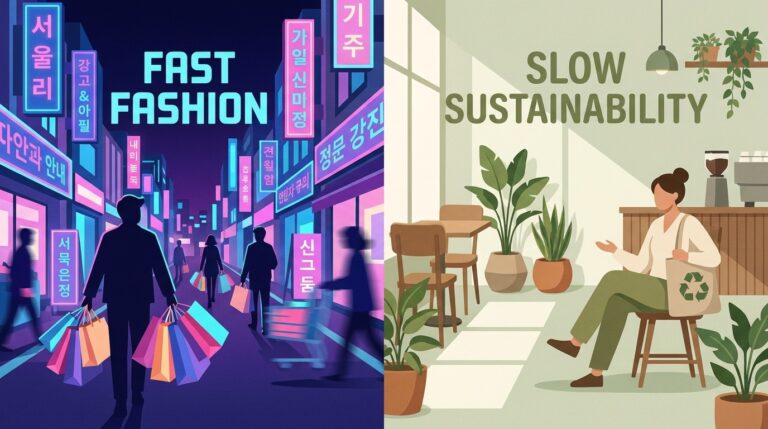
Picture this: You’re walking through the neon-lit streets of Dongdaemun at 3 AM. The sheer volume of clothing is staggering—motorcycles zipping by, carrying massive plastic bags (daebong) stuffed with tomorrow’s trends. This is the beating heart of Korea’s ultra-fast fashion. But cut to the next afternoon in trendy Seongsu-dong, and you’ll see K-Pop fans lining up at a pop-up store to buy upcycled bags made from old concert banners.
Welcome to the modern Korean paradox: the clash between hyper-speed trend cycles and a rapidly growing slow fashion movement.
As a C2-level Korean learner, you already know how to ask for a different size or color. But can you eloquently debate the environmental impact of “wear-it-once” culture with a Seoulite over a vegan matcha latte? If you want to move beyond textbook shopping phrases and truly engage with Korea’s MZ generation about ethical consumption, you need the right vocabulary.
Transparency Note: This guide is crafted from real conversations I’ve had with advanced students who wanted to discuss K-Culture, sustainability, and fashion without sounding like they were reading a news broadcast.
Phase 2: Core Expressions Deep Dive
To sound like an educated native speaker discussing sustainability, master these three C2-level expressions.
1. 한 철 입고 버리다
- Pronunciation: han cheol ipgo beorida [hahn chul eep-go buh-ree-dah]
- Meaning: (Literal) To wear for one season and throw away. (Real nuance) The exact definition of disposable, fast fashion.
- K-Culture Moment: You’re watching a popular Korean fashion YouTuber do a “haul” review. They hold up a cheap, trendy top and say, “This material isn’t great. 한 철 입고 버리기엔 괜찮아요 (It’s okay for wearing for just one season and tossing).”
- Editor’s Insight: This phrase perfectly captures the essence of fast fashion (SPA 브랜드 in Korea). It implies something is cheap, highly trendy, but lacks durability. It carries a slight tone of resignation about the quality.
- Situation Spectrum:
- Casual friends: ✅
- Semi-formal (Colleagues): ✅
- Formal (Seniors/Boss): ⚠️ (Acceptable in a discussion, but sounds a bit colloquial)
- 🤔 Think About It: Why is “one season” (한 철) the metric for time here instead of “one year” or “a few months”? How does Korea’s distinct four seasons dictate the extreme shift in fashion trends?
2. 유행을 타지 않는 옷
- Pronunciation: yuhaeng-eul taji anneun ot [yoo-hang-eul tah-jee ahn-neun oat]
- Meaning: (Literal) Clothes that don’t ride the trend. (Real nuance) Timeless, classic pieces; wardrobe staples.
- K-Culture Moment: In a K-Drama, the wealthy, sophisticated CEO character never wears flashy logos. Her stylist describes her look as focusing on 유행을 타지 않는 high-quality pieces—the epitome of “old money” aesthetic and slow fashion.
- Editor’s Insight: The verb 타다 (to ride) is used brilliantly here. Just like riding a roller coaster or a wave, trends in Korea go up and down violently. If clothes “don’t ride” the trend, they are immune to the fast-fashion cycle.
- Situation Spectrum:
- Casual friends: ✅
- Semi-formal (Colleagues): ✅
- Formal (Seniors/Boss): ✅
- 🤔 Think About It: Does your native language use a physical metaphor like “riding” to describe following trends?
3. 가치 소비를 지향하다
- Pronunciation: gachi sobireul jihyanghada [gah-chee so-bee-reul jee-hyang-hah-dah]
- Meaning: (Literal) To aim for value consumption. (Real nuance) To practice ethical, conscious, or sustainable shopping.
- K-Culture Moment: An idol goes on a V-Live and shows off a new phone case made of recycled ocean plastic, proudly telling fans that they are trying to practice 가치 소비 these days.
- Editor’s Insight: This is the ultimate MZ generation buzzword. 가치 소비 (Value consumption) means spending money according to one’s personal, often ethical, values. Using 지향하다 (to aim for/pursue) instead of 하다 elevates your Korean to a highly educated, C2 level.
- Situation Spectrum:
- Casual friends: ⚠️ (A bit too academic for a pub, better suited for deep cafe talks)
- Semi-formal (Colleagues): ✅
- Formal (Seniors/Boss): ✅
- 🤔 Think About It: How does the concept of “value consumption” conflict with the traditional Korean societal pressure to wear recognizable luxury brands to show status?
Phase 3: Textbook vs. Real Korean
Let’s upgrade your vocabulary from “foreign exchange student” to “Seoul local.”
[Describing Fast Fashion Quality]
* 📖 Textbook Korean: 이 옷은 품질이 안 좋아서 오래 못 입습니다. (The quality of these clothes is bad, so I can’t wear them long.)
* 🗣️ Real Korean: 완전 SPA 브랜드 재질이라 몇 번 빨면 금방 늘어나요. (It’s totally fast-fashion material, so it stretches out after a few washes.)
* 💡 Why it’s different: Koreans commonly use SPA 브랜드 to refer to fast fashion (like Zara, H&M, SPAO). Using 재질 (material/vibe) as slang adds that native flavor.
[Talking About Second-hand Shopping]
* 📖 Textbook Korean: 저는 중고 옷을 사는 것을 좋아합니다. (I like buying used clothes.)
* 🗣️ Real Korean: 요즘은 새 옷 사기 죄책감 들어서, 주로 당근하거나 구제 숍 가요. (Lately I feel guilty buying new clothes, so I usually use Karrot [secondhand app] or go to vintage shops.)
* 💡 Why it’s different: “당근하다” has become a verb meaning “to buy/sell secondhand,” showing how app culture shapes modern Korean vocabulary.
Bottom Note: At the C2 level, you should be comfortable using social phenomena (like the Karrot app) as verbs in casual conversation while easily switching back to academic terms (like 가치 소비) in formal debates.
Phase 4: Cultural Context — K-Culture Deep Dive
4-1. Non-verbal Elements: The Art of “눈치” (Nunchi) in Fashion
In Korea, Nunchi (the subtle art of reading the room) applies heavily to fashion. Historically, standing out too much was frowned upon, leading to “clone fashion” (everyone wearing the exact same trendy padded jacket). However, in the context of slow fashion, Nunchi is shifting. There is a growing subtle, judgmental gaze (눈치) toward extreme wastefulness or using non-tumblers at vegan cafes. When discussing sustainability, matching the other person’s level of environmental concern—without sounding preachy—requires exquisite verbal Nunchi.
4-2. K-Culture Links: Idols and the “Upcycling” Trend
Have you noticed K-Pop music videos increasingly featuring outfits made from repurposed denim or safety pins? This isn’t just an edgy aesthetic; it’s a deliberate nod to sustainable fashion. Entertainment companies are highly aware of their global environmental footprint. By dressing idols in upcycled (업사이클링) brands, they tap into the MZ generation’s desire for 가치 소비.
Critical Viewpoint: However, there is an ironic disconnect. While K-Pop promotes upcycled fashion, the industry still relies on mass-producing physical albums with randomized photocards, leading fans to buy dozens of albums only to throw the CDs in the trash (a huge environmental issue in Korea). Recognizing this dichotomy is a true C2-level insight.
Phase 5: Real-world Roleplay Scenario
Scenario A: The Seongsu-dong Cafe Debate
- Setting: Saturday afternoon at a trendy, zero-waste cafe in Seongsu-dong. The interior is all exposed concrete and upcycled furniture. You are drinking an oat milk latte.
- Characters:
- YOU: An expat living in Seoul, trying to build a sustainable capsule wardrobe.
- Ji-ae (28): Your Korean friend. Very trendy, loves shopping, but is starting to feel “eco-guilt.”
Ji-ae: 아, 어제 역 출구 지하상가에서 티셔츠 3장 샀는데, 막상 집에 오니까 입을 게 없는 거 있지? 👚
(A, eoje yeok chulgu jihasangga-eseo tisyeocheu 3jang satneunde, maksang jib-e onikka ibeul ge eomneun geo itji?)
[Ah, I bought 3 t-shirts at the underground mall near the station yesterday, but now that I’m home, I feel like I have nothing to wear.]
YOU: 지하상가 옷이 싸긴 한데, 결국 한 철 입고 버리게 되잖아.
(Jihasangga osi ssagin hande, gyeolguk han cheol ipgo beorige doe-jana.)
[The underground mall clothes are cheap, but you end up wearing them for just one season and throwing them away.]
Ji-ae: 내 말이! 싼 맛에 샀는데 한 번 빠니까 목이 다 늘어났어. 돈 아까워 죽겠어.
(Nae mari! Ssan mase satneunde han beon ppanikka mogi da neureonasseo. Don akkawo jukgesseo.)
[That’s what I’m saying! I bought them because they were cheap, but the neck stretched out after one wash. It’s such a waste of money.]
YOU: 그래서 요즘 사람들이 가치 소비에 관심이 많은가 봐. 차라리 돈 좀 더 주고 유행 안 타는 옷 사는 게 낫지.
(Geuraeseo yojeum saramdeuri gachi sobie gwansimi maneun-ga bwa. Charari don jom deo jugo yuhaeng an taneun ot saneun ge natji.)
[I guess that’s why people are so interested in value consumption these days. It’s better to pay a bit more and buy timeless clothes.]
Ji-ae: 너 옷 입은 거 보니까 진짜 다 깔끔하고 유행 안 타는 스타일이네. 나도 이제 슬로우 패션 좀 지향해 볼까?
(Neo ot ibeun geo bonikka jinjja da kkalkkeumhago yuhaeng an taneun seutairine. Nado ije seulrou paesyeon jom jihyanghae bolkka?)
[Looking at your clothes, they are all clean and timeless. Should I try aiming for slow fashion now too?]
🔀 Your Turn! How do you respond?
– A) “응, 지구를 위해서 당장 SPA 브랜드 끊어!” (Yeah, cut out fast fashion right now for the Earth!)
– B) “처음부터 다 바꾸긴 힘드니까, 당근마켓부터 시작해 보는 건 어때?” (It’s hard to change everything at once, so how about starting with Karrot market?)
– C) “지하상가 옷은 진짜 쓰레기야.” (Underground mall clothes are literal garbage.)✅ Best Choice: B — Reason: It offers a practical, culturally relevant solution (Karrot app) without sounding preachy. C2 Korean isn’t just about big words; it’s about mature communication.
⚠️ Choice A & C Analysis: Koreans generally dislike overly aggressive or preachy attitudes, even regarding good causes. “꼰대” (Boomer/Preachy) vibes should be avoided.
Bonus Scenario: Dongmyo Flea Market Haggling
You are digging through a pile of clothes at the famous Dongmyo Vintage Market.
Ajussi: 아가씨(총각), 그거 힙한 구제야. 2만 원에 줄게!
You: 사장님, 이거 얼룩이 좀 있는데요. 만 오천 원에 주시면 바로 계좌이체 할게요! (Boss, this has a little stain. If you give it to me for 15,000 won, I’ll do a bank transfer right now!)
Pro Tip: Offering immediate bank transfer (계좌이체) or cash is the best way to haggle in Korean markets.
Phase 6: 10-Second Shadowing Drill
Let’s practice your flow and intonation.
😌 요즘은 / 유행을 좇기보다는, / 환경을 생각하는 / 가치 소비에 / 더 관심이 가더라고요.
(yojeumeun / yuhaeng-eul jotgibodaneun, / hwangyeong-eul saenggakhaneun / gachi sobie / deo gwansimi gadeoragoyo.)
[Lately, rather than chasing trends, I find myself more interested in value consumption that considers the environment.]
- Tone: Thoughtful, mature, slightly reflective (the ~더라고요 ending gives it a reflective, “I realized that…” feeling).
Phase 7: K-Culture Mini Dictionary
1. 구제
* Romanization: guje
* English: Vintage / Second-hand clothes
* Context: Often associated with massive flea markets like Dongmyo or Gwangjang Market. While “빈티지” (vintage) sounds curated and expensive, “구제” has a raw, digging-through-piles, thrift-store vibe.
2. 당근하다
* Romanization: danggeunhada
* English: To buy or sell on Karrot (Danggeun Market)
* Context: Danggeun is a hyper-local second-hand app. It became so ubiquitous that the brand name became a verb, crucial for the modern circular economy in Korea.
3. 보세
* Romanization: bose
* English: Non-branded / No-name boutique clothes
* Context: Usually refers to the cheap, trendy clothes sold in underground subway malls or Dongdaemun. It is the Korean equivalent of fast fashion before global SPA brands arrived.
4. 그린워싱
* Romanization: geurinwosing
* English: Greenwashing
* Context: A C2-level debate term. Used to criticize fashion brands that claim to be eco-friendly but actually aren’t.
Phase 8: Traveler Survival Kit
Are you planning to explore Seoul’s famous vintage and thrift scenes like Dongmyo or Gwangjang Market? You’ll need these specific phrases.
🆘 Survival Expression #1: Asking for a discount
– 🇰🇷 “현금으로 하면 좀 깎아주실 수 있나요?” (hyeongeum-euro hamyeon jom kkakkajusil su innayo?)
– 🗣️ Sound-alike: [hyung-geum-eu-ro ha-myun jom kkah-kkah-joo-shil soo een-nah-yo?]
– 📍 Where to use: Traditional markets, vintage shops.
– 💡 Pro Tip: Never try this in a department store or corporate fast-fashion chain. It only works with independent vendors!🆘 Survival Expression #2: Checking the condition
– 🇰🇷 “혹시 이거 오염이나 하자 있나요?” (hoksi igeo oyeomina haja innayo?)
– 🗣️ Sound-alike: [hok-shee ee-guh oh-yum-ee-nah ha-jah een-nah-yo?]
– 📍 Where to use: Second-hand stores.
– 💡 Pro Tip: ‘하자’ (defect) and ‘오염’ (stain) are crucial words when thrift shopping, as refunds are usually not accepted.📌 Editor’s Travel Note
– Best Vintage Spots: Dongmyo Flea Market (for extreme bargain hunting), Gwangjang Market 2nd Floor (curated vintage), Seongsu-dong (high-end upcycling brands).
– Payment: Korea is a cashless society, except at flea markets. Always have the app “Toss” or your bank app ready for a quick “계좌이체” (bank transfer), or bring physical cash.
Phase 9: Critical Thinking Corner — “한 발 더 깊이”
Global Era & Society: The Paradox of K-Fashion
🧠 Think Deeper:
Korea is the undisputed trendsetter of Asia, with styles changing at breakneck speeds (often fueled by K-Pop and K-Dramas). Yet, it also boasts one of the most rigorous and strict waste recycling systems in the world (분리수거). This creates a fascinating cultural friction. The MZ generation is caught between the intense societal pressure to look “trendy” and their growing guilt over environmental destruction. As a result, the Korean language has rapidly absorbed and localized English terms like 제로 웨이스트 (Zero Waste), 업사이클링 (Upcycling), and 비건 (Vegan) to articulate a new identity: the conscious consumer. Speaking Korean at a C2 level means understanding that when a young Korean says they are into “슬로우 패션” (Slow Fashion), it is often a mild rebellion against the hyper-competitive, fast-paced Palli-palli culture they grew up in.💬 Your Turn: Does your country have a fast-fashion hub like Dongdaemun? How is the younger generation in your culture balancing the desire for trends with environmental concerns? Share in the comments!
Phase 10: FAQ & Avoiding Misunderstandings
Q: Can I use “구제” (Guje) and “빈티지” (Vintage) interchangeably?
A: Yes and no. “빈티지” sounds more expensive and curated (like a vintage Chanel bag or a 1980s band tee in a nice boutique). “구제” has a grittier nuance—think huge piles of clothes sold by the kilogram. If you call a high-end vintage store a “구제 숍,” the owner might be slightly offended!
Q: How do I tell a store clerk I don’t need a shopping bag for environmental reasons?
A: Simply say: “환경을 위해서 봉투는 괜찮아요.” (For the environment, I’m okay without a bag.) Or, even more naturally: “그냥 가방에 넣고 갈게요.” (I’ll just put it in my bag.)
❌ Common Mistake #1: Translating “Slow Fashion” too literally as “느린 패션.”
✅ Do this instead: Koreans use the English loanword “슬로우 패션” or the descriptive phrase “환경을 생각하는 패션” (Eco-conscious fashion).❌ Common Mistake #2: Assuming vintage clothes can be returned.
✅ Do this instead: In Korea, almost all thrift and vintage stores operate on a strict “교환/환불 불가” (No exchange/No refund) policy. Check carefully before buying!
Phase 11: Summary & Action Items
- One-Liner Summary: Elevate your Korean fashion vocabulary from basic shopping to deep discussions about sustainable 가치 소비 (value consumption) and surviving the 한 철 (one season) trend cycles.
-
Action Mission 3 Steps:
- 🥉 Bronze (Solo): Look at your closet and pick out one item. Describe it out loud in Korean: “이건 유행 안 타는 옷이야” vs “이건 한 철 입고 버릴 옷이야.”
- 🥈 Silver (Online): Go to a Korean YouTube video about ‘지속 가능한 패션’ (sustainable fashion) and leave a comment using the phrase 가치 소비.
- 🥇 Gold (Real World): Visit a vintage shop or use a secondhand app (if you’re in Korea) and try negotiating or asking about the item’s condition in Korean!
- K-Culture Mission:
Watch an interview with your favorite K-Pop idol or actor. Pay attention to see if they mention the words 환경 (environment) or 업사이클링 (upcycling) when talking about their stage outfits or daily life!
Phase 12: Quiz — Interactive Challenge
1. Situational Judgment:
Your Korean colleague asks why you spend so much money on basic, plain sweaters instead of trendy patterns. What is the most sophisticated (C2-level) response?
* A) 비싼 게 좋으니까요. (Because expensive things are good.)
* B) 저는 유행을 타지 않는 옷에 투자하는 걸 좋아해요. (I like to invest in clothes that don’t ride the trend.)
* C) SPA 브랜드는 진짜 쓰레기잖아요. (Fast fashion brands are literally trash.)
2. Fill in the Blank:
싸다고 아무 옷이나 사면 결국 [ ] 입고 버리게 되더라고요.
(Hint: meaning ‘for one season’)
3. True or False — K-Culture Edition:
If you find a stain on a jacket in Dongmyo market, you can just bring it back the next day with a receipt to get a refund. (T / F)
🚨 Click here for the answers!
1. B (It’s elegant and clearly communicates the slow fashion mindset. A is too blunt, C is too aggressive.)
2. 한 철 (han cheol)
3. False. Vintage markets in Korea almost never give receipts, and returns are generally not accepted. Check carefully before you pay!
Frequently Asked Questions (FAQ)
Q: What does "한 철 입고 버리다" mean in Korean and how do you pronounce it?
A: In Korean, "한 철 입고 버리다" is pronounced [han cheol ipgo beorida [hahn chul eep-go buh-ree-dah] and means: (Literal) To wear for one season and throw away. (Real nuance) The exact definition of disposable, fast fashion.
Q: What does "유행을 타지 않는 옷" mean in Korean and how do you pronounce it?
A: In Korean, "유행을 타지 않는 옷" is pronounced [yuhaeng-eul taji anneun ot [yoo-hang-eul tah-jee ahn-neun oat] and means: (Literal) Clothes that don't ride the trend. (Real nuance) Timeless, classic pieces; wardrobe staples.
Q: What does "가치 소비를 지향하다" mean in Korean and how do you pronounce it?
A: In Korean, "가치 소비를 지향하다" is pronounced [gachi sobireul jihyanghada [gah-chee so-bee-reul jee-hyang-hah-dah] and means: (Literal) To aim for value consumption. (Real nuance) To practice ethical, conscious, or sustainable shopping.







