

Phase 1: Empathy (Immersive Open)
Hello there! It’s your Head Editor from Daily Hangul.
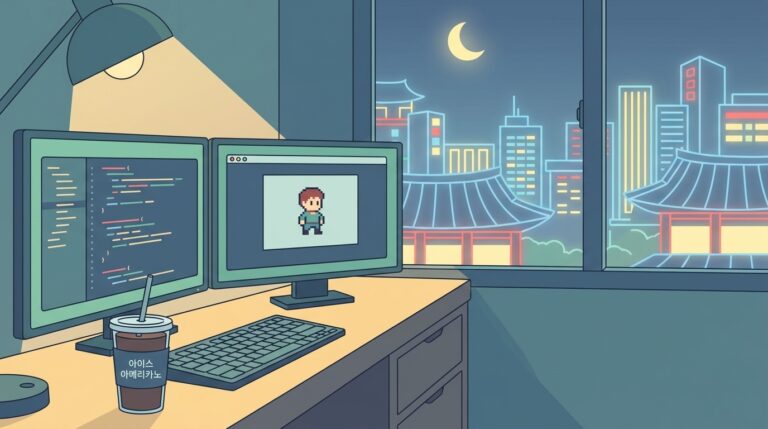
Picture this: It’s 2:00 AM on a Friday in a small, neon-lit studio in Pangyo, the heart of South Korea’s IT and gaming industry. The desk is piled high with empty iced Americano cups. You and your indie dev team have just squashed the final game-breaking bug. Tomorrow, you are pitching this passion project to a major Korean game publisher. You’ve mastered the code, but when the publisher asks about your development process or your business model, textbook Korean like “우리는 열심히 일했습니다” (We worked hard) just won’t cut it. It sounds… robotic.
To survive in Korea’s fiercely competitive indie game and eSports ecosystem, you need to speak the language of the trenches. Whether you are aiming to launch your indie title on Steam, secure a publishing deal in Seoul, or just connect with Korean gamers on Discord, mastering the industry’s real-life jargon is your ultimate cheat code.
This guide isn’t just from a textbook—it’s built from the late-night crunches, the victorious pitch meetings, and the questions advanced (C1) learners like you have asked me over the years. Let’s level up your Korean!
Phase 2: Core Expressions Deep Dive
Here are the top expressions you need when developing and publishing a game in Korea.
1. 영혼을 갈아 넣다
- Pronunciation: Yeonghoneul gara neota [young-hone-eul gah-lah nuh-tah]
- Meaning: Literal: To grind one’s soul and put it in. Real Nuance: To pour your blood, sweat, and tears into a project; to crunch incredibly hard.
- K-Culture Moment: This is the ultimate badge of honor (and exhaustion) for Korean creators. If you watch a documentary about K-Pop idol training or a K-Drama about tech startups (like Start-Up), you’ll feel this vibe. In the indie game scene, developers use this to humbly brag about the insane amount of effort they put into their game’s pixel art or coding.
- Editor’s Insight: It carries a mix of pride, exhaustion, and self-deprecating humor. It’s much more evocative and human than simply saying “I worked hard.”
- Situation Spectrum:
- Casual with Dev Friends: ✅
- Semi-formal with a Publisher (to show passion): ⚠️ (Use politely: 영혼을 갈아 넣었습니다)
- Highly formal boardroom: 🚫
- 🤔 Think About It: Why does the Korean language use such intense, almost violent imagery (“grinding one’s soul”) to describe hard work? Does your native language have a similarly dramatic way to describe “crunch culture”?
2. 입소문을 타다
- Pronunciation: Ipsomuneul tada [ip-so-moon-eul tah-dah]
- Meaning: Literal: To ride the mouth-rumor. Real Nuance: To go viral via word-of-mouth.
- K-Culture Moment: Indie games usually lack massive marketing budgets. Their survival depends entirely on “입소문” (word of mouth) among Korean gaming communities like Inven or Ruliweb. When a famous Korean Twitch streamer plays a hidden gem and it suddenly spikes on Steam, developers celebrate because the game is finally “입소문을 탔다.”
- Editor’s Insight: Use this when discussing your marketing strategy or celebrating unexpected organic growth.
- Situation Spectrum:
- Casual: ✅
- Semi-formal: ✅
- Formal: ✅ (Very standard business term)
- 🤔 Think About It: “입소문” combines “입” (mouth) and “소문” (rumor). How do modern digital trends (like going viral on TikTok/YouTube) change the traditional meaning of “word of mouth” in Korea?
3. 버그를 잡다
- Pronunciation: Beogeureul japda [buh-geu-reul jap-dah]
- Meaning: Literal: To catch a bug. Real Nuance: To fix bugs / debugging.
- K-Culture Moment: You’ll hear this constantly in PC Bangs (internet cafes) or dev studios. While “디버깅” (debugging – Konglish) is widely used, “버그를 잡다” feels much more hands-on and colloquial. It’s like you are physically hunting down the errors in your code.
- Editor’s Insight: Action verbs are very important in Korean. Instead of saying “I fixed it” (고쳤다), saying “I caught it” (잡았다) implies a successful hunt, adding a layer of active accomplishment.
- Situation Spectrum:
- Casual: ✅
- Semi-formal: ✅
- Formal: ✅
- 🤔 Think About It: In English, we “squash” or “fix” bugs. In Korean, you “catch” (잡다) them. How does the choice of verb change the psychological approach to problem-solving?
Phase 3: Textbook vs. Real Korean
[Explaining Your Game’s Success]
* 📖 Textbook Korean: 우리 게임은 인기가 많습니다. (Our game is very popular.)
* 🗣️ Real Korean: 유저들 사이에서 반응이 완전 떡상했어요. (The response among users completely skyrocketed.)
* 💡 Why the difference?: “떡상” (skyrocketing) originated in the crypto/stock market but is now heavily used in youth and gaming culture to describe anything rapidly gaining popularity.
[Discussing the Release]
* 📖 Textbook Korean: 게임을 발매할 예정입니다. (We plan to release the game.)
* 🗣️ Real Korean: 다음 달에 스팀 얼리 액세스로 런칭해요. (We are launching it on Steam Early Access next month.)
* 💡 Why the difference?: The Korean IT/Gaming industry heavily borrows from English. Terms like “런칭” (launching), “얼리 액세스” (early access), and “업뎃” (update) are industry standards over pure Korean equivalents.
[Describing the Workload]
* 📖 Textbook Korean: 저희 팀은 밤늦게까지 열심히 일했습니다. (Our team worked hard until late at night.)
* 🗣️ Real Korean: 진짜 팀원들 영혼까지 갈아 넣어서 만들었어요. (We literally poured our team’s souls into making this.)
* 💡 Why the difference?: Emphasizing the sacrificial effort appeals to the Korean emotional concept of “정” (jeong) and shared struggle, making your pitch much more compelling.
Phase 4: Cultural Context — K-Culture Deep Dive
4-1. Non-Verbal Elements: Reading the Publisher’s “Nunchi”
In Korean business, Nunchi (눈치) is everything. When pitching your game to a publisher, watch their micro-expressions. If they suck air through their teeth and say, “아… 그건 좀…” (Ah… that’s a bit…), it’s a polite “No.” Also, always hand over your business card or a USB drive containing your game build with two hands. It instantly shows you respect Korean professional etiquette.
4-2. K-Culture Link: The PC Bang Playtest
If you want to know if your game will survive the Korean market, don’t test it in an isolated room—take it to a PC Bang. The PC Bang is the true colosseum of Korean eSports. It’s loud, fast-paced, and gamers there have zero patience for bad UI or slow tutorials. In Korean dramas, you often see characters ordering instant noodles and shouting at their screens in a PC Bang. This hyper-competitive, fast-consuming environment shapes why Korean indie games often prioritize incredibly tight gameplay loops and immediate visual feedback.
Phase 5: Real-Life Roleplay Scenario
Setting: 3:00 PM on a Tuesday. A sleek, minimalist café in Pangyo Techno Valley. You are sitting across from a Publishing Team Leader from a mid-sized Korean game company. You are pitching your new 2D action rogue-lite game.
Characters:
– YOU: Lead Developer of a small indie studio, fluent in English but navigating the Korean business world.
– Team Leader Kim (NPC): 40 years old, sharp, analytical, looking for the next big hit. Respectful but direct.
Dialogue:
Kim: 데모 버전 잘 해봤습니다. 타격감이 아주 좋던데요?
(Demo beojeon jal haebwatseumnida. Tagyeokgami aju joteondeyo?)
[I played the demo well. The hit-feeling (combat impact) is really good.]
(🎭 Stage Direction: Kim sips his iced Americano, looking impressed.)
YOU: 감사합니다. 팀원들이 정말 영혼을 갈아 넣어서 액션을 다듬었어요.
(Gamsahamnida. Timwondeuri jeongmal yeonghoneul gara neoeoseo aeksyeoneul dadeumeosseoyo.)
[Thank you. The team really poured their souls into polishing the action.]
Kim: 그게 보이네요. 그런데, BM(비즈니스 모델)은 어떻게 생각하고 계신가요?
(Geuge boineyo. Geureonde, BM-eun eotteoke saenggakago gyesingayo?)
[It shows. By the way, what are your thoughts on the Business Model (BM)?]
YOU: 과금 유도보다는 게임 패키지 판매로 갈 생각입니다.
(Gwageum yudobodaneun geim paekiji panmaero gal saenggagimnida.)
[Rather than inducing microtransactions, we plan to go with premium package sales.]
Kim: 그렇군요. 인디 씬에서는 그게 낫죠. 남은 버그 잡는 데는 얼마나 걸릴까요?
(Geureokunyo. Indi ssineseoneun geuge natjyo. Nameun beogeo jamneun deneun eolmana geollilkkayo?)
[I see. That’s better in the indie scene. How long will it take to catch the remaining bugs?]
🔀 Your Turn! How do you respond?
– A) “다 끝났습니다. 완벽합니다.” (It’s all finished. It’s perfect.)
– B) “거의 다 잡았고, 다음 달이면 폴리싱까지 끝납니다.” (We caught almost all of them, and polishing will be done by next month.)
– C) “버그가 너무 많아서 미치겠어요 ㅠㅠ” (There are so many bugs, it’s driving me crazy T_T)✅ Best Choice: B — It’s honest, professional, and uses great industry jargon (잡다, 폴리싱).
⚠️ Choice C Analysis: A bit too casual and self-deprecating for a pitch meeting. Save this for venting to your dev friends!
YOU: 거의 다 잡았고, 다음 달이면 폴리싱까지 끝납니다.
(Geoui da jabatgo, daeum darimyeon pollisingkkaji kkeunnamnida.)
[We caught almost all of them, and polishing will be done by next month.]
Kim: 좋습니다. 일정은 꽤 타이트하지만 해볼 만하네요.
(Joseumnida. Iljeongeun kkwae taiteuhajiman haebol manhhaeyo.)
[Good. The schedule is quite tight, but it’s doable.]
YOU: 네, 유저들 사이에서 빨리 입소문을 탔으면 좋겠어요.
(Ne, yujeodeul saieseo ppalli ipsomuneul tasseumyeon jokesseoyo.)
[Yes, I hope it quickly rides the word-of-mouth among users.]
Kim: 저희가 퍼블리싱을 맡게 되면, 마케팅은 걱정 안 하셔도 됩니다. 다음 주에 계약서 초안 보내드릴게요.
(Jeohuiga peobeullising-eul matge doemyeon, maketing-eun geokjeong an hasyeodo doemnida. Daeum jue gyeyakseo choan bonaedeurilgeyo.)
[If we take on the publishing, you don’t have to worry about marketing. I’ll send you a draft contract next week.]
YOU: 정말 감사합니다. 긍정적으로 검토해 보겠습니다!
(Jeongmal gamsahamnida. Geungjeongjeogeuro geomtohae bogetseumnida!)
[Thank you so much. We will review it positively!]
Phase 6: 10-Second Shadowing Drill
Read this aloud. Focus on the pauses (/) and the emotion tags!
😤 저희 팀이 / 이번 인디 게임에 / 제 영혼을 / 쫙~~~ 갈아 넣었습니다!
(jeohui timi / ibeon indi geime / je yeonghoneul / jjwakk~~~ gara neoeotseumnida!)
[Our team completely poured our souls into this indie game!]
Phase 7: K-Culture Mini Dictionary
1. 판교 (Pangyo)
* Romanization: Pangyo
* English: South Korea’s Silicon Valley
* Context: A city just south of Seoul that houses the HQs of massive gaming giants (Nexon, NCSoft, Kakao Games) and countless indie studios.
2. 과금 (Gwageum)
* Romanization: Gwageum
* English: In-app purchases / Microtransactions
* Context: A highly debated topic in Korean gaming. “무과금” (Mu-gwageum) means a player who spends zero money, while “핵과금” (Haek-gwageum) refers to whales.
3. 타격감 (Tagyeokgam)
* Romanization: Tagyeokgam
* English: Hit feeling / Impact feedback
* Context: A crucial evaluation metric for Korean gamers. It describes how satisfying it feels to hit an enemy (screen shake, sound effects, hit pauses).
4. 존버 (Jonbeo)
* Romanization: Jonbeo
* English: Holding on desperately / Diamond hands
* Context: Originally slang for enduring hardship. Indie devs use this when surviving on instant ramen, hoping their game eventually succeeds.
Phase 8: Traveler’s Survival Kit (Gaming Convention Edition)
If you are visiting Korea to attend G-Star (Busan) or PlayX4 (Ilsan) to showcase your indie game, you need these survival phrases!
🆘 Survival Phrase #1
– 🇰🇷 “B2B 부스가 어디에 있나요?” (B-to-B buseuga eodie innayo?)
– 🗣️ English Sound: [bee-too-bee boo-seu-gah uh-dee-eh in-nah-yo?]
– 📍 Where to use: At the convention center information desk.🆘 Survival Phrase #2
– 🇰🇷 “명함 하나 주실 수 있나요?” (Myeongham hana jusil su innayo?)
– 🗣️ English Sound: [myoung-ham ha-nah joo-shil soo in-nah-yo?]
– 📍 Where to use: Asking for a business card after a quick pitch.🆘 Survival Phrase #3
– 🇰🇷 “데모 플레이 해보시겠어요?” (Demo peullei haebosigesseoyo?)
– 🗣️ English Sound: [deh-mo puhl-lay hae-bo-she-guess-uh-yo?]
– 📍 Where to use: Inviting a passerby or publisher to try your game.📌 Editor’s Travel Note
– Navigating G-Star: G-Star in Busan is massive. Use Naver Map or KakaoMap (Google Maps doesn’t work well for walking/transit in Korea).
– Networking: Korean professionals still heavily rely on physical business cards (명함). Bring a thick stack. Hand them out and receive them with two hands, and take a second to read the card before putting it away!
Phase 9: Critical Thinking — “One Step Deeper”
Global Era: Konglish in the Korean Dev Scene
🧠 Think Deeper:
If you walk into a Korean game studio, you’ll hear English words disguised as Korean: 런칭 (Launching), 픽스 (Fix), 디버깅 (Debugging), 유저 (User). Because programming languages and early game dev resources were predominantly in English, the Korean IT ecosystem adapted by absorbing these terms. However, they’ve taken on local nuances. For example, a “유저” (User) in Korea is treated almost with the reverence of a demanding customer, deeply reflecting Korea’s fast-paced, highly responsive service culture. Are these loanwords polluting the pure Korean language, or are they natural linguistic evolutions in a globalized industry?💬 Your Turn: Does your native language borrow heavily from English in the tech or gaming sectors? How does the older generation view this? Let me know in the comments!
Phase 10: FAQ & Avoiding Misunderstandings
Q: Can I use “영혼을 갈아 넣다” in a formal cover letter to a Korean gaming company?
A: Maybe, but be careful. While it shows passion, it is technically an informal idiom. For a highly formal cover letter, it’s safer to write “온 열정을 다해 개발에 임했습니다” (I approached the development with all my passion). Reserve the “grinding soul” phrase for the interview room to show a flash of industry wit!
Q: Is it okay to use 반말 (informal language) with players in my game’s Discord server?
A: No! Even though gamers talk casually to each other, as a developer (the official representative), you must maintain professional distance using 존댓말 (polite/formal language). Using 반말 can be seen as arrogant or disrespectful to your consumer base.
❌ Common Mistake #1: Calling the publisher “당신” (Dangsin – You).
✅ Do This Instead: “당신” is highly confrontational or overly romantic in Korean. Always address business partners by their title. e.g., “팀장님” (Team Leader Kim) or “대표님” (CEO).
Phase 11: Summary & Action Items
One-Liner Summary: To pitch your indie game like a local, prove your dedication by “pouring your soul into it” (영혼을 갈아 넣다) and aim for that viral “word of mouth” (입소문).
Your Action Missions:
– 🥉 Bronze: Look in the mirror and practice saying “영혼을 갈아 넣었습니다!” with true exhausted passion.
– 🥈 Silver: Go to a Korean indie game forum or Steam page and try to spot the word “버그” or “입소문” in the reviews.
– 🥇 Gold: Use one of the survival phrases with a Korean gamer, developer, or even a local publisher!
K-Culture Mission (Gaming Edition):
Log into Steam, find a popular Korean indie game (like Skul: The Hero Slayer or Dave the Diver), switch the review language to Korean, and analyze how real players describe the “타격감” (hit feeling) or complain about the bugs!
Did you ever stay up all night catching a bug? Share your “crunch” story in the comments using today’s expressions!
Phase 12: Quiz — Interactive Challenge
Q1. (Situational) Your indie game just got featured by a massive Korean YouTuber, and sales are through the roof. What is the most natural way to describe this?
1. 게임을 많이 팔았습니다. (Sold a lot of games.)
2. 입소문을 타고 완전 떡상했어요! (Riding word of mouth, it completely skyrocketed!)
3. 버그를 다 잡았습니다. (Caught all the bugs.)
Q2. (T/F – K-Culture) In Korea, if you are pitching to a publisher, you should maintain strong, unblinking eye contact to show dominance and confidence.
True or False?
Q3. Fill in the blank:
“이번 프로젝트에 제 _____을(를) 갈아 넣었어요.”
(Hint: You put your ‘soul’ into it.)
🚨 Click here for the answers!
Q1: 2번. While 1 is grammatically correct, 2 is exactly how a Korean dev would celebrate a viral hit.
Q2: False. While eye contact is good, maintaining unblinking, aggressive eye contact with someone older or higher in status is considered rude in Korea. Soften your gaze and read the room (Nunchi!).
Q3: 영혼 (Yeonghon)
Frequently Asked Questions (FAQ)
Q: What does "영혼을 갈아 넣다" mean in Korean and how do you pronounce it?
A: In Korean, "영혼을 갈아 넣다" is pronounced [Yeonghoneul gara neota [young-hone-eul gah-lah nuh-tah] and means: Literal: To grind one's soul and put it in. Real Nuance: To pour your blood, sweat, and tears into a project; to crunch incredibly hard.
Q: What does "입소문을 타다" mean in Korean and how do you pronounce it?
A: In Korean, "입소문을 타다" is pronounced [Ipsomuneul tada [ip-so-moon-eul tah-dah] and means: Literal: To ride the mouth-rumor. Real Nuance: To go viral via word-of-mouth.
Q: What does "버그를 잡다" mean in Korean and how do you pronounce it?
A: In Korean, "버그를 잡다" is pronounced [Beogeureul japda [buh-geu-reul jap-dah] and means: Literal: To catch a bug. Real Nuance: To fix bugs / debugging.







