

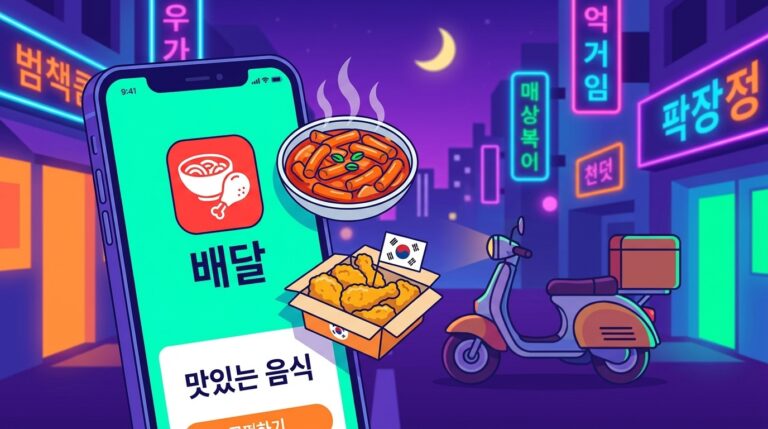
Hello! I’m the lead editor of Daily Hangul, your veteran tutor and local culture navigator.
Imagine this: It’s 11 PM on a Friday. In your favorite K-Drama, the exhausted protagonist flops onto the couch, taps their smartphone a few times, and bam—20 minutes later, crispy fried chicken and an ice-cold beer (Chimaek) arrive at their door. You might be thinking, “Wow, I want to do that in Korea!”
But then, you open a Korean delivery app like Baemin (배달의민족) or Yogiyo (요기요), and panic sets in. What is this endless list of options? What does “문 앞에 두고 가주세요” mean? What if the rider calls me?
Don’t worry! This guide is built from the literal SOS messages of my foreign students who were trapped in their Seoul Airbnbs, craving Tteokbokki but too intimidated by the app to order. Today, we’re going to decode the Korean delivery culture so you can order midnight snacks (야식 – Yasik) like a true local.
Phase 2: Core Expressions Deep Dive
Let’s break down the most crucial phrases you need to conquer the delivery app.
1. 문 앞에 두고 벨 눌러주세요
- Pronunciation: mun ape dugo bel nulleojuseyo. [moon ah-pay doo-go bel nool-luh-joo-say-yo]
- Meaning: Please leave it at the door and ring the bell. (Literal: Door front leave and bell press please.)
- K-Culture Moment: This is the default “Contactless Delivery” option. Whether you are in your pajamas, doing a face mask, or just feeling introverted after a long day of K-Pop concerts, this is your magic spell.
- Editor’s Insight: You just select this option from a drop-down menu in the app. You don’t even have to say it out loud! It reflects the deep trust in Korean society—nobody will steal your chicken.
- Situation Spectrum:
- App Request Note: ✅
- Face-to-Face: 🚫 (It implies you aren’t there!)
- 🤔 Think About It: Why is contactless delivery so common and trusted in Korea? Does your home country have a similar level of trust with unattended packages?
2. 리뷰 이벤트 참여할게요!
- Pronunciation: ribyu ibenteu chamyeohalgeyo! [ree-byoo ee-ben-teu cha-myuh-hal-gay-yo]
- Meaning: I will participate in the review event!
- K-Culture Moment: Korean delivery is fiercely competitive. To survive, restaurants offer free “Service” (서비스 – freebies like extra cheese balls or drinks) if you promise to leave a 5-star photo review.
- Editor’s Insight: You write this in the “Request to Restaurant” (사장님께) box. If you write this and don’t actually leave a review… well, nothing illegal happens, but you lose your “K-Nunchi” karma!
- Situation Spectrum:
- App Request Note: ✅
- 🤔 Think About It: How does this “Review Event” culture reflect the extreme competitiveness of the Korean food service industry?
3. 현장 결제 할게요
- Pronunciation: hyeonjang gyeolje halgeyo. [hyun-jang gyul-jay hal-gay-yo]
- Meaning: I will pay in person (on-site).
- K-Culture Moment: As a traveler, you might not have a Korean bank account linked to the app. Choosing “만나서 결제” (Meet and pay) or “현장 결제” allows you to hand your physical credit card or cash to the delivery rider.
- Editor’s Insight: When the rider arrives, they will pull out a mini card reader. Just insert your card!
- Situation Spectrum:
- App Payment Option: ✅
- Giving instructions over the phone: ✅
- 🤔 Think About It: Korea is essentially a cashless society now. How do you feel about paying everything with just a few taps on your phone versus using physical cards?
Phase 3: Textbook vs. Real Korean
- [Situation 1: Asking for extra side dishes]
- 📖 Textbook Korean: 단무지를 하나 더 주실 수 있습니까? (Could you please give me one more pickled radish?)
- 🗣️ Real Korean: 단무지 많이 주세요~ (Radish a lot please~)
- 💡 Why is it different?: In app request boxes, Koreans prioritize cuteness and brevity. Adding a tilde (~) softens the command so it doesn’t sound rude to the owner.
- [Situation 2: Telling the rider where you are]
- 📖 Textbook Korean: 배달원 선생님, 저는 지금 1층 로비에 있습니다. (Mr. Deliveryman, I am currently in the first-floor lobby.)
- 🗣️ Real Korean: 1층 로비요! (1st-floor lobby!)
- 💡 Why is it different?: “Pali-pali” (hurry, hurry) culture! Riders are always on the clock. Keep it brief and precise.
Bottom Note: For B1 learners, using “~주세요” (Please give me~) is the perfect balance of polite and natural.
Phase 4: Cultural Context — K-Culture Deep Dive
4-1. Non-verbal Etiquette in Apps
When leaving notes on apps, Koreans often use cute text emojis like ㅎㅎ (haha) or ㅠㅠ (crying) to show politeness. If you just write “치킨 무 줘” (Give chicken radish), you sound angry. Write “치킨 무 많이 부탁드려요~ ㅎㅎ” and you might get a free soda with it! That’s text-based Nunchi (눈치).
4-2. The “Service” (서비스) Culture in K-Food
Have you ever watched a K-Drama where the restaurant owner brings out an extra plate of egg rolls and says, “This is Service”? This offline culture has migrated to delivery apps through “Review Events.” It’s a beautiful transactional relationship of Jeong (정 – affection). The owner gives you free cheese balls, and in return, you write a glowing review with mouth-watering photos.
Phase 5: Real-Life Roleplay Scenario
Setting: It’s Saturday night, 11 PM. You are chilling in a cozy Airbnb in Hongdae with your Korean friend, Minji. You’re both watching a K-Drama, and suddenly, the characters start eating Tteokbokki. Your stomach growls.
Characters:
– YOU: A B1 Korean learner, eager to try ordering food yourself.
– Minji (28): Your helpful, food-loving Korean friend.
Dialogue:
Minji: 아, 배고파. 우리 야식 시켜 먹을까? 떡볶이 어때?
(a, baegopa. uri yasik sikyeo meogeulkka? tteokbokki eottae?)
[Ah, I’m hungry. Should we order a midnight snack? How about Tteokbokki?]
YOU: 좋아요! 제가 배달 앱으로 해볼게요.
(joayo! jega baedal aebeuro haebolgeyo.)
[Sounds good! I’ll try doing it with the delivery app.]
(🎭 Stage Direction: You confidently open the Baemin app, but immediately get confused by the options.)
Minji: 오~ 멋진데? 여기 ‘엽기떡볶이’ 시키자. 매운맛은 뭘로 할래?
(o~ meotjinde? yeogi ‘yeopgitteokbokki’ sikija. maeunmaseun mwollo hallae?)
[Oh~ cool! Let’s order ‘Yupdduk’ here. What spice level do you want?]
YOU: 음… ‘착한맛’으로 할게요. 너무 매운 건 못 먹어요.
(eum… ‘chakhanmaseuro’ halgeyo. neomu maeun geon mot meogeoyo.)
[Hmm… I’ll do ‘Mild flavor’ (Literally: Kind flavor). I can’t eat things that are too spicy.]
Minji: 그래. 어, 잠깐만! 여기 리뷰 이벤트 있다.
(geurae. eo, jamkkanman! yeogi ribyu ibenteu itda.)
[Okay. Oh, wait! There’s a review event here.]
YOU: 리뷰 이벤트요? 그게 뭐예요?
(ribyu ibenteuyo? geuge mwoyeyo?)
[A review event? What is that?]
Minji: 리뷰 쓰면 서비스 주는 거야. 사장님한테 메시지 남겨야 돼. 뭐라고 쓸래?
(ribyu sseumyeon seobiseu juneun geoya. sajangnimhante mesiji namgyeoya dwae. mworago sseullae?)
[If you write a review, they give you free service. You have to leave a message for the owner. What will you write?]
🔀 Your Turn! How should you respond?
– A) “리뷰 쓰겠습니다. 당면 주세요.”
– B) “리뷰 이벤트 참여할게요! 쿨피스 부탁드려요~ ㅎㅎ”
– C) “서비스 내놔요!”✅ Best Choice: B — It has the exact right phrasing, ends with a polite and cute “~주세요~”, and includes a text emoji (ㅎㅎ) for extra friendliness.
⚠️ Choice A Analysis: A bit too robotic and formal, like a soldier ordering food.
🚫 Choice C Analysis: This means “Hand over the service!” You will definitely not get your food if you write this.
Minji: 완벽해! 이제 결제만 하면 돼.
(wanbyeokhae! ije gyeoljeman hamyeon dwae.)
[Perfect! Now we just need to pay.]
YOU: 저는 한국 카드가 없어요. ‘현장 결제’ 할게요!
(jeoneun hanguk kadeuga eopseoyo. ‘hyeonjang gyeolje’ halgeyo!)
[I don’t have a Korean card. I’ll do ‘Pay in person’!]
Minji: 오, 똑똑한데? 40분 걸린대. 드라마나 계속 보자!
(o, ttokttokhande? sasipbun geollindae. deuramana gyesok boja!)
[Oh, smart! It says it’ll take 40 minutes. Let’s keep watching the drama!]
Phase 6: 10-Second Shadowing Drill
Let’s practice the magic phrase to get those sweet freebies. Listen to the rhythm!
😊 사장님~ / 리뷰 이벤트 / 참여할게요! / 쿨피스 / 부탁드려요~ ㅎㅎ
(sa-jang-nim~ / ri-byu i-ben-teu / cha-myeo-hal-ge-yo! / kul-pi-seu / bu-tak-deu-ryeo-yo~)
- Intonation: Raise your pitch slightly at the
~to sound friendly. - Emotion: 😊 Friendly, slightly excited for the free drink!
Phase 7: K-Culture Mini Dictionary
1. 야식
* Romanization: yasik
* English: Late-night snack
* Context: Korea comes alive at night. Ordering Yasik (like bossam, chicken, or jokbal) around 10 PM to midnight is a cherished bonding activity with friends or family.
2. 서비스
* Romanization: seobiseu
* English: On the house / Freebie
* Context: In Korea, “service” doesn’t mean waitstaff hospitality; it means complimentary food given to show appreciation to customers.
3. 라이더
* Romanization: raideo
* English: Delivery driver
* Context: The heroes of the “Pali-pali” culture. You’ll see their scooters zipping through Seoul traffic at all hours to ensure your food arrives hot.
4. 최소주문금액
* Romanization: choesojumungeumaek
* English: Minimum order amount
* Context: You usually can’t just order one kimbap. Apps require a minimum spend (usually around 12,000 KRW to 18,000 KRW) for delivery to be viable.
Phase 8: Traveler Survival Kit
If you are traveling in Korea, you might not have an Alien Registration Card (ARC) to verify an app account. Here is your survival kit!
🆘 Survival Expression #1: “현장 결제 할게요”
– 🇰🇷 현장 결제 할게요 (hyeonjang gyeolje halgeyo)
– 🗣️ English Guide: I will pay on-site.
– 📍 Where to use: App checkout screen or over the phone.
– 💡 Pro Tip: Select “만나서 결제” (Meet to pay) in the app so you can use your foreign credit card or cash when the rider arrives.🆘 Survival Expression #2: “로비로 나와주세요”
– 🇰🇷 1층 로비로 갈게요 (ilcheung robiro galgeyo)
– 🗣️ English Guide: I will go to the 1st-floor lobby.
– 📍 Where to use: Hotels.
– 💡 Pro Tip: Most Korean hotels do not allow delivery riders to go up to guest rooms for security reasons. You must go down to the lobby or the designated delivery pickup zone to get your food.📌 Editor’s Travel Note
– Useful Apps: Yogiyo (요기요) is slightly more foreigner-friendly than Baemin because it often allows ordering without a strict phone number verification if you use certain payment methods. There is also an English delivery app called Shuttle, which is great for expats!
– Tipping Culture: Do NOT tip the delivery driver. Delivery fees (배달비) are already included in the app, and tipping is not a part of Korean culture. They might get confused and try to give your money back!
Phase 9: Critical Thinking Corner — “A Step Deeper”
🧠 Think Deeper: Food & Identity (음식과 정체성)
Historically, Korean food culture is entirely based on sharing—big pots of stew in the middle of the table, sharing side dishes, and eating as a community. However, the explosive growth of delivery apps reflects a massive shift in Korean society: the rise of the “Hon-jok” (혼족 – solo living tribe). Yet, ironically, the menus on these apps are still heavily skewed towards “Sets” meant for 2-3 people. It shows a society in transition, balancing the deep-rooted desire to share a meal (Jeong) with the modern reality of living alone.
💬 Your Turn: Does your country have a big food delivery culture? How has it changed the way people socialize and eat? Share in the comments!
Phase 10: FAQ & Avoiding Mistakes
Q: Can I really order food to the Han River park?
Yes! But you can’t just put “Han River” as your address. You must find the designated “Delivery Zones” (배달존 – Baedal Zone) in the park, order it there, and wait for the rider.
Q: What if the rider calls me and speaks super fast Korean?
Don’t panic. Just say: “한국어 잘 못해요. 로비에 두고 가주세요.” (I don’t speak Korean well. Please leave it at the lobby.) Usually, they just want to know if they can leave it at the door.
❌ Common Mistake #1: Waiting outside the door for the driver when you selected “문 앞에 두고 가주세요” (Leave at door).
✅ Do this instead: Stay inside! Wait until you hear the app notification chime or the doorbell ring, give them 10 seconds to leave, and then retrieve your food like a ninja.
Phase 11: Summary & Action Items
- One-Liner Summary: Conquer Korean delivery apps by mastering “Contactless Delivery” (문 앞에 놔주세요), “In-person Payment” (현장 결제), and scoring freebies with “Review Events” (리뷰 이벤트).
Action Mission 3 Steps:
– 🥉 Bronze (Solo): Practice saying “리뷰 이벤트 참여할게요!” with a big smile three times.
– 🥈 Silver (Online): Download Baemin or Yogiyo, put in your hotel address, and see if you can navigate to the checkout page!
– 🥇 Gold (Real Life): Order a late-night snack tonight using “현장 결제” (Pay in person) and successfully get your food from the rider!
K-Culture Mission:
Next time you watch a K-Drama, count how many times the characters eat delivery food (especially fried chicken or jajangmyeon). What’s the situation? Are they celebrating, or are they depressed?
Phase 12: Quiz — Interactive Challenge
1. Situational Judgment:
You are staying at a hotel in Seoul. Your chicken arrives. What should you do?
– A) Tell the rider your room number and wait in bed.
– B) Wait in the lobby to receive it.
– C) Ask the front desk receptionist to pay for it.
Answer: B! Delivery drivers are generally not allowed past hotel lobbies in Korea.
2. Fill in the Blank:
If you want free cheese balls, you must promise to leave a good review. In the request box, you type:
“사장님, __________________ 참여할게요! ㅎㅎ”
Answer: 리뷰 이벤트 (Review Event)
3. True or False – K-Culture Edition:
“You should prepare a 10% tip in cash for the delivery rider when they arrive.”
Answer: False! There is absolutely zero tipping culture in Korea. The delivery fee is already calculated in the app.
Frequently Asked Questions (FAQ)
Q: What does "문 앞에 두고 벨 눌러주세요" mean in Korean and how do you pronounce it?
A: In Korean, "문 앞에 두고 벨 눌러주세요" is pronounced [mun ape dugo bel nulleojuseyo. [moon ah-pay doo-go bel nool-luh-joo-say-yo] and means: Please leave it at the door and ring the bell. (Literal: Door front leave and bell press please.)
Q: What does "리뷰 이벤트 참여할게요!" mean in Korean and how do you pronounce it?
A: In Korean, "리뷰 이벤트 참여할게요!" is pronounced [ribyu ibenteu chamyeohalgeyo! [ree-byoo ee-ben-teu cha-myuh-hal-gay-yo] and means: I will participate in the review event!
Q: What does "현장 결제 할게요" mean in Korean and how do you pronounce it?
A: In Korean, "현장 결제 할게요" is pronounced [hyeonjang gyeolje halgeyo. [hyun-jang gyul-jay hal-gay-yo] and means: I will pay in person (on-site).







