

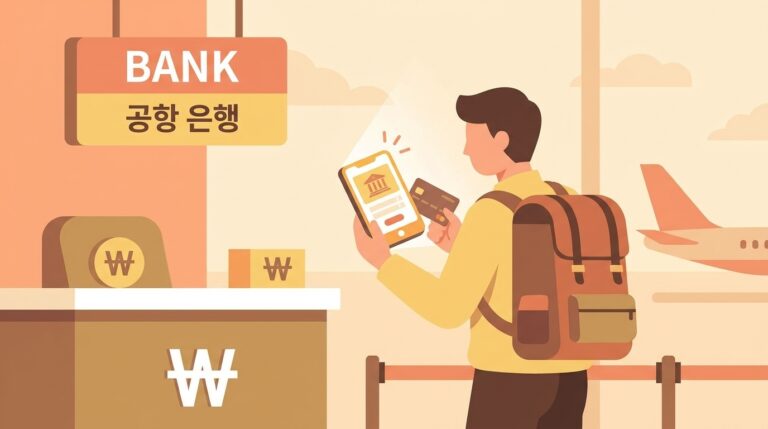
Phase 1: Empathy (The Immersive Cold Open)
Hello! I’m the Senior Editor at Daily Hangul.
Imagine this: You’ve just landed at Incheon International Airport. The sleek, futuristic architecture welcomes you, and you’re ready to start your Korean adventure. You’ve done your homework. You know that Korea is rapidly becoming a cashless society, and you’ve got your “Travel Wallet” card ready. You’ve even downloaded a “90% exchange rate preferential coupon” (환전 우대 쿠폰) on your phone to get the best bang for your buck.
But as you step up to the pristine bank counter, the teller fires off a rapid sequence of high-level financial terms. Your textbook taught you “돈을 바꾸고 싶습니다” (I want to exchange money), but suddenly you’re hearing words like udae, myeonje, and chungjeon.
If you don’t know the precise phrasing, you might miss out on that 90% discount, or worse, find yourself fumbling at a convenience store when your travel card doesn’t work. For an advanced (C2) learner, simply surviving isn’t enough—you want to navigate these situations with the smooth efficiency of a Seoul local.
Everything in this guide is based on real struggles from expats and seasoned travelers navigating Korea’s cutting-edge fintech landscape. Let’s bridge the gap between textbook survival Korean and real-world fluency.
Phase 2: Core Expression Deep Dive
1. 환율 우대 쿠폰 적용해 주세요
- Pronunciation: [Hwanyul udae kupon jeogyonghae juseyo] + [Hwan-yool oo-deh koo-pon jug-yong-heh joo-seh-yo]
- Meaning: Literal: “Please apply the exchange rate preferential coupon.” / Real nuance: “Can I get the discount on the exchange rate spread using this coupon?”
- K-Culture Moment: Picture a sleek K-Drama where the sharp-suited chaebol executive handles millions, but even everyday Koreans love a good udae (VIP treatment/preference). You’ll hear this at airport banks when savvy travelers flash their smartphone screens to the tellers.
- Editor’s Insight: The word 우대 (優待) translates to “preferential treatment.” In Korean banking, they don’t say “discount” (할인) for currency exchange; they treat you like a VIP by offering a “preferential rate.” Knowing this specific noun instantly elevates your Korean from a tourist level to a resident level.
- Situation Spectrum:
- Casual with friends: ⚠️ (Friends don’t apply coupons to each other)
- Bank Teller / Service Worker (Polite formal): ✅
- High-level Business Meeting: 🚫
- 🤔 Think About It: Why does Korean banking vocabulary use terms associated with “privilege” (udae) rather than simple “discounts”? How does this reflect the traditional Korean emphasis on customer service and saving face?
2. 트래블 월렛에 외화 충전할게요
- Pronunciation: [Teuraebeul wollet-e oehwa chungjeonhalgeyo] + [Teu-reh-ble wall-let-eh weh-hwa choong-jun-hal-geh-yo]
- Meaning: Literal: “I will charge foreign currency to my Travel Wallet.” / Real nuance: “I want to top up my Travel Wallet card with foreign currency.”
- K-Culture Moment: You’re standing outside a vibrant Myeongdong street food stall that surprisingly accepts cards. You quickly open your banking app to “recharge” your digital wallet. This is the modern Korean traveler’s reflex.
- Editor’s Insight: In English, we “top up” or “load” a card. In Korean, the verb is 충전하다 (to charge), the exact same word used for charging a smartphone battery. In Korea’s hyper-digital ecosystem, your digital wallet is treated just like a battery that needs juice.
- Situation Spectrum:
- Casual/Thinking out loud: ✅
- Convenience Store Staff: ✅
- Formal Presentation: ⚠️
- 🤔 Think About It: The integration of English loanwords like “Travel Wallet” with Sino-Korean words like “oehwa” (foreign currency) and “chungjeon” (charge) is everywhere. How does your native language handle new fintech concepts?
3. 수수료 면제되나요?
- Pronunciation: [Susuryo myeonjedeo-nayo?] + [Soo-soo-ryo myun-jeh-dweh-na-yo?]
- Meaning: Literal: “Is the commission fee exempted?” / Real nuance: “Are there any foreign transaction/withdrawal fees?”
- K-Culture Moment: Whenever Koreans travel abroad, the hottest topic on Naver Travel Cafes is how to avoid ATM fees. This phrase is the golden ticket to keeping your hard-earned cash.
- Editor’s Insight: While beginners might ask “수수료 없어요?” (Is there no fee?), a C2 speaker uses 면제 (exemption). It shows you understand the system—there is a fee, but you are asking if it is waived for you.
- Situation Spectrum:
- Casual/Friends: 🚫
- Bank/Service Desk: ✅
- Business Context: ✅
- 🤔 Think About It: Notice the passive structure 되나요 (Is it become/done?). Korean frequently uses passive voices to sound less demanding and more polite. Asking “Do you exempt the fee?” (수수료 면제해요?) sounds incredibly aggressive in Korean!
Phase 3: Textbook vs. Real Korean
[Situation 1: Asking for a better exchange rate]
* 📖 Textbook Korean: 환전할 때 할인을 받고 싶습니다. (I want to receive a discount when exchanging money.)
* 🗣️ Real Korean: 이거 90% 우대 되죠? (This gets the 90% preferential rate, right?)
* 💡 Why the difference?: Koreans value efficiency. Using “되죠?” (It works, right?) assumes a shared understanding of the coupon system, bypassing the clunky textbook request.
[Situation 2: Paying with a Travel Card]
* 📖 Textbook Korean: 이 카드로 계산하겠습니다. (I will calculate with this card.)
* 🗣️ Real Korean: 트래블페이로 할게요. 바로 빠져나가죠? (I’ll use Travel Pay. It deducts immediately, right?)
* 💡 Why the difference?: The verb “빠져나가다” (to slip out/drain) is the visceral, colloquial way Koreans describe money leaving an account automatically.
[Situation 3: Figuring out ATM fees]
* 📖 Textbook Korean: ATM 기계 수수료가 얼마입니까? (How much is the ATM machine fee?)
* 🗣️ Real Korean: 여기서 뽑으면 수수료 면제 맞나요? (If I withdraw here, the fee is waived, right?)
* 💡 Why the difference?: “뽑다” literally means “to pluck/pull out,” but it is the go-to native slang for withdrawing cash or printing a document.
Phase 4: Cultural Context — K-Culture Deep Dive
4-1. Non-Verbal Nuances
When handing over your phone to show a coupon, or handing over your Travel Wallet card, always use two hands (or support your right elbow with your left hand). In the fast-paced “빨리빨리” (Ppal-li Ppal-li) environment of a Korean bank or convenience store, having the barcode or QR code fully brightened and ready on your screen is considered good Nunchi (social awareness). Holding up the line because your screen is dim is a major faux pas!
4-2. The “Cashless” Reality & Fintech Revolution
If you watch recent K-Dramas, you rarely see anyone pulling out leather wallets. They simply tap their phones (Samsung Pay or Apple Pay) or hand over a sleek, vertically-designed card. Korea is an overwhelmingly cashless society. Even tipping is practically non-existent, making exact digital payments the norm.
However, a fascinating paradox exists: while traditional currency exchange (환전) is becoming obsolete for daily life, the concept has morphed into “app-based charging” (외화 충전). The Travel Wallet card is the holy grail for modern travelers because it allows you to lock in exchange rates via the app and pay zero transaction fees. Understanding this bridge between physical cash and digital charging is crucial for navigating modern Korea.
Phase 5: Real-Life Roleplay Scenario
Setting: Friday morning, 10:00 AM. You are at a bustling bank branch inside Incheon International Airport. The electronic ticket board beeps. It’s your turn. You walk up to Counter 3.
Characters:
– YOU (The Savvy Traveler): An advanced Korean learner who knows how to work the system to avoid high airport exchange rates.
– Bank Teller (Lee Min-ji, 28): Professional, speaks in rapid-fire formal banking Korean (하십시오체).
Dialogue:
Teller: 딩동! 314번 고객님, 이쪽으로 오십시오. 어떤 업무 도와드릴까요?
(Ding-dong! Sam-baek-sip-sa-beon gogaengnim, ijjogeuro osipsio. Eotteon eommu dowadeurilkkayo?)
[Ding-dong! Customer 314, please come this way. How may I help you?]
YOU: 안녕하세요. 어플로 달러 환전 신청한 거 찾으러 왔는데요.
(Annyeonghaseyo. Eopeullo dalleo hwanjeon sincheonghan geo chajeureo wanneundeyo.)
[Hello. I’m here to pick up the US dollars I requested for exchange via the app.]
Teller: 네, 신분증이랑 예약 번호 확인 부탁드립니다.
(Ne, sinbunjeung-irang yeyak beonho hwagin butakdeurimnida.)
[Yes, please provide your ID and reservation number for verification.]
(🎭 Stage Direction: You hand over your passport with two hands and show the app screen.)
YOU: 여기 여권이요. 아, 그리고 제가 이벤트로 받은 90% 환율 우대 쿠폰이 있는데…
(Yeogi yeogwoniyo. Ah, geurigo jaega ibenteuro badeun gusip-peosenteu hwanyul udae kuponi inneunde…)
[Here is my passport. Ah, and I have a 90% exchange rate preferential coupon I got from an event…]
🔀 Your Turn! How do you finish this sentence?
– A) “이거 꼭 할인해 주세요!” (Please make sure to discount this!)
– B) “이거 자동 적용된 거 맞죠?” (This was automatically applied, right?)
– C) “수수료 면제해 주세요.” (Please exempt the fee.)✅ Best Choice: B — Reason: At a C2 level, you understand that app reservations usually process coupons automatically. Asking “맞죠?” (Right?) confirms the fact politely while showing you know the system.
⚠️ Choice A Analysis: Using “할인” (discount) sounds a bit amateur in a banking context, and “꼭” sounds overly demanding to a teller.
Teller: 네, 고객님. 어플로 신청하실 때 이미 90% 우대 적용되어서 결제 완료되셨습니다.
(Ne, gogaengnim. Eopeullo sincheonghasil ttae imi gusip-peosenteu udae jeogyongdoeeoseo gyeolje wallyodoesyeotseumnida.)
[Yes, sir/ma’am. The 90% preference was already applied and payment completed when you applied via the app.]
YOU: 아, 다행이네요. 그럼 백 달러짜리 다섯 장이랑, 나머지는 소액권으로 섞어 주시겠어요?
(Ah, dahaenginneyo. Geureom baek dalleo-jjari daseot jang-irang, nameojineun soaekgwoneuro seokkeo jusigesseoyo?)
[Ah, that’s a relief. Then could you give me five 100-dollar bills, and mix the rest in smaller denominations?]
Teller: 네, 준비해 드리겠습니다. (Counting money) 금액 확인해 주시고요, 더 필요하신 업무 있으신가요?
(Ne, junbihae deurigesseumnida. … Geumaek hwaginhae jusigoyo, deo piryohasin eommu isseusingayo?)
[Yes, I’ll prepare that for you. Please check the amount. Is there any other transaction you need?]
YOU: 아, 제가 트래블 월렛 카드도 발급받았는데, 여기서 유로화로 바로 충전도 되나요?
(Ah, jaega teuraebeul wollet kadeudo balgeup-badanneunde, yeogiseo yurohwaro baro chungjeondo doenayo?)
[Ah, I also had a Travel Wallet card issued. Can I top it up with Euros right here?]
Teller: 아! 트래블 월렛 충전은 연동된 은행 계좌를 통해서 고객님 어플에서 직접 하시면 수수료가 전면 면제됩니다!
(Ah! Teuraebeul wollet chungjeoneun yeondongdoen eunhaeng gyejwaryeul tonghaeseo gogaengnim eopeuleseo jikjeop hasimyeon susuryoga jeonmyeon myeonjedoemnida!)
[Ah! If you top up the Travel Wallet directly on your app through your linked bank account, the fee is entirely exempted!]
YOU: 아하, 어플로 하는 게 훨씬 이득이군요. 감사합니다!
(Aha, eopeullo haneun ge hwolssin ideugigunyo. Gamsahamnida!)
[Aha, doing it via the app is much more beneficial. Thank you!]
Phase 6: 10-Second Shadowing Drill
Master the rhythm of advanced Korean. Pay attention to the pauses (/) and the confident, polite tone.
😊 저기요, / 이거 / 90% 우대 쿠폰 / 적용된 거 맞죠?
(jeogiyo, / igeo / gusip-peosenteu udae kupon / jeogyongdoen geo matjyo?)
Tone: Friendly but assertive. You know your stuff.
🤔 트래블 페이로 결제할게요. / 바로 / 빠져나가나요?
(teuraebeul peiro gyeoljehalgeyo. / baro / ppajyeonaganayo?)
Tone: Curious, confirming the technical detail softly.
Phase 7: K-Culture Mini Dictionary
1. 눈치 (Nunchi)
* Romanization: nunchi
* English: Social awareness / Reading the room
* Context: Essential everywhere, but especially in queues. Having your app open and coupon ready before you reach the counter is excellent nunchi.
2. 우대 (Udae)
* Romanization: udae
* English: Preferential treatment
* Context: Used extensively in banking (exchange rates, interest rates) to make the customer feel valued instead of just using the word “discount.”
3. 충전 (Chungjeon)
* Romanization: chungjeon
* English: Charging (battery) / Topping up (digital wallet)
* Context: Reflects how deeply digital wallets are integrated into Korean life; money isn’t just deposited, it’s “charged” into the system.
4. 계좌이체 (Gyejwa-iche)
* Romanization: gyejwa-iche
* English: Bank transfer
* Context: Even if you don’t have cash, mom-and-pop stores and street vendors will gladly accept a direct wire transfer via apps like Toss or KakaoPay.
Phase 8: Traveler Survival Kit
🆘 Survival Phrases for Fintech Travelers
– 🇰🇷 “여기 트래블 월렛 되나요?” (yeogi teuraebeul wollet doenayo?)
– 🗣️ Meaning: “Do you accept Travel Wallet here?”
– 📍 Where to use: Small restaurants, markets, or taxis.
– 💡 Pro Tip: In 99% of places with a card terminal (단말기), the Travel Wallet works exactly like a local debit card. Just hand it over with confidence!📌 Editor’s Travel Note
– Must-have Apps: Travel Wallet (트래블월렛), Toss (토스), KakaoMap (카카오맵).
– Cash vs Card: Korea is a card haven! You only realistically need physical cash for T-Money card top-ups (if you don’t use a specialized app), street food, and traditional markets (though many now take cards).
– Tipping: There is absolutely NO tipping in Korea. Trying to tip the bank teller or the taxi driver will cause mass confusion and polite refusal.
Phase 9: Critical Thinking Corner — “One Step Deeper”
Global Era Korean: The Fintech Lexicon
When we look at words like “트래블 월렛” (Travel Wallet) and verbs like “외화 충전하다” (To charge foreign currency), we witness the fascinating evolution of the Korean language in the global era. Historically, banking terms were strictly formal Sino-Korean (Hanja) words like hwanjeon (환전) or songgeum (송금). However, as Korea transformed into a hyper-connected, cashless society, tech companies began adopting English loanwords (페이, 월렛) and combining them with native Korean grammar structures.
This creates a highly pragmatic, hybrid vocabulary that moves faster than traditional dictionaries can track. The debate continues: Is this “Konglish” eroding the purity of the Korean language, or is it a brilliant demonstration of linguistic flexibility in a digital age?
💬 Your Turn: Does your native language quickly adopt tech-related English words, or does your country invent its own terms for things like “digital wallets” and “contactless payments”? Share in the comments!
Phase 10: FAQ & Mistake Prevention
- Q: “Can I use ‘충전’ (charge) when talking about my own energy?”
- A: Yes! It’s a common metaphorical expression. You can say “주말에 푹 쉬면서 에너지 충전했어요” (I rested well over the weekend and recharged my energy).
- Q: “Do I need physical cash at all if I have a Travel Wallet?”
- A: Very little. It’s safe to keep about 30,000 to 50,000 KRW in cash for emergencies or small street vendors. Otherwise, the card is king.
❌ Common Mistake #1: Saying “차지해주세요” (Please charge it) using the English word ‘charge’.
✅ Do this instead: Always use the Korean term “충전해주세요” (Chungjeon-hae juseyo). In Korean, ‘차지’ (charge) is only used in sports (like a penalty charge) or specific technical contexts, never for digital wallets.❌ Common Mistake #2: Asking “할인 있어요?” (Is there a discount?) at a bank.
✅ Do this instead: Use “우대 되나요?” (Is there a preferential rate?). Banks operate on “spreads,” not retail discounts.
Phase 11: Summary & Action Items
One-Liner Summary: Ditch the textbook “money exchange” phrases and master the C2-level vocabulary of Udae (preference) and Chungjeon (recharging) to navigate Korea’s cashless society like a pro.
Action Mission:
– 🥉 Bronze: Stand in front of a mirror and practice saying, “이거 90% 우대 되죠?” with a confident, polite nod.
– 🥈 Silver: Leave a comment on a Korean travel blog or forum asking, “요즘 한국 갈 때 트래블 월렛 충전이 제일 편하죠?” (Topping up a Travel Wallet is the easiest way when visiting Korea these days, right?).
– 🥇 Gold: On your next trip to Korea, confidently use your Travel Wallet at a convenience store and ask the clerk, “외화로 바로 빠져나가나요?” (Does it withdraw directly in foreign currency?).
K-Culture Mission:
Download a Korean map app (like KakaoMap) and virtually explore Incheon Airport. Find where the bank counters are, and visualize the exact moment you’ll hand over your phone and say your newly learned phrase!
Engagement: Have you ever lost money due to bad exchange rates while traveling? Tell us your horror stories below!
Phase 12: Interactive Challenge (Quiz)
1. Situational Judgment: You are at a currency exchange booth in Myeongdong. You want to ask if they don’t charge any extra transaction fees. What is the most natural, advanced way to ask?
– A) 수수료가 얼마입니까?
– B) 수수료 면제되나요?
– C) 수수료 할인해 주세요.
2. Fill in the blank:
“내일 여행 가기 전에 트래블 월렛 앱에서 달러를 [ ______ ] 해야겠어.”
(I need to [ ______ ] dollars on the Travel Wallet app before traveling tomorrow.)
3. True or False – K-Culture Edition:
“If a bank teller gives you a great exchange rate, you should leave a small tip on the counter.” (T/F)
(Scroll down for answers!)
Check Answers
1. B (수수료 면제되나요? implies you want to know if the fee is waived. A is too basic, C is incorrect because fees are ‘waived’, not ‘discounted’.)
2. 충전 (chungjeon) – In Korea, we ‘recharge’ our digital accounts like batteries.
3. False! Tipping is completely absent in Korean culture and might even cause the teller to chase you down the airport to return your money!
Frequently Asked Questions (FAQ)
Q: What does "환율 우대 쿠폰 적용해 주세요" mean in Korean and how do you pronounce it?
A: In Korean, "환율 우대 쿠폰 적용해 주세요" is pronounced [Hwanyul udae kupon jeogyonghae juseyo] and means: Literal: "Please apply the exchange rate preferential coupon." / Real nuance: "Can I get the discount on the exchange rate spread using this coupon?"
Q: What does "트래블 월렛에 외화 충전할게요" mean in Korean and how do you pronounce it?
A: In Korean, "트래블 월렛에 외화 충전할게요" is pronounced [Teuraebeul wollet-e oehwa chungjeonhalgeyo] and means: Literal: "I will charge foreign currency to my Travel Wallet." / Real nuance: "I want to top up my Travel Wallet card with foreign currency."
Q: What does "수수료 면제되나요?" mean in Korean and how do you pronounce it?
A: In Korean, "수수료 면제되나요?" is pronounced [Susuryo myeonjedeo-nayo?] and means: Literal: "Is the commission fee exempted?" / Real nuance: "Are there any foreign transaction/withdrawal fees?"







