

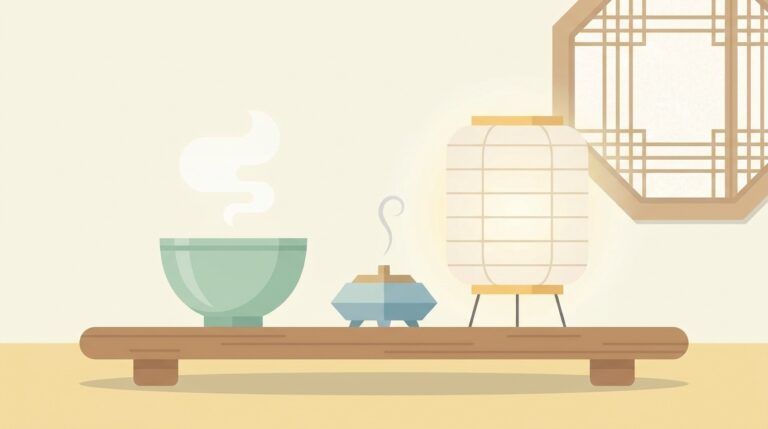
Phase 1: Empathy & K-Culture Cold Open
Hello! I’m your Daily Hangul Editor.
Picture this: You are standing in the middle of Gangnam. Neon signs are flashing, K-pop is blasting from cosmetics shops, and people are walking past you at the speed of light—the epitome of Korea’s famous pali-pali (hurry up) culture. It is exhilarating, but eventually, your social battery hits 1%.
In K-dramas, what does the protagonist do when life in Seoul becomes too overwhelming? They don’t just sleep. They pack a small bag, head to a remote temple in the mountains, or sit quietly in a Hanok (traditional Korean house) courtyard, listening to the rain while sipping hot tea. This pursuit of profound inner peace is a massive part of modern K-Culture, often referred to as ‘힐링’ (Healing).
As an advanced (C1) Korean learner, you already know how to say “I am tired” (피곤해요) or “I want to rest” (쉬고 싶어요). But to truly connect with Koreans on a deeper emotional level, you need to know how to express the nuances of clearing your mind, finding serenity, and engaging in the meditative practice of traditional tea ceremonies (다도 – Dado).
Let’s dive into the sophisticated language of finding your Zen in Korea.
Phase 2: Deep Dive into Core Expressions
1. 마음을 비우다
- Pronunciation: maeumeul biuda [ma-eum-eul bee-oo-da]
- Meaning: Literal: To empty the mind. / Real nuance: To let go of greed, expectations, or obsessive thoughts; to clear one’s head.
- K-Culture Moment: You will hear this in dramas when a character is trying to get over a breakup or a failed job interview. A wise elder or a monk during a Temple Stay will pour tea and say, “Just empty your mind.” It’s not about becoming brain-dead; it’s about detachment from stress.
- Editor’s Insight: This is a very elegant, mature expression. If a friend is stressing over something they cannot control, telling them to “마음을 비우세요” is much deeper than just “Don’t worry” (걱정하지 마세요).
- Situation Spectrum:
- Casual with friends: ✅ (e.g., “야, 그냥 마음 비워.” – Hey, just let it go.)
- Semi-formal (Coworkers): ✅
- Formal (Elders/Boss): ⚠️ (You can say you are trying to empty your mind, but don’t command an elder to empty theirs!)
- 🤔 Think About It: Why does Korean culture associate peace with “emptiness” rather than “filling” oneself with positive thoughts? How does this reflect Buddhist/Taoist philosophies deeply rooted in Korean history?
2. 차분해지다
- Pronunciation: chabunhaejida [cha-boon-hae-jee-da]
- Meaning: Literal/Real nuance: To become calm, serene, and settled.
- K-Culture Moment: Imagine sitting in a traditional tea house in Insadong. As the scent of the wooden Hanok and brewing tea fills the air, your racing heartbeat slows down. You take a sip and sigh. This exact feeling of your energy settling down is ‘차분해지다’.
- Editor’s Insight: While ‘조용하다’ simply describes a lack of noise, ‘차분하다’ describes a state of emotional and atmospheric stability. It is the perfect adjective for the vibe of meditation.
- Situation Spectrum:
- Casual with friends: ✅
- Semi-formal (Coworkers): ✅
- Formal (Elders/Boss): ✅
- 🤔 Think About It: Koreans often use ‘차분하다’ to describe someone’s personality as a compliment (e.g., “저 사람은 참 차분해요”). Why is a calm demeanor highly valued in Korean society?
3. 온전히 집중하다
- Pronunciation: onjeonhi jipjunghada [on-jeon-hee jip-joong-ha-da]
- Meaning: Literal/Real nuance: To focus entirely/wholly; to be fully present.
- K-Culture Moment: During a traditional tea ceremony (다도), you don’t just drink. You listen to the water boiling, feel the warmth of the cup, and watch the color of the tea change. The tea master will ask you to be entirely present in the moment.
- Editor’s Insight: The adverb ‘온전히’ (wholly, intactly) elevates your Korean from intermediate to advanced. It shows a deep level of mindfulness.
- Situation Spectrum:
- Casual with friends: ✅
- Semi-formal (Coworkers): ✅
- Formal (Elders/Boss): ✅
- 🤔 Think About It: In a society dominated by smartphones and multi-tasking, taking time to ‘focus entirely’ on a single drop of tea is an act of rebellion. Does your culture have a specific ritual that demands absolute presence?
Phase 3: Textbook vs. Real Korean
At the C1 level, you need to understand how native speakers creatively alter language to express extreme exhaustion and the desperate need for peace.
[Situation 1: Expressing the need to clear your head]
* 📖 Textbook Korean: 머리가 복잡해서 쉬고 싶어요. (My head is complicated, so I want to rest.)
* 🗣️ Real Korean: 뇌를 좀 비우고 싶어요. / 멍 때리고 싶어요. (I want to empty my brain a bit. / I want to space out.)
* 💡 Why the difference?: ‘멍 때리다’ (to space out) is a very common slang. There’s even an annual “Space Out Competition” in Seoul! It reflects the severe mental fatigue of modern Koreans.
[Situation 2: Describing a peaceful place]
* 📖 Textbook Korean: 이 한옥 카페는 아주 조용하고 평화로워요. (This Hanok cafe is very quiet and peaceful.)
* 🗣️ Real Korean: 분위기가 진짜 고즈넉하네요. 힐링 돼요. (The atmosphere is truly serene. It is healing.)
* 💡 Why the difference?: ‘고즈넉하다’ is a beautiful, advanced native Korean word specifically used to describe the tranquil, undisturbed quietness of traditional places or nature. Add the Konglish ‘힐링’ (Healing), and you sound exactly like a Seoulite on a weekend getaway.
Phase 4: Cultural Context — K-Culture Deep Dive
4-1. Non-verbal Nuances in Dado (Tea Ceremony)
When engaging in meditation or tea time in Korea, body language is as important as words.
– Two Hands Always: Whether receiving a cup of tea or passing the teapot, always use both hands. It is a sign of deep respect for the host and the process.
– Posture (정좌 – Jeongjwa): If sitting on the floor in a traditional tea room, sitting cross-legged or kneeling is common. Slouching breaks the ‘차분한’ (calm) atmosphere.
– Nunchi and Silence: In Western cultures, silence between friends can feel awkward. In a Korean tea house, learning to share silence comfortably without the pressure to make small talk is a sign of profound nunchi (social awareness) and intimacy.
4-2. The ‘Healing’ Trend in K-Dramas & Reality
The concept of ‘마음의 평화’ (peace of mind) is frequently depicted in K-Dramas as a direct antidote to corporate burnout.
– The Tropes: Think of dramas like My Liberation Notes or Little Forest, where the ultimate luxury isn’t a designer bag, but simply sitting on a wooden porch (마루 – maru) looking at the wind rustling through the trees.
– The Reality: In reality, the K-Culture approach to “healing” is surprisingly structured. Koreans actively schedule their relaxation. They book “Fire-spacing out” (불멍) cafes where you literally pay to stare at a campfire in the city, or “Water-spacing out” (물멍) spots by the Han River. Knowing these terms proves you deeply understand contemporary Korean psychology.
Phase 5: Real-Life Roleplay Scenario
Setting: A Friday afternoon. A sudden downpour has hit Seoul. You and your Korean colleague, Min-su, have escaped the rain into a hidden, dimly lit traditional tea house in Bukchon Hanok Village. The smell of old wood and brewing herbal tea fills the air. Raindrops are falling on the tiled eaves.
Characters:
– YOU: An expat working in Seoul, noticing your colleague is severely stressed.
– Min-su (32): Your coworker. He just finished a brutal week of overtime (야근).
Dialogue:
Min-su: 와… 바깥은 완전 전쟁터인데, 여기는 다른 세상 같네요. 🍵
(wa… bakkat-eun wanjeon jeonjaengteo-inde, yeogineun dareun sesang gatneyo.)
[Wow… it’s a total battlefield outside, but it feels like a different world here.]
YOU: 그러니까요. 빗소리 들으니까 마음이 좀 차분해지지 않아요?
(geureonilkkayo. bissori deureunikka maeumi jom chabunhaejiji anayo?)
[I know, right? Doesn’t listening to the rain make your mind feel a bit calmer?]
Min-su: 네, 이번 주 내내 스트레스가 심했는데, 싹 내려가는 기분이에요.
(ne, ibeon ju naenae seuteureseuga simhaenneunde, ssak naeryeoganeun gibunieyo.)
[Yeah, I was heavily stressed all week, but I feel it all washing away.]
YOU: 민수 씨, 이럴 때는 그냥 아무 생각 하지 말고 마음을 비우세요.
(minsu ssi, ireol ttaeneun geunyang amu saenggak haji malgo maeumeul biuseyo.)
[Min-su, at times like this, just don’t think about anything and empty your mind.]
Min-su: 맞아요. 우리 오늘 회사 얘기는 절대 하지 맙시다. 그냥 멍 때려요.
(majayo. uri oneul hoesa yaegineun jeoldae haji mapsida. geunyang meong ttaeryeoyo.)
[You’re right. Let’s absolutely not talk about work today. Let’s just space out.]
🔀 Your Turn! How do you reply?
– A) “네, 좋은 생각이에요. 조용히 해요.” (Textbook, a bit abrupt due to “조용히 해요” which sounds like “shut up”)
– B) “좋아요. 온전히 이 고즈넉한 분위기를 즐겨봐요.” (Advanced, elegant, perfect for the setting)
– C) “대박! 완전 짱이에요!” (Too energetic and slangy, ruins the calm vibe)✅ Best Choice: B — It uses advanced vocabulary (‘온전히’, ‘고즈넉하다’) perfectly matched to the sophisticated, quiet atmosphere of a traditional tea house.
⚠️ Choice A Analysis: Telling someone ‘조용히 해요’ in Korean is almost like a command to be quiet. It kills the mood.
YOU: (Smiling) 좋아요. 온전히 이 고즈넉한 분위기를 즐겨봐요.
(joayo. onjeonhi i gojeuneokhan bunwigireul jeulgyeobwayo.)
[Sounds good. Let’s fully enjoy this serene atmosphere.]
(🎭 Stage Direction: Min-su nods, takes a deep breath, and you both silently watch the rain while sipping tea.)
Phase 6: 10-Second Shadowing Drill
Read this aloud to practice the smooth, relaxed intonation required for these phrases. Speak slowly and breathe between slashes.
😌 복잡한 생각은 / 다 비우고, // 온전히 / 이 시간을 / 즐겨보세요.
(bokjapan saenggageun / da biugo, // onjeonhi / i siganeul / jeulgyeoboseyo.)
[Empty out all complicated thoughts, and fully enjoy this time.]
Tip: Do not rush! Let the vowels stretch slightly to sound more comforting.
Phase 7: K-Culture Mini Dictionary
1. 다도 (Dado)
* Romanization: dado
* English: Traditional Tea Ceremony / The Way of Tea
* Context: More than just drinking tea, it is a meditative practice focusing on mindfulness, etiquette, and appreciating the aesthetics of the tea-making process.
2. 멍때리기 (Meong-ttaerigi)
* Romanization: meong-ttaerigi
* English: Spacing out / Zoning out
* Context: Once scolded by parents, it is now celebrated as a necessary mental health break for overworked Koreans. Variations include 불멍 (staring at fire) and 물멍 (staring at water).
3. 고즈넉하다 (Gojeuneokhada)
* Romanization: gojeuneokhada
* English: Serene, tranquil, quietly peaceful
* Context: An advanced descriptive verb exclusively used for atmospheres, especially traditional Hanoks, quiet temples, or peaceful nature scenes.
4. 템플스테이 (Temple Stay)
* Romanization: tempeulseutei
* English: Temple Stay program
* Context: A popular cultural program where locals and tourists stay at a Buddhist temple to experience monastic life, meditation, and 108 bows to clear the mind.
Phase 8: Traveler Survival Kit
If you are visiting Korea and want to escape the crowded tourist traps to find true peace, you will likely visit a traditional tea house (전통 다원). Here is your C1 survival kit.
🆘 Survival Expressions for a Traditional Tea House
– 🇰🇷 “마음이 좀 편안해지는 차로 추천해 주실 수 있나요?”
– 🗣️ (maeumi jom pyeonanhaejineun charo chucheonhae jusil su innayo?)
– 📍 English: Could you recommend a tea that makes the mind feel at ease?
– 💡 Pro Tip: Traditional Korean teas often serve medicinal purposes. Omija (five-flavor berry) or Ssanghwa-tang (herbal medicine tea) are great, but asking for a “calming” tea shows immense cultural fluency.📌 Editor’s Travel Note
– Where to go: Skip the chain cafes and search for “전통찻집” (Traditional Tea House) on Naver Map around Bukchon, Insa-dong, or Seongbuk-dong.
– Caffeine alert: Unlike green tea or black tea, many Korean traditional teas (like Yuzu tea, Jujube tea) are fruit or root-based and naturally caffeine-free. Perfect for late-night healing!
Phase 9: Critical Thinking Corner — “A Step Deeper”
The Paradox of Healing: Working Hard to Rest Hard
🧠 Think Deeper:
Have you noticed how intensely Koreans approach relaxation? The language reflects this. We don’t just ‘rest’; we actively “empty our minds” (마음을 비우다) or intentionally engage in “spacing out” (멍때리기). In a hyper-competitive society that glorifies pali-pali (speed) and noryeok (immense effort), resting naturally feels almost impossible or guilt-inducing. Therefore, “Healing” (힐링) has become an industry and a scheduled task. By creating specific spaces (like Temple Stays or Hanok cafes) and specific vocabularies for rest, Koreans grant themselves the official permission to stop working. The existence of these profound, peaceful expressions highlights exactly how stressful the daily reality can be.💬 Your Turn: Does your culture have a concept similar to Korea’s structured “healing” trend, or do people rest more organically? Share your thoughts in the comments!
Phase 10: FAQ & Avoiding Mistakes
Q: Can I use “마음을 비우세요” to my boss if they are stressed?
– No! While it is a beautiful expression, advising a superior on their mental state can sound condescending. Instead, politely say, “따뜻한 차 드시고 조금 쉬시면 좋겠습니다” (It would be nice if you drank some warm tea and rested a bit).
Q: Is asking for “coffee” at a traditional tea house rude?
– Yes, generally. Most authentic 전통찻집 strictly serve traditional teas and snacks (like Hangwa or Yugwa). Asking for an Iced Americano ruins the carefully curated cultural vibe.
❌ Common Mistake #1: Saying “조용히 해요” (Be quiet) to praise a peaceful atmosphere.
✅ Do This Instead: Say “분위기가 참 고즈넉하네요” (The atmosphere is truly serene).
Phase 11: Summary & Action Items
One-Liner Summary: True fluency at the C1 level means knowing how to elegantly express inner peace, using terms like ‘마음을 비우다’ and ‘고즈넉하다’ to navigate Korea’s profound ‘healing’ culture.
Action Mission:
– 🥉 Bronze (Solo): Brew a cup of hot tea tonight. Before drinking, say aloud to yourself: “마음을 비우고 온전히 집중하자.”
– 🥈 Silver (Online): Find a photo of a beautiful Korean Hanok or temple on Instagram and leave a comment: “분위기가 정말 고즈넉하네요. 힐링 돼요.”
– 🥇 Gold (Real-world): Next time a Korean friend complains about severe work stress, warmly suggest: “주말에 같이 멍 때리러 갈래요?” (Want to go space out together this weekend?)
K-Culture Mission:
Search YouTube for “한국 사찰음식” (Korean Temple Food) or “다도 명상” (Dado Meditation). Watch a 5-minute video and try to spot how many times they mention ‘마음’ (mind) or ‘비우다’ (empty).
Let’s Chat: What is your personal favorite way to ‘empty your mind’ when you are stressed? Let me know below!
Phase 12: Interactive Quiz
1. Situational Judgment: You are at a beautiful, secluded Temple Stay deep in the mountains. You want to post a picture on your Korean social media. Which caption is the most natural and advanced?
– A) 아주 조용하고 지루해요. (Very quiet and boring.)
– B) 고즈넉한 사찰에서 마음을 비우는 시간 🍵 (Time to empty the mind at a serene temple.)
– C) 너무 조용히 해 주세요. (Please be very quiet.)
2. Fill in the Blank:
“요즘 야근을 너무 많이 해서 뇌가 피곤해. 주말에 한강 가서 물 보면서 ___ 때릴 거야.”
(I’m so tired from overtime lately. This weekend I’m going to the Han River to look at the water and ________.)
3. K-Culture True/False:
During a formal traditional tea ceremony (Dado) in Korea, it is considered polite to quickly drink your tea in one gulp to show you enjoy it. (True / False)
Click here for Answers!
1. B (Perfect use of C1 vocabulary to describe a healing experience.)
2. 멍 (멍 때리다 – spacing out, a crucial survival skill in modern Korea!)
3. False (You should drink it slowly, usually in 3 or 4 small sips, appreciating the color, scent, and taste, holding the cup with both hands.)
Frequently Asked Questions (FAQ)
Q: What does "마음을 비우다" mean in Korean and how do you pronounce it?
A: In Korean, "마음을 비우다" is pronounced [maeumeul biuda [ma-eum-eul bee-oo-da] and means: Literal: To empty the mind. / Real nuance: To let go of greed, expectations, or obsessive thoughts; to clear one's head.
Q: What does "차분해지다" mean in Korean and how do you pronounce it?
A: In Korean, "차분해지다" is pronounced [chabunhaejida [cha-boon-hae-jee-da] and means: Literal/Real nuance: To become calm, serene, and settled.
Q: What does "온전히 집중하다" mean in Korean and how do you pronounce it?
A: In Korean, "온전히 집중하다" is pronounced [onjeonhi jipjunghada [on-jeon-hee jip-joong-ha-da] and means: Literal/Real nuance: To focus entirely/wholly; to be fully present.






