

Phase 1: Empathy (Immersive Opening)
Hello there! It’s your Daily Hangul Editor.
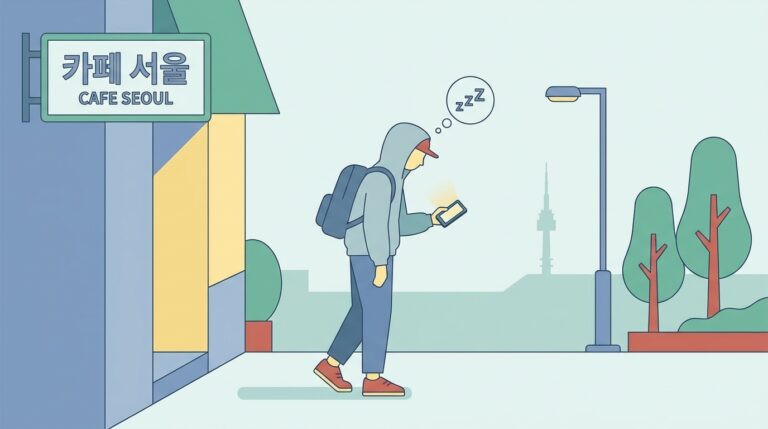
Picture this: You are in Seongsu-dong, the Brooklyn of Seoul. You and your friend are standing in a winding line outside a bakery just to buy their viral ‘salt bread’ (소금빵). It has been 45 minutes. The K-Pop music from the nearby cosmetic store is looping for the third time. You look at your phone—battery at 15%.
You want to express just how excruciatingly bored you are. You dig into your mental textbook and say, “저는 지루합니다” (I am bored). Your Korean friend chuckles awkwardly. Why? Because while technically correct, it sounds like a robot reporting its system status!
When waiting in massive lines or sitting through a 16-episode K-Drama where nothing happens in episode 13, locals don’t use textbook phrasing. They sigh, stretch, and talk about how their boredom is causing physical reactions—like yawning!
Today, we’re going to dive into the art of being naturally, authentically bored in Korean. Let’s upgrade your vocabulary so you can sigh like a true local!
Phase 2: Core Expressions Deep Dive
1. 지루해서 하품이 나와요.
- Pronunciation: [Jiruhaeseo hapumi nawayo] (Think of the ‘하/Ha’ sound as an actual, breathy yawn!)
- Meaning: Literal: “Because it is boring, a yawn comes out.” / Real Nuance: “This is so boring, I can’t help but yawn.”
- K-Culture Moment: Imagine sitting in a company meeting (회식/hoesik prep) that has been dragging on for an hour, or watching a filler episode of a K-Drama. You whisper this to your friendly coworker while covering your mouth.
- Editor’s Insight: This expression focuses on the situation being tedious. You are subjected to something uninteresting, and your body is naturally reacting by yawning. It’s descriptive and very natural!
- Situation Spectrum:
- Close Friends (Casual): ✅ (지루해서 하품 나와!)
- Coworkers (Semi-formal): ⚠️ (Use cautiously in a whisper: 하품이 나오네요.)
- Boss/Elders (Formal): 🚫 (Never say their meeting makes you yawn!)
- 🤔 Think About It: Why does the Korean language often connect emotions with physical reactions (like yawning, getting goosebumps, or stomach aches)? Does your native language do this too?
2. 심심해 죽겠어요.
- Pronunciation: [Simsimhae jukgesseoyo] (‘Juk’ sounds like ‘jook’, but cut it short and sharp.)
- Meaning: Literal: “I’m bored to death.” / Real Nuance: “I have absolutely nothing to do, and it’s killing me.”
- K-Culture Moment: You are quarantined in your hotel, or it’s a rainy Sunday and your plans were canceled. You text this to your friend, hoping they’ll invite you out for some Chimaek (Chicken and Beer).
- Editor’s Insight: ⚠️ CRITICAL B1 TIP!
지루하다(boring) and심심하다(bored/nothing to do) are completely different! A movie can be 지루하다, but YOU are 심심하다 because you have no plans. Adding “~죽겠다” (to death) is the ultimate Korean way to exaggerate a feeling.- Situation Spectrum:
- Close Friends (Casual): ✅ (아, 심심해 죽겠어!)
- Coworkers (Semi-formal): ⚠️
- Boss/Elders (Formal): 🚫
- 🤔 Think About It: Koreans love adding “~죽겠다” (to death) to everything. Hungry to death, tired to death, happy to death. What does this dramatic linguistic habit tell us about the intensity of Korean emotional expression?
3. 시간이 진짜 안 가네요.
- Pronunciation: [Sigani jinjja an ganeyo] (‘An ganeyo’ flows together smoothly like ‘ang-ga-ne-yo’)
- Meaning: Literal: “Time is really not going.” / Real Nuance: “Time is dragging. Is it only 3 PM?!”
- K-Culture Moment: You are at a bus stop in the countryside during your trip to Jeju Island, and the bus tracking app says the next bus is in 40 minutes.
- Editor’s Insight: This is the most polite and safe way to express boredom in a slightly uncomfortable situation without insulting anyone. You’re blaming the “time,” not the person or the event!
- Situation Spectrum:
- Close Friends (Casual): ✅ (시간 진짜 안 간다.)
- Coworkers (Semi-formal): ✅ (시간이 참 안 가네요.)
- Boss/Elders (Formal): ⚠️ (Acceptable if you’re both waiting for something, like a train.)
Phase 3: Textbook vs Real Korean
[Situation 1: When a movie plot is incredibly predictable]
* 📖 Textbook Korean: 이 영화는 매우 지루합니다. (This movie is very boring.)
* 🗣️ Real Korean: 아, 노잼. 하품 나와. (Ah, no-jaem. I’m yawning.)
* 💡 Why the difference?: ‘노잼’ (No + 재미/Fun) is an indispensable slang term born from internet culture, universally used by anyone under 40 for anything unentertaining.
[Situation 2: Waiting 2 hours for a table at a famous BBQ joint]
* 📖 Textbook Korean: 저는 기다리는 것이 싫습니다. (I dislike waiting.)
* 🗣️ Real Korean: 아, 시간 진짜 안 간다. (Ah, time is really not passing.)
* 💡 Why the difference?: Koreans often use passive, observational statements (혼잣말 – talking to oneself) to express frustration without sounding overly aggressive or complaining.
Bottom Note: For B1 learners, using ‘노잼’ with friends is a great way to sound like an insider, but stick to ‘시간이 안 가네요’ when you are with acquaintances or language exchange partners you just met!
Phase 4: Cultural Context — K-Culture Deep Dive
4-1. Non-Verbal Cues: The Polite Yawn
Language isn’t just about words. If you say “지루해서 하품이 나와요,” and actually yawn, remember Korean etiquette: Always cover your mouth with your hand. Yawning openly is considered careless. Also, use your Nunchi (눈치 – situational awareness). Never express boredom openly if someone worked hard to organize the event or cook the meal!
4-2. K-Travel & Food: The “Waiting” (웨이팅) Culture
Korea is famously known for its “빨리빨리” (Ppal-li-ppal-li / Hurry-hurry) culture. Internet speeds are lightning fast, and deliveries arrive in minutes. However, there is a fascinating paradox: Koreans will gladly wait 2 hours for a trendy meal.
In popular areas like Yeonnam-dong or Myeongdong, you will see people gathered outside cafes doing absolutely nothing but looking at their phones. This is called the ‘웨이팅’ (Waiting) culture. Because waiting is such a common part of the foodie experience, knowing how to sigh and say, “시간이 진짜 안 가네요” (Time is really dragging) is a crucial survival skill for your Seoul trip!
Phase 5: Real-Life Roleplay Scenario
Setting: Saturday afternoon, 2 PM. You are standing in an alleyway in Bukchon Hanok Village. You and your Korean friend, Minji, are waiting outside a viral matcha cafe. The sun is beating down, and you’ve already scrolled through all your Instagram feeds twice.
Characters:
– YOU: An expat who loves Korean food but is losing patience.
– Minji (28): Your Korean friend who insists this cafe is “totally worth it.”
Dialogue:
Minji: 앱 보니까 우리 앞에 아직 15팀 남았대… 조금만 더 기다리자!
(Aep bonikka uri ape ajik yeoldaseot tim namatdae… jogeumman deo gidarija!)
[Translation] The app says there are still 15 teams ahead of us… let’s wait just a little longer!
YOU: 15팀이요? 우리 벌써 한 시간 기다렸어요.
(Yeoldaseot timiyo? Uri beolsseo han sigan gidaryeosseoyo.)
[Translation] 15 teams? We’ve already waited an hour.
Minji: 미안해 ㅠㅠ 여기가 요즘 제일 핫플이라서 그래.
(Mianhae ㅠㅠ yeogiga yojeum jeil hatpeuriraseo geurae.)
[Translation] I’m sorry ㅠㅠ It’s just because this is the hottest place these days.
🔀 Your Turn! How will you respond to express your boredom naturally?
– A) “저는 너무 심심합니다. 다른 곳으로 갑시다.”
– B) “아, 지루해서 하품 나와요. 우리 그냥 딴 데 갈까요?”
– C) “여기 진짜 노잼!”✅ Best Choice: B — It perfectly balances natural exasperation with a gentle suggestion to leave.
⚠️ Why not A? It sounds like a military robot reporting its battery level.
⚠️ Why not C? ‘노잼’ means something isn’t entertaining (like a movie or joke). A waiting line isn’t ‘노잼’, it’s just tedious.
(🎭 Stage Direction: You fan yourself with your hand and sigh)
YOU: 아, 지루해서 하품 나와요. 우리 그냥 딴 데 갈까요?
(A, jiruhaeseo hapum nawayo. Uri geunyang ttan de galkkayo?)
[Translation] Ah, it’s so boring I’m yawning. Shall we just go somewhere else?
Minji: 그래, 하품까지 나오면 어쩔 수 없지. 근처 다른 카페 가자!
(Geurae, hapumkkaji naomyeon eojjeol su eopji. Geuncheo dareun kape gaja!)
[Translation] Okay, if you’re even yawning, it can’t be helped. Let’s go to another cafe nearby!
Phase 6: 10-Second Shadowing Drill
Let’s practice the perfect exasperated sigh. Pay attention to the pauses / and the emotion tags!
😩 아휴, / 시간이 / 진~짜 안 가네요. / 심심해 죽겠어요!
(Ahyu, / sigani / jin~jja an ganeyo. / simsimhae jukgesseoyo!)
Pro-tip: Drag out the “진~짜” (jin~jja) to really emphasize how slowly time is moving!
Phase 7: K-Culture Mini Dictionary
Here are some keywords you absolutely need to understand the Korean “waiting and boredom” culture:
1. 눈치
* Romanization: nunchi
* English: Situational awareness / Tact
* Context: The quintessential Korean social sense. You need ‘nunchi’ to know if it’s safe to say you’re bored without offending the host.
2. 웨이팅
* Romanization: we-i-ting
* English: Waiting in line (for restaurants/cafes)
* Context: Derived from the English word “waiting,” but specifically used as a noun for lining up at popular eateries. “웨이팅 길어요?” (Is the wait long?)
3. 핫플
* Romanization: hat-peul
* English: Hot place / Trendy spot
* Context: A shortened form of ‘Hot Place.’ If a spot is a ‘hat-peul’, expect a very long ‘we-i-ting’ and potential boredom!
4. 빨리빨리
* Romanization: ppal-li-ppal-li
* English: Hurry, hurry
* Context: The driving force behind Korean society. It makes the contrast of waiting hours for a cafe even more fascinating.
Phase 8: Traveler Survival Kit
Since expressing boredom often happens while waiting during your travels, here are the absolute must-know phrases to navigate K-Waiting lines!
🆘 Survival Phrases for the Bored Traveler
– 🇰🇷 “대기 시간이 얼마나 되나요?” (daegi sigani eolmana doenayo?)
– 🗣️ Meaning: How long is the wait time?
– 📍 Where to use: Restaurants, cafes, theme park rides.
– 🇰🇷 “우리 앞에 몇 팀 있어요?” (uri ape myeot tim isseoyo?)
– 🗣️ Meaning: How many teams are ahead of us?📌 Editor’s Travel Note
– The Kiosk Culture: Most trendy restaurants in Korea do not have physical lines anymore. Look for a tablet (CatchTable or Tableling) by the door. You input your phone number (or request an email sign-up for foreigners) and wait elsewhere until you get a message!
– Don’t wait if you’re starving: If you are “배고파 죽겠어요” (starving to death), skip the hot-places and duck into any local Kimbap shop. It’ll be delicious, cheap, and zero wait time.
Phase 9: Critical Thinking — A Step Deeper
🧠 Think Deeper: The Paradox of “Ppal-li-ppal-li” and “Waiting”
How can a culture famous for its extreme impatience (빨리빨리 / Hurry-hurry) also be a culture where people willingly stand outside a cafe for two hours just for a photo and a pastry?
In the K-culture context, ‘waiting’ has transformed from a mere inconvenience into a badge of honor. Successfully enduring the wait and posting about the “핫플” (hot place) on social media proves that you are culturally relevant and part of the trend. This phenomenon shows how modern Korean language and behavior juggle two opposing values: the absolute demand for efficiency in daily tasks, versus immense patience for social currency.
💬 Your Turn: Do people in your culture wait hours for trendy food? Or is time valued over trends? Let us know in the comments!
Phase 10: FAQ & Mistake Prevention
Q: Can I say “지루해요” to my boss during a long presentation?
A: NO! Absolutely not. Saying “지루하다” implies the subject matter (their presentation) is uninteresting. It is highly offensive in a professional setting. If you must say something, say “집중력이 조금 떨어지네요” (I’m losing my concentration a bit) or ask for a short break.
Q: Can I tell a K-Pop idol on a live stream “심심해요”?
A: Yes! If you are casually chatting in the comments, “오빠/언니, 심심해요! 재미있는 이야기 해주세요!” (I’m bored! Tell me a funny story!) is cute and perfectly acceptable.
❌ Common Mistake #1: Confusing 지루하다 and 심심하다.
– “이 책은 심심해요.” (X – Books cannot feel boredom!)
– “이 책은 지루해요.” (O – This book is boring.)
– “저는 할 일이 없어서 심심해요.” (O – I have nothing to do, so I am bored.)
Phase 11: Summary & Action Items
One-Liner Summary: Use “지루해서 하품이 나와요” when an event is painfully uninteresting, and “심심해 죽겠어요” when you are suffering from having absolutely nothing to do!
Action Mission:
– 🥉 Bronze (Solo): Stand in front of your mirror, sigh dramatically, and say “심심해 죽겠어요!” 3 times.
– 🥈 Silver (Online): Find a slow, relaxing vlog on YouTube and leave a comment saying: “영상이 편안해서 좋아요. 하지만 가끔 시간이 안 가네요!” (The video is relaxing. But sometimes time drags!)
– 🥇 Gold (Real World): Next time you are waiting in line with a Korean friend, use the sighing technique and say, “시간이 진짜 안 가네요.”
K-Culture Mission:
Next time you watch a K-Drama and see characters waiting at a bus stop, restaurant, or during a boring office scene, look closely at their body language. Do they cover their mouth when they yawn? Do they mutter “아휴, 시간 안 가” to themselves? Spotting these moments is half the fun!
Phase 12: Interactive Quiz
1. Situational Judgment:
You are stuck at home on a rainy Sunday. You have read all your books and watched all your shows. You text your friend. What is the BEST phrase?
A) 이 일요일은 참 지루합니다.
B) 나 심심해 죽겠어. 치맥 콜?
C) 시간이 참 안 가네요.
(Answer: B. You have nothing to do, so you are 심심하다. Asking for chicken and beer (치맥) makes you sound like a local!)
2. True or False — K-Culture Edition:
In Korea, it is polite to yawn widely and loudly during a boring meeting to let the speaker know they should wrap up.
(Answer: False! Always read the room (Nunchi), cover your mouth, and try to hide your boredom out of respect.)
3. Fill in the Blank:
You are waiting for a table at a famous BBQ restaurant. You want to ask the staff: “How long is the wait time?”
“____ 시간이 얼마나 되나요?”
(Answer: 대기 / Daegi)
Great job today! Next time you’re stuck in a boring situation, at least you’ll know exactly how to complain in perfect Korean. See you in the next Daily Hangul lesson! 😊
Frequently Asked Questions (FAQ)
Q: What does "지루해서 하품이 나와요." mean in Korean and how do you pronounce it?
A: In Korean, "지루해서 하품이 나와요." is pronounced [Jiruhaeseo hapumi nawayo] and means: Literal: "Because it is boring, a yawn comes out." / Real Nuance: "This is so boring, I can't help but yawn."
Q: What does "심심해 죽겠어요." mean in Korean and how do you pronounce it?
A: In Korean, "심심해 죽겠어요." is pronounced [Simsimhae jukgesseoyo] and means: Literal: "I'm bored to death." / Real Nuance: "I have absolutely nothing to do, and it's killing me."
Q: What does "시간이 진짜 안 가네요." mean in Korean and how do you pronounce it?
A: In Korean, "시간이 진짜 안 가네요." is pronounced [Sigani jinjja an ganeyo] and means: Literal: "Time is really not going." / Real Nuance: "Time is dragging. Is it only 3 PM?!"







