

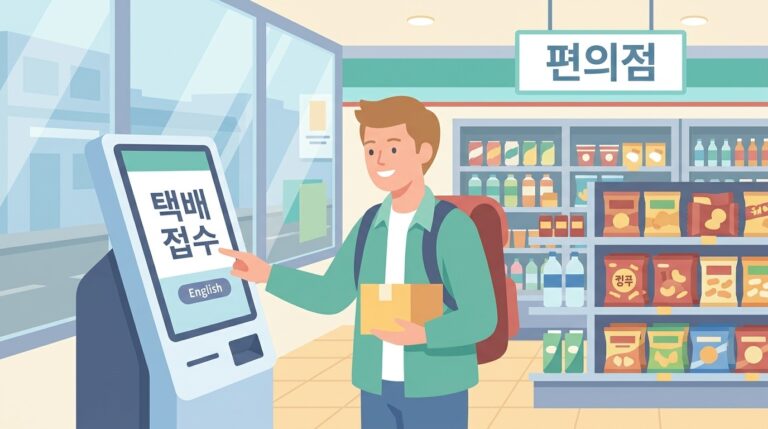
Phase 1: Empathy (Welcome to the Real Korea)
Hello! I’m your Senior Editor at Daily Hangul.
Imagine this: You finally secured that rare K-Pop photocard on Twitter, or you found the perfect vintage jacket on ‘Danggeun’ (Korea’s ultimate second-hand app). The seller messages you: “I’ll send it via GS25 Half-Price Parcel (반값택배).” You walk into the brightly lit convenience store, confident, until you are faced with a giant, blinking kiosk that looks like a spaceship control panel. The part-time worker looks at you, waiting. You freeze.
Sound familiar? You’re not alone! While textbooks teach you how to send a letter at the post office, real life in Korea happens at the convenience store (편의점). Knowing how to navigate the convenience store parcel system (택배 – taekbae) isn’t just about logistics; it’s a rite of passage. It saves you money, connects you to the local second-hand culture, and instantly levels up your Korean street-cred.
Let’s decode this machine and the conversations around it, based on the real sweat and tears of my intermediate students!
Phase 2: Deep Dive into Core Expressions
1. 반값택배 찾으러 왔는데요.
- Pronunciation: [ban-gap-taek-bae cha-jeu-reo wan-neun-de-yo] + (The ‘인데요/는데요’ sounds like a gentle, lingering invitation for the listener to respond, not a harsh stop.)
- Meaning: I’m here to pick up a half-price parcel. (Literal: I came to find a half-price parcel, and…)
- K-Culture Moment: You’ll hear this constantly in convenience stores near universities. It’s the ultimate phrase for budget-savvy students and K-Pop fans trading merch.
- Editor’s Insight: For B2 learners, the magic here is
-는데요. Instead of the robotic textbook ending왔습니다(I came),-는데요softens your statement. It gives background information and politely implies, “…so could you help me?”- Situation Spectrum:
- Casual (Friends): ✅ (Drop the ‘요’: 반값택배 찾으러 왔는데)
- Semi-formal (Clerks/Coworkers): ✅ (Perfect!)
- Formal (Boss/Elders): ⚠️ (A bit too casual for a CEO, but fine for store clerks.)
- 🤔 Think About It: Why do Koreans prefer open-ended sentences like
-는데요instead of direct requests like “Give me my parcel”? How does this reflect the cultural value of maintaining harmony (기분 – gibun)?2. 착불로 할게요 / 선불할게요.
- Pronunciation: [chak-bul-lo hal-gge-yo / seon-bul-hal-gge-yo]
- Meaning: I’ll pay on delivery (Receiver pays) / I’ll prepay (Sender pays).
- K-Culture Moment: Buying a K-Drama OST album from someone online? They’ll ask you: “선불? 착불?” If you don’t know the difference, you might end up paying twice or causing a logistical headache!
- Editor’s Insight: ‘선’ (Seon) means ‘Before’ (like in 선배 – Senior), and ‘착’ (Chak) means ‘Arrival’. ‘불’ (Bul) means ‘Payment’. Breaking down Hanja (Chinese characters) is a massive hack for B2 learners to expand vocabulary exponentially.
- Situation Spectrum:
- Casual: ✅ (선불할게 / 착불로 해)
- Semi-formal/Formal: ✅ (Perfect for all service situations.)
- 🤔 Think About It: Korea’s delivery network is built on immense trust. The “Pay on Delivery” (착불) system implies absolute faith that the receiver will pay up. Does your country have a similar system?
3. 운송장 번호
- Pronunciation: [un-song-jang beon-ho]
- Meaning: Tracking number / Waybill number.
- K-Culture Moment: The moment a seller messages you this number, the excitement begins! You can track your package moving across the country in literal hours thanks to Korea’s “Palli-Palli” (hurry up) culture.
- Editor’s Insight: You will see this word on the kiosk screen and the printed sticker. You don’t usually say it out loud, but you absolutely must know how to read it.
- Situation Spectrum:
- Universal term used in all written and spoken contexts regarding deliveries.
Phase 3: Textbook vs. Real Korean
[Situation 1: Approaching the clerk for a pickup]
* 📖 Textbook Korean: 제 소포를 받으러 왔습니다. (I came to receive my parcel.)
* 🗣️ Real Korean: 택배 찾으러 왔는데요. / 반값택배 수령이요. (I’m here to find my parcel. / Half-price parcel pickup, please.)
* 💡 Why the difference?: Koreans rarely use the word ‘소포’ (parcel) anymore; ‘택배’ (home delivery) has completely taken over. Also, we “find” (찾다) packages rather than “receive” (받다) them in spoken Korean.
[Situation 2: Asking where the machine is]
* 📖 Textbook Korean: 택배 기계가 어디에 있습니까? (Where is the parcel machine?)
* 🗣️ Real Korean: 택배 기계 어디 있어요? / 포스트박스 어디예요? (Where’s the parcel machine? / Where’s the Postbox?)
* 💡 Why the difference?: In convenience stores, the machines are often branded (like “Postbox”). Using the -어요/예요 ending is much more natural and friendly than the stiff -습니까.
Phase 4: Cultural Context — K-Culture Deep Dive
4-1. Non-Verbal Nuances (The Art of Nunchi at the Register)
When you hand over your printed receipt from the kiosk to the cashier, don’t just shove it at them. Wait until they are done scanning the previous customer’s snacks. Nunchi (눈치) is crucial here! Hand it over with a slight nod or a polite “택배 접수할게요” (I’d like to register this parcel). If you are paying for it, have your card ready immediately. Convenience store lines move fast, and holding up the line is a major faux pas!
4-2. The “Danggeun” & Photocard Economy
The real reason you need to master this? The second-hand economy. In Korea, apps like 당근 (Karrot Market) or Bunjang (번장), and Twitter (for K-pop photocards) rely heavily on “Half-Price Delivery” (반값택배 or CU끼리택배).
Instead of paying 3,500 KRW for a regular home delivery, you pay about 1,800 KRW, and the package travels from the sender’s convenience store to the receiver’s convenience store using the store’s own logistics trucks. It takes a day or two longer, but for a B2 Korean learner deeply immersed in K-Culture, knowing how to ask “반택 되나요?” (Can we do half-price delivery?) is the ultimate flex that says, “I know how things actually work here.”
Phase 5: Real-Life Roleplay Scenario
Setting: It’s 8:00 PM on a rainy Tuesday at a busy GS25 near Sinchon Station. You just sold an extra album from your favorite K-Pop group on Twitter. The buyer requested “Ban-gap Taekbae.” You’ve boxed it up, printed the sticker from the kiosk, and now you’re at the counter.
Characters:
– YOU: A savvy B2 Korean learner, proud of your recent sale.
– Clerk (Ji-hoon, 22): A university student working part-time. He’s polite but clearly wants to keep the line moving.
Dialogue:
YOU: 저기요, 이거 반값택배 접수할게요.
(jeo-gi-yo, i-geo ban-gap-taek-bae jeop-su-hal-gge-yo.)
[Excuse me, I’d like to register this half-price parcel.]
(🎭 Stage Direction: You confidently place the boxed album and the long kiosk receipt on the counter.)
Ji-hoon: 네, 이쪽으로 올려주세요. 선불이신가요?
(ne, i-jjog-eu-ro ol-lyeo-ju-se-yo. seon-bul-i-sin-ga-yo?)
[Yes, please put it up here. Is it prepaid?]
YOU: 네, 선불로 할게요.
(ne, seon-bul-lo hal-gge-yo.)
[Yes, I’ll prepay.]
Ji-hoon: 멤버십 할인이나 적립 있으세요?
(mem-beo-sip hal-in-i-na jeong-nip is-seu-se-yo?)
[Do you have a membership discount or points to accumulate?]
YOU: 아뇨, 없습니다. 카드로 결제할게요.
(a-nyo, eop-seum-ni-da. ka-deu-ro gyeol-je-hal-gge-yo.)
[No, I don’t. I’ll pay by card.]
(🎭 Stage Direction: You insert your card. The terminal beeps.)
Ji-hoon: 영수증 필요하세요?
(yeong-su-jeung pil-yo-ha-se-yo?)
[Do you need a receipt?]
🔀 YOUR TURN! How do you respond?
– A) “네, 주십시오.” (Stiff and military-like.)
– B) “아뇨, 버려주세요.” (Natural, everyday choice.)
– C) “영수증은 괜찮습니다.” (Polite and soft.)✅ Best Choice: B or C.
Reason: “버려주세요” (Please throw it away) is what 90% of Koreans say. “괜찮습니다” (It’s okay/I’m good) is also perfect. Choice A sounds like you are acting in a historical drama!
YOU: 아뇨, 괜찮습니다.
(a-nyo, gwaen-chan-seum-ni-da.)
[No, I’m good.]
Ji-hoon: 네, 결제 완료되었습니다. 택배는 저기 수거함에 넣어주세요.
(ne, gyeol-je wal-lyo-doe-eot-seum-ni-da. taek-bae-neun jeo-gi su-geo-ham-e neo-eo-ju-se-yo.)
[Yes, the payment is complete. Please put the parcel in the collection box over there.]
YOU: 감사합니다. 수고하세요!
(gam-sa-ham-ni-da. su-go-ha-se-yo!)
[Thank you. Keep up the good work!]
Phase 6: 10-Second Shadowing Drill
Practice reading these out loud, focusing on the pauses (/) and the emotional tone!
- 😊 Bright & Polite: 저기요, / 택배 / 찾으러 왔는데요! (jeo-gi-yo, / taek-bae / cha-jeu-reo wan-neun-de-yo!)
- 😤 Confident: 결제는 / 착불로 / 할게요. (gyeol-je-neun / chak-bul-lo / hal-gge-yo.)
- 🥺 A bit lost: 혹시 / 택배 수거함 / 어디 있어요? (hok-si / taek-bae su-geo-ham / eo-di is-seo-yo?)
Phase 7: K-Culture Mini Dictionary
1. 당근 (Danggeun)
* Romanization: dang-geun
* Meaning: Karrot (The second-hand marketplace app)
* Context: Literally means “carrot,” but it’s the biggest local trading app in Korea. If someone asks “당근이세요?” (Are you a carrot?), they are asking if you are the buyer/seller they are supposed to meet!
2. 반택 (Ban-taek)
* Romanization: ban-taek
* Meaning: Short for 반값택배 (Half-price parcel).
* Context: Gen Z and K-Pop fans love abbreviations. You’ll see “반택포” (Ban-taek-po) on Twitter, meaning “Half-price shipping included in the price.”
3. 수거함 (Su-geo-ham)
* Romanization: su-geo-ham
* Meaning: Collection box.
* Context: After paying, you don’t leave the box on the counter. You must drop it into the large fabric bag or box (usually near the door) where the delivery drivers collect them.
4. 뽁뽁이 (Bbok-bbok-i)
* Romanization: bbok-bbok-i
* Meaning: Bubble wrap.
* Context: An onomatopoeia for the popping sound. If you send fragile K-pop albums or cosmetics, you must wrap them securely in bbok-bbok-i.
Phase 8: Traveler Survival Kit
Even if you aren’t trading photocards, convenience store delivery is a lifesaver if your luggage is overweight, or you want to send souvenirs straight to the airport!
🆘 Survival Phrases for Travelers
– 🇰🇷 “공항으로 택배 보낼 수 있나요?” (gong-hang-eu-ro taek-bae bo-nael su in-na-yo?)
– 🗣️ English Guide: Can I send a parcel to the airport?
– 📍 Where to use: Ask this before using the kiosk, as not all stores offer airport luggage delivery (한진택배 usually handles this).
- 🇰🇷 “이거 포장할 박스 파나요?” (i-geo po-jang-hal bak-seu pa-na-yo?)
- 🗣️ English Guide: Do you sell boxes to pack this?
- 📍 Where to use: When you bought too many snacks and need a box. (Hint: Post offices sell boxes, but convenience stores usually don’t! You have to bring it packed!)
📌 Editor’s Travel Note
– Packaging Rule: Convenience stores do not pack your items for you. You must arrive with your item already in a taped box. They will reject paper shopping bags!
– App Tip: Download the ‘GS25’ or ‘CU’ app. You can pre-fill all the addresses in English/Korean on your phone, get a QR code, and just scan it at the kiosk. It saves you from painfully typing Korean addresses on a laggy touchscreen!
Phase 9: Critical Thinking Corner — “One Step Deeper”
🧠 Think Deeper: Infrastructure and the “Palli-Palli” Culture
Why are convenience stores the hub for logistics in Korea? It perfectly reflects the “Palli-Palli” (hurry up) culture and the density of Korean cities. Because there is a convenience store on almost every corner in Seoul, leveraging them as 24-hour postal nodes is incredibly efficient. Furthermore, the “Pay on Delivery” (착불) and the fact that packages are often just left in open collection bags (수거함) highlight a high-trust society. People expect speed, but they also trust that their packages won’t be stolen.💬 Your Turn: Does your country have a similar system where you can send packages at 2 AM from a corner store? How does the idea of “high-trust logistics” work where you live? Let me know in the comments!
Phase 10: FAQ & Avoiding Misunderstandings
Q: Do I need a Korean phone number to use the parcel kiosk?
Yes and No. For half-price delivery (where the receiver gets a QR code via KakaoTalk to pick it up), you absolutely need a Korean phone number. For regular delivery, you might be able to use a dummy number or the “Non-member” (비회원) option, but it’s highly recommended to have a Korean SIM for smooth tracking.
Q: Can I send international mail via a convenience store?
Yes, mostly at GS25 and CU! They have partnerships with DHL or EMS. You can choose the “International Parcel” (국제택배) option on the kiosk screen.
❌ Common Mistake #1: Bringing an unpackaged item.
✅ Do this instead: Wrap it in a proper cardboard box and tape it securely before entering the store.❌ Common Mistake #2: Staring at the screen trying to type your address.
✅ Do this instead: Always use the “Non-member receipt” (비회원 접수) on the store’s website via your smartphone first, then just log in with your reservation number at the kiosk. The physical keyboards on those machines are notoriously difficult to use!
Phase 11: Summary & Action Items
One-Liner Summary: Mastering convenience store parcels (택배) unlocks the true local Korean experience, saving you money and connecting you to the vibrant second-hand culture!
Your Action Missions:
– 🥉 Bronze (Solo): Read the kiosk screen options (선불, 착불, 반값택배) out loud using the pronunciation guide.
– 🥈 Silver (Online): Go to Twitter or a Korean forum and search the keyword “반택포” to see how real Koreans use it in trading.
– 🥇 Gold (Real Life): Next time you are in Korea, buy a small item online and choose “반값택배” to a convenience store near your hotel. Experience the thrill of picking it up!
K-Culture Mission:
Walk into a GS25 or CU (even via Google Street View!) and locate the “Postbox” machine. Spot the collection bag (수거함) underneath or next to it!
Phase 12: Interactive Challenge (Quiz)
1. Situational Judgment: You are buying a photocard from a fan on Twitter. They ask: “택배비는 어떻게 하실래요?” (What do you want to do about the shipping fee?). You want to pay for it right now along with the photocard price so you don’t have to pay later. What do you say?
– A) 착불로 할게요.
– B) 선불할게요.
– C) 수거함에 넣어주세요.
2. Fill in the Blank:
“저기요, 알바생님! 저 ______ 찾으러 왔는데요.” (Excuse me, part-timer! I’m here to pick up my half-price parcel.)
– A) 소포
– B) 운송장
– C) 반값택배
3. True or False – K-Culture Edition:
If you buy a snack at the convenience store and want to send it to your friend, the clerk will pack it in a nice box for you. (T / F)
(Answers: 1: B, 2: C, 3: False – You must pack it yourself!)
What did you score? Let me know, and see you in the next lesson!
Frequently Asked Questions (FAQ)
Q: What does "반값택배 찾으러 왔는데요." mean in Korean and how do you pronounce it?
A: In Korean, "반값택배 찾으러 왔는데요." is pronounced [ban-gap-taek-bae cha-jeu-reo wan-neun-de-yo] and means: I'm here to pick up a half-price parcel. (Literal: I came to find a half-price parcel, and...)
Q: What does "착불로 할게요 / 선불할게요." mean in Korean and how do you pronounce it?
A: In Korean, "착불로 할게요 / 선불할게요." is pronounced [chak-bul-lo hal-gge-yo / seon-bul-hal-gge-yo] and means: I'll pay on delivery (Receiver pays) / I'll prepay (Sender pays).
Q: What does "운송장 번호" mean in Korean and how do you pronounce it?
A: In Korean, "운송장 번호" is pronounced [un-song-jang beon-ho] and means: Tracking number / Waybill number.







