

Phase 1: Empathy (Immersive Opening)
Hello! I’m your Daily Hangul Editor.
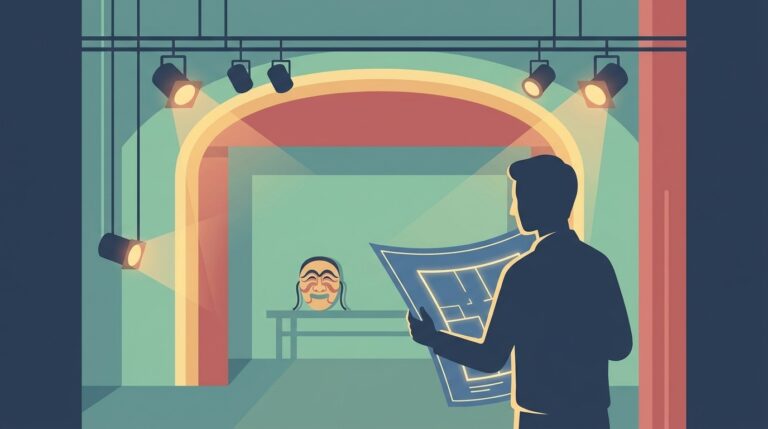
Imagine this: You are standing in the pitch-black wings of a grand theatre in Daehangno (대학로), the Broadway of Seoul. The hum of the audience is a distant rumble. Suddenly, the stage manager whispers into the headset, the pin spots flash on, and a massive LED set piece glides silently across the stage. A Korean stage designer next to you mutters, “아, 동선 꼬이겠는데?” (Ah, the blocking is going to get tangled?)
If you’ve ever watched a breathtaking K-Musical or a K-Pop concert, you know that Korean stage design is legendary for its cinematic transitions and massive scale. But behind that flawless execution lies a chaotic, fast-paced world of highly specific vocabulary.
At the C1 level, you already know how to say “The stage is beautiful” (무대가 아름답습니다). But how do you talk like the people who actually build it? How do you describe the flow of space, the blind spots, or the moment a performance completely destroys the stage in the best way possible?
Today, we are going backstage. This guide is based on real conversations with Korean theatre professionals and advanced learners who wanted to step beyond the textbook and into the spotlight.
Phase 2: Deep Dive into Core Expressions
1. 동선을 짜다 (To plan the movement/blocking)
- Pronunciation: dongseoneul jjada [Dong (like a bell) + Sun (like the star) + eul / jja (tense ‘j’ sound like ‘j’ in jump, but harder) + da]
- Meaning: Literal: To weave the movement line / Real nuance: To plan the blocking, spatial flow, or itinerary.
- K-Culture Moment: In a K-Drama behind-the-scenes video, you’ll often hear directors say, “배우님, 여기서 동선 한번 맞춰볼게요” (Actor, let’s check the blocking here).
- Editor’s Insight: This word is the holy grail of Korean spatial planning. While it originates in theatre and film (blocking), Koreans use it everywhere. Planning a trip to Jeju? You plan your ‘동선’. Organizing tables in a restaurant? You check the ‘동선’ so waiters don’t bump into each other. It implies an obsession with efficiency.
- Situation Spectrum:
- Casual friends planning a trip: ✅
- Colleagues discussing a project workflow: ✅
- Boss/Elder: ✅ (Very professional)
- 🤔 Think About It: Why does a theatre term like ‘동선’ (movement line) dominate everyday Korean planning? How does this reflect the “빨리빨리” (Ppalli-ppalli / hurry-hurry) culture of optimizing time and space?
2. 시야방해 / 사각지대 (Restricted view / Blind spot)
- Pronunciation: siyabanghae [She-yah-bang-heh] / sagakjidae [Sah-gahk-jee-deh]
- Meaning: Literal: Vision interference / Dead angle zone. Real nuance: Restricted view seats or blind spots on stage.
- K-Culture Moment: “피켓팅” (Blood-ticketing—fierce competition for tickets). You finally got a VIP seat for a musical starring your favorite idol, but reviews say it’s a “시야방해석” (Restricted View Seat) because of a massive pillar in the stage design.
- Editor’s Insight: Stage designers are terrified of creating a ‘사각지대’. In Korea’s highly competitive fandom culture, fans pay top dollar and expect perfection. If a set piece blocks the main actor, the designer will hear about it online instantly.
- Situation Spectrum:
- Complaining to a friend about your seat: ✅
- Professional theatre design meeting: ✅
- Formal complaints: ✅
- 🤔 Think About It: In Korean theatre culture, the audience’s viewing experience is heavily critiqued on social media. Do audiences in your country write detailed reviews about stage blind spots?
3. 무대를 뒤집어 놓다 (To tear up the stage)
- Pronunciation: mudaereul dwijibeo nota [Moo-deh-reul / dwee-jee-buh / no-tah (soft ‘t’)]
- Meaning: Literal: To turn the stage upside down. Real nuance: To absolutely crush a performance, to “slay.”
- K-Culture Moment: The curtain falls. The lead actor hits a high note that shakes the theatre. The audience erupts. Backstage, the crew high-fives saying, “오늘 완전 무대 뒤집어 놓으셨다!”
- Editor’s Insight: This is highly expressive C1 slang. It was popularized by a famous meme but is now standard praise. It means the energy was so powerful it metaphorically flipped the physical space you designed.
- Situation Spectrum:
- Fan communities & Friends: ✅
- Casual backstage talk among crew: ✅
- Formal review in a conservative newspaper: 🚫 (Too informal)
- 🤔 Think About It: Korean has many aggressive metaphors for doing something exceptionally well (e.g., 찢었다 – tore it, 부셨다 – broke it). Why do you think destruction is linked to excellence in performance?
Phase 3: Textbook vs. Real Korean
[Describing a Grand Stage Set]
* 📖 Textbook Korean: 무대가 정말 큽니다. (The stage is very big.)
* 🗣️ Real Korean: 스케일이 장난 아니에요. (The scale is no joke.)
* 💡 Why the difference?: Koreans love using “장난 아니다” (It’s not a joke) to express that something exceeds expectations, borrowing the English word ‘scale’ for impact.
[Praising an Actor’s Use of the Stage]
* 📖 Textbook Korean: 배우가 무대를 잘 사용합니다. (The actor uses the stage well.)
* 🗣️ Real Korean: 무대 장악력이 미쳤어요. (Their stage dominance is crazy.)
* 💡 Why the difference?: “장악력” (Dominance/Grip) is a high-level vocabulary word heavily used in arts critique to describe charisma that fills an empty space.
[Talking About Rapid Scene Changes]
* 📖 Textbook Korean: 다음 장면으로 빨리 바뀝니다. (It changes quickly to the next scene.)
* 🗣️ Real Korean: 무대 전환 속도가 엄청나요. (The stage transition speed is immense.)
* 💡 Why the difference?: “무대 전환” (Stage transition) is the exact industry terminology. Using this makes you sound like a true theatre insider.
Phase 4: Cultural Context — K-Culture Deep Dive
4-1. Non-verbal Cue: Backstage Nunchi (눈치)
In a Korean theatre setting, Nunchi (눈치) is survival. When a set change happens in the dark, you don’t shout; you communicate with your eyes and swift movements. If the director sighs while looking at a prop, a designer with quick nunchi is already moving to fix it before a word is spoken. It’s about reading the “air” of the room.
4-2. The “Non-Replica” K-Musical Phenomenon
You might be wondering why stage design is such a big deal in Korea. Unlike Broadway tours that often bring the exact same set worldwide (Replica), Korea is famous for “Non-Replica” (논레플리카) productions.
When global musicals come to Seoul, Korean stage designers completely redesign the sets, costumes, and lighting to fit the dramatic, fast-paced tastes of Korean audiences (and to accommodate the massive LED screens K-culture loves). So, understanding Korean stage design is understanding the very heart of how Koreans localize global art to make it more dynamic.
Phase 5: Real-Life Roleplay Scenario
Setting: 11:30 PM. A lively pub in Daehangno (대학로). The table is covered in draft beer and fried chicken. You and your Senior Korean Stage Designer, Min-soo, just finished a grueling tech rehearsal.
Characters:
– YOU: A foreign assistant stage designer working in Seoul. You’ve been trying to adapt to the fast-paced work culture.
– Min-soo (35): The Lead Stage Designer. Strict during rehearsals, but warm and brotherly when drinking.
Dialogue:
Min-soo: 아, 오늘 테크 리허설 진짜 빡셌다. 그치? 🍺
(Ah, oneul tekeu riheoseol jinjja ppakssetda. geuchi?)
(Ah, today’s tech rehearsal was really intense, right?)
YOU: 네, 특히 2막 무대 전환할 때 완전 긴장했어요.
(Ne, teukhi 2mak mudae jeonhanhal ttae wanjeon ginjanghaesseoyo.)
(Yes, I was totally nervous, especially during the stage transition in Act 2.)
Min-soo: 맞아. 근데 네가 짠 왼쪽 동선 덕분에 배우들이 훨씬 편해하더라. 수고했어.
(Maja. Geunde nega jjan oenjjok dongseon deokbune baeudeuri hwolssin pyeonhaehadeora. Sugohaesseo.)
(Right. But thanks to the left-side blocking you planned, the actors were much more comfortable. Great job.)
🔀 Your Turn! How should you respond to this compliment?
– A) “네, 제가 좀 잘 짜긴 했죠!” (Yes, I did plan it pretty well!)
– B) “아닙니다, 선배님이 많이 도와주신 덕분이죠.” (Not at all, it’s all thanks to your help, sunbae.)
– C) “진짜요? 대박! 무대 완전 찢었죠?” (Really? Awesome! We totally tore up the stage, right?)✅ Best Choice: B — Reason: In a Korean professional setting, the C1 level of cultural fluency dictates “modesty first.” Deflecting the compliment back to the senior’s guidance (선배님 덕분) builds deep trust.
⚠️ Choice C Analysis: While “무대 찢었다” is great slang, using it to praise yourself to your boss comes off as arrogant or overly casual.
(Assuming you chose B)
Min-soo: (Smiling) 짜식, 한국 패치 다 됐네. 자, 짠하자! 내일 첫공을 위해서!
(Jjasik, hanguk paechi da dwaenne. Ja, jjanhaja! Naeil cheotgongeul wihaeseo!)
(You punk, you’re fully “Korean-patched” now. Let’s cheers! To tomorrow’s first performance!)
(🎭 Stage Direction: Min-soo clinks his beer glass against yours, slightly lower than his glass, following Korean drinking etiquette.)
Phase 6: 10-Second Shadowing Drill
Practice the rhythm and intonation. Remember, C1 fluency is about how you say it!
😲 우와 / 이번 뮤지컬 / 무대 전환 속도가 / 장난 아닌데요?
(Uwa / ibeon myujikeol / mudae jeonhwan sokdoga / jangnan anindeyo?)
(Wow, the stage transition speed for this musical is no joke!)
Tip: Emphasize “장난” (jangnan) to really show your amazement.
Phase 7: K-Culture Mini Dictionary
1. 대학로 (Daehangno)
* Romanization: Daehangno
* English: The Theatre District in Seoul
* Context: Often compared to Broadway or the West End. It’s packed with hundreds of small to mid-sized theatres. If you are in stage design, this is your Mecca.
2. 피켓팅 (Blood-ticketing)
* Romanization: Piketting
* English: Blood + Ticketing (Fierce ticket booking)
* Context: The war-like process of securing a theatre or concert ticket online, often selling out in 3 seconds.
3. 회전문 (Revolving Door)
* Romanization: Hoejeonmun
* English: Watching the same show multiple times
* Context: Hardcore K-Musical fans will “spin the revolving door” and watch a show 10, 20, or even 50 times to analyze the stage details and see different actor pairings.
4. 첫공 / 막공 (Cheotgong / Makgong)
* Romanization: Cheotgong / Makgong
* English: First Performance / Last Performance
* Context: Short for 첫 공연 and 마지막 공연. The energy, ad-libs, and sometimes even the stage effects differ slightly on these special days.
Phase 8: Traveler’s Survival Kit (Theatre Edition)
Are you visiting Seoul to catch a world-class K-Musical? Here are your survival phrases for navigating the theatre.
🆘 Survival Phrase #1: Claiming your ticket
– 🇰🇷 “예매자 이름은 [Your Name]이고, 휴대폰 뒷자리는 [1234]입니다.”
– 🗣️ Yemaeja ireumeun [Name]-igo, hyudaepon dwitjarineun [1234]-imnida.
– 📍 Used at: The Box Office (매표소)
– 💡 Pro Tip: Korean theatres almost always require your phone number’s last 4 digits to confirm your identity.🆘 Survival Phrase #2: Renting Opera Glasses
– 🇰🇷 “오페라 글라스 대여 가능한가요?”
– 🗣️ Opera geullaseu daeyeo ganeunghangayo?
– 📍 Used at: The lobby rental desk.
– 💡 Pro Tip: Also known as ‘오글’ (O-geul) for short. You usually need to leave your ID card as a deposit!📌 Editor’s Travel Note
– Punctuality is ruthless: Korean theatres enforce strict “No Late Entry” policies. If the show starts at 7:30, doors shut at 7:30 sharp. You might have to wait until Act 2 to enter.
– Photos: Absolutely NO photos inside the auditorium, not even of the empty stage before the show starts, unless it’s a designated “Curtain Call Day” (커튼콜 데이).
Phase 9: Critical Thinking — “One Step Deeper”
Media vs. Reality: The Rise of the “Idol-Actor” (연기돌) and Stage Design
If you follow K-Pop, you know many idols eventually debut in musicals. This “Media vs. Reality” intersection has drastically changed Korean stage design. Because idols bring massive global fandoms, theatres moved from intimate acoustic settings to arenas requiring heavy LED screens, intricate mic systems, and spectacular visual effects to satisfy concert-going crowds. Some critics argue this commercializes the pure theatre art form, while others praise it for injecting massive capital and cutting-edge technology into the industry.
🧠 Think Deeper:
Stage design isn’t just about art anymore; it’s about accommodating global fandoms and high-tech expectations.💬 Your Turn: How does celebrity casting affect the performing arts in your home country? Does it change the scale of the productions? Let me know in the comments!
Phase 10: FAQ & Avoiding Misunderstandings
Q: Can I take a selfie with the stage background before the show starts?
NO. This is the #1 mistake foreigners make. In Korea, the stage design itself is heavily protected by copyright (저작권). Ushers will run down the aisle with glowing wands to tell you to put your phone away.
Q: Can I use “무대 찢었다” (Tore the stage) to the actor’s face if I meet them at the stage door?
Maybe. If they are a young idol or actor, they will laugh and love it. If they are a veteran actor (대선배님) in their 50s or 60s, it’s better to stick to the formal “오늘 공연 정말 감동적이었습니다” (Today’s performance was truly moving).
❌ Common Mistake: Yelling “Bravo!” during a quiet, emotionally tense scene transition.
✅ Do this instead: Korean audiences are known as “시체관극” (Corpse-viewing) — they stay deadly silent to respect the actors’ concentration. Wait until the musical number completely finishes, or the curtain call, to unleash your cheers.
Phase 11: Summary & Action Items
One-Liner Summary: To master the Korean backstage, learn to weave the space with ‘동선’, avoid ‘시야방해’, and design a show that ‘무대를 뒤집어 놓을’ scale!
Action Mission 3 Steps:
– 🥉 Bronze (Solo): Read the 3 core expressions out loud with the attitude of a stressed, genius stage designer.
– 🥈 Silver (Online): Find a YouTube video of a K-Musical (like Excalibur or Frankenstein) and leave a comment: “무대 전환 속도가 장난 아니네요!”
– 🥇 Gold (Real World): The next time you plan a trip or a hangout with Korean friends, casually say, “우리 오늘 동선 어떻게 짤까?” (How should we plan our route today?) Watch their jaws drop at your native fluency.
🎭 K-Culture Mission:
Search “한국 뮤지컬 무대 전환” (Korean musical stage transition) on YouTube. Watch the behind-the-scenes clips and try to spot the stage designers working in the dark!
Phase 12: Quiz — Interactive Challenge
1. Situational Judgment:
You are looking at a blueprint with your Korean director. You realize the main actor will be hidden behind a prop from the second-floor seats. What should you say?
– A) 감독님, 무대를 찢었습니다!
– B) 감독님, 2층에서 시야방해가 생길 것 같습니다.
– C) 감독님, 동선이 아주 좋습니다.
2. True or False – K-Culture Edition:
If you arrive 5 minutes late to a Korean musical, the usher will quietly walk you to your seat with a flashlight. (T / F)
(Answers below)
Click to reveal answers!
1. B – You need to warn them about the restricted view (시야방해).
2. False – Korean theatres have extremely strict late-entry policies. You will likely be held in the lobby until an official “latecomer entry point” which might not be until intermission!
Frequently Asked Questions (FAQ)
Q: What does "동선을 짜다 (To plan the movement/blocking)" mean in Korean and how do you pronounce it?
A: In Korean, "동선을 짜다 (To plan the movement/blocking)" is pronounced [dongseoneul jjada [Dong (like a bell] and means: Literal: To weave the movement line / Real nuance: To plan the blocking, spatial flow, or itinerary.
Q: What does "시야방해 / 사각지대 (Restricted view / Blind spot)" mean in Korean and how do you pronounce it?
A: In Korean, "시야방해 / 사각지대 (Restricted view / Blind spot)" is pronounced [siyabanghae [She-yah-bang-heh] and means: Literal: Vision interference / Dead angle zone. Real nuance: Restricted view seats or blind spots on stage.
Q: What does "무대를 뒤집어 놓다 (To tear up the stage)" mean in Korean and how do you pronounce it?
A: In Korean, "무대를 뒤집어 놓다 (To tear up the stage)" is pronounced [mudaereul dwijibeo nota [Moo-deh-reul / dwee-jee-buh / no-tah (soft 't'] and means: Literal: To turn the stage upside down. Real nuance: To absolutely crush a performance, to "slay."







