

Phase 1: Empathy (The K-Culture Cold Open)
Hello, language enthusiasts! It’s your Daily Hangul Editor here.
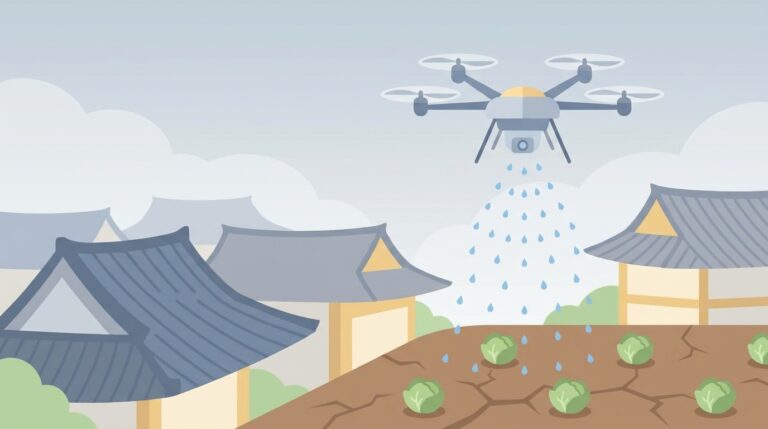
Picture this: You’re watching a historical K-Drama (사극, sageuk). The king is kneeling in the dirt, robes soiled, looking up at a relentless, scorching sun. He’s performing a Giuje (기우제), a traditional rainmaking ritual, begging the heavens for a single drop of water to save his dying kingdom from a catastrophic drought. Fast forward to modern-day Seoul. Instead of the king in the courtyard, we have meteorologists deploying cloud-seeding aircraft over the Yellow Sea, trying to artificially induce rain to wash away severe fine dust and rescue plummeting crop yields.
At a C2 (Advanced) level, your Korean needs to evolve beyond saying, “오늘은 비가 오네요” (It’s raining today). In Korean society, weather isn’t just small talk; it dictates the national mood, drives the economy (wait until you hear about the “Cabbage Crisis”), and pushes technological innovation. Today, we’re going to master the high-level vocabulary used in news broadcasts, corporate boardrooms, and deep social discussions regarding climate technology, specifically artificial rain (인공 강우) and drought resolution (가뭄 해갈).
Are you ready to sound like a native Korean intellectual? Let’s dive in.
Phase 2: Core Expressions Deep Dive
1. 인공 강우 (Artificial Rain / Cloud Seeding)
- Pronunciation: [in-gong gang-u] Sounds like: in-gong (in-gong) gahng-oo
- Meaning: Artificial precipitation / Cloud seeding.
- K-Culture Moment: You’ll hear this constantly on the 8 PM News during spring and winter, not just for drought, but as a high-tech countermeasure against Korea’s infamous fine dust (미세먼지) seasons.
- Editor’s Insight: ‘인공’ means artificial, and ‘강우’ means rainfall. It sounds highly academic, but it’s common public knowledge in Korea due to the intense national focus on air quality and agriculture.
- Situation Spectrum:
- Casual chatting: ⚠️ (A bit formal, but used when discussing news)
- Office / News discussions: ✅
- Formal presentations: ✅
- 🤔 Think About It: Why does a relatively small country like South Korea invest so heavily in weather-manipulation tech? How does geographic vulnerability shape a nation’s scientific priorities?
2. 가뭄 해갈 (Resolving the drought)
- Pronunciation: [ga-mum hae-gal] Sounds like: gah-moom heh-gahl
- Meaning: Relieving or quenching a drought.
- K-Culture Moment: Used by politicians and farmers on TV. “해갈” literally means quenching a deep thirst.
- Editor’s Insight: This is a fantastic C2 word. Instead of saying “가뭄이 끝났어요” (The drought ended), using “가뭄이 해갈되었습니다” instantly elevates your Korean to a professional, native-like standard.
- Situation Spectrum:
- Casual chatting: 🚫 (Too literary for a pub)
- News / Formal writing: ✅
- Business discussions: ✅
- 🤔 Think About It: “해갈” is often used metaphorically. Can you think of a situation in your life where a long-standing “thirst” for something was finally quenched?
3. 가뭄에 콩 나듯 (Like beans sprouting in a drought)
- Pronunciation: [ga-mu-me kong na-deut] Sounds like: gah-moo-meh kong nah-deut
- Meaning: Literal: Like beans sprouting during a drought. Real: Very rarely; once in a blue moon.
- K-Culture Moment: You’re waiting for your favorite K-Pop idol to post on Instagram, but they are notoriously inactive. A Korean fan might say, “우리 오빠는 셀카를 가뭄에 콩 나듯 올려요” (Our oppa posts selfies like beans sprouting in a drought).
- Editor’s Insight: This idiom perfectly connects Korea’s agrarian past (droughts destroying crops) with modern everyday complaints about rarity.
- Situation Spectrum:
- Casual chatting: ✅
- Office / Semi-formal: ✅
- Formal presentations: ⚠️ (Depends on the tone)
- 🤔 Think About It: Agricultural metaphors are deeply embedded in Korean idioms. Does your native language have idioms based on farming or weather phenomena?
4. 단비 (Welcome rain / Sweet rain)
- Pronunciation: [dan-bi] Sounds like: dahn-bee
- Meaning: Much-needed, welcome rain that ends a drought.
- K-Culture Moment: You’ll hear this in poetic K-Pop ballads or K-Drama dialogue. “너는 내 인생의 단비 같아” (You are like the sweet rain in my life).
- Editor’s Insight: It literally translates to “sweet rain.” It’s used both meteorologically and metaphorically to describe a perfect, timely solution to a desperate problem.
- Situation Spectrum:
- Casual chatting: ✅
- Literary / Poetic: ✅
- Formal News: ✅
Phase 3: Textbook vs. Real Korean
[Situation 1: Discussing a rare occurrence]
* 📖 Textbook Korean: 그런 일은 아주 가끔 일어납니다. (That happens very rarely.)
* 🗣️ Real Korean: 그런 일은 진짜 가뭄에 콩 나듯 해요. (That happens like beans sprouting in a drought.)
* 💡 Why the difference?: Advanced speakers use idioms (관용어) to add color, emotion, and historical context to their speech, rather than just stating facts.
[Situation 2: Reacting to a much-needed solution]
* 📖 Textbook Korean: 이것은 우리 회사에 좋은 해결책입니다. (This is a good solution for our company.)
* 🗣️ Real Korean: 와, 이건 우리 팀에 완전 단비 같은 소식이네요! (Wow, this is like sweet rain for our team!)
* 💡 Why the difference?: Koreans love emotional resonance in the workplace. Comparing a budget approval to “sweet rain” shows empathy and relief.
[Situation 3: Reading the news about cloud seeding]
* 📖 Textbook Korean: 기술로 비를 만듭니다. (They make rain with technology.)
* 🗣️ Real Korean: 인공 강우 기술로 가뭄 해갈을 시도하고 있대요. (I heard they are attempting to resolve the drought with artificial rain technology.)
* 💡 Why the difference?: Utilizing Sino-Korean vocabulary (한자어) like 인공 강우 and 해갈 is essential for participating in adult, intellectual discourse in Korea.
Phase 4: Cultural Context — K-Culture Deep Dive
4-1. Non-Verbal Cues: The Sky-Staring Sigh
When discussing droughts or fine dust in Korea, there is a collective, non-verbal routine. People will look out the window at the hazy, yellow-gray sky, let out a deep sigh (한숨), and slightly shake their heads. This shared physical expression of frustration reflects the Korean concept of Nunchi (눈치)—reading the room. When everyone is collectively worried about the weather, expressing toxic positivity (“But it’s so warm!”) shows a lack of Nunchi.
4-2. The K-Food Connection: The “Gold Cabbage” Crisis
Why is artificial rain a national priority? Enter K-Food. A severe drought in Korea doesn’t just mean empty reservoirs; it means a national culinary crisis. When there’s no rain, the cabbage (배추) harvest fails. Suddenly, the price of cabbage skyrockets. The media starts calling it 금배추 (Gold Cabbage).
Because making Kimchi (Kimjang) in late autumn is a deeply ingrained cultural necessity, a cabbage shortage feels like a national emergency. Therefore, investing in 인공 강우 isn’t just about agriculture—it’s about protecting the very identity of the Korean dining table.
Phase 5: Real-Life Roleplay Scenario
Setting: It’s a hazy Thursday afternoon. You and your Korean colleagues are at a sleek cafe in Yeouido, Seoul’s financial district. You’re looking out the window, but you can barely see the National Assembly building through the dry, dusty air. The region hasn’t seen rain in over a month.
Characters:
– YOU (The Reader): An expat manager, fluent in Korean, working at a tech firm in Seoul.
– Min-su (35): Your tech-savvy, slightly cynical colleague.
– Ji-eun (40): Your pragmatic team leader who loves cooking.
Dialogue:
Min-su: 아, 진짜 하늘 좀 보세요. 먼지 때문에 숨을 못 쉬겠어요.
(A, jinjja haneul jom boseyo. Meonji ttaemune sumeul mot swigesseoyo.)
[Ah, seriously, look at the sky. I can’t breathe because of the dust.]
(🎭 Stage Direction: Min-su taps his iced Americano nervously.)
Ji-eun: 그러니까요. 비가 와야 이 미세먼지도 씻겨 내려가고 가뭄도 해갈될 텐데.
(Geureonikkayo. Biga waya i misemeonjido ssitgyeo naeryeogago gamumdo haegaldoel tende.)
[Exactly. We need rain to wash away this fine dust and resolve the drought.]
YOU: 뉴스 보니까 정부에서 인공 강우 실험을 더 늘린다고 하더라고요.
(Nyuseu bonikka jeongbueseo ingong gangu sireomeul deo neullindago hadeoragoyo.)
[I saw on the news that the government is increasing artificial rain experiments.]
Min-su: 인공 강우요? 에이, 그거 아직 실효성이 없지 않나요? 가뭄에 콩 나듯 찔끔 내리고 말던데.
(Ingong ganguyo? Ei, geugeo ajik silhyoseongi eopji annayo? Gamume kong nadeut jjilkkeum naerigo maldeonde.)
[Artificial rain? Hey, isn’t that still ineffective? It just trickles down like beans sprouting in a drought and stops.]
Ji-eun: 그래도 뭐라도 해야죠. 지금 농가 피해가 장난 아니에요. 배추값이 금값이라니까요!
(Geuraedo mworado haeyajyo. Jigeum nongga pihaega jangnan anieyo. Baechugapsi geumgapsiranikkayo!)
[Still, they have to do something. The damage to farms right now is no joke. The price of cabbage is like gold!]
🔀 Your Turn! How do you respond?
– A) “비가 빨리 오면 좋겠네요.” (I hope it rains soon. – A bit too simple for C2.)
– B) “맞아요, 빨리 단비가 내려서 금배추 사태가 해결되어야 할 텐데요.” (Right, I hope the sweet rain falls soon so the gold cabbage crisis can be resolved.)
– C) “농부들이 기우제를 지내야겠네요.” (The farmers should hold a rainmaking ritual. – A bit sarcastic/historical, might sound awkward.)✅ Best Choice: B — You successfully combine the poetic/advanced term “단비” with the socio-economic reality of “금배추” (Gold Cabbage). It shows deep empathy and high-level cultural understanding. Ji-eun will be highly impressed.
Ji-eun: 어머, OO씨 한국 사람 다 됐네요! 맞아요. 제발 단비가 내렸으면 좋겠어요.
(Eomeo, OO-ssi hanguk saram da dwaenneyo! Majayo. Jebal danbiga naeryeosseumyeon jokesseoyo.)
[Oh my, you’ve become completely Korean! Exactly. I really hope the sweet rain falls.]
Phase 6: 10-Second Shadowing Drill
Time to get your mouth muscles moving. Practice this high-level news commentary phrase!
😤 인공 강우가 / 가뭄 해갈에 / 실질적인 대안이 / 될 수 있을까요?
(ingong ganguga / gamum haegare / siljiljeogin daeani / doel su isseulkkayo?)
[Can artificial rain be a practical alternative for resolving the drought?]
Shadowing Tip: Emphasize ‘인공’ and ‘해갈’. Pause briefly at the slashes (/). Speak with a tone of intellectual curiosity, like a news anchor asking a panel expert.
Phase 7: K-Culture Mini Dictionary
1. 미세먼지
* Romanization: mise-meonji
* English: Fine dust / Particulate matter
* Context: The driving force behind many of Korea’s weather tech innovations. It’s a daily conversation topic from March to May.
2. 기우제
* Romanization: giuje
* English: Rainmaking ritual
* Context: A traditional shamanistic or royal ritual praying for rain. Used metaphorically today when people are desperately hoping for an unlikely outcome.
3. 금배추 / 금사과
* Romanization: geum-baechu / geum-sagwa
* English: Gold cabbage / Gold apple
* Context: A socio-economic slang used when climate disasters (drought, extreme heat) cause the prices of staple foods to skyrocket.
4. 장마
* Romanization: jangma
* English: East Asian monsoon season
* Context: The intense rainy season in summer. Ironically, despite having a monsoon season, Korea frequently suffers from spring droughts, making water management a tricky science.
Phase 8: Traveler’s Survival Kit
Even if you aren’t debating cloud seeding on your trip, extreme weather and poor air quality are real factors when visiting Korea.
🆘 Survival Expression #1: Checking Air Quality
– 🇰🇷 “오늘 미세먼지 농도 어때요?” (oneul misemeonji nongdo eottaeyo?)
– 🗣️ English: How is the fine dust concentration today?
– 📍 Where to use: Asking hotel concierges or local friends before heading out.
– 💡 Pro Tip: Download apps like “MiseMise (미세미세)”. It uses simple icons (from a smiling face to a gas mask) to tell you if you need an N95 mask today.📌 Editor’s Travel Note
– Mask Culture: In Korea, wearing a mask when the air is bad (or when you have a cold) is considered basic etiquette, long before global pandemics.
– Weather Apps: Don’t rely solely on global weather apps. The local app Naver Weather is far more accurate for micro-climates and fine dust alerts in Korea.
Phase 9: Critical Thinking Corner — “One Step Deeper”
🧠 Think Deeper: Global Era & Technological Pragmatism (빨리빨리 meets Mother Nature)
Why doesn’t Korea just accept the drought and wait for the rain? The Korean pursuit of 인공 강우 (Artificial Rain) perfectly illustrates the intersection of the Ppalli-Ppalli (hurry up) culture and high-tech pragmatism. Traditionally, Koreans viewed nature as something to harmoniously endure (hence the Giuje). Today, however, waiting is seen as inefficient. Whether it’s laying down fiber-optic cables overnight or shooting silver iodide flares into clouds to force rainfall, modern Korean society believes that every problem—even Mother Nature’s moods—has an immediate, engineered solution. This reflects a society that refuses to be passive in the face of adversity.
💬 Your Turn: How does your culture handle extreme weather? Is there a push for high-tech manipulation, or is it treated as “an act of God” to simply endure? Share your thoughts in the comments!
Phase 10: FAQ & Avoiding Mistakes
❌ Common Mistake #1: Using “가뭄” (drought) to describe being thirsty.
– If you are thirsty after a run, do NOT say “제가 가뭄이에요” (I am a drought). Say “목이 말라요” (I am thirsty). “가뭄” is strictly for environmental phenomena or metaphorical lack of resources.
Q: Can I use “단비” (Sweet rain) for non-weather situations?
Yes! Absolutely. If your team is overworked and the boss suddenly announces a surprise bonus, you can say, “완전 단비 같은 보너스네요!” (It’s a totally sweet-rain-like bonus!). It shows incredible fluency.
Q: Is it polite to talk about politics regarding climate tech at work?
At a C2 level, discussing the effectiveness of government policies (like cloud seeding) is common among colleagues. However, avoid heavily blaming specific political parties; focus on the technology and the economic impact (like the price of cabbage).
Phase 11: Summary & Action Items
- One-Liner Summary: Today we leveled up from simple weather talk to discussing high-tech climate solutions using C2-level terms like 인공 강우 (cloud seeding) and 가뭄 해갈 (drought resolution).
-
Action Mission 3-Step:
- 🥉 Bronze (Solo): Read the Shadowing Drill sentence aloud 3 times, focusing on an intellectual, news-anchor tone.
- 🥈 Silver (Online): Go to YouTube, search “한국 인공 강우 뉴스” (Korea artificial rain news), and try to catch the words “해갈” or “단비” in the broadcast.
- 🥇 Gold (Real Life): Next time there’s a problem that finally gets solved, impress your Korean friends by saying, “와, 진짜 단비 같은 소식이네요!”
- K-Culture Mission: Go to a Korean supermarket (or look online) and check the price of a whole napa cabbage (배추). If it’s over 5,000 KRW, you are witnessing the effects of climate on K-Food first-hand!
Phase 12: Quiz — Interactive Challenge
1. Situational Judgment: Your favorite indie band hasn’t released an album in 4 years. They just dropped a single track. What is the most natural Korean reaction?
– A) 가뭄이 해갈되었어요.
– B) 신곡이 가뭄에 콩 나듯 나오네요.
– C) 비가 많이 와요.
2. True or False – K-Culture Edition: “When there is a severe spring drought in Korea, it rarely makes national news because the country doesn’t rely on agriculture anymore.”
– True or False?
3. Fill in the Blank:
“오랜 가뭄 끝에 내린 ( _____ ) 덕분에 농작물 피해를 줄일 수 있었습니다.”
[Thanks to the ( _____ ) that fell after the long drought, we were able to reduce crop damage.]
🚨 Click here for the answers!
1. B (They release new songs like beans sprouting in a drought – very rarely.)
2. False (It makes huge news because it directly affects the price of cabbage for Kimchi, leading to the “Gold Cabbage” crisis!)
3. 단비 (Welcome/sweet rain).
Did you get them all right? Keep practicing, and soon you’ll be discussing Korean climate tech like a native! See you in the next Daily Hangul module!
Frequently Asked Questions (FAQ)
Q: What does "인공 강우 (Artificial Rain / Cloud Seeding)" mean in Korean and how do you pronounce it?
A: In Korean, "인공 강우 (Artificial Rain / Cloud Seeding)" is pronounced [in-gong gang-u] and means: Artificial precipitation / Cloud seeding.
Q: What does "가뭄 해갈 (Resolving the drought)" mean in Korean and how do you pronounce it?
A: In Korean, "가뭄 해갈 (Resolving the drought)" is pronounced [ga-mum hae-gal] and means: Relieving or quenching a drought.
Q: What does "가뭄에 콩 나듯 (Like beans sprouting in a drought)" mean in Korean and how do you pronounce it?
A: In Korean, "가뭄에 콩 나듯 (Like beans sprouting in a drought)" is pronounced [ga-mu-me kong na-deut] and means: Literal: Like beans sprouting during a drought. Real: Very rarely; once in a blue moon.
Q: What does "단비 (Welcome rain / Sweet rain)" mean in Korean and how do you pronounce it?
A: In Korean, "단비 (Welcome rain / Sweet rain)" is pronounced [dan-bi] and means: Much-needed, welcome rain that ends a drought.







