

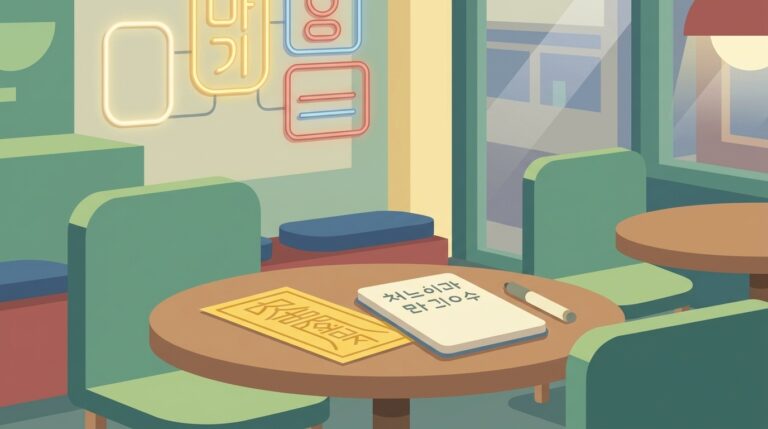
Phase 1: Empathy — The K-Drama Mystery Unfolded
Hello! I’m your Lead Editor from Daily Hangul. Have you ever watched a K-Drama and noticed a scene right before a big exam or a dangerous mission? The overprotective mother secretly slips a tiny, folded piece of yellow paper with weird red ink into the main character’s backpack or wallet. The subtitles usually just say [Amulet] or [Talisman].
But what exactly is that yellow paper? And why do Koreans—who live in one of the most technologically advanced countries in the world, with 5G everywhere—still rely on it?
Today, we are diving deep into the fascinating world of Korean superstitions, fortune-telling, and the phrase ‘부적을 가지고 다니다’ (Carrying a talisman). Knowing this will not only help you understand K-Dramas much better, but it will also give you incredible insider knowledge when you visit places like Hongdae’s famous Saju (fortune-telling) cafes. Let’s unlock this mystery together!
Phase 2: Core Expressions Deep Dive
1. 부적을 가지고 다니다
- Pronunciation: bu-jeok-eul ga-ji-go da-ni-da (Boo-jeok-eul ga-ji-go da-nee-da)
- Meaning:
- Literal: To carry a talisman around.
- Real Nuance: To keep a lucky charm (specifically a traditional Korean paper talisman) with you for protection or good luck.
- K-Culture Moment: In the drama Goblin (도깨비) or traditional historical dramas (Sageuk), characters constantly seek out shamans to get these yellow papers. In real life, moms often get them for high school seniors taking the Suneung (College Scholastic Ability Test).
- Editor’s Insight: The grammar ‘-고 다니다’ is very important here. It means you don’t just carry it once; it’s a continuous habit. You keep it in your wallet or bag everywhere you go.
- Situation Spectrum:
- Casual with friends: ✅ (Common to share if you visited a fortune teller)
- Semi-formal (Co-workers): ⚠️ (A bit too personal unless you are close)
- Formal (Boss/Elders): 🚫 (Usually a private matter)
- 🤔 Think About It: Why do you think Koreans keep these talismans completely hidden inside wallets or pillowcases? Does keeping a wish secret make it feel more powerful?
2. 사주를 보다
- Pronunciation: sa-ju-reul bo-da (Sah-joo-reul bo-dah)
- Meaning:
- Literal: To look at the four pillars.
- Real Nuance: To get your fortune told based on your birth year, month, day, and exact time.
- K-Culture Moment: You will see countless neon signs saying ‘사주/타로’ (Saju/Tarot) in trendy spots like Hongdae or Myeongdong. It is actually a very popular date course for young couples in Korea!
- Editor’s Insight: It’s not always super serious. For many young Koreans, getting their Saju read is just for fun or to get some life advice when they are stressed about job hunting or dating.
- Situation Spectrum:
- Casual with friends: ✅
- Semi-formal: ✅ (Co-workers often joke about their Saju results)
- Formal: ⚠️
- 🤔 Think About It: In many Western cultures, astrology (Zodiac signs) is popular. How is traditional Korean Saju similar to or different from Western astrology?
3. 액땜하다
- Pronunciation: aek-ttaem-ha-da (Ak-ttam-ha-dah. The ‘ㄲ’ and ‘ㄸ’ are strong, tense sounds!)
- Meaning:
- Literal: To pay off misfortune.
- Real Nuance: To experience a small bit of bad luck now, which prevents a much bigger tragedy from happening later. It’s a way of comforting someone.
- K-Culture Moment: If you drop your new phone and the screen cracks, your Korean friend might say, ‘액땜했다고 생각해!’ (Just think of it as taking the hit to avoid something worse!). It’s the ultimate optimistic twist on a bad situation.
- Editor’s Insight: This is a fantastic ‘insider’ expression. Using this when a friend experiences a minor setback will make you sound 100% like a native Korean!
- Situation Spectrum:
- Casual with friends: ✅
- Semi-formal: ✅
- Formal: 🚫 (Do not say this to your boss if they lose a big contract!)
Phase 3: Textbook vs. Real Korean
[Carrying the Talisman]
* 📖 Textbook Korean: 저는 지갑 안에 부적을 가지고 다닙니다. (I carry a talisman inside my wallet.)
* 🗣️ Real Korean: 나 지갑에 부적 넣고 다녀. (I carry a bujeok in my wallet.)
* 💡 Why the difference?: Koreans love efficiency! In spoken Korean, subject particles (‘는’) and object particles (‘을’) are often dropped. Also, ‘넣고 다녀’ (put in and carry) sounds much more natural than just ‘have and carry’.
[Wishing Someone Good Luck]
* 📖 Textbook Korean: 행운을 빕니다. (I wish you good luck.)
* 🗣️ Real Korean: 대박 나세요! (Hit the jackpot!) or 화이팅! (Fighting!)
* 💡 Why the difference?: ‘행운을 빕니다’ sounds like a translated English movie subtitle. ‘대박’ (Daebak) is the go-to cultural slang for wishing immense success.
Bottom Note: For B1 (Intermediate) learners, getting comfortable dropping particles and using natural verbs like ‘-고 다니다’ is the key to sounding less like a robot and more like a friend!
Phase 4: Cultural Context — K-Culture Deep Dive
4-1. The Non-Verbal Rule of the Bujeok
If you ever receive a bujeok or see one, there is a very strict non-verbal rule: Do not unfold it. The yellow paper is usually folded tightly into a small triangle or rectangle. Korean superstition dictates that if you open it to read the red ink, the magic escapes and it becomes useless. So, if a Korean friend shows you their talisman, simply look at the folded paper and say, ‘Wow!’ Do not try to open it!
4-2. The Suneung (CSAT) Phenomenon
In K-Dramas like SKY Castle or Crash Course in Romance, you see the intense pressure of Korean education. During November, when the national college entrance exam (Suneung) happens, shamans and Buddhist monks work overtime. Mothers buy bujeok for thousands of dollars and secretly stitch them inside their children’s school uniforms or hide them under their pillows.
Critical View: While dramas sometimes exaggerate this, the core truth remains—in a hyper-competitive society, a paper talisman provides immense psychological comfort to nervous parents who feel powerless.
Phase 5: Real-Life Roleplay Scenario
Setting: Friday evening, 8 PM. You and your Korean friend Min-su are walking down the vibrant streets of Hongdae. You just walked out of a tiny, dimly lit cafe with a neon sign that says ‘Saju & Tarot’.
Characters:
– YOU: An intermediate Korean learner exploring Hongdae for the first time.
– Min-su: (28, your Korean language exchange partner, very trendy and open-minded)
Dialogue:
Min-su: 와, 아까 그 사주 선생님 진짜 잘 맞추지 않아? 소름 돋았어.
(wa, akka geu saju seonsaengnim jinjja jal matchuji ana? soreum dodasseo.)
[English] Wow, wasn’t that fortune teller so accurate earlier? I got goosebumps.
YOU: 진짜요! 저도 깜짝 놀랐어요. 근데 민수 씨, 아까 선생님이 준 종이는 뭐예요?
(jinjja-yo! jeodo kkamjjak nollasseoyo. geunde min-su ssi, akka seonsaengnimi jun jong-ineun mwoyeyo?)
[English] Really! I was surprised too. But Min-su, what was that paper the teacher gave you earlier?
Min-su: 아, 이거? 올해 취업 운 좋게 해주는 부적이야.
(a, igeo? olhae chwieop un joke haejuneun bujeogiya.)
[English] Ah, this? It’s a talisman to bring me good luck for job hunting this year.
(🎭 Stage Direction: Min-su carefully pulls out his wallet and shows a small, folded yellow paper tucked inside.)
Min-su: 이렇게 지갑에 부적을 가지고 다녀야 효과가 있대.
(ireoke jigabe bujeogeul gajigo danyeoya hyogwaga itdae.)
[English] They say you have to carry the talisman in your wallet like this for it to work.
🔀 YOUR TURN! How should you respond?
– A) 어? 안에 뭐라고 쓰여 있어요? 한 번 열어봐도 돼요?
(Huh? What is written inside? Can I open it once?)
– B) 우와, 신기해요! 민수 씨 올해 꼭 취업할 거예요. 화이팅!
(Wow, fascinating! You will definitely get a job this year. Fighting!)
– C) 에이, 그런 미신을 진짜 믿어요?
(Come on, do you really believe in such superstitions?)✅ Best Choice: B — Reason: It acknowledges the cultural item respectfully and offers encouragement.
⚠️ Choice A Analysis: Big mistake! Opening a bujeok breaks the ‘magic’. Min-su will definitely panic!
⚠️ Choice C Analysis: Even if young Koreans know it’s just a superstition, they do it for peace of mind. Calling it out so bluntly can kill the mood.
YOU: 우와, 신기해요! 민수 씨 올해 꼭 취업할 거예요. 화이팅!
(uwa, singihaeyo! min-su ssi olhae kkok chwieopal geoyeyo. hwaiting!)
[English] Wow, fascinating! You will definitely get a job this year. Fighting!
Min-su: 고마워! 취업하면 내가 맛있는 거 쏠게!
(gomawo! chwieopamyeon naega masinneun geo ssolge!)
[English] Thanks! If I get a job, I’ll treat you to something delicious!
Phase 6: 10-Second Shadowing Drill
Practice this sentence to sound incredibly natural. Pay attention to the pauses (/) and the emotion!
😊 저는 / 지갑에 / 부적을 넣고 다녀요!
(jeo-neun / ji-gab-e / bu-jeog-eul / neo-ko da-nyeo-yo!)
Make sure ‘넣고’ sounds like [너코/neo-ko], not [넏고]! Keep your voice bright and conversational.
Phase 7: K-Culture Mini Dictionary
1. 부적 (Bujeok)
* Romanization: bu-jeok
* English: Paper talisman / Amulet
* Context: A yellow paper with red symbols or characters. Created by shamans or monks to ward off evil or bring specific luck (wealth, health, passing exams).
2. 사주 (Saju)
* Romanization: sa-ju
* English: Four Pillars of Destiny (Fortune Telling)
* Context: Based on your birth year, month, day, and time. Many Koreans check their Saju at the start of a new year to see their upcoming luck.
3. 무당 (Mudang)
* Romanization: mu-dang
* English: Korean Shaman
* Context: Traditional spiritual leaders who perform rituals (Gut) and create bujeok. You will see them heavily featured in K-Thriller movies like The Wailing (곡성) or Exhuma (파묘).
4. 미신 (Misin)
* Romanization: mi-sin
* English: Superstition
* Context: Beliefs like not writing a name in red ink, or sleeping with a fan on in a closed room (Fan Death).
Phase 8: Traveler’s Survival Kit
Are you planning to visit a Saju Cafe in Hongdae or Myeongdong? Here are your survival phrases!
🆘 Survival Phrases for Saju Cafes
– 🇰🇷 ‘사주 봐주세요.’ (saju bwajuseyo.)
– 🗣️ English: Please read my Saju (fortune).
– 📍 Where to use: As soon as you sit down in the cafe.
– 💡 Pro Tip: You absolutely MUST know your exact time of birth (e.g., 2:30 PM). Without the time, Saju is incomplete!🆘 Survival Phrase #2
– 🇰🇷 ‘연애운은 어때요?’ (yeonae-uneun eottaeyo?)
– 🗣️ English: How is my romantic luck?
– 📍 Where to use: When asking specific questions. You can replace ‘연애’ (romance) with ‘재물’ (wealth) or ‘직장’ (career).📌 Editor’s Travel Note
– Language Barrier: Many Saju cafes now have readers who speak English, Japanese, or Chinese, especially in tourist areas like Itaewon or Hongdae. Look for signs that say ‘English Tarot/Saju’.
– Payment: These small tents or cafes often prefer cash or account transfers. It’s safe to bring about 30,000 to 50,000 KRW in cash just in case!
Phase 9: Critical Thinking — ‘One Step Deeper’
🧠 Think Deeper: Media vs. Reality & The Psychology of Superstition
It might seem contradictory that South Korea, a global leader in AI, smartphones, and pop culture, still has a thriving multi-million dollar industry based on shamans and paper talismans. But if we look closer, it perfectly reflects the extreme pressures of modern Korean society. In a world where one exam (Suneung) or one job interview can define your entire social status, people experience intense anxiety. A bujeok isn’t necessarily about rejecting science; it is a profound psychological safety net. It represents the desperate hope of a mother or the self-comfort of a job seeker saying, ‘I have done absolutely everything I can, even asking the heavens for help.’
💬 Your Turn: Does your culture have a similar item or practice that people rely on when they are extremely stressed or nervous about the future? Share it in the comments below!
Phase 10: FAQ & Avoiding Mistakes
Q: If I get a bujeok, can I show it to people?
Maybe. You can tell them you have it and quickly show the folded paper, but DO NOT unfold it. Koreans believe unfolding it ruins the spell.
Q: Do young Gen Z Koreans really care about Saju and Bujeok?
Yes and no. They treat Saju mostly as entertainment, like a personality test (similar to MBTI). But when times get really tough (like searching for a job for years), even modern youths might quietly tuck a bujeok into their wallets.
❌ Common Mistake #1: Calling a Saju reader a ‘무당’ (Mudang/Shaman) directly to their face in a cafe.
✅ Do this instead: In a Saju cafe, they study ancient texts, they don’t necessarily channel spirits. Always call them ‘선생님’ (Seon-saeng-nim / Teacher) to show respect!
Phase 11: Summary & Action Items
- One-Liner Summary: A bujeok (부적) is a traditional Korean talisman carried in wallets for good luck, reflecting the human desire for comfort in a highly competitive society.
Action Mission 3 Steps:
– 🥉 Bronze (Solo): Stand in front of a mirror and say, ‘저는 지갑에 부적을 넣고 다녀요’ three times with a natural rhythm.
– 🥈 Silver (Online): Find your birth time today and look up your ‘Korean Saju’ online.
– 🥇 Gold (Real World): Next time a friend has bad luck, use the phrase ‘액땜했다고 생각해!’ (Think of it as preventing worse luck!) to comfort them.
🎬 K-Culture Mission:
Watch a historical K-Drama (like The Moon Embracing the Sun or Alchemy of Souls) this weekend and try to spot the yellow bujeok paper. You’ll be surprised how often they appear once you know what they are!
Did you enjoy today’s lesson? Have you ever had your fortune read in Korea? Let me know in the comments! 👇
Phase 12: Quiz — Interactive Challenge
1. Situational Judgment:
Your Korean friend opens their wallet to pay for coffee, and a small, folded yellow piece of paper with red ink falls out. What is the BEST thing to do?
– A) Quickly grab it, unfold it, and read what it says.
– B) Say, ‘Oh, is that a bujeok? I hope it brings you good luck!’
– C) Laugh and say, ‘You believe in magic?’
(Answer: B. Never unfold a bujeok, and always respect their cultural beliefs!)
2. Fill in the Blank:
저는 부적을 지갑에 (____) 다녀요.
(Answer: 넣고. ‘넣고 다녀요’ means ‘put it in and carry it around’.)
3. True or False — K-Culture Edition:
In a Saju (fortune-telling) cafe, you only need to know your birth date, not the time.
(Answer: FALSE. To get an accurate Saju reading, the exact time of birth is crucial!)
Frequently Asked Questions (FAQ)
Q: What does "부적을 가지고 다니다" mean in Korean and how do you pronounce it?
A: In Korean, "부적을 가지고 다니다" is pronounced [bu-jeok-eul ga-ji-go da-ni-da (Boo-jeok-eul ga-ji-go da-nee-da] and means: Literal: To carry a talisman around.
Q: What does "사주를 보다" mean in Korean and how do you pronounce it?
A: In Korean, "사주를 보다" is pronounced [sa-ju-reul bo-da (Sah-joo-reul bo-dah] and means: Literal: To look at the four pillars.
Q: What does "액땜하다" mean in Korean and how do you pronounce it?
A: In Korean, "액땜하다" is pronounced [aek-ttaem-ha-da (Ak-ttam-ha-dah. The 'ㄲ' and 'ㄸ' are strong, tense sounds!] and means: Literal: To pay off misfortune.







