

Phase 1: Empathy (The Cold Open)
Hello! I am the Lead Editor of Daily Hangul, your personal veteran tutor and local culture navigator.
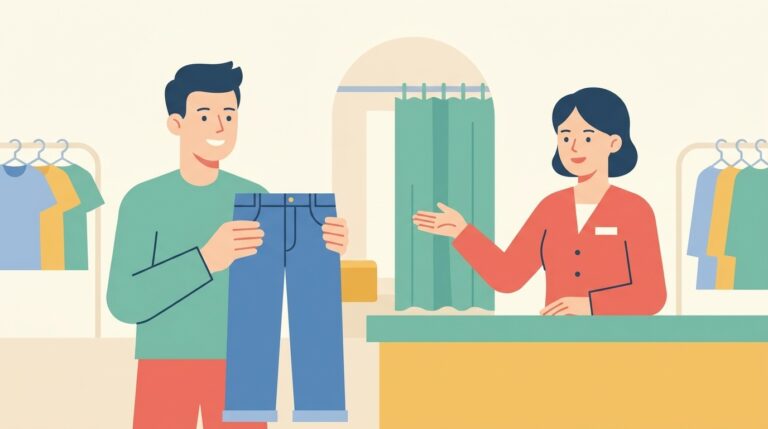
Picture this: You are exploring the vibrant streets of Hongdae, neon lights flashing around you. You walk into a trendy boutique, just like the ones you’ve seen in your favorite K-Dramas during those iconic ‘makeover’ montages. You spot the perfect pair of jeans. You grab them, excited, but then… you look at the tag. There are no numbers you recognize. Or worse, it just says “F”. You look up at the store clerk, they smile at you, and your mind goes completely blank. How do you ask for your size?
If you’ve ever felt that mild panic while shopping in Korea, trust me, you are not alone! Many of my students come to me after a weekend in Seoul saying, “Teacher, I couldn’t buy the pants because I didn’t know how to ask if they had my size!”
Today, we are going to fix that. This guide is built on real questions from real learners. By the end of this post, you won’t just be buying pants—you’ll be shopping with the confidence of a true Seoul local!
Phase 2: Deep Dive into Core Expressions
Let’s master the 3 golden phrases you need for pants shopping.
1. 이거 M 사이즈 있어요?
- Pronunciation: igeo em saijeu isseoyo? [ee-guh M size ee-ssuh-yo?]
- Meaning: Do you have this in size M?
- K-Culture Moment: You will hear this constantly in underground shopping malls like Goto Mall or Gangnam Station. Shoppers hold up an item and make eye contact with the busy clerk, politely asking this to check inventory.
- Editor’s Insight: The word 이거 (this) is your best friend in Korea! Just point to the pants and say this phrase. You can replace ‘M’ with your waist size in inches (e.g., 28 – 이십팔, though many clerks understand English numbers for sizes!).
- Situation Spectrum:
- Casual with friends: ✅ (Drop ‘요’: 이거 M 사이즈 있어?)
- To store clerks (Polite): ✅
- Formal/Elders: ⚠️ (Use proper titles, but for shopping, the ‘요’ form is perfect)
- 🤔 Think About It: Why do Koreans use English words like ‘사이즈’ (size) instead of a native Korean word? It shows how deeply Western fashion and global trade have influenced modern Korean daily life!
2. 입어봐도 돼요?
- Pronunciation: ibeobwado dwaeyo? [ee-buh-bwa-do dway-yo?]
- Meaning: Can I try this on?
- K-Culture Moment: In K-Dramas, the wealthy male lead usually sits on a luxurious sofa while the female lead tries on 20 different outfits. Before going into that fitting room, she has to ask the staff this very question!
- Editor’s Insight: Korean pronunciation tip! ‘입어’ sounds like ‘ee-buh’. Don’t separate the words; let them flow together like water. Always ask before trying things on in Korea, as some stores have strict rules.
- Situation Spectrum:
- Casual with friends: 🚫 (You wouldn’t ask a friend this unless borrowing their clothes)
- To store clerks (Polite): ✅
- 🤔 Think About It: Korean culture values permission and respecting boundaries. Asking “Is it okay if I…” (해도 돼요?) is a core part of being polite in Korean society.
3. 허리가 너무 작아요.
- Pronunciation: heoriga neomu jagayo. [huh-ree-ga nuh-moo ja-ga-yo.]
- Meaning: The waist is too small.
- K-Culture Moment: You know those massive Korean BBQ dinners (회식)? If you eat too much pork belly (삼겹살), you might be saying this phrase the next day when putting on your jeans!
- Editor’s Insight: ‘허리’ means waist. If it’s too big, you say ‘커요’ (keoyo). Koreans appreciate specific feedback so they can bring you a better option.
- Situation Spectrum:
- To store clerks (Polite): ✅
Phase 3: Textbook vs. Real Korean
[When asking for a size]
* 📖 Textbook Korean: 바지 사이즈가 어떻게 되십니까? (What is the pants size? – Very formal)
* 🗣️ Real Korean: 이거 28 (이십팔) 있어요? (Do you have this in 28?)
* 💡 Why the difference?: Textbooks teach the highly formal ‘비니다/십니까’ form for business, but in busy retail, efficiency and friendly politeness (‘요’ form) are preferred!
[When you want to try it on]
* 📖 Textbook Korean: 이것을 입어 보아도 되겠습니까? (Would it be acceptable to try this on?)
* 🗣️ Real Korean: 피팅룸 어디예요? (Where is the fitting room?) or 입어봐도 돼요? (Can I try it on?)
* 💡 Why the difference?: Spoken Korean loves to drop object markers (을/를) and shorten words. ‘피팅룸’ (Fitting room) is universally understood.
Bottom Note: As an A2 learner, stick to the ‘요’ (yo) ending. It is perfectly polite and natural for any shopping situation!
Phase 4: Cultural Context — K-Culture Deep Dive
4-1. Non-verbal Elements: The Art of Nunchi
When shopping in Korea, Nunchi (눈치)—the ability to read the room—is crucial.
– Hand Gestures: When handing the pants back to the clerk, use two hands or lightly support your right elbow with your left hand. It shows respect!
– Eye Contact: Don’t stare intensely, but a warm smile and a slight bow of the head when saying “Thank you” (감사합니다) goes a long way.
4-2. K-Travel & K-Fashion Link
If you are shopping in famous underground malls (like Gangnam Station or Express Bus Terminal’s Goto Mall), be aware of the fast-paced environment. These places are treasure troves for K-Fashion, heavily influenced by K-Pop idol airport fashion.
Critical Perspective: While K-Pop idols look flawless in their perfectly tailored outfits, everyday Korean street fashion in these markets relies heavily on “Free Size” (프리사이즈). We will discuss this more in Phase 9, but don’t be discouraged if the sizing feels very different from your home country. It’s not you; it’s a completely different sizing standard!
Phase 5: Real-Life Roleplay Scenario
Setting: Saturday afternoon at a bustling underground shopping mall in Hongdae. Upbeat K-Pop is playing from the speakers. Racks of trendy clothes are everywhere.
Characters:
– YOU: A foreign traveler who just found a great pair of wide-leg jeans.
– Clerk (점원 – Jeomwon): A friendly Korean store clerk in her 20s.
Dialogue:
Clerk: 찾으시는 거 있으세요? 😊
(chajeusineun geo isseuseyo?)
[Translation: Are you looking for anything in particular?]
YOU: 이거 한번 입어봐도 돼요?
(igeo hanbeon ibeobwado dwaeyo?)
[Translation: Can I try this on once?]
Clerk: 네! 피팅룸 저쪽이에요. 사이즈 몇 입으세요?
(ne! pitingrum jeojjogieyo. saijeu myeot ibeuseyo?)
[Translation: Yes! The fitting room is over there. What size do you wear?]
(🎭 Stage Direction: The clerk looks at the pants in your hand, waiting for your size)
🔀 Your Turn! How do you answer?
– A) “저는 미국에서 미디움을 입어요.” (I wear medium in America.)
– B) “M 사이즈 입어요. 이거 M 사이즈 있어요?” (I wear size M. Do you have this in size M?)
– C) “아무거나 주세요.” (Just give me anything.)✅ Best Choice: B — It is clear, direct, and asks the follow-up question naturally.
⚠️ Choice A Analysis: While true, Korean clerks might not know American sizing conversions off the top of their heads.
⚠️ Choice C Analysis: “Anything” might get you the wrong fit and is a bit unnatural here!
Clerk: 아, M 사이즈요? 잠시만요… 네, 여기 있습니다!
(a, em saijeuyo? jamsimanyo… ne, yeogi itseumnida!)
[Translation: Ah, size M? Just a moment… Yes, here it is!]
(After trying them on…)
YOU: 저기요… 허리가 너무 작아요. L 사이즈 있어요?
(jeogiyo… heoriga neomu jagayo. el saijeu isseoyo?)
[Translation: Excuse me… the waist is too small. Do you have an L size?]
Clerk: 아, 이 바지가 조금 작게 나왔어요. L 사이즈 드릴게요!
(a, i bajiga jogeum jakge nawasseoyo. el saijeu deurilgeyo!)
[Translation: Ah, these pants run a little small. I’ll give you an L size!]
Phase 6: 10-Second Shadowing Drill
Let’s practice! Speak out loud and follow the emotional tags and pauses.
- 🥺 Asking politely: 저기요, / 이거 / M 사이즈 있어요?
(jeogiyo, / igeo / em saijeu isseoyo?) - 😊 With a bright smile: 이거 / 입어봐도 돼요?
(igeo / ibeobwado dwaeyo?) - 😢 A bit disappointed: 허리가 / 너무 작아요.
(heoriga / neomu jagayo.)
Phase 7: K-Culture Mini Dictionary
1. 프리사이즈
* Romanization: peurisaijeu
* English: Free Size (One Size Fits All/Most)
* Context: Very common in Korean fashion. It usually translates to a standard Korean Small or Medium.
2. 피팅룸
* Romanization: pitingrum
* English: Fitting Room
* Context: Sometimes also called 탈의실 (taruisil), but “fitting room” is widely used.
3. 눈대중
* Romanization: nundaejung
* English: Eyeballing / Guessing by looking
* Context: In traditional markets (like Dongdaemun), experienced merchants will often use nundaejung to guess your size instantly just by looking at you!
4. 수선
* Romanization: suseon
* English: Alterations
* Context: Pant legs too long? Many Korean department stores and neighborhood dry cleaners (세탁소) offer cheap and incredibly fast suseon services.
Phase 8: Traveler Survival Kit
Since you’ll likely be shopping while traveling in Korea, here are the absolute must-know phrases for your wallet!
🆘 Survival Phrases TOP 3
– 🇰🇷 “이거 얼마예요?” (igeo eolmayeyo?)
– 🗣️ Pronunciation: [ee-guh ull-ma-yay-yo?]
– 📍 Where to use: Everywhere! Markets, boutiques, food stalls.
– 💡 Pro Tip: If you don’t understand the Korean numbers they say back to you, just open the calculator app on your phone and politely hand it to them. They will type the price!
- 🇰🇷 “카드 돼요?” (kadeu dwaeyo?)
- 🗣️ Meaning: Do you accept credit cards?
🇰🇷 “교환 돼요?” (gyohwan dwaeyo?)
- 🗣️ Meaning: Can I exchange this later?
📌 Editor’s Travel Note
– Cash vs Card: Korea is a “card heaven.” However, in underground shopping malls (지하상가), paying in cash (현금 – hyeongeum) or via bank transfer can sometimes get you a 10% discount!
– Trying on Clothes: Do NOT wear lipstick or heavy makeup when pulling shirts over your head. Stores will give you a face cover (페이스 커버 – a thin white mesh hood) to prevent makeup stains on clothes.
Phase 9: Critical Thinking — “One Step Deeper”
🧠 Think Deeper: Media vs Reality (The Sizing Illusion)
When we watch K-Dramas or K-Pop music videos, we see a very specific, homogenous body type. This is reflected in Korea’s unique “Free Size” (프리사이즈) culture. In many Western countries, brands pride themselves on inclusive sizing (XXS to 4XL) to celebrate diverse body shapes. In contrast, Korea’s fast-fashion industry often relies on a single “Free Size” to maximize production efficiency, reflecting a society that historically had less physical diversity and strong, unified beauty standards.
If you find that Korean pants don’t fit perfectly, don’t let it hurt your feelings! It is simply a reflection of regional manufacturing standards, not a judgment on your body.
💬 Your Turn: How does clothing sizing work in your country? Is “One Size Fits All” common, or do you have a wide range of specific sizes? Let me know in the comments!
Phase 10: FAQ & Avoiding Common Mistakes
Q: Can I use “이거 입어봐도 돼요?” to elders?
Yes! The ‘해요’ (haeyo) ending is universally polite. It is perfectly fine to use with older store owners.
Q: Can I try on white t-shirts?
Generally, NO. Many Korean boutiques have a strict “No trying on white clothes/knitwear” rule because they stain and stretch easily. Always ask first!
Q: What if I don’t know my Korean pants size?
Just tell them your waist size in inches (e.g., 28, 30, 32). The inch system is widely used for jeans and trousers in Korea.
❌ Common Mistake #1: Taking clothes straight into the fitting room without asking.
✅ Do This Instead: Always make eye contact with the clerk, hold up the item, and ask “입어봐도 돼요?” first.
Phase 11: Summary & Action Items
One-Liner Summary: To get the perfect pants in Korea, just remember to ask for your size (사이즈 있어요?) and request permission to try them on (입어봐도 돼요?).
Action Mission 3 Steps:
– 🥉 Bronze (Solo): Stand in front of your mirror with a pair of pants and say “이거 입어봐도 돼요?” 3 times with a polite smile.
– 🥈 Silver (Online): Go to a K-Fashion online store (like Musinsa) and try to find the Korean words for “Size” (사이즈) and “Waist” (허리) on the item details page.
– 🥇 Gold (Real Life): On your next trip to Korea (or at a local Korean market), use these exact phrases to ask a clerk for your size!
🎬 K-Culture Mission:
Next time you watch a K-Drama and there is a shopping scene, listen closely! Can you hear the characters using the word “사이즈” (Size)?
Did you enjoy today’s lesson? What is your favorite Korean fashion brand? Drop a comment below! 👇
Phase 12: Interactive Challenge Quiz
Test your new Daily Hangul skills!
1. Situational Judgment: You are in a Hongdae boutique. You find a pair of jeans you love, but you need a larger size. What is the MOST natural thing to say to the clerk?
– A) 바지 사이즈가 어떻게 되십니까?
– B) 이거 라지(L) 사이즈 있어요?
– C) 허리가 커요.
2. True or False – K-Culture Edition:
“It is perfectly okay to take a white t-shirt and walk straight into the fitting room without asking the clerk.”
3. Fill in the blank:
You want to try on a jacket.
“이거 _________ 돼요?” (Can I try this on?)
(Answers below!)
Click here for Answers!
- B (A is too formal and unnatural. C means the waist is too big, which doesn’t ask for a new size.)
- False! Always ask first (입어봐도 돼요?), especially for white clothes, as many stores prohibit trying them on to prevent makeup stains.
- 입어봐도 (ibeobwado)
Frequently Asked Questions (FAQ)
Q: What does "이거 M 사이즈 있어요?" mean in Korean and how do you pronounce it?
A: In Korean, "이거 M 사이즈 있어요?" is pronounced [igeo em saijeu isseoyo? [ee-guh M size ee-ssuh-yo?] and means: Do you have this in size M?
Q: What does "입어봐도 돼요?" mean in Korean and how do you pronounce it?
A: In Korean, "입어봐도 돼요?" is pronounced [ibeobwado dwaeyo? [ee-buh-bwa-do dway-yo?] and means: Can I try this on?
Q: What does "허리가 너무 작아요." mean in Korean and how do you pronounce it?
A: In Korean, "허리가 너무 작아요." is pronounced [heoriga neomu jagayo. [huh-ree-ga nuh-moo ja-ga-yo.] and means: The waist is too small.







