

Phase 1: Empathy (The Thrill of the Hunt)
Hello! I’m the lead editor of Daily Hangul.
Imagine this: You’re scrolling through TikTok or Instagram, and you see it. The legendary “Yonsei Milk Cream Bread” or the crunchy “Dubai Chocolate” that every K-Pop idol and influencer is raving about. You run to the nearest GS25 or CU, heart pounding, only to find an empty shelf with a lonely price tag. You want to ask the part-timer, “Hey, do you have any more in the back?” or “When are you getting more?”… but your mind goes blank.
Sure, you could just point and say “Eop-seo-yo?” (You don’t have it?), but we’re aiming for that B2 level fluency! Knowing the right words in a Korean convenience store (편의점 – pyeon-ui-jeom) doesn’t just get you the snack; it earns you the ultimate “Insider” (인싸) nod from the locals.
This guide is crafted from the actual tears of our students who walked away empty-handed. Let’s make sure you secure that viral dessert next time!
Phase 2: Deep Dive into Core Expressions
Here are the top 3 expressions you need for your dessert hunt.
1. 혹시 이거 재고 있나요?
- Pronunciation: [hok-si i-geo jae-go in-na-yo?] (Jaego sounds like ‘J-go’)
- Meaning: (Literal) By any chance, is there stock for this? / (Real Nuance) Do you happen to have any more of these in the back?
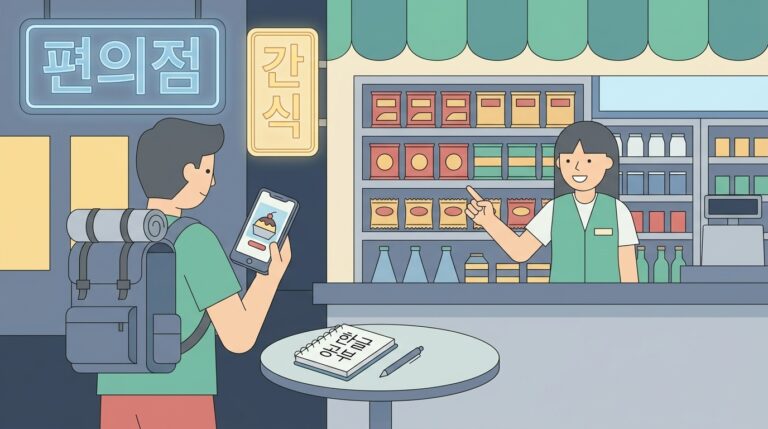
- K-Culture Moment: You show a picture of the viral snack on your phone to the staff. Adding “Hoksi” (by any chance) softens the question. It’s the polite buffer Koreans use when asking for a favor or inquiring about something uncertain.
- Editor’s Insight: This isn’t just for food! You can use this at Olive Young for sold-out lip tints or at Nike for sneakers. The word ‘재고’ (stock) makes you sound instantly fluent.
- Situation Spectrum:
- Casual (Friends): ⚠️ (Friends don’t sell you things!)
- Semi-formal (Store Staff): ✅
- Formal (Boss): 🚫
- 🤔 Think About It: Why do Koreans love using “Hoksi”? It reflects the cultural value of ‘기류’ (reading the room). It gives the listener an easy out to say “No” without feeling bad. Does your language have a “buffer word” like this?
2. 다 나갔어요 / 품절이에요
- Pronunciation: [da na-gat-seo-yo / pum-jeol-i-e-yo]
- Meaning: (Literal) It all went out / It is sold out. / (Real Nuance) We’re completely out of stock.
- K-Culture Moment: You ask for the snack, and the staff gives you a sympathetic smile and says, “아… 다 나갔어요” (Ah… da nagasseoyo). It’s the tragic phrase you’ll hear when a K-Pop idol casually mentions a snack on V-Live and it sells out nationwide.
- Editor’s Insight: While ‘품절’ (sold out) is the official word you’ll see on apps and tags, in spoken Korean, staff will almost always say “다 나갔어요” (It all went out).
- Situation Spectrum:
- Casual (Friends): ✅ (e.g., “내 멘탈 다 나갔어” – My mind is gone)
- Semi-formal (Store Staff): ✅
- Formal: ✅
- 🤔 Think About It: Koreans often use movement verbs for states of being. “Going out” means being sold. Can you think of other Korean expressions that use movement metaphorically?
3. 언제 입고되나요?
- Pronunciation: [eon-je ip-go-doe-na-yo?] (‘ip-go’ sounds like ‘eep-go’)
- Meaning: (Literal) When does it become stocked? / (Real Nuance) When does the delivery truck arrive with more?
- K-Culture Moment: Hardcore dessert hunters don’t give up. If it’s sold out, the next step is finding out the delivery schedule. This is the phrase the true ‘Pyeon-ui-jeom runners’ use.
- Editor’s Insight: ‘입고’ (arrival of goods) is a fantastic B2 vocabulary word. If you use this, the part-timer will respect your dedication and might just tell you, “Come back at 10 PM.”
- Situation Spectrum:
- Casual: 🚫
- Semi-formal (Store Staff): ✅
- Formal: ✅
- 🤔 Think About It: The suffix ‘-되다’ turns the noun ‘입고’ into a passive verb. Passive verbs are everywhere in business and formal Korean because they focus on the event, not the person doing it.
Phase 3: Textbook vs Real Korean
Let’s ditch the robotic phrases and sound like a true Seoulite.
[Situation 1: Asking if it’s sold out]
* 📖 Textbook Korean: 이것은 모두 팔렸습니까? (Is this all sold?)
* 🗣️ Real Korean: 혹시 이거 다 나갔나요? (Did this all go out?)
* 💡 Why the difference?: Using verbs like 나갔다 (went out) sounds much more natural and conversational than the rigid ‘팔리다’ (to be sold).
[Situation 2: Showing your friend a new viral dessert]
* 📖 Textbook Korean: 새로운 디저트가 나왔습니다. (A new dessert has come out.)
* 🗣️ Real Korean: 야, 이거 신상 떴어! (Hey, this new item just dropped!)
* 💡 Why the difference?: ‘신상’ (short for 신상품 – new product) is a staple slang, and ‘뜨다’ (to float/rise) is the ultimate verb for something going viral or dropping online.
[Situation 3: Expressing joy when you finally find it]
* 📖 Textbook Korean: 드디어 찾았습니다. 기쁩니다. (I finally found it. I am happy.)
* 🗣️ Real Korean: 헐 대박! 드디어 구했다! (Omg jackpot! I finally got it!)
* 💡 Why the difference?: ‘구하다’ (to obtain/rescue) emphasizes the struggle of the hunt. Finding a viral dessert is practically a rescue mission!
Bottom Note: At the B2 level, start replacing standard verbs with these situational verbs (나갔다, 구했다, 떴다) to instantly elevate your natural fluency.
Phase 4: Cultural Context — K-Culture Deep Dive
4-1. Non-verbal Communication: The Power of the Screen
When hunting for a specific item, trying to explain it in words is inefficient. The ultimate Korean “Nunchi” (눈치 – social tact) move? Have the photo of the dessert ready on your phone, hold it up slightly, and say, “혹시 이거…” (Hoksi igeo…). It saves the staff time and prevents miscommunication.
4-2. The “Open Run” & Convenience Store Apps
In Korea, we don’t just wander around hoping to find viral food. We use tech. Apps like Pocket CU or Wooridongne GS have real-time “Stock Maps” (재고 찾기).
You’ll often see K-Drama characters frantically running to the convenience store at night to grab a specific snack to cheer up a friend. In reality, they probably checked the app first!
Critical Viewpoint: This hyper-convenience shows Korea’s “Ppalli-Ppalli” (hurry up) culture. If you want to survive the viral dessert wars, you need the apps, not just luck!
Phase 5: Real-Life Roleplay Scenario
Setting: 10:30 PM, Friday night. A brightly lit CU convenience store in Hongdae. You’ve checked three stores already for the viral “Pistachio Dubai Chocolate.” You walk in, and Jiwon (21, college student part-timer), is organizing the drink fridge.
Characters:
– YOU: A dessert-obsessed expat on a mission.
– Jiwon: The tired but friendly part-timer who has been asked about this chocolate 50 times today.
Dialogue:
YOU: 저기요, 혹시 두바이 초콜릿 재고 있나요? 🥺
(Jeogiyo, hoksi dubai chokollit jaego innayo?)
[Excuse me, do you happen to have the Dubai chocolate in stock?]
Jiwon: 아… 그거 아까 낮에 다 나갔어요.
(A… geugeo akka naje da nagasseoyo.)
[Ah… that all went out earlier this afternoon.]
(🎭 Stage Direction: Jiwon gives you a sympathetic “you’re too late” look)
YOU: 헐… 역시 구하기 힘드네요. 그럼 언제 입고되나요?
(Heol… yeoksi guhagi himdeuneyo. Geureom eonje ipgodwenayo?)
[Omg… as expected, it’s hard to get. Then when does it restock?]
Jiwon: 오늘 밤 12시쯤 물류 트럭 오거든요? 그때 한두 개 들어올 거예요.
(Oneul bam yeol-du-si-jjeum mullyu teureok ogeodeunyo? Geuttae han-du gae deureool geoeyo.)
[The delivery truck comes around midnight tonight, you know? One or two should come in then.]
🔀 Your Turn! How do you respond?
– A) “아, 알겠습니다. 안녕히 계세요.” (Ah, understood. Goodbye.)
– B) “진짜요? 혹시 제가 예약할 수 있을까요?” (Really? By any chance, could I reserve it?)
– C) “대박! 그럼 저 여기서 12시까지 기다릴게요!” (Jackpot! Then I’ll wait here until 12!)✅ Best Choice: B — Asking for a reservation (예약 – yeyak) is the pro-move! While official reservations aren’t always allowed, friendly part-timers might set one aside for you behind the counter.
⚠️ Choice C Analysis: Waiting inside the store for 1.5 hours is a bit too intense and might make the staff uncomfortable. Better to go to a nearby cafe and come back!
YOU (Choosing B): 진짜요? 혹시 제가 예약할 수 있을까요? 금방 다시 올게요!
(Jinjjayo? Hoksi jega yeyakhal su isseulkkayo? Geumbang dasi olgeyo!)
[Really? By any chance, could I reserve it? I’ll come right back!]
Jiwon: 원래 예약은 안 되는데… 오시면 따로 빼놓을게요.
(Wollae yeyageun an dweneunde… osimyeon ttaro ppaenogeulgeyo.)
[Reservations aren’t originally allowed but… if you come back, I’ll set it aside for you.]
YOU: 와, 진짜 감사합니다! 12시에 뵐게요!
(Wa, jinjja gamsahamnida! yeol-du-si-e boelgeyo!)
[Wow, thank you so much! See you at 12!]
Phase 6: 10-Second Shadowing Drill
Time to practice your rhythm! Pay attention to the pauses (/) and the emotion tags.
🥺 저기요, / 혹시 / 두바이 초콜릿 / 재고 있나요?
(jeo-gi-yo, / hok-si / du-ba-i cho-kol-lit / jae-go in-na-yo?)
😢 아... / 벌써 다 나갔나요? / 언제 입고돼요?
(A... / beol-sseo da na-gat-na-yo? / eon-je ip-go-dwae-yo?)
😊 대박! / 드디어 / 구했다!
(Dae-bak! / deu-di-eo / gu-haet-da!)
Phase 7: K-Culture Mini Dictionary
1. 편의점 런 (Pyeon-ui-jeom Run)
* Romanization: pyeon-ui-jeom reon
* English: Convenience store run / Open run
* Context: Rushing to a convenience store as soon as a viral item drops. Inspired by luxury brand “open runs.”
2. 신상 (Sinsang)
* Romanization: sin-sang
* English: New arrival / New product
* Context: Short for 신상품. Used everywhere from dessert hunting to fashion. If it’s new, it’s ‘신상’.
3. 당 충전 (Dang chung-jeon)
* Romanization: dang chung-jeon
* English: Sugar recharge
* Context: A phrase Koreans use when they are stressed or tired and desperately need something sweet. “I need a dang chung-jeon right now!”
4. 2+1 (투플러스원)
* Romanization: tu-peul-leo-seu-won
* English: Buy two get one free
* Context: The holy grail of Korean convenience stores. You must grab 3 items to get the deal!
Phase 8: Traveler Survival Kit
Hunting for snacks is an essential part of the Korean travel experience!
🆘 Survival Phrases for the Pyeon-ui-jeom
– 🇰🇷 “이거 2+1 (투플러스원) 맞나요?” (igeo tu-peul-leo-seu-won mannayo?)
– Is this buy 2 get 1 free?
– 🇰🇷 “봉투 하나 주세요.” (bong-tu ha-na ju-se-yo.)
– Please give me a plastic bag. (They don’t give them automatically!)
– 🇰🇷 “영수증은 버려주세요.” (yeong-su-jeung-eun beo-ryeo-ju-se-yo.)
– Please throw away the receipt.📌 Editor’s Travel Note
– Useful Apps: Download ‘Pocket CU’ (포켓CU) and ‘Wooridongne GS’ (우리동네GS) to check stock before walking.
– Payment: Korea is cashless! Use a T-money card or a travel credit card. Apple Pay works perfectly at GS25 and CU!
– Self-Microwave: Bought a hot-bar or bento box? Don’t ask the staff to heat it. There are microwaves by the window for you to use yourself!
Phase 9: Critical Thinking Corner — “One Step Deeper”
🧠 Think Deeper: Media vs Reality (The FOMO Culture)
Why do certain convenience store snacks sell out nationwide overnight? In Korea, trends move at lightning speed. Driven by SNS and K-Pop influencers, trying the ‘newest dessert’ isn’t just about taste; it’s a social currency. It’s proof that you are “trendy” and “in the know.” The word ‘유행’ (trend) holds immense power in Korean society, reflecting a collective desire to share experiences and not be left out (FOMO).
💬 Your Turn: Does your culture have this intense “hype” culture over convenience store snacks? How do people react to viral food trends in your country? Let us know in the comments!
Phase 10: FAQ & Avoiding Misunderstandings
- Q: Is it rude to ask the staff to check the storage room?
- A: If you ask politely using “혹시 재고 있나요?”, it’s perfectly fine! However, if they say “다 나갔어요,” trust them. Don’t press them to double-check.
- Q: Can I use 반말 (informal language) to a younger part-timer?
- A: Absolutely NOT. Even if the staff looks like a teenager, you are in a customer-staff dynamic. Always use 존댓말 (polite language, -요).
❌ Common Mistake #1: Saying “없어요?” (Eop-seo-yo? / Don’t have it?) abruptly while pointing at an empty shelf.
✅ Do This Instead: Soften your tone. “혹시 이거 다 나갔나요?” (Did this all go out by any chance?). It sounds much warmer!
Phase 11: Summary & Action Items
One-Liner Summary: Soften your search with “혹시 재고 있나요?” (Do you happen to have stock?) to secure that viral dessert like a pro.
Action Mission 3 Steps:
– 🥉 Bronze (Solo): Read the shadowing drill sentences out loud 3 times. Focus on sounding desperate but polite!
– 🥈 Silver (Online): Look up “편의점 신상” (Convenience store new arrivals) on YouTube or Instagram. Drop a comment in Korean on a video you like!
– 🥇 Gold (Real-Life): Next time you visit a Korean convenience store or an Asian supermarket, ask the staff “혹시 이거 재고 있나요?” using a photo on your phone.
🎯 K-Culture Mission: Download the ‘Pocket CU’ app (or search for it online) and try to locate the ‘재고조회’ (Stock Check) button!
Did you ever succeed in a ‘Pyeon-ui-jeom Run’? What snack was it? Tell us below!
Phase 12: Interactive Quiz
1. Situational Judgment:
You want to ask if the viral Dubai chocolate is in stock. Which is the MOST natural and polite way?
– A) 이거 줘. (Give me this.)
– B) 혹시 이거 재고 있나요? (By any chance, is there stock for this?)
– C) 왜 안 팔아요? (Why don’t you sell this?)
2. Fill in the Blank:
You found out the snack is sold out. You want to ask when it will be restocked.
“언제 ______되나요?”
– A) 품절 (Pum-jeol)
– B) 예약 (Ye-yak)
– C) 입고 (Ip-go)
3. True or False — K-Culture Edition:
– T / F: In Korea, it is polite to tip the convenience store part-timer if they help you find a viral snack.
Click here for Answers!
- B (A and C are very rude! B uses ‘혹시’ to soften the request.)
- C (입고 means arrival of stock/restocking.)
- False (Korea has zero tipping culture. Giving a tip to a part-timer will confuse them and might even make them uncomfortable. A bright “감사합니다!” is the best tip!)
Frequently Asked Questions (FAQ)
Q: What does "혹시 이거 재고 있나요?" mean in Korean and how do you pronounce it?
A: In Korean, "혹시 이거 재고 있나요?" is pronounced [hok-si i-geo jae-go in-na-yo?] and means: (Literal) By any chance, is there stock for this? / (Real Nuance) Do you happen to have any more of these in the back?
Q: What does "다 나갔어요 / 품절이에요" mean in Korean and how do you pronounce it?
A: In Korean, "다 나갔어요 / 품절이에요" is pronounced [da na-gat-seo-yo / pum-jeol-i-e-yo] and means: (Literal) It all went out / It is sold out. / (Real Nuance) We're completely out of stock.
Q: What does "언제 입고되나요?" mean in Korean and how do you pronounce it?
A: In Korean, "언제 입고되나요?" is pronounced [eon-je ip-go-doe-na-yo?] and means: (Literal) When does it become stocked? / (Real Nuance) When does the delivery truck arrive with more?







