

Phase 1: Empathy & K-Culture Cold Open
Hello! I’m the Lead Editor of Daily Hangul.
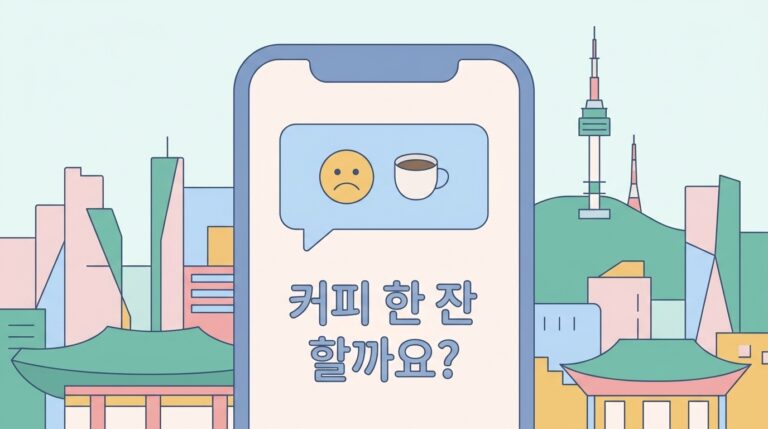
Have you ever seen this classic K-Drama scene? The main character is staring at their glowing smartphone screen, biting their lip. Outside, the rain is pouring. They type out a message, delete it, and type it again. They have to cancel a long-awaited dinner, but they are terrified of ruining the relationship. The subtitle just says, “I’m sorry, I can’t make it,” but the emotional weight feels so much heavier.
Canceling plans is universally stressful. But doing it in a new language? That’s a whole different level of anxiety! You might be thinking: “Will my Korean friends be mad?” or “Do I sound like a rude robot?”
Don’t worry. This guide is built from the real, panicked questions of my beginner students who didn’t know how to cancel a K-BBQ dinner when they caught a cold. Today, we’ll learn how to say “No” gracefully, keep your friendships intact, and navigate the subtle Nunchi (눈치) of canceling plans in Korea. Let’s dive in!
Phase 2: Core Expressions Deep Dive
1. 미안해요. 오늘 못 가요.
- Pronunciation: [mi-an-hae-yo. o-neul mot ga-yo.]
- Sound-alike guide: ‘Mi-an-hae-yo’ sounds like “Me-on-hey-yo”. ‘mot’ sounds like “moat” but cut short. ‘ga-yo’ sounds like “guy-yo”.
- Meaning: I’m sorry. I can’t go today.
- K-Culture Moment: Picture a messaging app like KakaoTalk. You send this to your language exchange partner an hour before you’re supposed to meet at a hip cafe in Seongsu-dong because you suddenly feel sick.
- Editor’s Insight: The word 못 (mot) is your best friend here. It means “cannot” (due to circumstances out of your control), which saves the listener’s feelings. It says, “My heart wants to go, but my body/schedule won’t let me.”
- Situation Spectrum:
- Casual friends: ✅
- Co-workers (Semi-formal): ✅
- Boss/Elders (Formal): ⚠️ (Better to use 죄송합니다 / joe-song-ham-ni-da instead of 미안해요)
- 🤔 Think About It: Why is apologizing before stating the reason so important in Korean culture? Does your native culture soften bad news the same way?
2. 다음에 만나요.
- Pronunciation: [da-eu-me man-na-yo.]
- Sound-alike guide: ‘da-eu-me’ sounds like “da-ooh-may”. ‘man-na-yo’ sounds like “mahn-nah-yo”.
- Meaning: Let’s meet next time.
- K-Culture Moment: After a sad breakup scene or a canceled date in a drama, this phrase is the emotional band-aid.
- Editor’s Insight: You can never just cancel in Korea. You must always offer the hope of a future meeting to maintain harmony. It’s the ultimate polite wrap-up phrase.
- Situation Spectrum:
- Casual friends: ✅
- Co-workers (Semi-formal): ✅
- Boss/Elders (Formal): 🚫 (Use ‘다음에 뵙겠습니다’ / da-eu-me boep-get-seum-ni-da)
- 🤔 Think About It: Do people always mean “next time” literally? In many cultures, “let’s meet next time” is just a polite goodbye. How about in yours?
3. 예약 취소할게요.
- Pronunciation: [ye-yak chwi-so-hal-ge-yo.]
- Sound-alike guide: ‘ye-yak’ sounds like “yay-yak”. ‘chwi-so’ sounds like “chwee-so”.
- Meaning: I will cancel the reservation.
- K-Culture Moment: You booked a fancy Hanok stay in Jeonju or a popular Michelin-star restaurant in Seoul, but your train is delayed. You call them to let them know.
- Editor’s Insight: This is pure survival Korean. ‘예약’ means reservation, and ‘취소’ means cancel. Memorize this block!
- Situation Spectrum:
- Casual friends: 🚫 (Not for friends)
- Service Staff (Restaurants/Hotels): ✅
- 🤔 Think About It: “No-shows” are highly discouraged in Korea. Calling to cancel, even in broken Korean, is deeply appreciated by local business owners.
Phase 3: Textbook vs. Real Korean
[Situation 1: Canceling a hangout with a friend]
* 📖 Textbook Korean: 저는 오늘 약속에 갈 수 없습니다. (I cannot go to the appointment today.)
* 🗣️ Real Korean: 아, 진짜 미안해요. 오늘 좀 힘들 것 같아요. ㅠㅠ (Ah, really sorry. Today might be a bit difficult. ㅠㅠ)
* 💡 Why the difference?: Textbooks teach rigid grammar. Real Koreans use filler words like “아 (Ah)” and “진짜 (really)” to show genuine regret, and use “~할 것 같아요 (it seems like)” to sound less aggressive.
[Situation 2: The friend asks “Are you okay?”]
* 📖 Textbook Korean: 네, 저는 괜찮습니다. (Yes, I am fine.)
* 🗣️ Real Korean: 넵! 다음에 꼭 봐요! (Yep! Let’s definitely see each other next time!)
* 💡 Why the difference?: Adding “꼭 (definitely)” reassures your friend that you actually do want to hang out in the future.
Bottom Note: For A1 beginners, it’s totally okay to keep it simple! Just adding “진짜 (jin-jja / really)” in front of “미안해요” will make you sound 10x more like a local.
Phase 4: Cultural Context — K-Culture Deep Dive
4-1. Non-verbal Elements & ‘Nunchi’ (눈치)
When canceling plans, Nunchi (the art of reading the room) is everything.
– Timing is crucial: Never cancel 10 minutes before the meeting unless it’s a true emergency.
– The Emoji Rule: A dry text saying “오늘 못 가요” (I can’t go today) can feel cold. Always attach a crying emoji (ㅠㅠ or 😭) to visually show your regret.
4-2. K-Food Connection: The Sacred Act of Eating Together
In Korea, eating isn’t just about calories; it’s the core of social bonding. You will notice that Koreans rarely say, “Let’s hang out.” Instead, they say, “밥 한 번 먹자” (Let’s grab a meal sometime).
Because food is so deeply tied to relationships, canceling a meal is a big deal. If you must cancel a K-BBQ night, always cushion the blow with the promise of food: “다음에 꼭 같이 밥 먹어요!” (Let’s definitely eat together next time!).
Critical Point: Why do Koreans obsess over eating together? Historically and culturally, sharing side dishes and grilling meat on the same table creates a sense of 정 (Jeong – deep emotional connection). Canceling a meal feels like pausing that connection, so reassuring them of the “next time” is essential etiquette.
Phase 5: Real-Life Roleplay Scenario
Setting: It’s Friday, 5:00 PM. You were supposed to meet your Korean friend at 7:00 PM at a famous Samgyeopsal (pork belly) restaurant in Gangnam. However, you ate something bad for lunch and your stomach is killing you. You decide to call him.
Characters:
– YOU: A foreign traveler in Seoul who loves Korean food but currently has a stomachache.
– Min-su (32): Your friendly Korean friend who is already dreaming about the pork belly.
Dialogue:
Min-su: 여보세요? 삼겹살 먹을 준비 됐어요? 🥩
(yeo-bo-se-yo? sam-gyeop-sal meo-geul jun-bi dwaet-seo-yo?)
[Hello? Are you ready to eat pork belly?]
YOU: 민수 씨… 저 진짜 미안해요.
(min-su ssi… jeo jin-jja mi-an-hae-yo.)
[Min-su… I’m really sorry.]
Min-su: 어? 왜요? 무슨 일 있어요?
(eo? wae-yo? mu-seun il it-seo-yo?)
[Huh? Why? Is something wrong?]
(🎭 Stage Direction: Min-su’s voice drops, sounding concerned.)
YOU: 배가 너무 아파요. 오늘 식당에 못 가요.
(bae-ga neo-mu a-pa-yo. o-neul sik-dang-e mot ga-yo.)
[My stomach hurts too much. I can’t go to the restaurant today.]
Min-su: 아고… 괜찮아요? 약 먹었어요?
(a-go… gwaen-chan-a-yo? yak meo-geo-sseo-yo?)
[Oh no… Are you okay? Did you take medicine?]
🔀 Your Turn! How should you respond and wrap up the conversation?
– A) 네, 안녕히 계세요. (Yes, goodbye.)
– B) 네, 약 먹었어요. 다음에 꼭 만나요! (Yes, I took medicine. Let’s definitely meet next time!)
– C) 저는 삼겹살 싫어요. (I hate pork belly.)✅ Best Choice: B — You answered his question and added the “golden rule” of canceling: promising to meet next time.
⚠️ Choice A & C Analysis: Choice A is way too robotic and cuts the conversation off coldly. Choice C is a disaster—never say you hate the food they were excited about!
Phase 6: 10-Second Shadowing Drill
Let’s practice the ultimate survival cancellation phrase. Read it out loud, following the pauses and emotion!
🥺 아, / 진짜 미안해요. / 오늘 / 못 가요.
(a, / jin-jja mi-an-hae-yo. / o-neul / mot ga-yo.)
[Tone: Sad and apologetic. Drag out the ‘진짜’ (jin~~~jja) slightly to sound authentic!]
😊 다음에 / 꼭 / 만나요!
(da-eu-me / kkok / man-na-yo!)
[Tone: Bright and hopeful. Smile while saying it!]
Phase 7: K-Culture Mini Dictionary
Here are 4 words you must know when navigating Korean plans:
1. 약속
* Romanization: yaksok
* English: Plans / Appointment / Promise
* Context: In English, “promise” is very serious. In Korea, having a “약속” just means you have plans to hang out or meet someone.
2. ㅠㅠ
* Romanization: u-yu u-yu (often just typed without reading aloud)
* English: Crying face emoji
* Context: These are Korean consonants that look like streaming tears. Add them to text messages to soften bad news. (e.g., 못 가요 ㅠㅠ)
3. 핑계
* Romanization: ping-gye
* English: Excuse
* Context: When someone cancels repeatedly with bad reasons, Koreans might say, “That’s just a 핑계!”
4. 눈치
* Romanization: nunchi
* English: Social sense / reading the room
* Context: If you cancel 5 minutes before the meeting, people will say you have “no nunchi” (눈치 없다).
Phase 8: Traveler Survival Kit
If you are traveling in Korea, canceling a reservation gracefully makes you a top-tier tourist.
🆘 Survival Phrases for Travelers
– 🇰🇷 “예약 취소할게요.” (ye-yak chwi-so-hal-ge-yo.)
– 🗣️ Meaning: I will cancel the reservation.
– 📍 Where to use: Hotels, restaurants, tour guides, hair salons.
– 💡 Pro Tip: If you booked via Naver or Kakao maps, you can usually click a button to cancel without calling. But if you must call, just say “Hello, cancel please” (안녕하세요. 취소할게요). They will understand!📌 Editor’s Travel Note
– No-Show Culture: Korea takes reservations seriously. Not showing up without notice is considered very rude.
– Language Barrier: If you’re too scared to call, ask your hotel front desk receptionist to call the restaurant for you. They are usually more than happy to help!
Phase 9: Critical Thinking — “One Step Deeper”
🧠 Think Deeper: Food & Identity (음식과 정체성)
Have you noticed that Koreans almost always mention “next time” (다음에 만나요) or “let’s eat later” (다음에 밥 먹어요) when canceling plans? This isn’t just a polite lie. Korea’s rapid modernization was built on a strong sense of community, and sharing meals is the ultimate symbol of that community. By saying “let’s eat next time,” you are signaling, “I am canceling the event today, but I am NOT canceling our relationship.” The food is a metaphor for the friendship itself.💬 Your Turn: In your culture, what is the “polite lie” or comforting phrase people use when they have to cancel plans? Share it in the comments!
Phase 10: FAQ & Avoiding Misunderstandings
Q1: “Can I just say ‘안 가요’ (I am not going)?”
NO! Absolutely not! This is the #1 mistake beginners make.
– 못 가요 (mot ga-yo) = I cannot go (I want to, but I’m sick/busy).
– 안 가요 (an ga-yo) = I will not go (I don’t want to go. I hate the idea).
If you say “안 가요” to a Korean friend, they will be deeply offended.
Q2: “If they say ‘Let’s meet next time,’ do I need to schedule a date right away?”
Maybe. If it’s a close friend, you can ask “When?” (언제요?). But if it’s a casual acquaintance, “다음에” (next time) is often just a polite closing. Just reply “네!” (Yes!) and move on.
❌ Common Mistake #1: Canceling without giving a brief reason.
✅ Do this instead: Always give a simple reason. “배가 아파요” (My stomach hurts) or “일이 있어요” (I have work). It shows respect.
Phase 11: Summary & Action Items
One-Liner Summary: To cancel safely in Korean, remember your magic combo: 미안해요 (Sorry) + 못 가요 (Can’t go) + 다음에 만나요 (See you next time).
Action Mission 3 Steps:
– 🥉 Bronze (Solo): Stand in front of a mirror, look super sad, and practice saying “미안해요. 오늘 못 가요” 3 times.
– 🥈 Silver (Online): Send a message with “ㅠㅠ” to a friend today (even if you’re not canceling anything, just practice the emoji!).
– 🥇 Gold (Real Life): Next time you actually have to reschedule with a language partner, use “다음에 만나요” to soften the blow!
🎬 K-Culture Mission:
Watch one episode of your favorite K-Drama this week. Pay close attention to when characters look at their phones sadly. Can you hear them say “미안해” or “못 가”?
Did you ever have a funny misunderstanding when trying to cancel plans? Tell me in the comments below!
Phase 12: Quiz — Interactive Challenge
1. Fill in the Blank:
You feel sick and can’t go to the K-Pop dance class today.
“진짜 미안해요. 오늘 ___ 가요.”
A) 안 (an)
B) 못 (mot)
2. True or False — K-Culture Edition:
Sending a sad text saying “미안해요. 오늘 못 가요 ㅠㅠ” is considered childish and should not be used with casual friends. (T/F)
3. Situational Judgment:
You need to cancel a dinner reservation at a restaurant. What should you say?
A) 저는 식당 싫어요. (I hate the restaurant.)
B) 다음에 만나요. (Let’s meet next time – spoken to the chef.)
C) 예약 취소할게요. (I will cancel the reservation.)
(Check your answers by highlighting the invisible text below!)
Answers: 1. B (Never use 안!) / 2. False (The ㅠㅠ emoji is practically required to show regret!) / 3. C
Frequently Asked Questions (FAQ)
Q: What does "미안해요. 오늘 못 가요." mean in Korean and how do you pronounce it?
A: In Korean, "미안해요. 오늘 못 가요." is pronounced [mi-an-hae-yo. o-neul mot ga-yo.] and means: a key conversational Korean expression covered in this lesson.
Q: What does "다음에 만나요." mean in Korean and how do you pronounce it?
A: In Korean, "다음에 만나요." is pronounced [da-eu-me man-na-yo.] and means: a key conversational Korean expression covered in this lesson.
Q: What does "예약 취소할게요." mean in Korean and how do you pronounce it?
A: In Korean, "예약 취소할게요." is pronounced [ye-yak chwi-so-hal-ge-yo.] and means: a key conversational Korean expression covered in this lesson.







