

Phase 1: Empathy (Immersive K-Culture Cold Open)
Hello! I’m your Lead Editor from Daily Hangul.
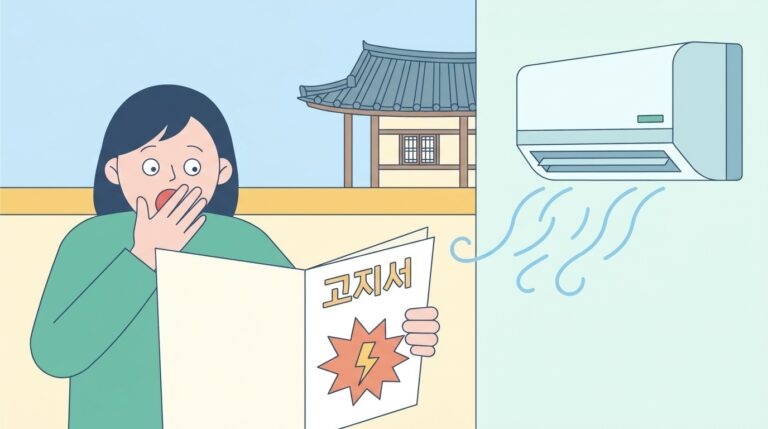
Picture this K-Drama scene: It’s the peak of the sweltering Korean summer. The high school protagonist secretly lowers the living room air conditioner to 18°C. Suddenly, their mother appears, delivers a lethal smack to the back, and yells, “Do you think money grows on trees?! Turn that off right now!”
While the subtitles might just read, “Stop wasting electricity,” the true terror behind the mother’s eyes is something every Korean deeply understands: the dreaded ‘Utility Bill Bomb’ (요금 폭탄).
For advanced learners aiming for C2 level, simply knowing the word ‘electricity’ (전기) isn’t enough. In Korea, discussing energy policy, KEPCO’s (Korea Electric Power Corporation) mounting deficits, and the debate over raising utility rates is a hot topic at office watercoolers and family dinners alike.
If you want to sound not just fluent, but like a true Korean intellectual who reads the morning news, you need to understand the cultural and political weight of ‘전기 요금 현실화’ (The realization/normalization of electricity rates). This post is built on real debates happening right now in Korean society. Let’s dive in!
Phase 2: Deep Dive into Key Expressions
1. 전기 요금 현실화
- Pronunciation: [jeon-gi yo-geum hyeon-sil-hwa]
- Sound-alike guide: ‘hyeon’ sounds like ‘hy’ + ‘on’, and ‘hwa’ sounds like you’re blowing out a candle: hwaaa.
- Meaning: (Literal) Realization of electricity rates. (Real nuance) Normalizing or raising electricity rates to reflect actual production costs.
- K-Culture Moment: You won’t hear teenagers say this. This is prime 9 PM News vocabulary. When a politician or a news anchor says “현실화” (realization), everyone groans, knowing their bills are about to go up.
- Editor’s Insight: The word ‘현실화’ (making it a reality) is a brilliant political euphemism. Instead of saying “We are raising the price” (인상), policymakers say “We are making the price realistic.” It softens the blow.
- Situation Spectrum:
- Casual friends (Casual): ⚠️ (Too formal, friends use ‘요금 인상’)
- Coworkers discussing news (Semi-formal): ✅
- Business meeting/Debate (Formal): ✅
- 🤔 Think About It: Why do governments use euphemisms like “normalization” instead of “price hike”? Does your home country use similar linguistic softening for policy changes?
2. 누진세 폭탄 (맞다)
- Pronunciation: [nu-jin-se pok-tan (mat-da)]
- Sound-alike guide: ‘pok’ sounds like the sound of popping a balloon, ‘tan’ like getting a tan on the beach.
- Meaning: (Literal) Being hit by a progressive tax bomb. (Real nuance) Getting a shockingly high electricity bill because you entered a higher tax bracket for usage.
- K-Culture Moment: Summer in Korea is humid. You leave the AC on while sleeping, and next month, you open your Gojisuh (utility bill) and drop your coffee. You just got “bombed” by the progressive tax system.
- Editor’s Insight: Koreans love adding ‘폭탄’ (bomb) to anything surprisingly overwhelming. (e.g., 과제 폭탄 = assignment bomb, 세금 폭탄 = tax bomb). ‘맞다’ here implies being a helpless victim of this financial blast.
- Situation Spectrum:
- Casual friends (Casual): ✅
- Coworkers (Semi-formal): ✅
- Boss/Seniors (Formal): ⚠️ (Use ‘누진세 부담이 큽니다’ instead)
- 🤔 Think About It: The word ‘bomb’ reflects a feeling of sudden, unavoidable disaster. How does this reflect the average citizen’s feeling of powerlessness against utility policies?
3. 공기업 만성 적자
- Pronunciation: [gong-gi-eop man-seong jeok-ja]
- Sound-alike guide: ‘jeok’ rhymes with ‘chuck’, ‘ja’ like the start of ‘jaw’.
- Meaning: (Literal) Chronic deficit of public enterprises.
- K-Culture Moment: When complaining about electricity rates, someone at the office will inevitably sigh and say, “Well, KEPCO’s chronic deficit is severe…” (한전 만성 적자가 심각하니까…)
- Editor’s Insight: At the C2 level, mastering Sino-Korean (Hanja) compound words like ‘만성’ (chronic) and ‘적자’ (red ink/deficit) instantly elevates your Korean from “fluent conversationalist” to “educated professional.”
- Situation Spectrum:
- Casual friends (Casual): ⚠️ (A bit too serious for a pub)
- Coworkers (Semi-formal): ✅
- News/Debates (Formal): ✅
Phase 3: Textbook vs. Real Korean
[Situation 1: Hearing the news about rate hikes]
* 📖 Textbook Korean: 정부가 전기 요금을 인상했습니다. (The government raised the electricity rate.)
* 🗣️ Real Korean: 아, 또 전기세 오른대. 내 월급 빼고 다 올라. (Ah, they say the electricity bill is going up again. Everything goes up except my salary.)
* 💡 Why the difference?: Koreans colloquially say ‘전기세’ (electricity tax) instead of the technically correct ‘전기 요금’ (electricity fee), viewing it more as an inescapable tax than a choice. Also, “Everything goes up except my salary” is the ultimate Korean working-class catchphrase!
[Situation 2: Warning someone to turn off the AC]
* 📖 Textbook Korean: 전기를 절약해야 공기업의 적자를 막을 수 있습니다. (We must save electricity to prevent the public enterprise’s deficit.)
* 🗣️ Real Korean: 야, 에어컨 좀 꺼. 전기세 폭탄 맞고 싶어? (Hey, turn off the AC. Do you want to get hit with a bill bomb?)
* 💡 Why the difference?: Everyday conversations prioritize immediate personal consequences (my wallet) over macroeconomic problems (KEPCO’s deficit).
Phase 4: Cultural Context — K-Culture Deep Dive
4-1. Non-verbal Element: The AC Remote ‘Nunchi’ (눈치)
In a Korean office setting, who controls the air conditioner remote? It’s a prime example of Nunchi (눈치). Usually, the youngest employee (막내) sits near the AC. If the boss says, “아유, 덥네” (Whew, it’s hot), the junior must catch the hint and lower the temperature immediately. But if the company recently posted a memo about “Energy Saving to combat KEPCO’s deficit,” the junior must pretend not to notice the heat.
4-2. K-Drama Connection: The Rooftop Room (옥탑방) Trope
In K-Dramas, the struggling protagonist often lives in an Oktapbang (rooftop room). These rooms are notoriously poorly insulated. In summer, they are saunas; in winter, they are freezers. The protagonist usually sits sweating with a tiny handheld fan, looking at a utility bill, sighing over the ‘누진세’ (progressive tax). Understanding this policy context makes these drama scenes hit much harder. It’s not just about the heat; it’s about the systemic burden of energy costs on the working class.
Phase 5: Real-life Roleplay Scenario
Setting: A trendy cafe near Gangnam Station. It’s Friday afternoon, 2 PM. You and your Korean coworker, Min-su, are grabbing an iced Americano to survive the sweltering heat before heading back to the office.
Characters:
– YOU: A foreign expat working in Seoul, dealing with your first Korean summer.
– Min-su (32): Your Korean coworker. Friendly, loves to complain about the economy, always looking for life hacks to save money.
Dialogue:
Min-su: 으아, 밖은 완전 찜통이네요. 에어컨 빵빵한 카페가 최고예요. 🥵
(eu-a, bakkeun wanjeon jjimtong-ineyo. eeokeon ppangppanghan kapega choegoyeyo.)
[Ugh, it’s a total steamer outside. A cafe with blasting AC is the best.]
YOU: 맞아요. 사무실보다 여기가 더 시원한 것 같아요.
(majayo. samusilboda yeogiga deo siwonhan geot gatayo.)
[Right. I think it’s cooler here than the office.]
Min-su: 우리 회사가 요즘 한전(KEPCO) 적자 핑계 대면서 에어컨 온도를 26도로 고정해 놨잖아요. 진짜 미치겠어.
(uri hoesaga yojeum hanjeon jeokja pinggye daemyeonseo eeokeon ondoreul isipyukdoro gojeonghae nwatjanayo. jinjja michigesseo.)
[Our company fixed the AC at 26 degrees making KEPCO’s deficit an excuse lately. It’s driving me crazy.]
YOU: 아, 뉴스 봤어요. 정부가 ‘전기 요금 현실화’를 추진한다면서요?
(a, nyuseu bwasseoyo. jeongbuga ‘jeon-gi yogeum hyeonsilhwa’reul chujinhandamyeonseoyo?)
[Ah, I saw the news. I heard the government is pushing for the ‘realization of electricity rates’?]
Min-su: 네, 맞아요. 말만 ‘현실화’지 결국 우리 지갑 터는 거죠. 저번 달 저희 집 전기세 누진세 폭탄 맞았거든요.
(ne, majayo. malman ‘hyeonsilhwa’ji gyeolguk uri jigap teoneun geojyo. jeobeon dal jeohui jip jeongise nujinse poktan majatgeodeunyo.)
[Yeah, exactly. It’s only ‘realization’ in words; ultimately, they’re robbing our wallets. My house got hit with a progressive tax bomb last month.]
🔀 Your Turn! How will you respond?
– A) “아, 안타깝네요. 전기를 아껴 써야죠.” (Ah, that’s a pity. We should save electricity.)
– B) “헐, 대박! 저희 집도 관리비 엄청 나왔어요. 진짜 월급 빼고 다 오르네요.”
– C) “공기업의 만성 적자를 해결하려면 불가피한 조치 아닐까요?”✅ Best Choice: B — Why? You are sympathizing with his pain using natural, everyday empathy (“헐, 대박!”) and linking it to a common grievance (“월급 빼고 다 오르네요”). This builds a strong bond.
⚠️ Choice A & C Analysis: Choice A sounds like a rigid public service announcement. Choice C is a fantastic C2-level sentence for an academic debate, but saying this to a friend complaining about their bills will make you sound like a robot politician!
Min-su (If you chose B): 그쵸?! 역시 [You] 님도 한국 패치 완벽하게 되셨다니까! 짠테크라도 해야겠어요.
(geuchyo?! yeoksi [You] nimdo hanguk paechi wanbyeokage doesyeotdanikka! jjanteukeurado haeyagesseoyo.)
[Right?! See, you are perfectly ‘Korean-patched’ (adapted to Korea)! I guess I’ll have to start Jjantech (extreme saving).]
(🎭 Stage Direction: Min-su takes a sip of his iced coffee with a dramatic sigh.)
Phase 6: 10-Second Shadowing Drill
Practice reading this C2-level sentence like a news anchor, then transition into an everyday citizen’s sigh.
👔 단호하게 (Firmly, like a news anchor)
공기업의 / 만성 적자를 / 해소하기 위해 / 전기 요금 현실화는 / 불가피합니다.
(gong-gi-eobui / man-seong jeok-jareul / hae-so-ha-gi wi-hae / jeon-gi yo-geum hyeon-sil-hwa-neun / bul-ga-pi-ham-ni-da.)
😢 억울하게 (Frustrated, like an average citizen)
아니 / 말만 현실화지 / 이번 달 전기세 / 완전 폭탄 맞았잖아요!
(ani / malman hyeon-sil-hwa-ji / i-beon dal jeon-gi-se / wan-jeon pok-tan ma-jat-ja-na-yo!)
Phase 7: K-Culture Mini Dictionary
1. 눈치 (Nunchi)
* Romanization: nunchi
* English: Social situational awareness / tact.
* Context: The unspoken Korean art of reading the room. Knowing when to turn down the AC without the boss asking is peak ‘Nunchi’.
2. 관리비 (Gwallibi)
* Romanization: gwallibi
* English: Maintenance fee / Utility and building fees.
* Context: If you live in an Officetel or apartment, electricity is often rolled into this monthly ‘maintenance fee’. Opening the Gwallibi envelope in summer is terrifying.
3. 한전 (Han-jeon)
* Romanization: han-jeon
* English: KEPCO (Korea Electric Power Corporation).
* Context: The state-run energy company. When energy policies are discussed, “Hanjeon’s deficit” is always the central topic.
4. 짠테크 (Jjanteukeu)
* Romanization: jjanteukeu
* English: Salty Tech / Extreme penny-pinching strategy.
* Context: A compound of ‘짠’ (salty/stingy) and ‘재테크’ (financial tech). Due to inflation and rate hikes, young Koreans share ‘Jjantech’ tips, like unplugging all appliances before leaving for work.
Phase 8: Traveler Survival Kit
Even if you’re just visiting Korea, you’ll encounter the reality of energy policies—especially if you’re staying in an Airbnb or long-term rental where you must control your own Ondol (floor heating) and Aircon.
🆘 Survival Phrases for Housing/Airbnb
– 🇰🇷 “관리비에 전기세 포함인가요?” (gwallibie jeongise pohamin-gayo?)
– 🗣️ English: Is the electricity bill included in the maintenance fee?
– 📍 Where to use: Real estate agents (부동산), Airbnb hosts, Goshiwon.
- 🇰🇷 “보일러 외출 모드로 해둘까요?” (boilleo oechul modeuro haedulkkayo?)
- 🗣️ English: Should I set the boiler to ‘Away’ mode?
- 📍 Where to use: Leaving your accommodation in winter to avoid a massive gas/electricity bill.
🇰🇷 “에어컨 온도를 조금만 낮춰 주실 수 있나요?” (eeokeon ondoreul jogeumman natchwo jusil su innayo?)
- 🗣️ English: Could you lower the AC temperature a little bit?
- 📍 Where to use: In a cafe or restaurant when it’s too hot.
📌 Editor’s Travel Note
– Ondol & Boilers: Korean heating is floor-based (Ondol). Never turn the boiler completely off in winter; pipes might freeze, and turning it back on uses more energy. Always use ‘외출’ (Away/Outing) mode!
– Card vs. Bank Transfer: Utility bills are often paid via bank transfer to a virtual account (가상계좌) printed on the bill, rather than by credit card at a store.
Phase 9: Critical Thinking Corner — “One Step Deeper”
🧠 Think Deeper: Language & Power (Euphemisms in Policy)
At the C2 level, it’s vital to analyze how language is used to wield power and manage public opinion. The term ‘전기 요금 현실화’ (Realization of electricity rates) is a classic political euphemism. By framing a rate hike as bringing prices “back to reality,” the government shifts the narrative. It implies that previous, cheaper rates were an illusion or a luxury, and accepting higher prices is the ‘logical’ and ‘realistic’ duty of a mature citizen.
This is a stark contrast to the language of the working class, who use terms like ‘폭탄’ (bomb) or ‘삥 뜯다’ (extort) to describe the exact same policy. The gap between the polite, Hanja-heavy language of policymakers and the visceral slang of the public highlights the tension between macro-economics and micro-livelihoods.
💬 Your Turn: Does your government use specific euphemisms when raising taxes or utility bills? How do everyday people react to those words? Share your country’s policy slang in the comments!
Phase 10: FAQ & Mistake Prevention
Q: Can I use “폭탄 맞았어요” in a business meeting?
No. In a formal setting, ‘폭탄’ sounds unprofessional. Instead, say: “이번 달 요금 인상폭이 큽니다” (The margin of rate increase is large this month) or “부담이 가중되었습니다” (The burden has been aggravated).
Q: Why do Koreans say ‘전기세’ (tax) when it’s technically a ‘요금’ (fee)?
Because electricity is monopolized by the state-run KEPCO, citizens perceive the monthly payment as an unavoidable tax imposed by the government, rather than a consumer choice. It reflects the public psyche.
❌ Common Mistake #1: Saying “전기를 많이 샀어요” (I bought a lot of electricity) to mean your bill is high.
✅ Do this instead: “전기를 많이 썼어요” (I used a lot of electricity) or “전기세가 많이 나왔어요” (The electricity bill came out high).
Phase 11: Summary & Action Items
✨ One-Liner Summary:
When KEPCO’s deficits rise, the government pushes for ‘요금 현실화’ (rate normalization), leaving everyday Koreans bracing for a ‘누진세 폭탄’ (progressive tax bomb).
🎯 Action Mission:
– 🥉 Bronze: Look in the mirror and passionately complain about the heat: “아휴, 전기세 폭탄 맞겠네!” (Ugh, I’m gonna get hit with a bill bomb!)
– 🥈 Silver: Post on a Korean learning forum: “요즘 한국은 전기 요금 현실화 때문에 논란이 많다면서요?” (I hear there’s a lot of debate in Korea lately about the normalization of electricity rates?)
– 🥇 Gold: Next time a Korean friend complains about prices going up, sympathize with them using: “진짜 내 월급 빼고 다 오르네요!”
📺 K-Culture Mission:
Watch any K-Drama featuring an office setting or a family home (Reply 1988 is great for this!). Pay close attention to how they interact with fans, air conditioners, and the lights. You’ll notice the obsession with turning things off—it’s deeply ingrained in the culture!
Phase 12: Quiz — Interactive Challenge
1. Situational Judgment:
You are in a formal debate class discussing KEPCO’s financial issues. What is the most appropriate C2-level phrase to use?
– A) 한전이 요즘 돈이 없어서 폭탄을 던졌어요.
– B) 공기업의 만성 적자를 해소하기 위해 요금 현실화가 논의되고 있습니다.
– C) 전기세가 너무 비싸서 짠테크를 해야 해요.
💡 Click for Answer & Explanation
Answer: B.
Explanation: B uses high-level, academic vocabulary suitable for a debate. A and C use casual slang (폭탄, 짠테크) which are perfect for friends but inappropriate for a formal debate.
2. True or False – K-Culture Edition:
In Korea, it is culturally acceptable for the youngest employee to freely adjust the office air conditioner whenever they feel hot. (T/F)
💡 Click for Answer
False.
Explanation: Due to ‘Nunchi’ (reading the room) and hierarchy, the youngest usually waits for a senior to complain about the heat or ask someone to adjust the AC.
3. Fill in the Blank:
“아, 에어컨 너무 많이 틀었나 봐. 이번 달 관리비 완전 _____ 맞았어!”
(Hint: 💣)
💡 Click for Answer
Answer: 폭탄 (pok-tan)
Frequently Asked Questions (FAQ)
Q: What does "전기 요금 현실화" mean in Korean and how do you pronounce it?
A: In Korean, "전기 요금 현실화" is pronounced [jeon-gi yo-geum hyeon-sil-hwa] and means: a key conversational Korean expression covered in this lesson.
Q: What does "누진세 폭탄 (맞다)" mean in Korean and how do you pronounce it?
A: In Korean, "누진세 폭탄 (맞다)" is pronounced [nu-jin-se pok-tan (mat-da] and means: a key conversational Korean expression covered in this lesson.
Q: What does "공기업 만성 적자" mean in Korean and how do you pronounce it?
A: In Korean, "공기업 만성 적자" is pronounced [gong-gi-eop man-seong jeok-ja] and means: a key conversational Korean expression covered in this lesson.






