

Phase 1: Empathy (Immersive Open)
Hello there! I’m the Lead Editor at Daily Hangul. I am not just an AI; I’m your veteran tutor, Korean friend, and local cultural navigator who has spent over a decade exploring the streets, cafes, and photo studios of Seoul.
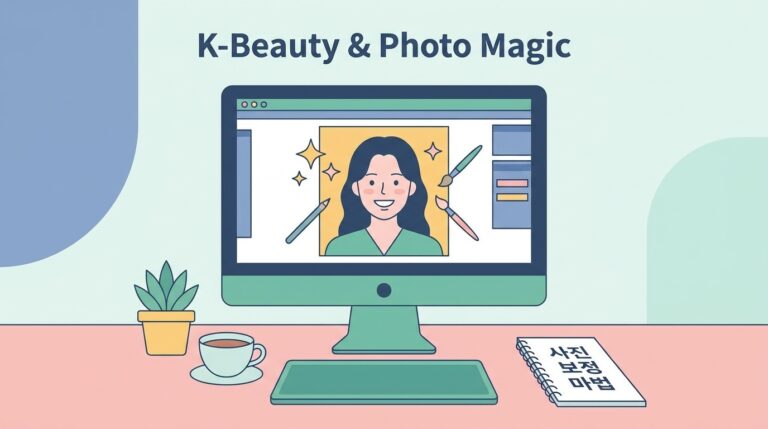
Let’s set the scene: You’re visiting Korea, and you decide to take one of those famous Korean ID photos (증명사진). You sit down, the flashes go off, and then… you’re invited to sit next to the photographer. Their fingers fly across the keyboard and mouse at light speed. Blemishes disappear. Asymmetry is fixed. You look like the lead in a K-Drama!
But then, the photographer turns to you and asks, “Is there anything else you want me to fix?”
You panic. You want your jawline just a tiny bit slimmer, but how do you say that without sounding rude or using weird translator Korean? Don’t worry! This guide is based on real questions from my students who wanted to experience the magic of Korean photo studios without the language barrier.
Phase 2: Deep Dive into Core Expressions
Here are the top 3 magical phrases you need when sitting next to a Korean Photoshop wizard.
1. 조금 더 갸름하게 해 주세요. (Please make it a bit slimmer.)
- Pronunciation: jogeum deo gyareumhage hae juseyo.
(jo-geum / deo / gya-reum-ha-ge / hae / ju-se-yo)
Sound Guide: ‘gya’ sounds like the ‘g’ in ‘game’ mixed quickly with ‘ya’. - Meaning: Literal: “Please make it more slender.” / Real nuance: “Please slim down my jawline/face shape.”
- K-Culture Moment: The iconic “V-line” is a huge beauty standard in Korea. In photo studios, slimming the jawline is basically a default service. If they didn’t do it enough, you drop this phrase.
- Editor’s Insight: This phrase is extremely polite and standard. The word “조금” (a little) softens the request, making you sound considerate, not demanding.
- Situation Spectrum:
- Casual (to a friend editing a selfie): ✅
- Semi-formal (to a photographer): ✅
- Formal: ✅
- 🤔 Think About It: Why do Koreans often use “조금” (a little) even when they want a big change? It’s all about softening the blow and maintaining harmony in communication!
2. 잡티 없애 주세요. (Please remove the blemishes.)
- Pronunciation: japti eopsae juseyo.
(jap-ti / eop-sae / ju-se-yo) - Meaning: Literal: “Make blemishes disappear.” / Real nuance: “Please smooth out my skin / clear my acne.”
- K-Culture Moment: Ever wonder why K-Pop idols always have flawless skin in photos? It’s all about removing the ‘잡티’ (japti – spots, freckles, blemishes).
- Editor’s Insight: This is a direct but perfectly polite request. If you want to sound even softer, add “피부” (pibu – skin) in front: “피부 잡티 없애 주세요.”
- Situation Spectrum:
- Casual: ✅
- Semi-formal: ✅
- Formal: ✅
- 🤔 Think About It: How does the obsession with “glass skin” (유리알 피부) in K-Beauty influence the way Koreans edit their photos?
3. 너무 과해요. 자연스럽게 해 주세요. (It’s too much. Please make it natural.)
- Pronunciation: neomu gwahaeyo. jayeonseureopge hae juseyo.
(neo-mu / gwa-hae-yo. / ja-yeon-seu-reop-ge / hae / ju-se-yo) - Meaning: Literal: “It’s excessive. Please do it naturally.” / Real nuance: “I look like an alien! Please dial back the Photoshop!”
- K-Culture Moment: Sometimes, the photographer gets too passionate. You look at the screen and realize your nose has disappeared into a blur of perfection. This phrase is your emergency brake.
- Editor’s Insight: ‘자연스럽게’ (Naturally) is a magic word in Korea. Whether it’s makeup, hair, or photo editing, the goal is ‘꾸안꾸’ (kku-an-kku: effortlessly chic, decorated but not decorated).
- Situation Spectrum:
- Casual: ✅
- Semi-formal: ✅
- Formal: ⚠️ (Say it with a smile so you don’t sound angry!)
- 🤔 Think About It: Is there a difference between what is considered “natural” in your home country versus in Korea?
Phase 3: Textbook vs Real Korean
[Situation 1: Asking to slim your face]
* 📖 Textbook Korean: 얼굴 크기를 줄여 주시겠습니까? (Would you reduce the size of my face?)
* 🗣️ Real Korean: 여기(턱) 조금만 깎아주세요~ (Please shave this part(jaw) a bit~)
* 💡 Why the difference?: “깎다” means to cut or shave (like an apple). In young, everyday slang, it’s the go-to word for Photoshop slimming because it visually feels like carving a sculpture!
[Situation 2: Showing satisfaction]
* 📖 Textbook Korean: 정말 훌륭합니다. 고맙습니다. (This is truly excellent. Thank you.)
* 🗣️ Real Korean: 와 대박, 새 사람으로 태어났어요! (Wow, daebak. I’m reborn as a new person!)
* 💡 Why the difference?: Koreans love self-deprecating humor when it comes to heavily edited photos. Joking that you’ve been “reborn” is a massive compliment to the photographer’s skills.
Bottom Note: For A2 learners, sticking to “~해 주세요” (Please do ~) is the safest and most polite way to ask for anything in a service setting.
Phase 4: Cultural Context — K-Culture Deep Dive
4-1. Non-Verbal Cues & ‘Nunchi’
When asking for photo edits, point at the screen gently (do not touch their monitor!). A huge part of nunchi (reading the room) here is smiling. If you look dead serious while saying “Make it natural,” the photographer might think you are offended. Laugh at your own original photo—it instantly creates a friendly bond!
4-2. The K-Drama “Makeover & ID Photo” Trope
Have you noticed how in K-Dramas, when a protagonist is about to turn their life around, get a new job, or move on from a bad breakup, they go to a salon and then take a new 증명사진 (jeungmyeongsajin – ID Photo)?
In Korea, an ID photo isn’t just for a driver’s license; it’s heavily used for job resumes. There is a deep cultural belief that a bright, symmetrical, well-retouched resume photo can actually boost your chances of getting hired. That’s why Korean photo studios evolved to have world-class retouching skills. The photographer isn’t just taking your picture; they are crafting your future professional image!
Phase 5: Interactive Roleplay Scenario
Setting: Saturday afternoon. A popular photo studio in Hongdae. You just took your profile photos, and the photographer invites you to sit next to them for the 1:1 editing session.
Characters:
– YOU: A foreign traveler wanting a cool profile pic for Instagram.
– Photographer (Ji-hoon): Fast, friendly, and wields a mouse like a magic wand.
Dialogue:
Ji-hoon: 자, 사진 고르셨고요. 기본적인 보정은 다 했습니다. 어떠세요? 📸
(ja, sajin goreusyeotgoyo. gibonjeogin bojeongeun da haetseumnida. eotteoseyo?)
[Alright, you chose the photo. I’ve done the basic retouching. How is it?]
(🎭 Stage Direction: Ji-hoon zooms in on your face on the giant monitor. You look great, but maybe a bit too perfect.)
YOU: 와… 이게 저예요? 대박!
(wa… ige jeoyeyo? daebak!)
[Wow… is this me? Awesome!]
Ji-hoon: 하하, 네 맞습니다. 더 원하시는 부분 있으세요?
(haha, ne matseumnida. deo wonhasineun bubun isseuseyo?)
[Haha, yes it is. Is there any part you want more (editing) on?]
🔀 Your Turn! How should you reply?
– A) “아니요, 완벽해요. 감사합니다.” (No, it’s perfect. Thank you.)
– B) “저기… 눈을 두 배로 크게 해 주세요!” (Um… please make my eyes twice as big!)
– C) “턱을 조금 더 갸름하게 해 주세요.” (Please make my jawline a bit slimmer.)✅ Best Choice: C — It’s specific, natural, and uses exactly what we learned!
⚠️ Choice B Analysis: Making eyes “twice as big” is funny, but in Korean studios, they prefer maintaining your natural proportions. If you say this, the photographer might laugh and say, “Then you won’t look like you!”
YOU: (Choosing C) 턱을 조금 더 갸름하게 해 주세요.
(teogeul jogeum deo gyareumhage hae juseyo.)
[Please make my jawline a bit slimmer.]
Ji-hoon: 네, 알겠습니다. 자연스럽게 깎아 드릴게요!
(ne, algetseumnida. jayeonseureopge kkakka deurilgeyo!)
[Yes, understood. I’ll shave it down naturally!]
Phase 6: 10-Second Shadowing Drill
Let’s practice the flow and intonation! Follow the slashes for pauses.
- 😊 밝게 (Brightly):
저기요, / 턱을 / 조금만 / 갸름하게 해 주세요!
(jeogiyo, / teogeul / jogeumman / gya-reum-ha-ge hae juseyo!) -
🥺 아쉽게 (Slightly pleading):
피부 잡티만 / 싹~ / 없애 주세요.
(pibu japtiman / ssak~ / eop-sae ju-se-yo.) -
😤 단호하지만 친절하게 (Firm but kind):
너무 과해요. / 조금 더 / 자연스럽게 해 주세요.
(neomu gwahaeyo. / jogeum deo / ja-yeon-seu-reop-ge hae juseyo.)
Phase 7: K-Culture Mini Dictionary
1. 눈치 (Nunchi)
* Romanization: nunchi
* English: Social situational awareness.
* Context: Reading the atmosphere. In a studio, having ‘nunchi’ means knowing when to stop asking for edits before the photo looks fake.
2. 보정 (Bojeong)
* Romanization: bojeong
* English: Retouching / Color grading.
* Context: The standard term for editing photos. “보정해 주세요” means “Please edit/retouch it.”
3. 뽀샵 (Pposyap)
* Romanization: pposyap
* English: Slang for Photoshop.
* Context: You might hear younger people say “이거 뽀샵 너무 심해” (This Photoshop is too extreme).
4. 인생네컷 (Insaengnekeot)
* Romanization: insaengnekeot
* English: Life Four Cuts.
* Context: The wildly popular self-photo booths in Korea. Literally translates to “the best four cuts (photos) of your life.”
Phase 8: Traveler’s Survival Kit
Are you visiting Korea soon? Photo studios are a MUST-do. Here are your survival phrases!
🆘 Survival Phrase #1: Getting the files
– 🇰🇷 “원본 파일 받을 수 있나요?”
– 🗣️ (wonbon pail badeul su innayo?)
– 📍 Where to use: After the shoot, if you want the digital files sent to your email or phone.🆘 Survival Phrase #2: Asking about time
– 🇰🇷 “얼마나 걸려요?”
– 🗣️ (eolmana geollyeoyo?)
– 📍 Where to use: Asking how long the printing or editing process will take.
📌 Editor’s Travel Note:
– Many Korean studios will AirDrop the photos directly to your iPhone or send them via a KakaoTalk link!
– Unlike Western countries, tipping the photographer is NOT required or expected in Korea.
Phase 9: Critical Thinking — “A Step Deeper”
Media vs Reality (Beauty Standards & Identity)
🧠 Think Deeper:
In Korea, getting a heavily retouched ID photo isn’t seen as “faking” your identity; rather, it’s often viewed as presenting the “best possible version” of yourself. It reflects a culture that highly values neatness, preparation, and aesthetic harmony. However, this also raises questions about extreme beauty standards. The gap between the mirror and the “Photoshopped me” is a humorous struggle shared by many young Koreans today, leading to the popular joke: “I need to live my life looking like my profile photo!”💬 Your Turn: Do people in your culture edit their professional ID or resume photos? How much editing is considered “too much”? Share your thoughts in the comments!
Phase 10: FAQ & Avoiding Common Mistakes
Q: Can I use 반말 (informal language) like “갸름하게 해 줘” to the photographer?
No! The photographer is providing a professional service. Even if they are younger than you, always use the polite form (존댓말), ending in “~요” (~yo).
Q: Can I ask them to change my hair color in the photo?
Usually, yes! Korean studios can do magic. You can ask: “머리색 조금 어둡게 해 주세요” (Please make my hair color a bit darker).
❌ Common Mistake #1: Saying “예쁘게 해 주세요” (Make me pretty).
✅ Do this instead: That’s too vague! The photographer’s idea of ‘pretty’ might be different from yours. Be specific: “잡티 없애 주세요” (Remove blemishes) or “자연스럽게 해 주세요” (Make it natural).
Phase 11: Summary & Action Items
One-Liner Summary: To get the perfect Korean studio photo, be specific but polite using “~해 주세요” and always remember the magic word: “자연스럽게” (Naturally).
Action Mission 3 Steps:
– 🥉 Bronze (Solo): Stand in front of a mirror, point to your jaw, and say “조금 더 갸름하게 해 주세요” out loud 3 times.
– 🥈 Silver (Online): Find a heavily edited K-Pop or K-Drama photo online and comment (or write in your notebook): “보정이 너무 과해요!” (The editing is too much!)
– 🥇 Gold (Real-world): Visit an ‘Insaengnekeot’ (Life Four Cuts) booth in your city (or when you visit Korea), select the “Beauty Filter” option, and take the best photos of your life!
Phase 12: Quiz — Interactive Challenge
1. Situational Judgment: You look at the edited photo, and your face looks completely different. It’s too much! What should you say?
A) 대박! (Awesome!)
B) 자연스럽게 해 주세요. (Please make it natural.)
C) 잡티 없애 주세요. (Please remove blemishes.)
Answer: B. It’s the polite way to ask them to dial down the extreme editing.
2. Fill in the Blank: “턱을 조금 더 ( ____ ) 해 주세요.” (Please make my jawline a bit slimmer.)
Answer: 갸름하게 (gyareumhage)
3. True or False – K-Culture Edition: In Korea, giving a tip to the photographer for doing a great Photoshop job is highly expected.
Answer: False! Korea is a non-tipping culture. Expressing your joy verbally (“대박!”) is the best tip you can give!
Did you enjoy today’s Daily Hangul guide? Let me know which expression you’ll use first!”
Frequently Asked Questions (FAQ)
Q: What does "조금 더 갸름하게 해 주세요. (Please make it a bit slimmer.)" mean in Korean and how do you pronounce it?
A: In Korean, "조금 더 갸름하게 해 주세요. (Please make it a bit slimmer.)" is pronounced [jogeum deo gyareumhage hae juseyo.] and means: Literal: "Please make it more slender." / Real nuance: "Please slim down my jawline/face shape."
Q: What does "잡티 없애 주세요. (Please remove the blemishes.)" mean in Korean and how do you pronounce it?
A: In Korean, "잡티 없애 주세요. (Please remove the blemishes.)" is pronounced [japti eopsae juseyo.] and means: Literal: "Make blemishes disappear." / Real nuance: "Please smooth out my skin / clear my acne."
Q: What does "너무 과해요. 자연스럽게 해 주세요. (It's too much. Please make it natural.)" mean in Korean and how do you pronounce it?
A: In Korean, "너무 과해요. 자연스럽게 해 주세요. (It's too much. Please make it natural.)" is pronounced [neomu gwahaeyo. jayeonseureopge hae juseyo.] and means: Literal: "It's excessive. Please do it naturally." / Real nuance: "I look like an alien! Please dial back the Photoshop!"







