

Phase 1: The ‘KakaoTalk Panic’ Moment
Hello! This is your Daily Hangul Editor.
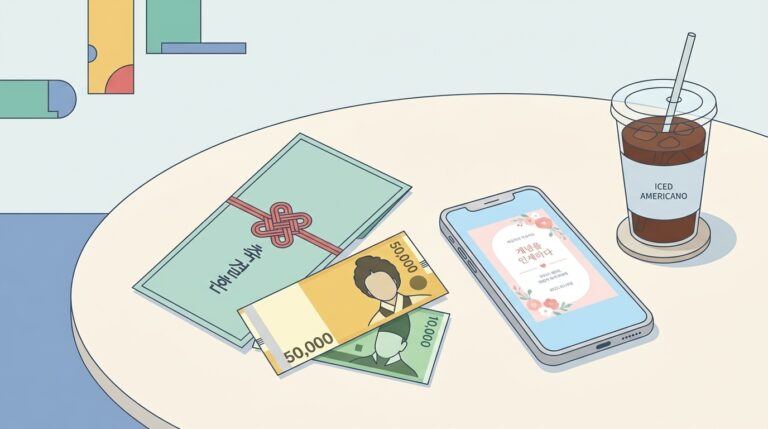
Imagine this: You are sitting at a cafe in Seoul, sipping your iced Americano. Suddenly, your phone buzzes. It’s a KakaoTalk message from a Korean coworker or a friend. You open it, and there it is—a beautifully designed Mobile Wedding Invitation (모바일 청첩장) with romantic photos and soft background music.
You quickly type out, “Congratulations!” (축하해요!). But then, a cold sweat drops. You remember the golden rule of Korean weddings: You don’t bring a toaster or a set of wine glasses. You bring an envelope of cash.
“Wait… how much am I supposed to give? Is 50,000 won too cheap? Is 100,000 won too much? What if I’m not going to the wedding but just sending money?”
If you’ve ever felt this unique blend of happiness for your friend and utter financial confusion, welcome to the club! Figuring out the 축의금 (Chug-uigeum, congratulatory money) is something even native Koreans stress over. In fact, there are countless internet forums where Koreans debate exactly how much to give based on the relationship.
Today, as your local culture navigator, I am going to teach you the essential phrases to discuss this delicate topic and the unwritten rules of Korean wedding money. Let’s decode the nunchi of weddings!
Phase 2: Core Expressions — Deep Dive
Let’s look at the survival phrases you need when you need to ask your other friends for advice on how much to pay.
1. 보통 축의금 얼마 해?
- Pronunciation: bo-tong chug-ui-geum eol-ma hae? [bo-tong choog-wee-geum ul-ma hae?]
- Meaning: (Literal) Usually congratulatory money how much do you do? / (Real Nuance) How much are you guys giving for the wedding?
- K-Culture Moment: This is the most frequently asked question in a group chat right after someone announces their marriage. It’s the moment friends try to align their “giving amount” so no one looks too cheap or overly generous.
- Editor’s Insight: The verb ‘하다 (to do)’ is used here instead of ‘내다 (to pay/give)’. Asking “얼마 해?” feels much more natural and conversational among peers than “얼마 낼 거야?”.
- Situation Spectrum:
- Close Friends (Casual): ✅
- Coworkers (Semi-formal): ⚠️ (Use “얼마 하실 거예요?” instead)
- Boss/Elders (Formal): 🚫 (You generally don’t ask your boss how much they are giving)
- 🤔 Think About It: Why do Koreans prefer to check how much others are giving before deciding their own amount? Does your culture prioritize collective consensus or individual choice in gift-giving?
2. 밥 먹고 갈 거야?
- Pronunciation: bap meok-go gal geo-ya? [bap muk-go gal guh-ya?]
- Meaning: (Literal) Are you going to eat and go? / (Real Nuance) Are you staying for the wedding buffet?
- K-Culture Moment: You are standing in the lobby of a grand wedding hall. You hand over your envelope. The person at the desk asks this exact question before handing you a 식권 (Sik-gwon, meal ticket).
- Editor’s Insight: This question directly affects your envelope amount. Wedding buffets in Korea are expensive (often 50,000 to 80,000 won per person). If you stay to eat, the unwritten rule is that your gift money should cover your meal price.
- Situation Spectrum:
- Close Friends (Casual): ✅
- Coworkers (Semi-formal): ⚠️ (Use “식사 하고 가실 거예요?”)
- Boss/Elders (Formal): 🚫
- 🤔 Think About It: In Korea, attending the meal is seen as part of the blessing, but the cost is practically subsidized by the guest. How are wedding meals handled in your home country?
3. 친한 정도에 따라 다르지.
- Pronunciation: chin-han jeong-do-e tta-ra da-reu-ji. [chin-han jung-doh-eh tah-rah da-reu-jee.]
- Meaning: (Literal) It differs depending on the degree of closeness. / (Real Nuance) It depends on how close you are to the person.
- K-Culture Moment: This is the universal, slightly frustrating answer you will get when you ask a Korean friend how much to give.
- Editor’s Insight: Koreans mentally categorize relationships into tiers: ‘Just say hi’, ‘Eat lunch sometimes’, ‘Close friends’, and ‘Besties’. The money scales up with the tier.
- Situation Spectrum:
- Close Friends (Casual): ✅
- Coworkers (Semi-formal): ⚠️
- Boss/Elders (Formal): 🚫
- 🤔 Think About It: Putting a literal price tag on friendship sounds cold, but in Korea, it’s a practical way to manage social obligations. What do you think about this system?
Phase 3: Textbook vs. Real Korean
[Situation 1: Asking a coworker about the money amount]
* 📖 Textbook Korean: 축의금은 얼마를 내는 것이 좋습니까? (How much congratulatory money is good to pay?)
* 🗣️ Real Korean: 대리님, 혹시 축의금 얼마 하실 거예요? (Assistant Manager, by any chance, how much are you going to give?)
* 💡 Why the difference?: Real Korean heavily relies on “혹시 (by any chance)” to soften the blow when asking sensitive questions about money.
[Situation 2: Deciding not to eat the buffet]
* 📖 Textbook Korean: 저는 식사를 하지 않을 예정입니다. (I am not planning to have a meal.)
* 🗣️ Real Korean: 저 밥 안 먹고 갈 거라서 식권 안 주셔도 돼요. (I’m leaving without eating, so you don’t need to give me a meal ticket.)
* 💡 Why the difference?: Koreans always explain the reason (I’m leaving without eating) before declining something to ensure they sound polite, not dismissive.
(Bottom Note: B1 learners, mastering the use of “혹시” and providing brief reasons will instantly make your Korean sound twice as natural!)
Phase 4: Cultural Context — K-Culture Deep Dive
4-1. Non-verbal Nunchi at the Wedding Desk
When you approach the 축의대 (Chuguidae, the reception desk), there is a specific protocol.
1. The Crisp Bills: You must use the cleanest, newest bills possible. Handing over crumpled money is a huge faux pas.
2. The White Envelope: The money must be in a specific white envelope (축의금 봉투), which you can buy at Daiso or convenience stores. Often, wedding halls have blank ones at the desk.
3. Writing Your Name: Write your name vertically on the back left bottom corner of the envelope. If it’s a coworker, write your company name next to it so the couple knows exactly who you are.
4-2. The K-Drama Connection
Have you seen the drama “Because This Is My First Life” or “Hometown Cha-Cha-Cha”? You often see scenes where characters complain about “spending all their monthly salary on wedding money because it’s wedding season (Spring/Fall).” In dramas, an envelope of money is sometimes dramatically handed over as a way to cut ties or show off, but in reality, it’s a quiet, organized transaction at a busy desk.
Critical View: While K-Dramas make it seem like everyone attends every wedding they are invited to, modern Koreans (especially MZ generation) are experiencing “wedding invitation fatigue.” Many now respectfully decline to attend and just transfer 50,000 won via KakaoPay if they aren’t super close.
Phase 5: Real-Life Roleplay Scenario
Setting: Tuesday lunch break. You are at a company cafeteria with Minsoo, a friendly Korean coworker. Another coworker from a different team just handed out wedding invitations.
Characters:
– YOU: An expat working in Korea for 2 years. You know the bride, but you only say hi in the hallway.
– Minsoo (30s): Your work buddy. Knows all the office gossip.
Dialogue:
Minsoo: 아까 지연 씨 청첩장 받았어요?
(a-kka ji-yeon ssi cheong-cheop-jang ba-da-sseo-yo?)
[Did you get Ji-yeon’s wedding invitation earlier?]
YOU: 네, 받았어요. 그런데 좀 고민이에요.
(ne, ba-da-sseo-yo. geu-reon-de jom go-min-i-e-yo.)
[Yes, I got it. But I’m a bit worried.]
Minsoo: 왜요? 주말에 약속 있어요?
(wae-yo? ju-mal-e yak-sok i-sseo-yo?)
[Why? Do you have plans this weekend?]
YOU: 그건 아닌데… 지연 씨랑 별로 안 친해서요.
(geu-geon a-nin-de… ji-yeon ssi-rang byeol-ro an chin-hae-seo-yo.)
[It’s not that… I’m not that close with Ji-yeon.]
Minsoo: 아~ 축의금 얼마 할지 고민이구나?
(a~ chug-ui-geum eol-ma hal-ji go-min-i-gu-na?)
[Ah~ You’re worried about how much wedding money to give?]
YOU: 네. 민수 씨는 보통 얼마 해요?
(ne. min-su ssi-neun bo-tong eol-ma hae-yo?)
[Yes. How much do you usually give, Minsoo?]
Minsoo: 음… 친한 정도에 따라 다르긴 한데…
(eum… chin-han jeong-do-e tta-ra da-reu-gin han-de…)
[Well… it depends on how close we are, but…]
🔀 YOUR TURN! How should you respond to figure out the right amount?
– A) “오만 원은 너무 적어요?” (Is 50,000 won too little?)
– B) “제 대신 돈 좀 내주세요.” (Please pay the money for me.)
– C) “그냥 안 갈래요.” (I just won’t go.)✅ Best Choice: A — This is the perfect, honest question. In Korea, 50,000 won is the standard baseline for “not close, not attending.” Asking this directly to a close coworker is totally acceptable.
⚠️ Choice B Analysis: Never ask someone to pay your wedding money unless you are extremely close and you will immediately wire them the money (e.g., “제가 지금 계좌이체 할 테니까 대신 봉투 좀 내주세요”).
Minsoo: 에이, 안 친하고 식장 안 갈 거면 5만 원만 해도 돼요!
(e-i, an chin-ha-go sik-jang an gal geo-myeon o-man won-man hae-do dwae-yo!)
[Hey, if you’re not close and not going to the venue, 50,000 won is totally fine!]
YOU: 아, 다행이네요. 고마워요 민수 씨!
(a, da-haeng-i-ne-yo. go-ma-wo-yo min-su ssi!)
[Ah, that’s a relief. Thanks, Minsoo!]
Phase 6: 10-Second Shadowing Drill
Practice your flow and intonation! Remember, the goal is to sound natural, not robotic.
🤔 저기... / 혹시 축의금 / 얼마 하실 거예요?
(jeo-gi... / hok-si chug-ui-geum / eol-ma ha-sil geo-ye-yo?)
[Carefully / asking for advice]
😊 아, 저는 / 밥 안 먹고 갈 거라서 / 오만 원만 하려고요.
(a, jeo-neun / bap an meok-go gal geo-ra-seo / o-man won-man ha-ryeo-go-yo.)
[Lightly / explaining your reason]
Phase 7: K-Culture Mini Dictionary
1. 축의금
* Romanization: chug-ui-geum
* English: Congratulatory money
* Context: Cash given to celebrate weddings, baby first birthdays (Doljanchi), etc. Always given in an envelope.
2. 모바일 청첩장
* Romanization: mo-ba-il cheong-cheop-jang
* English: Mobile wedding invitation
* Context: A web-link invitation sent via KakaoTalk. It includes photos, location maps, and—crucially nowadays—the couple’s bank account numbers for those who can’t attend.
3. 식권
* Romanization: sik-gwon
* English: Meal ticket
* Context: A small ticket given at the reception desk after you hand in your money. You need this to enter the buffet hall.
4. 품앗이
* Romanization: pum-a-si
* English: Communal sharing of labor/resources
* Context: The historical root of the Korean money-giving culture. You give money to help the couple start their life, with the unspoken understanding that they will return the favor when you get married.
Phase 8: Traveler’s Survival Kit
Even if you are just traveling, you might need to buy an envelope for a tip (though tipping isn’t customary, sometimes expats want to thank a specific guide) or you might be invited to a Korean friend’s wedding during your stay.
🆘 Survival Phrases for Buying Envelopes
– 🇰🇷 “축의금 봉투 어디 있어요?” (chug-ui-geum bong-tu eo-di i-sseo-yo?)
– 🗣️ English Guide: [choog-wee-geum bong-too uh-dee ee-suh-yo?]
– 📍 Where to use: Daiso, Convenience stores (CU, GS25), Stationery shops.
– 💡 Pro Tip: Envelopes for weddings (축의금) and funerals (조의금) look different! Make sure you buy the one with “축결혼 (祝結婚)” written on it, not the one with a black ribbon design.📌 Editor’s Travel Note
– Cash is King here: You absolutely cannot use a credit card for wedding money. You must withdraw crisp cash from an ATM.
– The ATM lines: On weekends, ATMs inside subway stations near popular wedding halls will have long lines of people withdrawing 50k bills!
Phase 9: Critical Thinking — “One Step Deeper”
Money and Relationships: A Transaction or Community Support?
To many Westerners, bringing cash in an envelope feels impersonal, almost like a transaction. “Why not buy them a blender?” you might ask. However, looking through the lens of Korean society, this cash culture stems from an agricultural tradition called Pum-asi (품앗이).
Historically, village members pooled their labor and resources to help each other during major life events (weddings, funerals, harvests). Today, weddings are incredibly expensive in Korea (renting halls, “The Studio-Dress-Makeup” package). The cash envelope is the modern Pum-asi. It’s a way for the community to practically support the couple’s heavy financial burden. You give with the quiet faith that when your big day comes, the community will show up for you.
💬 Your Turn: Does your culture prefer practical cash gifts or sentimental physical gifts for weddings? Why do you think that is? Share your thoughts in the comments!
Phase 10: FAQ & Avoiding Misunderstandings
Q: “Can I give 40,000 won? 50,000 feels like too much but 30,000 feels too little.”
No! Never give amounts starting with 4 (40k, 400k). The number 4 (사) sounds like the Chinese character for “death.” Korean wedding money is traditionally given in odd numbers (3, 5, 7) because odd numbers symbolize positive energy (Yang). However, 10 (100,000) is acceptable because it’s seen as a “complete” number.
Q: “I forgot to write my name on the envelope. Is that bad?”
Yes, it’s a disaster. Couples keep meticulous Excel spreadsheets of who gave how much. This isn’t out of greed; it’s so they know exactly how much to return to you when you have a big event. If it’s blank, you get zero credit for your generosity!
❌ Common Mistake #1: Handing the envelope directly to the Bride or Groom.
✅ Do this instead: Hand it to the designated family members sitting at the “축의대” (Reception Desk) outside the hall. The couple is too busy taking photos and managing the event to hold cash!
Phase 11: Summary & Action Items
- One-Liner Summary: Your relationship depth and whether you eat the buffet determine your envelope amount—when in doubt, ask “보통 얼마 해?” (How much do you usually give?).
-
Action Mission 3 Steps:
- 🥉 Bronze (Solo): Say “보통 축의금 얼마 해?” out loud 3 times with a curious expression.
- 🥈 Silver (Online): Comment below whether you would give 50,000 won or 100,000 won to a coworker you eat lunch with every day.
- 🥇 Gold (Real World): Ask a Korean friend or language partner to explain the difference between a 50k won relationship and a 100k won relationship!
- K-Culture Mission: Go on Instagram and search the hashtag #모바일청첩장. Look at how beautifully Koreans design these digital invites!
Phase 12: Quiz — Interactive Challenge
1. Situational Judgment:
You are attending the wedding of a close friend. The wedding is at an expensive hotel. You are staying for the meal. How much should you prepare in your envelope?
– A) 30,000 won
– B) 50,000 won
– C) 100,000 won or more
2. True or False — K-Culture Edition:
“It is considered polite to hand the cash directly to the bride in the bridal waiting room (신부대기실).” ( T / F )
3. Fill in the Blank:
You want to ask your friend if they are staying for the buffet.
“너 오늘 ( ) 먹고 갈 거야?”
👀 Click here for answers!
1. C (Since you are a close friend AND eating an expensive hotel meal, 100k is the minimum. The hotel meal alone might cost 80k-100k won!)
2. False (You only hand the money to the reception desk. You go to the bridal room just to take photos and say congratulations.)
3. 밥 (bap)
Frequently Asked Questions (FAQ)
Q: What does "보통 축의금 얼마 해?" mean in Korean and how do you pronounce it?
A: In Korean, "보통 축의금 얼마 해?" is pronounced [bo-tong chug-ui-geum eol-ma hae? [bo-tong choog-wee-geum ul-ma hae?] and means: (Literal) Usually congratulatory money how much do you do? / (Real Nuance) How much are you guys giving for the wedding?
Q: What does "밥 먹고 갈 거야?" mean in Korean and how do you pronounce it?
A: In Korean, "밥 먹고 갈 거야?" is pronounced [bap meok-go gal geo-ya? [bap muk-go gal guh-ya?] and means: (Literal) Are you going to eat and go? / (Real Nuance) Are you staying for the wedding buffet?
Q: What does "친한 정도에 따라 다르지." mean in Korean and how do you pronounce it?
A: In Korean, "친한 정도에 따라 다르지." is pronounced [chin-han jeong-do-e tta-ra da-reu-ji. [chin-han jung-doh-eh tah-rah da-reu-jee.] and means: (Literal) It differs depending on the degree of closeness. / (Real Nuance) It depends on how close you are to the person.







