

Phase 1: Empathy (The “I’m Lost in Everland” Moment)
Hello there! I’m your Daily Hangul editor.
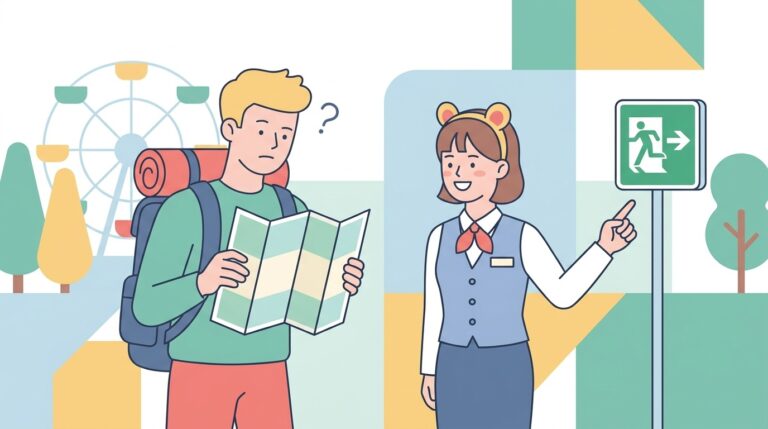
Imagine this: You’ve just spent the most amazing day at Everland or Lotte World. You rode the T-Express, ate churros, and watched the dazzling night parade. It feels just like a scene from a K-Drama or an episode of Running Man. But now, it’s 9:30 PM. Your feet are aching, the crowd is massive, and you just want to go back to your hotel. You look at the map, but everything is a blur. The signs are confusing, and you can’t find the way out.
In textbooks, asking for directions seems so simple. But when you are surrounded by thousands of people rushing in every direction, trying to remember “Excuse me, where is the exit?” in Korean can feel overwhelming.
Don’t worry! I’ve been there, and many of my students have shared this exact panic. Today, I’m going to teach you not just the textbook phrases, but the real, survival Korean you need to smoothly navigate your way out of any Korean zoo or amusement park. Let’s get you to that exit!
Phase 2: Core Expressions Deep Dive
Let’s look at the top 3 phrases you need to escape the maze.
1. 출구가 어디예요?
- Pronunciation: chulguga eodiyeyo? [chool-goo-gah uh-dee-yeh-yo?]
- Meaning: Where is the exit? (Literal: Exit + where is it?)
- K-Culture Moment: Picture an idol trying to escape a crowded airport in a vlog. They might quietly ask their manager, “출구가 어디예요?” to find the quickest way out.
- Editor’s Insight: This is your standard, most reliable phrase. “출구” (chulgu) means exit, and “어디예요?” (eodiyeyo?) is the magic phrase for “Where is…?”
- Situation Spectrum:
- Casual (Friends): ✅ (Drop the ‘yo’ -> 출구가 어디야?)
- Semi-formal (Staff/Strangers): ✅
- Formal (Elders/Boss): ✅
- 🤔 Think About It: In many languages, finding the “exit” is crucial for safety. Do you notice how Korean signs often use a green running man icon just like in your country, but the words might look different?
2. 나가는 곳이 어디예요?
- Pronunciation: naganeun gosi eodiyeyo? [nah-gah-neun go-shee uh-dee-yeh-yo?]
- Meaning: Where is the way out? (Literal: The place going out + where is it?)
- K-Culture Moment: If you look at the signs inside a Korean subway station or a zoo like Seoul Grand Park, you will see “나가는 곳” written in huge letters much more often than “출구”!
- Editor’s Insight: While “출구” is the Sino-Korean word (based on Chinese characters), “나가는 곳” is pure Korean and extremely common on signboards. Knowing this phrase makes you sound like a true local!
- Situation Spectrum:
- Casual: ✅
- Semi-formal: ✅
- Formal: ✅
- 🤔 Think About It: Why do you think Korea uses two different systems (pure Korean vs. Sino-Korean) for the exact same concept like an exit?
3. 잠시만요! 지나갈게요.
- Pronunciation: jamsimanyo! jinagalgeyo. [jahm-shee-mahn-yo! jee-nah-gal-geh-yo.]
- Meaning: Excuse me, I’m passing through. (Literal: Just a moment! I will pass.)
- K-Culture Moment: You are in a packed crowd after the Lotte World fireworks. You need to reach the exit, but people are blocking the way. Say this, and the crowd will part like the Red Sea.
- Editor’s Insight: Instead of saying “I’m sorry” (죄송합니다), Koreans say “Just a moment” (잠시만요) when moving through a crowd. It’s polite, effective, and essential for survival in busy spaces.
- Situation Spectrum:
- Casual: ✅
- Semi-formal: ✅
- Formal: ⚠️ (Say it softly and bow slightly)
- 🤔 Think About It: “Wait a moment” is used as “Excuse me” in Korea. How do you politely ask people to move in your culture?
Phase 3: Textbook vs. Real Korean
[Asking for the Way Out]
* 📖 Textbook Korean: 실례합니다. 출구가 어디에 있습니까? (Excuse me. Where is the exit located?)
* 🗣️ Real Korean: 저기요, 나가는 곳이 어디예요? (Excuse me, where is the way out?)
* 💡 Why so different?: The “-습니까?” ending is too stiff for an amusement park. “저기요” (Excuse me/Hey there) + “어디예요?” is the most natural way to get a staff member’s attention quickly.
[Moving Through a Crowd]
* 📖 Textbook Korean: 비켜주세요. (Please step aside.)
* 🗣️ Real Korean: 잠시만요~ (Just a moment~)
* 💡 Why so different?: Telling someone to “step aside” directly sounds very rude in Korea. “잠시만요” softens the request by implying “I just need a tiny moment of your time to pass.”
Bottom Note: For A2 learners, mastering “어디예요?” (Where is it?) and “잠시만요” (Just a moment) is your golden ticket. They work in 99% of travel situations!
Phase 4: Cultural Context — K-Culture Deep Dive
4-1. Non-Verbal Cues: The Art of Pointing
When you ask a staff member for the exit, watch their hands! In Korea, pointing with one index finger is often considered slightly rude. Instead, staff will use their entire hand with palm facing up to gesture towards the exit. When you ask, slightly nod your head as a sign of respect.
4-2. K-Travel Connection: Navigating the Chaos
Korean amusement parks like Everland and Lotte World are famous for their sheer scale and massive crowds, especially on weekends or public holidays (눈치게임 실패 – “Failing the Nunchi game” is a slang for picking the most crowded day to visit!).
When the park closes, everyone rushes to the exit at the same time to catch the last bus or subway. Knowing how to efficiently ask for the “나가는 곳” (Way out) and confidently saying “잠시만요” (Excuse me) will save you from missing your ride back to Seoul.
Phase 5: Interactive Roleplay Scenario
Setting: It’s 9:45 PM at Everland. The moonlight parade just finished. Thousands of people are walking around, and you are completely turned around. You spot an energetic part-time staff member (알바생) wearing a cute animal headband.
Characters:
– YOU: A tired but happy traveler who needs to catch the bus back to Gangnam.
– Staff (Jiwon, 22): Friendly, but currently managing a large crowd.
Dialogue:
YOU: (Approaching the staff member)
🔀 Your Turn! How should you get her attention?
– A) “이봐요!” (Hey you!)
– B) “저기요!” (Excuse me! / Over here!)
– C) “아줌마!” (Middle-aged lady!)✅ Best Choice: B — “저기요” is the perfect, polite way to call a staff member.
⚠️ Choice A & C Analysis: “이봐요” is rude and confrontational. “아줌마” is for older women and will definitely offend a 22-year-old!
(Assuming you chose B)
YOU: 저기요!
(jeogiyo!)
[Excuse me!]
Jiwon: 네, 손님! 무엇을 도와드릴까요?
(ne, sonnim! mueoseul dowadeurilkkayo?)
[Yes, customer! How can I help you?]
YOU: 나가는 곳이 어디예요?
(naganeun gosi eodiyeyo?)
[Where is the way out?]
Jiwon: (Gesturing with her whole hand) 아, 출구요? 저쪽 회전목마 지나서 오른쪽으로 가시면 됩니다!
(a, chulguyo? jeojjok hoejeonmongma jinaseo oreunjjogeuro gasimyeon doemnida!)
[Ah, the exit? Go past the merry-go-round over there and turn right!]
YOU: 회전목마… 오른쪽이요. 감사합니다!
(hoejeonmongma… oreunjjogiyo. gamsahamnida!)
[Merry-go-round… right side. Thank you!]
Jiwon: 네, 조심히 가세요!
(ne, josimhi gaseyo!)
[Yes, get back safely!]
Phase 6: 10-Second Shadowing Drill
Let’s practice your survival phrase! Repeat after me, paying attention to the pauses and intonation.
🥺 저기요, / 나가는 곳이 / 어디예요?
(jeo-gi-yo, / na-ga-neun go-si / eo-di-ye-yo?)
Tip: Say “저기요” a bit louder to get attention, then ask the question with a slightly raised pitch at the end, looking a bit helpless (🥺) so they take pity on you!
Phase 7: K-Culture Mini Dictionary
1. 출구
* Romanization: chulgu
* English: Exit
* Context: The formal word for exit. Often found on illuminated green signs above doors.
2. 나가는 곳
* Romanization: naganeun got
* English: Way out
* Context: The native Korean phrase used on directional signs in theme parks, subways, and zoos.
3. 눈치게임
* Romanization: nunchi geim
* English: Nunchi Game (Guessing Game)
* Context: In theme park culture, this means trying to guess which day will have the fewest visitors. If everyone thinks “it will rain, so no one will go,” and the park is packed, you “failed the Nunchi game.”
4. 알바생
* Romanization: alba-saeng
* English: Part-time worker
* Context: Theme park staff in Korea are famous for their energetic dances and friendly service. They are usually university students working part-time.
Phase 8: Traveler’s Survival Kit
🆘 Survival Phrases for Getting Un-Lost
– 🇰🇷 “여기 어디예요?” (yeogi eodiyeyo?) – Where am I right now?
– 🇰🇷 “화장실이 어디예요?” (hwajangsiri eodiyeyo?) – Where is the restroom?
– 🇰🇷 “길을 잃었어요.” (gireul ileosseoyo.) – I am lost.
– 📍 Where to use: Anywhere! Theme parks, subways, giant malls like COEX.
– 💡 Pro Tip: If you can’t understand their verbal directions, hand them your phone with a map app open and politely ask: “여기에 쳐주세요” (Please type it here).📌 Editor’s Travel Note
– Useful Apps: Google Maps doesn’t work well for walking directions in Korea. Download Naver Map or Kakao Map. They even show indoor maps for large malls!
– Follow the Green Light: In any Korean building, look for the green glowing sign of a man running through a door. That is always the “출구”.
Phase 9: Critical Thinking — “Think Deeper”
🧠 Think Deeper: Space, Crowds, and “Just a Moment”
South Korea has a high population density, and places like Seoul are always bustling. Because personal space is physically limited, Koreans have developed language habits to navigate crowds without causing offense. Instead of directly commanding someone to “move” or “excuse me (for being in my way),” using “잠시만요” (Wait just a moment) softens the interaction. It shifts the focus from “You are blocking me” to “I just need a brief moment to pass.” It perfectly reflects the fast-paced “빨리빨리” (Ppalli-ppalli/Hurry up) culture blended with social harmony.💬 Your Turn: How do people in your country handle moving through a massive crowd at a theme park or concert? Do you have a specific phrase you use? Share it in the comments!
Phase 10: FAQ & Avoiding Misunderstandings
- Q: Can I just point at a map and say “어디?” (Where?) to a staff member?
- A: NO. Dropping the “요” (yo) makes it 반말 (informal speech). Speaking informally to a stranger, even a young part-timer, is considered extremely rude. Always use “어디예요?” (eodiyeyo?).
- Q: I asked for the exit, but they replied so fast I couldn’t understand. What do I do?
- A: Use your body language! Point in the direction they gestured and ask, “이쪽이요?” (This way?). They will either nod or correct you.
❌ Common Mistake #1: Saying “안녕히 계세요” (Goodbye – stay well) to the park staff when you finally find the exit.
✅ Do this instead: Say “감사합니다” (Thank you) or “수고하세요” (Keep up the good work). You are the one leaving, and they are working!
Phase 11: Summary & Action Items
- One-Liner Summary: To escape a crowded Korean theme park, confidently ask “나가는 곳이 어디예요?” and use “잠시만요” to part the crowds!
-
Action Mission 3 Steps:
- 🥉 Bronze (Solo): Stand in your room, look confused, and practice saying “저기요, 출구가 어디예요?” out loud 3 times.
- 🥈 Silver (Online): Go to Google Maps or Naver Map, drop a pin at Everland, and imagine where the “나가는 곳” might be.
- 🥇 Gold (Real World): Next time you visit a Korean store, cafe, or park, ask “나가는 곳이 어디예요?” instead of looking for the English sign!
- K-Culture Mission: Watch an episode of a Korean variety show (like Running Man or an idol reality show set in a theme park). Listen carefully and see if you can hear them yell “어디예요?” or “잠시만요!” while running around.
Phase 12: Quiz — Interactive Challenge
1. Situational Judgment: You are stuck in a massive crowd watching the parade. You really need to go to the bathroom. What is the BEST phrase to say as you push through the crowd?
* A) 비켜주세요! (Step aside!)
* B) 잠시만요! 지나갈게요. (Just a moment! I’m passing.)
* C) 출구가 어디예요? (Where is the exit?)
2. True or False: On Korean signs in zoos and parks, you will only see the English word “EXIT” or the Chinese characters “출구”. There is no pure Korean phrase used for exits. (T / F)
3. Fill in the Blank:
Excuse me, where is the exit?
______, 출구가 ________?
(Scroll down for answers!)
…
…
…
Answers:
1. B – “잠시만요” is the polite and standard way to move through a crowd.
2. False – The pure Korean phrase “나가는 곳” (The place going out) is actually extremely common on signs!
3. 저기요, 출구가 어디예요?
Did you enjoy today’s survival guide? Let me know in the comments if you’ve ever gotten lost in Korea, and how you found your way out!
Frequently Asked Questions (FAQ)
Q: What does "출구가 어디예요?" mean in Korean and how do you pronounce it?
A: In Korean, "출구가 어디예요?" is pronounced [chulguga eodiyeyo? [chool-goo-gah uh-dee-yeh-yo?] and means: Where is the exit? (Literal: Exit + where is it?)
Q: What does "나가는 곳이 어디예요?" mean in Korean and how do you pronounce it?
A: In Korean, "나가는 곳이 어디예요?" is pronounced [naganeun gosi eodiyeyo? [nah-gah-neun go-shee uh-dee-yeh-yo?] and means: Where is the way out? (Literal: The place going out + where is it?)
Q: What does "잠시만요! 지나갈게요." mean in Korean and how do you pronounce it?
A: In Korean, "잠시만요! 지나갈게요." is pronounced [jamsimanyo! jinagalgeyo. [jahm-shee-mahn-yo! jee-nah-gal-geh-yo.] and means: Excuse me, I'm passing through. (Literal: Just a moment! I will pass.)







