

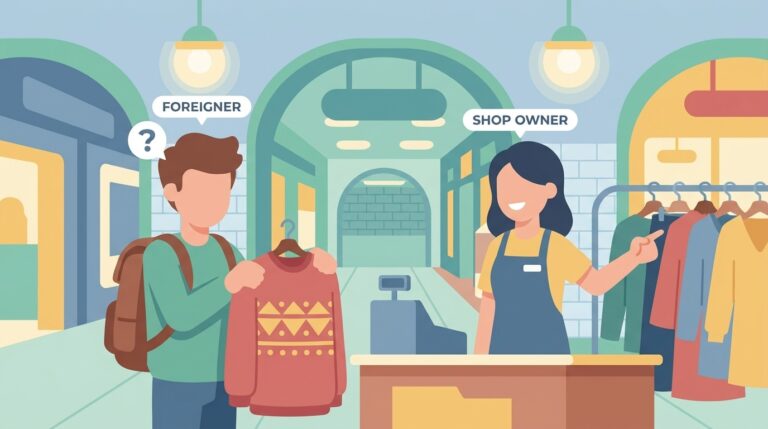
Phase 1: Empathy — The Hongdae Shopping Panic
Hello there! I’m your lead editor and resident local culture navigator from Daily Hangul.
Picture this: You are walking down the vibrant streets of Hongdae (홍대). You step into a trendy, aesthetic boutique that looks straight out of a K-Drama. You spot it—the perfect oversized trench coat you’ve been dreaming of. You pick it up, check the tag, and it says… “F”. What does that even mean? It looks a bit snug. You need a bigger one. The stylish shop owner walks over, smiling. Your mind goes blank.
“How do I ask for my size? Should I just say ‘Big’? Do I use Google Translate?”
If you’ve ever felt this mild panic in a Korean clothing store, you are not alone! Shopping is one of the best parts of visiting Korea, from the underground malls of Gangnam to the vintage shops of Seongsu-dong. But the sizing system and shopping etiquette can be a bit different from what you’re used to.
Today, I’m going to teach you the absolute must-know survival phrases for shopping in Korea. No more giving up on that perfect outfit just because you couldn’t find the right words!
Phase 2: Deep Dive into Core Expressions
Here are the top 3 phrases you need to conquer any Korean boutique.
1. 사이즈 있어요? (Do you have sizes?)
- Pronunciation: [sa-i-jeu i-sseo-yo?]
- Tip: ‘eu’ (으) sounds like the disgusted sound you make when you step in gum: “eugh”.
- Meaning: Literal: “Do size exist?” / Real Nuance: “Do you have this in my size?” or “Are there other sizes for this?”
- K-Culture Moment: You’ll hear this constantly in bustling underground shopping malls (지하상가) where clothes are often stacked tightly, and only one display item is shown.
- Editor’s Insight: You’ll notice we use the English word “size” (사이즈). It’s a widely accepted loanword in Korea! You can also put the specific size in front: “M (엠) 사이즈 있어요?” (Do you have an M size?).
- Situation Spectrum:
- Store clerks (Polite/Standard): ✅
- Friends (Casual): 🚫 (You would drop the ‘yo’ and just say ‘사이즈 있어?’)
- 🤔 Think About It: Why does Korean just say “Size exists?” instead of “Do you have my size?” Korean is a context-heavy language. We love dropping “I” and “You” to make sentences shorter and more efficient!
2. 더 큰 거 있어요? (Do you have a bigger one?)
- Pronunciation: [deo keun geo i-sseo-yo?]
- Tip: ‘eo’ (어) sounds like the “uh” in “uh-oh”, and ‘geo’ (거) sounds like the “guh” in “gullible”.
- Meaning: Literal: “More big thing exists?” / Real Nuance: “Do you have this in a larger size?”
- K-Culture Moment: Korean fashion heavily favors either the extremely fitted look (K-Pop idol style) or the dramatically oversized look (K-Drama casual). If an item looks too tight, confidently use this phrase!
- Editor’s Insight: “거” (geo) means “thing” or “one”. It’s a magic word you can use when pointing at almost anything. If you want a smaller one, you can say “더 작은 거 있어요?” (deo ja-geun geo i-sseo-yo?).
- Situation Spectrum:
- Store clerks (Polite/Standard): ✅
- 🤔 Think About It: In many Western stores, sizes are clearly separated on racks. In small Korean boutiques, the clerk often has to check the back room for inventory. How does this interaction change the shopping experience for you?
3. 입어봐도 돼요? (Can I try it on?)
- Pronunciation: [i-beo-bwa-do dwae-yo?]
- Meaning: Literal: “Even if I try wearing it, is it okay?” / Real Nuance: “Can I try this on?”
- K-Culture Moment: You grab that gorgeous blouse, but wait! In Korea, many stores have strict rules about what you can and cannot try on. (More on this in the FAQ!)
- Editor’s Insight: This phrase is an absolute lifesaver. Never just walk into a fitting room in a small boutique without asking this first. It shows respect and good manners.
- Situation Spectrum:
- Store clerks (Polite/Standard): ✅
- 🤔 Think About It: “~도 돼요?” means “is it okay if I…?”. It asks for permission rather than demanding it. How does this reflect the Korean cultural emphasis on mutual respect in public spaces?
Phase 3: Textbook vs. Real Korean
Let’s see how real people talk on the streets of Myeongdong compared to what traditional textbooks teach.
[Asking for a specific size]
* 📖 Textbook: 이것의 다른 치수가 있습니까? (i-geo-se da-reun chi-su-ga it-seum-ni-kka?) – Extremely formal and robotic.
* 🗣️ Real Korean: 이거 라지(L) 있어요? (i-geo L i-sseo-yo?) – Natural and effortless.
* 💡 Why the difference?: Koreans rarely use the native word for size, “치수” (chi-su), when shopping for casual clothes today. We just say the English letter (S, M, L) + 있어요?
[When something is too small]
* 📖 Textbook: 저에게 너무 작습니다. (jeo-e-ge neo-mu jak-seum-ni-da.) – Sounds like a dramatic line from a historical drama.
* 🗣️ Real Korean: 아, 좀 작네요. 더 큰 거 없어요? (a, jom jang-ne-yo. deo keun geo eop-seo-yo?)
* 💡 Why the difference?: Adding “좀” (jom / a little) softens the sentence, so it doesn’t sound like you’re criticizing the clothes.
(Bottom Note for A1: Don’t stress about complex grammar. Pointing at the clothes and just saying “M 있어요?” (M i-sseo-yo?) is 100% perfect for beginners!)
Phase 4: Cultural Context — K-Culture Deep Dive
4-1. Non-verbal cues: The Art of “Eye-Shopping”
When asking “사이즈 있어요?”, make sure to gently hold the clothing item up or point to it so the clerk knows exactly what you’re talking about. Also, small boutique owners might follow you around to help. Don’t be alarmed! It’s a sign of good service, not suspicion. If you’re just looking, smile and say: “그냥 보는 거예요” (geu-nyang bo-neun geo-ye-yo – I’m just looking).
4-2. The Infamous “Free Size” (프리 사이즈)
If you shop in Korea, you will quickly notice many tags say “F” or “FREE”.
In Korea, “Free Size” does NOT mean “One Size Fits All” (even though it’s supposed to). It usually means “One Size Fits Most Koreans,” which roughly translates to a US size Small or Medium.
Why does this exist? In fast-fashion areas like Dongdaemun (동대문) or underground malls, producing only one “average” size is incredibly cost-effective and efficient, allowing for the rapid turnover of trendy clothes. So, if you see an “F” and you’re not sure, hold it up and ask, “입어봐도 돼요?” (Can I try it on?).
Phase 5: Real-world Roleplay Scenario
Let’s put you in the spotlight!
Setting: Saturday afternoon at Goto Mall (Gangnam Underground Shopping Center). It’s crowded, buzzing with energy, and clothes are everywhere. You find an amazing K-Pop style varsity jacket on a mannequin.
Characters:
– YOU (The Shopper): Eager to buy the jacket but need a larger fit.
– 사장님 (Sajangnim / Store Owner): A friendly, fast-talking Korean “Auntie” (이모/Imo) who wants to make a sale.
Dialogue:
YOU: 저기요, 이거… 사이즈 있어요? 🧥
(jeo-gi-yo, i-geo… sa-i-jeu i-sseo-yo?)
[Excuse me, do you have sizes for this?]
사장님: 어머, 언니! 그거 너무 예쁘지? 근데 그거 프리 사이즈 하나야.
(eo-meo, eon-ni! geu-geo neo-mu ye-ppeu-ji? geun-de geu-geo peu-ri sa-i-jeu ha-na-ya.)
[Oh my, sister! Isn’t that so pretty? But that one is only Free Size.]
(🎭 Stage Direction: The owner takes the jacket off the rack and holds it against your shoulders)
YOU: 아… 그래요? 입어봐도 돼요?
(a… geu-rae-yo? i-beo-bwa-do dwae-yo?)
[Ah… really? Can I try it on?]
사장님: 그럼! 저기 안에서 입어봐.
(geu-reom! jeo-gi a-ne-seo i-beo-bwa.)
[Of course! Try it on in there.]
(🎭 Stage Direction: You try it on. It’s a bit tight on the shoulders.)
YOU: 흠… 이거 좀 작아요. 비슷한 걸로…
(heum… i-geo jom ja-ga-yo. bi-seu-tan geol-lo…)
[Hmm… this is a bit small. Something similar…]
🔀 Your Turn! How do you finish your sentence?
– A) “더 큰 거 있어요?” (deo keun geo i-sseo-yo? – Do you have a bigger one?)
– B) “엑스라지 줘요!” (ek-seu-ra-ji jwo-yo! – Give me XL!)
– C) “미안합니다, 안녕히 계세요.” (mi-an-ham-ni-da, an-nyeong-hi gye-se-yo – I am sorry, goodbye.)✅ Best Choice: A — It naturally continues the conversation, asking if she has a similar style in a larger size.
⚠️ Choice B Analysis: “줘요” (Give me) sounds a bit aggressive and demanding for a store setting.
⚠️ Choice C Analysis: A bit too dramatic for simply returning an item that didn’t fit!
사장님: 아, 큰 거? 잠시만~ (Digs into a pile of clothes) 이건 어때? 박시한 핏이야!
(a, keun geo? jam-si-man~ i-geon eo-ttae? bak-si-han pi-si-ya!)
[Ah, a big one? Hold on~ How about this? It has a boxy fit!]
Phase 6: 10-Second Shadowing Drill
Practice making it sound natural! Remember the pauses.
- 😊 이 옷 / 엠 사이즈 / 있어요?
(i ot / em sa-i-jeu / i-sseo-yo?)
[Brightly] Do you have this clothes in M size? -
🥺 저기요… / 이거 / 더 큰 거 / 있어요?
(jeo-gi-yo… / i-geo / deo keun geo / i-sseo-yo?)
[Hesitantly] Excuse me… do you have a bigger one of this? -
😊 이거 / 입어봐도 / 돼요?
(i-geo / i-beo-bwa-do / dwae-yo?)
[Politely asking] Can I try this on?
Phase 7: K-Culture Mini Dictionary
1. 프리 사이즈 (Free Size)
* Romanization: peu-ri sa-i-jeu
* English: “Free Size” (One Size)
* Context: A universal size commonly found in Korean women’s fashion, usually fitting US sizes S to M.
2. 핏 (Fit)
* Romanization: pit
* English: Fit / Silhouette
* Context: Koreans use this English word a lot! “오버핏” (Over-fit) means oversized, and “박스핏” (Box-fit) means a boxy silhouette.
3. 아이쇼핑 (Eye-shopping)
* Romanization: a-i-syo-ping
* English: Window shopping
* Context: A classic Konglish word. If a clerk asks if you need help, you can say “아이쇼핑 중이에요” (I’m window shopping).
4. 득템 (Deuk-tem)
* Romanization: deuk-tem
* English: A great catch / scoring a good item
* Context: A popular slang combination of a Chinese character (득 – to get) and English (tem – item). Use this when you find the perfect size on sale!
Phase 8: Traveler’s Survival Kit
Are you ready to hit the shopping streets of Seoul? Keep these flashcards handy.
🆘 Survival Phrase #1: Price
– 🇰🇷 “이거 얼마예요?” (i-geo eol-ma-ye-yo?)
– 🗣️ English meaning: How much is this?
– 📍 Where to use: Underground malls, street markets.
– 💡 Pro Tip: In places like Dongdaemun, prices might not be labeled. If you can’t understand the numbers they say, just hand them your phone with the calculator app open!🆘 Survival Phrase #2: Payment
– 🇰🇷 “카드 돼요?” (ka-deu dwae-yo?)
– 🗣️ English meaning: Do you accept cards?
– 📍 Where to use: Small stalls.📌 Editor’s Travel Note
– Card vs Cash: Korea is overwhelmingly a cashless society. However, in small underground malls (like Goto Mall), they might offer you a “cash discount” (현금할인 – hyeon-geum-hal-in) if you pay with cash or bank transfer.
– Haggling: Haggling is NOT common in standard stores or malls. You can try a little bit of cute haggling in traditional markets, but generally, the price is the price.
Phase 9: Critical Thinking Corner — “A Step Deeper”
🧠 Think Deeper: Korean in the Global Era (Konglish)
Have you noticed how many words in this lesson came from English? Size, fit, free. As Korea rapidly modernized and became a hub for global pop culture and fashion, it absorbed English vocabulary and remolded it to fit Korean daily life. This is called “Konglish.” While some traditionalists worry that the “purity” of the Korean language is fading, others argue that language is a living organism. Using “사이즈” instead of “치수” isn’t just about sounding western; it’s about speed, global trends, and practicality in a fast-paced society.💬 Your Turn: Does your native language borrow words from other languages to describe fashion or modern trends? Let me know in the comments!
Phase 10: FAQ & Avoiding Common Mistakes
Q1. “Can I just say ‘Big’ (크다 – keuda) and point?”
Yes! For A1 beginners, pointing and saying “조금 커요” (It’s a little big) or “조금 작아요” (It’s a little small) works perfectly. Koreans are very accommodating to tourists.
Q2. “Do I need to say ‘Please’ (제발 – jebal) when asking for a size?”
No! This is a very common mistake. “제발” is only used when begging dramatically (like in a K-Drama when someone’s life is on the line). Adding “~요” (yo) at the end of your sentence is already polite enough!
❌ Common Mistake #1: Trying on white shirts without asking.
✅ Do this instead: In Korea, many stores strictly prohibit customers from trying on white tops, knitwear, or tight t-shirts to prevent makeup stains. ALWAYS ask: “입어봐도 돼요?” (Can I try it on?). Some stores might even hand you a face cover (페이스 커버) — a thin mesh hood you wear over your head while trying on clothes so your makeup doesn’t ruin the fabric!
Phase 11: Summary & Action Items
- One-Liner Summary: Remember to say “사이즈 있어요?” (sa-i-jeu i-sseo-yo) to find your perfect fit, and “입어봐도 돼요?” (i-beo-bwa-do dwae-yo) before heading to the fitting room!
-
Action Mission 3 Steps:
- 🥉 Bronze (Solo): Look at a piece of clothing in your closet and say “더 큰 거 있어요?” out loud 3 times.
- 🥈 Silver (Online): Leave a comment below telling us what “사이즈” you usually wear!
- 🥇 Gold (Real World): Next time you visit a Korean store or a Korean brand online, try locating the “피팅룸” (Fitting room) and “프리 사이즈” (Free size) tags.
- K-Culture Mission: Watch a K-Drama episode where characters go shopping (like Crash Landing on You or Queen of Tears). See if you can catch them using the word “핏” (fit) or “사이즈” (size)!
Phase 12: Quiz — Interactive Challenge
Let’s test what you’ve learned!
1. Fill in the Blank:
You found a cute skirt, but you need a larger size. You hold it up and ask the clerk:
“저기요, 이거 더 (____) 거 있어요?”
A) 작은 (small)
B) 큰 (big)
C) 비싼 (expensive)
2. True or False – K-Culture Edition:
“In Korean underground shopping malls, ‘Free Size’ means it will perfectly fit any body type, no matter how tall or short you are.”
3. Situational Judgment:
You have full makeup on and want to try on a tight white turtleneck. What is the most appropriate action?
A) Just take it to the fitting room. They won’t mind.
B) Ask the clerk “입어봐도 돼요?” (Can I try it on?), understanding they might say no to protect the white fabric.
C) Say “제발!” (Please!) until they let you.
🎯 Click here for the answers!
1. B) 큰 (big) – “더 큰 거 있어요?” (Do you have a bigger one?)
2. False – “Free Size” usually caters to an “average” Korean body type (often a US Small/Medium). It does not fit everyone!
3. B – White clothes and makeup are a tricky combination in Korea. Always ask for permission first!
Did you enjoy shopping with me today? Let me know in the comments what phrase you want to learn next! Happy shopping and 득템 (Deuk-tem)! 🛍️
Frequently Asked Questions (FAQ)
Q: What does "사이즈 있어요? (Do you have sizes?)" mean in Korean and how do you pronounce it?
A: In Korean, "사이즈 있어요? (Do you have sizes?)" is pronounced [sa-i-jeu i-sseo-yo?] and means: a key conversational Korean expression covered in this lesson.
Q: What does "더 큰 거 있어요? (Do you have a bigger one?)" mean in Korean and how do you pronounce it?
A: In Korean, "더 큰 거 있어요? (Do you have a bigger one?)" is pronounced [deo keun geo i-sseo-yo?] and means: a key conversational Korean expression covered in this lesson.
Q: What does "입어봐도 돼요? (Can I try it on?)" mean in Korean and how do you pronounce it?
A: In Korean, "입어봐도 돼요? (Can I try it on?)" is pronounced [i-beo-bwa-do dwae-yo?] and means: Literal: "Even if I try wearing it, is it okay?" / Real Nuance: "Can I try this on?"







