

Phase 1: Empathy — Welcome to the K-Drama Reality!
Hello! I’m your lead editor from Daily Hangul, your veteran Korean tutor and local culture navigator.
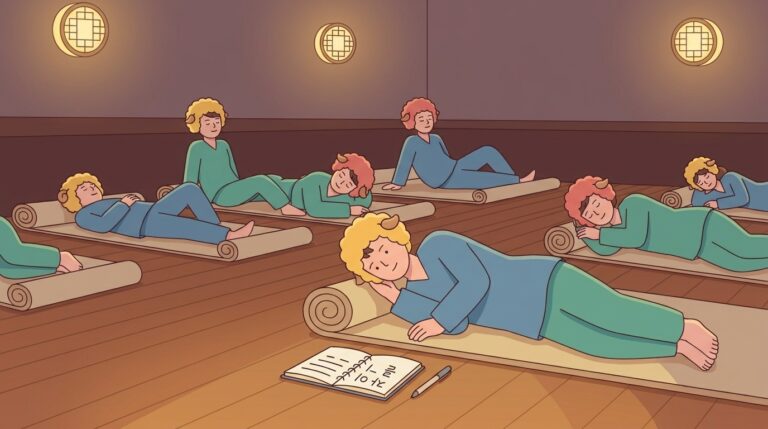
Picture this: You are watching a classic K-Drama. The main character just had a huge argument with their family, packed a tiny bag, and dramatically stormed out of the house. Where do they go? Straight to the 찜질방 (Jjimjilbang – Korean Sauna)! They roll up a towel into a cute ‘sheep head’ (양머리), crack a baked egg on their forehead, and eventually lie down on a thin mat in a massive, dimly lit room full of sleeping strangers.
Now, imagine you are traveling in Korea. You decide to try this iconic Jjimjilbang experience. You’ve soaked in the hot baths, eaten the eggs, and now you’re exhausted. You walk into the 수면실 (Sumyeonsil – Sleeping Room). It’s dark. People are sleeping. But wait… you need a blanket. Or maybe someone’s snoring too loudly. Or you just want to know if an empty mat is taken.
Don’t panic! As a beginner (A1), you don’t need complex grammar to survive here. You just need a few magic phrases and a little bit of cultural Nunchi (tact). Let’s dive in!
Phase 2: Core Expressions Deep Dive
Here are the absolute basic survival phrases for the sleeping room. We will keep it simple and effective.
1. 여기 자리 있어요?
- Pronunciation: [yeogi jari isseoyo?] -> “Yuh-gee jah-ree ee-ssuh-yo?”
- Meaning: Is this seat/spot taken? (Literal: Here space exists?)
- K-Culture Moment: Finding a spot on the heated floor of a Jjimjilbang is like a game of musical chairs. If you see an empty mat but a phone or towel is next to it, you MUST ask this before claiming it!
- Editor’s Insight: This isn’t just for saunas! You will use this magic phrase in cafes, libraries, and food courts all over Korea.
- Situation Spectrum:
- Casual / Strangers: ✅ (Perfect for anyone)
- Staff: ✅
- Formal: ⚠️ (Add “실례지만” – Excuse me, to be extra polite)
- 🤔 Think About It: Koreans often leave their phones or wallets on tables to “reserve” a spot. Why do you think Korea is so safe that people trust strangers with their belongings?
2. 이불 (좀) 주세요.
- Pronunciation: [ibul (jom) juseyo] -> “Ee-bool (johm) joo-seh-yo.”
- Meaning: Please give me a blanket. (Literal: Blanket [a little] please give.)
- K-Culture Moment: You approach the front desk or the counter inside the sauna. You’re freezing after coming out of the ice room. You just point and say this!
- Editor’s Insight: “주세요 (juseyo)” is the ultimate A1 cheat code. Noun + juseyo = You get what you want! The word “좀 (jom)” literally means “a little,” but we use it to soften the request to sound more polite.
- Situation Spectrum:
- Service Staff: ✅ (Perfect)
- Friends: ⚠️ (Use “이불 줘” instead)
- 🤔 Think About It: Why do Koreans add “좀 (a little)” when asking for things? It shows a cultural desire not to burden the listener too much!
3. 저기요… 쉿!
- Pronunciation: [jeogiyo… shwit!] -> “Juh-gee-yo… shhh!”
- Meaning: Excuse me… shh!
- K-Culture Moment: You’re trying to sleep, but the teenagers next to you are giggling and playing games on their phones.
- Editor’s Insight: Telling someone to “shut up” in Korean is very tricky and can sound aggressive. Instead of a full sentence, whispering “저기요 (Excuse me)” and making the universal “shh” sound is the safest, most socially acceptable way for a beginner to ask for quiet in a dark room.
- Situation Spectrum:
- Strangers making noise: ✅
- Older adults: 🚫 (Do not shush older adults! Move to another spot instead!)
Phase 3: Textbook vs. Real Korean
Let’s see how the textbook differs from what you actually hear in a Jjimjilbang!
[Asking for an extra pillow]
* 📖 Textbook Korean: 베개를 하나 더 주시겠습니까? (Would you please give me one more pillow?)
* 🗣️ Real Korean: 저기요, 베개 하나만요. (Excuse me, just one pillow please.)
* 💡 Why the difference?: Koreans value speed and efficiency (빨리빨리 – ppalli-ppalli culture). In casual service situations, short and sweet is best!
[Asking someone to be quiet]
* 📖 Textbook Korean: 조용히 해 주시길 바랍니다. (I hope you keep quiet.)
* 🗣️ Real Korean: (Whispering) 아휴, 시끄러워… (Sigh, so loud…)
* 💡 Why the difference?: Direct confrontation is avoided in Korea. Often, people will just sigh loudly to show their passive-aggressive annoyance (눈치 – Nunchi) rather than confronting the person directly!
Phase 4: Cultural Context — K-Culture Deep Dive
4-1. Non-verbal Communication: The Art of Tiptoeing
In the Jjimjilbang sleeping room, 눈치 (Nunchi) is everything. If you walk in at 2 AM, do not talk at a normal volume. You must whisper. Walk softly on your toes. If you accidentally step on someone’s sleeping mat, simply bow your head quickly as a silent “I’m sorry.”
4-2. The K-Drama Trope: The Runaway Safe Haven
Have you noticed in K-Dramas like Crash Landing on You or Legend of the Blue Sea, characters who have nowhere to go always end up sleeping at a Jjimjilbang? That’s because it’s incredibly cheap (around $10-$15 for a night), safe, and warm.
Critical View: In dramas, characters talk loudly, eat snacks in the sleeping room, and have dramatic reunions. In reality? The sleeping room is strictly for sleeping! If you crunch on chips in the sleeping room, you will get very angry glares from Korean Ahjummas (middle-aged women). Eat your snacks in the common hall!
Phase 5: Real-world Roleplay Scenario
Setting: 11:30 PM. The main sleeping room of “Dragon Hill Spa” in Seoul. It’s dark, except for the glow of the “Exit” sign. The floor is heated (Ondol). You have your pillow, but you forgot to grab a blanket. You tiptoe to the Ahjumma (staff) sitting near the entrance.
Characters:
– YOU: A tired traveler who just wants to sleep.
– Ahjumma (Staff): A middle-aged Korean lady organizing towels.
Dialogue:
(You tiptoe to the counter)
YOU: 저기요… (jeogiyo…)
(English) Excuse me…
(🎭 Stage Direction: You speak in a soft whisper)
Ahjumma: 네, 손님. (ne, sonnim.)
(English) Yes, customer.
YOU: 추워요. (chuwoyo.)
(English) I’m cold.
Ahjumma: 아유, 수면실이 좀 춥죠? 이불 드릴까요? (ayu, sumyeonsili jom chupjyo? ibul deurilkkayo?)
(English) Oh my, the sleeping room is a bit cold, right? Shall I give you a blanket?
🔀 Your Turn! How do you answer?
– A) “네, 이불 주세요!” (Loud and clear!)
– B) “네, 감사합니다.” (Whispering with a small bow)
– C) “아니요, 괜찮아요.” (No, it’s okay.)✅ Best Choice: B — Reason: You are in a sleeping area! Whispering “Yes, thank you” with a slight bow is polite, acknowledges her help, and respects the quiet zone.
⚠️ Choice A Analysis: Grammatically correct, but if you speak loudly, you lack Nunchi!
Ahjumma: 자, 여기요. (ja, yeogiyo.)
(English) Here you go.
YOU: 감사합니다. (gamsahamnida.)
(English) Thank you.
Phase 6: 10-Second Shadowing Drill
Let’s practice your pronunciation. Follow the pauses (/) and the emotional tags!
- 🥺 애절하게 (Desperately wanting a blanket):
저기요, / 이불 좀 / 주세요…
(jeo-gi-yo, / i-bul jom / ju-se-yo…) - 🤫 조심스럽게 (Cautiously looking for a spot):
여기 / 자리 / 있어요?
(yeo-gi / ja-ri / i-sseo-yo?)
Phase 7: K-Culture Mini Dictionary
Here are some essential cultural keywords you’ll encounter around the sauna:
1. 눈치
* Romanization: nunchi
* English: Social tact / Reading the room
* Context: The core social sense in Korea. Knowing you should whisper in the sleeping room without being told is having “fast Nunchi.”
2. 회식
* Romanization: hoesik
* English: Company dinner
* Context: Why are there so many men in suits sleeping at the Jjimjilbang on a Friday night? Because they missed the last train after a heavy Hoesik (company drinking party)!
3. 온돌
* Romanization: ondol
* English: Traditional Korean floor heating
* Context: The reason Koreans sleep on thin mats on the floor instead of beds in the Jjimjilbang. The floor itself is warm and therapeutic!
4. 양머리
* Romanization: yangmeori
* English: Sheep head (towel fold)
* Context: The iconic way Koreans fold Jjimjilbang towels over their heads. It protects hair from extreme heat and looks adorable for selfies.
Phase 8: Traveler Survival Kit
🆘 Survival Expressions for the Sauna
– 🇰🇷 “수면실 어디에요?” (sumyeonsil eodieyo?)
– 🗣️ Pronunciation: Soo-myun-shil uh-dee-eh-yo?
– 📍 Meaning: Where is the sleeping room?
- 🇰🇷 “이거 얼마예요?” (igeo eolmayeyo?)
- 🗣️ Pronunciation: Ee-guh ul-ma-yeh-yo?
- 📍 Meaning: How much is this? (For snacks!)
📌 Editor’s Travel Note
– The Magic Wristband: In modern Jjimjilbangs, you don’t carry cash. You tap your locker key (a digital wristband) to buy blankets, eggs, and drinks. You pay the total bill when you leave!
– Personal Space: Do not expect a private room. You are sleeping in a massive hall with 50+ other people. Embrace the communal vibe!
Phase 9: Critical Thinking Corner — “한 발 더 깊이”
🧠 Think Deeper: Space & Community (Communal Sleeping)
Why are Koreans so comfortable sleeping on the floor in a massive room surrounded by complete strangers? This traces back to Korea’s traditional Ondol (floor heating) culture and strong agrarian community roots. Historically, families slept together in one heated room to survive harsh winters. Today, the Jjimjilbang is an extension of that communal living. It breaks down social barriers—everyone wears the same uniform, shares the same heat, and sleeps side-by-side regardless of their social status outside.💬 Your Turn: Would you feel comfortable sleeping in a giant room with strangers? How does your culture handle public relaxation spaces? Share in the comments!
Phase 10: FAQ & Common Mistakes
Q: “Can I reserve a spot with my towel while I go eat?”
Maybe. If you leave for 5 minutes, it’s okay. If you leave for 2 hours, the Ahjumma will clean up your mat. Don’t be a space-hogger!
Q: “What if someone is snoring incredibly loudly?”
Unfortunately, you just have to endure it (or bring earplugs). Waking up a stranger to tell them they are snoring is considered rude.
❌ Common Mistake #1: Taking a phone call in the sleeping room.
✅ Do this instead: If your phone rings, grab it, run OUT to the hallway, and answer it there. The sleeping room is sacred quiet territory!
Phase 11: Summary & Action Items
One-Liner Summary: Remember your Nunchi—whisper, ask for things with “주세요 (juseyo)”, and embrace the warm Ondol floor!
Action Mission:
* 🥉 Bronze: Say “이불 주세요” (Ibul juseyo) out loud 3 times right now.
* 🥈 Silver: Search “Jjimjilbang Yangmeori tutorial” on YouTube and try making one with your bathroom towel!
* 🥇 Gold: Next time you visit a Korean restaurant or cafe, point to an empty seat and ask, “여기 자리 있어요?”
K-Culture Mission: Watch an episode of a Korean variety show (like Running Man) where they go to a sauna. Watch how they interact, sit on the floor, and order food!
Phase 12: Quiz — Interactive Challenge
1. Situational Judgment: You enter the dark sleeping room. You see a nice spot, but there’s a water bottle next to the mat. What should you do?
* A) Kick the bottle away and sleep.
* B) Ask the person next to it: “여기 자리 있어요?” (Is this taken?)
* C) Yell: “누구 자리예요?!” (Whose spot is this?!)
2. True or False — K-Culture Edition:
* “It is perfectly fine to have a loud conversation with your friends in the Jjimjilbang sleeping room if it’s before midnight.” (T/F)
3. Fill in the blank:
* You want a pillow (베개 – begae). You look at the staff and say politely: “베개 ____.” (Hint: The magic A1 word!)
(Answers: 1. B, 2. False – The sleeping room is always quiet!, 3. 주세요 / juseyo)
Did you get them all right? See you in the next lesson!
Frequently Asked Questions (FAQ)
Q: What does "여기 자리 있어요?" mean in Korean and how do you pronounce it?
A: In Korean, "여기 자리 있어요?" is pronounced [yeogi jari isseoyo?] and means: Is this seat/spot taken? (Literal: Here space exists?)
Q: What does "이불 (좀) 주세요." mean in Korean and how do you pronounce it?
A: In Korean, "이불 (좀) 주세요." is pronounced [ibul (jom] and means: Please give me a blanket. (Literal: Blanket [a little] please give.)
Q: What does "저기요... 쉿!" mean in Korean and how do you pronounce it?
A: In Korean, "저기요... 쉿!" is pronounced [jeogiyo... shwit!] and means: Excuse me... shh!







