

Phase 1: Empathy (Immersive Opening)
안녕하세요! Daily Hangul Editor here.
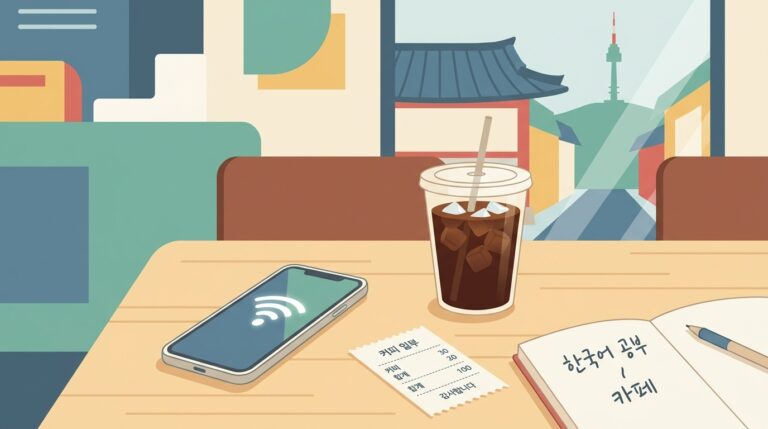
Picture this: You just walked into a stunning, aesthetic cafe in Seongsu-dong. You’ve got your iced Americano, you’ve found the perfect window seat, and you’re ready to upload that flawless cafe vlog to your Instagram Story. But wait—your travel eSIM just ran out of data. You look around, panic setting in. You see a router blinking in the corner. You need Wi-Fi. Fast.
In K-Dramas, you often see characters dramatically whipping out their laptops in cafes to “hack” something or quickly send a crucial file. But notice how they never seem to ask for the Wi-Fi password? That’s movie magic. In reality, connecting to Wi-Fi is the ultimate survival skill in Korea, a country practically running on a 5G heartbeat.
If you rely purely on textbook Korean, you might end up sounding like a robot from the 1990s, or worse, you might miss the cultural cues that the password is right under your nose. This guide is based on real SOS messages from my B1 students who found themselves disconnected in the middle of Seoul. Let’s get you back online, the authentic Korean way!
Phase 2: Core Expressions Deep Dive
1. 와이파이 비밀번호가 뭐예요?
- Pronunciation: wa-i-pa-i bi-mil-beon-ho-ga mwo-ye-yo? [wa-ee-pa-ee bee-meal-bun-ho-ga mwo-yeh-yo?]
- Meaning: What is the Wi-Fi password? (Literal: Wi-Fi secret number is what?)
- K-Culture Moment: This is the universal phrase you’ll hear in every cafe across Korea. In a drama, this is what the quirky best friend asks the moment they sit down at the table, even before looking at the menu.
- Editor’s Insight: The word ‘비밀’ (secret) makes it sound like you’re asking for classified intel, but it’s just the standard word for password. It feels polite but completely natural for any customer-to-staff interaction.
- Situation Spectrum:
- Casual with friends: ✅ (Drop the ‘요’ -> 뭐야?)
- Cafe Staff (Semi-formal): ✅
- Formal/Business: ⚠️ (Use ‘어떻게 되나요?’ instead of ‘뭐예요?’ for extra politeness)
- 🤔 Think About It: Why does Korean use “비밀번호 (Secret Number)” instead of a direct translation for “password”? It reflects the early days of Korean digitalization, where numeric PINs (for bank accounts and digital door locks) were the primary form of security before alphanumeric passwords became common.
2. 비번 공유 좀 해주세요.
- Pronunciation: bi-beon gong-yu jom hae-ju-se-yo. [bee-bun gong-you johm heh-joo-seh-yo.]
- Meaning: Please share the password.
- K-Culture Moment: You’re at a university study room or a group project meeting. One person figures out the Wi-Fi, and suddenly everyone turns to them holding out their phones.
- Editor’s Insight: Here is the insider secret—Koreans love abbreviating things. ‘비번’ is the trendy, shortened form of ‘비밀번호’. The word ‘좀’ (a little) softens the request, making it sound friendly rather than demanding.
- Situation Spectrum:
- Casual with friends: ✅
- Coworkers (Semi-formal): ✅
- Elders/Strangers: 🚫 (Stick to the full word ‘비밀번호’)
- 🤔 Think About It: Abbreviation (줄임말) culture is massive in Korea. Can you think of any abbreviations in your native language that only locals use daily?
3. 와이파이 잘 터져요?
- Pronunciation: wa-i-pa-i jal teo-jyeo-yo? [wa-ee-pa-ee jahl tuh-jyuh-yo? – ‘uh’ sounds like you’re thinking “uhh”]
- Meaning: Is the Wi-Fi connection good? (Literal: Does the Wi-Fi burst/explode well?)
- K-Culture Moment: You’re trying to stream a live K-Pop concert on your phone while riding the KTX train. Your friend asks you this to check if the video is lagging.
- Editor’s Insight: This is the most native-sounding expression on this list. We use the verb ‘터지다’ (to burst/explode) to describe a strong, fast connection. If the connection is bad, we say “와이파이 안 터져요 (It’s not bursting).”
- Situation Spectrum:
- Casual with friends: ✅
- Semi-formal: ✅
- Formal: 🚫
- 🤔 Think About It: Describing an internet connection as “bursting” shows Korea’s emphasis on speed and impact. How does your language visually or physically describe a strong internet signal?
Phase 3: Textbook vs. Real Korean
[Situation 1: Asking the cafe staff for the password]
* 📖 Textbook Korean: 와이파이 비밀번호를 알려주시겠습니까? (Would you please inform me of the Wi-Fi password?)
* 🗣️ Real Korean: 여기 와이파이 비번 뭐예요? (What’s the Wi-Fi pw here?)
* 💡 Why the difference?: Koreans value “빨리빨리” (hurry up) culture. Textbook Korean is too long for a fast-paced cafe environment. Shortening it to “비번” saves time for both you and the busy barista.
[Situation 2: Checking if your friend has internet access]
* 📖 Textbook Korean: 인터넷이 연결되었습니까? (Is the internet connected?)
* 🗣️ Real Korean: 너 와이파이 잡혀? / 터져? (Are you catching Wi-Fi? / Is it bursting?)
* 💡 Why the difference?: Everyday Korean uses very physical, dynamic verbs (잡다: to catch, 터지다: to burst) to describe technology, rather than passive, clinical terms.
Bottom Note: For B1 learners, using ‘비번’ with friends and ‘비밀번호’ with staff is the perfect balance of showing off your cultural fluency without crossing the line into being overly casual.
Phase 4: Cultural Context — K-Culture Deep Dive
4-1. Non-Verbal Cues: The Nunchi of Wi-Fi
Before you march up to the counter to ask for the Wi-Fi, you must practice Nunchi (눈치), the Korean art of reading the room. In bustling Korean cafes, interrupting a barista during a rush is a faux pas.
Look first: The password is usually displayed in one of three places:
1. On a small sign near the pickup counter.
2. Written on the cafe’s menu board.
3. Crucial Tip: At the very bottom of your receipt (영수증 하단). Never throw away your receipt until you’ve checked it for the “비밀번호”!
4-2. K-Travel Connection: The Public Network
Korea is a digital utopia. You’ll find “Public WiFi Free” networks on city buses, subway cars, and even random park benches. However, here’s the catch: when you connect to subway Wi-Fi, you often have to click through a captive portal screen, and sometimes it only works if you have a local SIM card from major carriers (SKT, KT, LGU+). If you’re a traveler using a roaming eSIM, the free subway Wi-Fi might reject you. Always ask a local friend: “이거 그냥 연결하면 돼요?” (Can I just connect to this?).
Phase 5: Practical Role-play Scenario
Setting: Saturday afternoon, 2 PM. A minimalist cafe in Yeonnam-dong. You just ordered an iced Americano and a piece of croffle. You want to upload a photo, but your data is slow.
Characters:
– YOU: A foreign traveler who knows enough Korean to order, but gets nervous during unexpected interactions.
– Barista (Minho, 20s): Wearing a neat apron, currently making three lattes at once. Friendly, but clearly busy.
Dialogue:
YOU: 저기요, 혹시 와이파이 돼요?
(jeo-gi-yo, hok-si wa-i-pa-i dwae-yo?)
[Excuse me, by any chance is Wi-Fi available?]
(🎭 Stage Direction: You approach the counter politely, trying not to interrupt his latte art)
Minho: 네, 됩니다.
(ne, doem-ni-da.)
[Yes, it is.]
YOU: 비밀번호가 뭐예요?
(bi-mil-beon-ho-ga mwo-ye-yo?)
[What is the password?]
Minho: 영수증 하단에 적혀 있습니다.
(yeong-su-jeung ha-dan-e jeo-kyeo it-seum-ni-da.)
[It is written at the bottom of the receipt.]
(🎭 Stage Direction: Minho points to the crumpled receipt you just shoved into your pocket)
YOU: 아… 영수증이요?
(ah… yeong-su-jeung-i-yo?)
[Ah… the receipt?]
(🎭 Stage Direction: You pull it out, but it’s a wall of tiny Korean text. You can’t find it.)
🔀 Your Turn! How do you respond?
– A) “한국어 못 읽어요.” (I can’t read Korean.)
– B) “어디에 있어요?” (Where is it?)
– C) “저기… 비번 좀 찾아주세요.” (Excuse me… please find the pw for me.)✅ Best Choice: B — “어디에 있어요?” It’s simple, polite, and prompts the barista to just point to the exact spot.
⚠️ Choice A Analysis: While honest, saying “I can’t read Korean” might panic the barista into trying to speak English, making the situation awkward. Choice C is a bit too demanding (using the casual ‘비번’ with a busy staff member).
[Bonus K-Culture Scenario: Ticketing War at the PC Bang]
You and your Korean friend are at a PC Bang (Internet Cafe) trying to buy K-Pop concert tickets. Speed is life.
Friend: 야! 너 폰 데이터 터져?
(ya! neo pon de-i-teo teo-jyeo?)
[Hey! Is your phone data bursting (working fast)?]
YOU: 아니, 와이파이 잡아야 돼. 여기 비번 뭐야?
(a-ni, wa-i-pa-i ja-ba-ya dwae. yeo-gi bi-beon mwo-ya?)
[No, I need to catch the Wi-Fi. What’s the pw here?]
Phase 6: 10-Second Shadowing Drill
Read this aloud to practice your rhythm! Pay attention to the pauses (/) and the emotion.
🥺 저기요, / 혹시 / 와이파이 비번 / 어디 있어요?
(jeo-gi-yo, / hok-si / wa-i-pa-i bi-beon / eo-di i-sseo-yo?)
[Excuse me, by any chance, where is the Wi-Fi password?]
Coach’s Tip: Make your voice slightly higher and softer on “저기요” (Excuse me) to sound extra polite. Don’t stress the syllables too hard; let it flow smoothly!
Phase 7: K-Culture Mini Dictionary
1. 눈치 (nunchi)
* Romanization: nunchi
* English: Social situational awareness
* Context: The quintessential Korean survival skill. Before asking for the Wi-Fi password, using your nunchi means checking the walls, your receipt, or waiting until the barista isn’t pouring hot water.
2. 비번 (bi-beon)
* Romanization: bi-beon
* English: Password (Abbreviation of 비밀번호)
* Context: Used heavily among Gen Z and Millennials. If you use this, Koreans will definitely think, “Oh, they know real Korean!”
3. 영수증 하단 (yeong-su-jeung ha-dan)
* Romanization: yeong-su-jeung ha-dan
* English: The bottom of the receipt
* Context: The holy grail phrase in Korean cafes. Most modern cafes print the Wi-Fi info and restroom codes here to save time.
4. 데이터 무제한 (de-i-teo mu-je-han)
* Romanization: de-i-teo mu-je-han
* English: Unlimited Data
* Context: What most Koreans have on their mobile plans, which is why your local friends might look confused when you desperately ask for Wi-Fi on the street.
Phase 8: Traveler’s Survival Kit
If you’re traveling in Korea, internet access is your lifeline for KakaoMap and translation apps. Memorize these!
🆘 Survival Expression #1: “Is there Wi-Fi here?”
– 🇰🇷 “여기 와이파이 돼요?” (yeo-gi wa-i-pa-i dwae-yo?)
– 🗣️ Pronunciation guide: [yuh-gee wa-ee-pa-ee dweh-yo?]
– 📍 Where to use: Cafes, restaurants, guesthouses.🆘 Survival Expression #2: “Can I get the password?”
– 🇰🇷 “비밀번호 좀 알려주세요.” (bi-mil-beon-ho jom al-lyeo-ju-se-yo.)
– 🗣️ Pronunciation guide: [bee-meal-bun-ho johm ahl-lyuh-joo-seh-yo.]
– 📍 Where to use: When the password isn’t on the receipt.📌 Editor’s Travel Note
– Apps to use on Wi-Fi: Naver Map or KakaoMap. Google Maps does not provide walking directions in Korea!
– Free Wi-Fi limits: In some franchise cafes (like Starbucks), the free Wi-Fi portal is in Korean. Just click the big central button (usually “동의” meaning agree) to connect.
– Power Outlets (콘센트): If you need to charge your phone, ask “콘센트 있어요?” (kon-sen-teu i-sseo-yo?). Korean cafes are famously generous with letting you charge devices for hours!
Phase 9: Critical Thinking Corner — “한 발 더 깊이”
🧠 Think Deeper: Korean in the Global Era (Language & Tech)
Have you noticed something interesting? The word for Wi-Fi in Korean is… “와이파이 (Wa-i-pa-i)”. The word for data is “데이터 (De-i-teo)”. As Korea modernized rapidly, it absorbed massive amounts of English tech terminology directly into its everyday vocabulary (known as Konglish or loanwords). However, instead of just borrowing the words, Koreans adapt them to fit the culture. They attach highly physical Korean verbs to them—like “catching” (잡다) Wi-Fi or data “bursting” (터지다). This shows how language isn’t just about vocabulary; it’s about the cultural mindset. Korea took global tech terms and injected them with its own dynamic, fast-paced “ppalli-ppalli” energy.💬 Your Turn: How does your language deal with new technology? Do you invent entirely new native words, or do you adopt English words? Let me know in the comments!
Phase 10: FAQ & Avoiding Misunderstandings
Q: Can I just say “비번 뭐예요?” to the cafe owner?
Maybe. If the cafe owner is a young person or it’s a very casual neighborhood spot, they won’t mind. But if the staff is much older, or if it’s a high-end restaurant, stick to “비밀번호 (bi-mil-beon-ho)” to maintain politeness.
Q: I keep saying ‘Wi-Fi’ but they don’t understand me! Why?
Pronunciation matters! If you say “Why-Fy” with a strong English accent, or “Wee-Fee” like in parts of Europe, Koreans might not catch it. You must pronounce it clearly in Korean syllables: Wa-I-Pa-I.
❌ Common Mistake #1: Throwing away the receipt immediately after paying.
✅ Do this instead: Look at the receipt! 90% of the time, the Wi-Fi name (SSID) and password are at the bottom under the label [WIFI].❌ Common Mistake #2: Asking “인터넷 있어요?” (Do you have internet?)
✅ Do this instead: Ask “와이파이 돼요?” (Is Wi-Fi available?). Asking if they have internet sounds a bit like asking if they have electricity—it’s too broad!
Phase 11: Summary & Action Items
One-Liner Summary: To connect like a local, check your receipt first, and if you must ask, use “와이파이 비밀번호가 뭐예요?”
Action Mission:
– 🥉 Bronze (Solo): Stand in front of your mirror and practice saying “와이파이 비밀번호 좀 알려주세요” three times smoothly.
– 🥈 Silver (Online): Change your phone or computer’s language to Korean for 1 hour and try to navigate your Wi-Fi settings (설정 > 와이파이).
– 🥇 Gold (Real World): Next time you are at a Korean cafe or restaurant, successfully ask for the Wi-Fi using today’s phrases!
K-Culture Mission:
Go to Google Images and search for “한국 영수증” (Korean receipt). Try to spot the word “비밀번호” or “비번” on the images!
Did you ever struggle to find Wi-Fi in a foreign country? Share your funny stories in the comments below!
Phase 12: Quiz — Interactive Challenge
1. Fill in the Blank:
You are at a cafe. The internet is super fast. You tell your friend:
“여기 와이파이 진짜 잘 _______!”
A) 터져요 (teo-jyeo-yo)
B) 죽어요 (ju-geo-yo)
C) 잡아요 (ja-ba-yo)
(Hint: Which verb means ‘to burst/explode with a strong signal’?)
2. True or False — K-Culture Edition:
“In Korean cafes, you have to pay extra to use the Wi-Fi or charge your phone.”
True / False
3. Situational Judgment:
You ask the barista for the Wi-Fi password. They say, “영수증 하단에 있습니다.” What should you do next?
A) Look at the menu board behind them.
B) Look at the bottom of the receipt they just handed you.
C) Ask them to write it down on a napkin.
(Answers: 1: A, 2: False – it is expected to be free and generous!, 3: B)
Frequently Asked Questions (FAQ)
Q: What does "와이파이 비밀번호가 뭐예요?" mean in Korean and how do you pronounce it?
A: In Korean, "와이파이 비밀번호가 뭐예요?" is pronounced [wa-i-pa-i bi-mil-beon-ho-ga mwo-ye-yo? [wa-ee-pa-ee bee-meal-bun-ho-ga mwo-yeh-yo?] and means: What is the Wi-Fi password? (Literal: Wi-Fi secret number is what?)
Q: What does "비번 공유 좀 해주세요." mean in Korean and how do you pronounce it?
A: In Korean, "비번 공유 좀 해주세요." is pronounced [bi-beon gong-yu jom hae-ju-se-yo. [bee-bun gong-you johm heh-joo-seh-yo.] and means: Please share the password.
Q: What does "와이파이 잘 터져요?" mean in Korean and how do you pronounce it?
A: In Korean, "와이파이 잘 터져요?" is pronounced [wa-i-pa-i jal teo-jyeo-yo? [wa-ee-pa-ee jahl tuh-jyuh-yo? - 'uh' sounds like you're thinking "uhh"] and means: Is the Wi-Fi connection good? (Literal: Does the Wi-Fi burst/explode well?)







