

Phase 1: Empathy (The Cold Open)
Hello! I’m your Daily Hangul Editor.
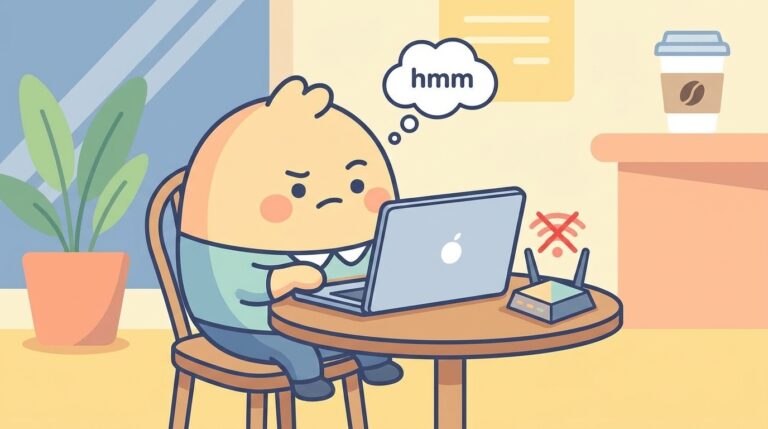
Picture this: You’re sitting in a trendy, aesthetic cafe in Seongsu-dong. Your iced Americano is perfectly chilled, and you are exactly three clicks away from securing tickets to your ultimate K-Pop bias’s comeback concert. Or maybe you’re just trying to submit a crucial report to your boss before the 5 PM deadline. You click the button. The screen freezes. The dreaded loading wheel of doom appears.
Your Wi-Fi is dead.
In a country famous for having some of the fastest internet speeds in the world, a sudden network drop feels like a catastrophic event. In K-Dramas, this is exactly the moment the main character aggressively taps their phone screen, lets out a deep sigh, and mutters something under their breath.
But what do they actually say? If you look in a textbook, you might find “The internet connection is unstable.” But let me tell you, no one in a PC Bang or a busy Korean office talks like that when they are losing their minds over a disconnected network. Today, we are going to learn the real, raw, and highly useful expressions Koreans use when the tech gods abandon them.
(Note: This guide is built on the real panicked questions my B2 students have asked me while living in Korea!)
Phase 2: Deep Dive into Core Expressions
1. 인터넷이 안 터져요.
- Pronunciation: inteonesi an teojyeoyo [in-tuh-net-ee ahn tuh-juh-yo]
- Meaning: (Literal) The internet is not bursting. / (Real Nuance) I can’t get any signal / The internet isn’t working.
- K-Culture Moment: You are in a crowded subway station, trying to load a KakaoMap route. You shake your phone, look at your friend, and say this phrase with a slight frown.
- Editor’s Insight: The verb 터지다 means “to burst” or “to explode.” In Korea, when a phone signal or Wi-Fi is strong, we say the signal “bursts.” If it’s not working, it “doesn’t burst.” It captures the physical frustration of waiting for a signal to break through!
- Situation Spectrum:
- Casual with friends: ✅ (인터넷 안 터져!)
- Co-workers (Semi-formal): ✅ (인터넷이 안 터지네요.)
- Boss/Formal: ⚠️ (Better to say: 인터넷 연결이 잘 안 됩니다.)
- 🤔 Think About It: Why would Koreans use the word “burst/explode” for a digital signal? Does this reflect the fast-paced expectations of Korean society? What idiom do you use in your language when the internet is dead?
2. 와이파이가 자꾸 끊겨요.
- Pronunciation: waipaiga jakku kkeunkyeoyo [wa-ee-pa-ee-ga ja-kkoo kkeun-kyuh-yo]
- Meaning: (Literal) The Wi-Fi repeatedly gets cut off. / (Real Nuance) The Wi-Fi keeps disconnecting / dropping.
- K-Culture Moment: You’re on a Zoom call with your Korean language tutor or a business partner, and their screen keeps freezing into funny faces. You type this into the chat to explain why you keep disappearing.
- Editor’s Insight: 자꾸 (jakku) means “repeatedly” or “frequently,” and it carries a slight tone of annoyance. You aren’t just stating a fact; you are expressing that this situation is bothering you.
- Situation Spectrum:
- Casual with friends: ✅ (와이파이 자꾸 끊겨.)
- Co-workers (Semi-formal): ✅ (와이파이가 자꾸 끊기네요.)
- Boss/Formal: ⚠️ (Use with softer tone: 와이파이가 계속 끊어지는 것 같습니다.)
- 🤔 Think About It: Koreans love the word 자꾸 when complaining about an ongoing minor inconvenience. How do you express polite annoyance in your native language without sounding too aggressive?
3. 공유기 껐다 켜보셨어요?
- Pronunciation: gongyugi kkeotda kyeobosyeosseoyo? [gong-yoo-gi kkuht-tta kyuh-bo-shyuh-ssoh-yo]
- Meaning: (Literal) Did you try turning the router off and turning it on? / (Real Nuance) Did you try restarting the router?
- K-Culture Moment: You finally call the internet provider’s customer service (고객센터). After navigating the ARS menu, the very first thing the polite agent asks you is this exact phrase.
- Editor’s Insight: This is the universal IT support mantra, Korean edition. ‘공유기’ is a router. ‘껐다 켜다’ means ‘to turn off and turn on’. It sounds so much more natural than the literal word for “reboot” (재부팅하다) in everyday conversation.
- Situation Spectrum:
- Casual with friends: ✅ (공유기 껐다 켜봤어?)
- Co-workers (Semi-formal): ✅ (공유기 껐다 켜보셨어요?)
- Boss/Formal: ✅ (공유기를 껐다 켜보시는 게 좋을 것 같습니다.)
- 🤔 Think About It: Customer service in Korea is notoriously fast. When they ask you to do this, they usually wait on the line patiently. Have you noticed differences in IT support etiquette between Korea and your home country?
Phase 3: Textbook vs. Real Korean
[Situation 1: Explaining that the network is unstable]
* 📖 Textbook Korean: 인터넷 연결이 불안정합니다. (The internet connection is unstable.)
* 🗣️ Real Korean: 인터넷이 자꾸 끊겨요. / 인터넷이 렉 걸려요. (The internet keeps dropping. / The internet is lagging.)
* 💡 Why the difference?: “렉 걸리다” (to catch a lag) comes straight from Korean PC gaming culture and has become the mainstream way to describe slow digital performance for all ages.
[Situation 2: Asking for the Wi-Fi password]
* 📖 Textbook Korean: 와이파이 비밀번호가 무엇입니까? (What is the Wi-Fi password?)
* 🗣️ Real Korean: 여기 와이파이 비번 뭐예요? (What’s the Wi-Fi pw here?)
* 💡 Why the difference?: Koreans love shortening words for efficiency. “비밀번호” (password) becomes “비번” (bibeon). If you use “비번”, you immediately sound like a local!
Bottom Note: For B2 level learners, “렉 걸려요” and “비번” are perfect slang words to use in daily life—they are universally understood and not considered rude among peers.
Phase 4: Cultural Context — K-Culture Deep Dive
4-1. Non-Verbal Cues: The Art of “Sighing”
When Koreans experience tech issues, they rarely scream. Instead, you will hear a very distinct, deep sigh: “아… 진짜…” (Ah… seriously…) while staring at the screen. It’s an expression of pure 빨리빨리 (Ppalli-ppalli, hurry-hurry) energy being thwarted.
4-2. The “Ticketing (티켓팅)” War
If you are a K-Pop fan, you know the terror of “Ticketing.” When BTS or BLACKPINK concert tickets drop, fans don’t just use their home Wi-Fi. They migrate to a PC Bang (PC방, internet cafe) because the LAN connection there is practically absolute. If the network drops during ticketing at a PC Bang, it’s not just an IT issue; it’s a tragedy.
* Critical View: This shows how internet speed isn’t just a convenience in Korea; it’s a competitive advantage in society, whether for university class registration (수강신청) or concert tickets.
Phase 5: Real-Life Roleplay Scenario
Setting: Friday, 4:50 PM. An office in Gangnam. You are trying to upload a massive video file to the shared company drive before the weekend starts, but the progress bar has been stuck at 99% for five minutes.
Characters:
– YOU: A foreign employee who just wants to go home.
– Min-su (32): Your friendly Korean coworker who sits next to you.
Dialogue:
YOU: 아… 진짜…
(Ah… jinjja…)
[Ah… seriously…]
(🎭 Stage Direction: You tap your mouse aggressively.)
Min-su: 왜 그래요? 무슨 일 있어요?
(Wae geuraeyo? Museun il isseoyo?)
[What’s wrong? Is something the matter?]
YOU: 지금 파일 올려야 되는데, 인터넷이 자꾸 끊겨요.
(Jigeum pail ollyeoya doeneunde, inteonesi jakku kkeunkyeoyo.)
[I need to upload a file right now, but the internet keeps dropping.]
Min-su: 헐, 저도 아까 그랬어요. 혹시 와이파이 신호 두 칸 아니에요?
(Heol, jeodo akka geuraesseoyo. Hoksi waipai sinho du kan anieyo?)
[Oh man, me too earlier. By any chance, does your Wi-Fi signal only have two bars?]
YOU: 어? 맞아요. 두 칸밖에 안 터져요.
(Eo? Majayo. Du kanbakke an teojyeoyo.)
[Huh? You’re right. I’m only getting two bars of signal.]
Min-su: 그거 회의실 공유기랑 연결돼서 그럴 거예요.
(Geugeo hoeuisil gongyugirang yeongyeoldwaeseo geureol geoyeyo.)
[That’s probably because it’s connected to the meeting room router.]
🔀 It’s your turn! How should you respond to Min-su?
– A) “아, 그럼 제 자리에 있는 공유기 껐다 켜볼까요?” (Ah, then should I try restarting the router at my desk?)
– B) “네, 알겠습니다. 감사합니다.” (Yes, understood. Thank you.)
– C) “아, 짜증나! 회사 인터넷 왜 이래요?” (Ah, so annoying! Why is the company internet like this?)✅ Best Choice: A — It shows problem-solving initiative using natural IT vocabulary!
⚠️ Choice B Analysis: Too textbook. It ends the conversation awkwardly without solving the issue.
🚫 Choice C Analysis: Too emotional for the workplace, even if Min-su is friendly. Complaining about the company to a colleague can be risky.
YOU: 아, 그럼 제 자리에 있는 공유기 껐다 켜볼까요?
(A, geureom je jarie itneun gongyugi kkeotda kyeobolkkayo?)
[Ah, then should I try turning the router at my desk off and on?]
Min-su: 네, 한번 재부팅 해보세요. 안 되면 IT팀에 전화해 볼게요.
(Ne, hanbeon jaebuting haeboseyo. An doemyeon IT-time jeonhwahae bolgeyo.)
[Yeah, try rebooting it. If it doesn’t work, I’ll call the IT team.]
Phase 6: 10-Second Shadowing Drill
Practice this common phrase with the right emotion and pacing. Imagine you are staring at a frozen YouTube video.
😤 아, 진짜 / 인터넷이 / 왜 이렇게 / 안 터지지?
(Ah, jinjja / in-tuh-net-ee / wae ee-ruh-ke / an tuh-ji-ji?)
- Pausing (/) Guide: Don’t rush. Pause slightly where the slashes are to sound exasperated.
- Emotion: Annoyed but speaking to yourself (soliloquy form with ‘~지?’).
Phase 7: K-Culture Mini Dictionary
1. 터지다
* Romanization: teojida
* English: To burst / To get a signal
* Context: Used to describe network reception, phone signals, or Wi-Fi strength.
2. 렉 걸리다
* Romanization: rek geollida
* English: To lag / to experience a glitch
* Context: Originally from PC gamers yelling about lag (렉), now used by everyone when a device or internet connection is painfully slow.
3. 비번
* Romanization: bibeon
* English: Password (Abbreviation of 비밀번호)
* Context: The most common way to ask for a Wi-Fi password at a cafe or restaurant.
4. 영수증
* Romanization: yeongsujeung
* English: Receipt
* Context: Crucial for IT survival in Korea! Cafe Wi-Fi passwords and restroom codes are almost always printed at the bottom of the receipt.
Phase 8: Traveler’s Survival Kit
Even if you aren’t working in an office, as a traveler, losing your connection to KakaoMap or Naver Map can leave you hopelessly lost in the middle of Hongdae!
🆘 Survival Expression #1
– 🇰🇷 “여기 와이파이 비번 영수증에 있어요?”
– 🗣️ yeogi waipai bibeon yeongsujeunge isseoyo?
– 📍 Where to use: Cafes, Restaurants
– 💡 Pro Tip: Before asking the staff, always check your receipt! Many cafes have a sign that says “와이파이 비밀번호: 영수증 하단 참조” (Wi-Fi password: See bottom of receipt).📌 Editor’s Travel Note
– Free Wi-Fi: Korea has “Public WiFi Free” in almost all subway stations and buses. However, the connection (터지는 것) can be spotty when the train is moving fast.
– SIM vs Pocket Wi-Fi: If your pocket Wi-Fi “자꾸 끊겨요” (keeps dropping), it might be out of battery! Always carry a power bank (보조배터리).
Phase 9: Critical Thinking Corner — “Going Deeper”
Language & Power in the Digital Age: The “Pali-Pali” Infrastructure
Have you ever wondered why Korean internet is so fast, and why Koreans get so visibly frustrated when a page takes more than 3 seconds to load? Korea’s 빨리빨리 (Ppalli-ppalli, hurry up) culture isn’t just an attitude; it physically shaped the country’s digital infrastructure. Because consumers demanded instant gratification, telecom companies built massive, hyper-fast networks. The phrase “인터넷이 안 터져요” reflects an expectation of perfection. In many other countries, a slow internet connection is just a mild annoyance you wait out. In Korea, it is viewed as a systemic failure that must be fixed immediately.
🧠 Think Deeper: How does the speed of the internet affect people’s patience in daily life? Does faster technology make us more anxious when it fails?
💬 Your Turn: How fast is the internet in your country? Do people get angry when the Wi-Fi drops, or do they just accept it? Share your cultural perspective in the comments!
Phase 10: FAQ & Avoiding Misunderstandings
Q: Can I use “인터넷 안 터져요” when emailing IT support?
No. “안 터져요” is a spoken, slightly colloquial expression. If you are writing an official IT ticket or email, use: “인터넷 연결이 불안정합니다” (Internet connection is unstable) or “네트워크 연결이 자주 끊어집니다” (Network connection frequently drops).
Q: Is it rude to ask cafe staff to fix the router?
It depends. If the cafe is completely packed and the staff are sweating over an espresso machine, it’s best to wait. But if it’s quiet, you can politely say: “저기요, 혹시 와이파이에 문제가 있나요? 연결이 안 돼서요.” (Excuse me, is there an issue with the Wi-Fi? It’s not connecting.)
❌ Common Mistake #1: Saying “인터넷이 부서졌어요” (The internet is broken/smashed).
✅ Do this instead: 부서지다 is for physical objects like glass or bones. For networks, use 끊기다 (disconnected), 안 되다 (not working), or 안 터지다 (no signal).
Phase 11: Summary & Action Items
One-Liner Summary: When your digital life freezes in Korea, remember: the signal “bursts” (터지다), the connection “gets cut” (끊기다), and the password is “비번” (bibeon)!
Action Mission 3-Steps:
– 🥉 Bronze (Solo): Look at your Wi-Fi router at home and say, “공유기 껐다 켜볼까?” out loud.
– 🥈 Silver (Online): Next time you lag in an online game or Zoom call, type “인터넷이 자꾸 끊겨요 ㅠㅠ” in the chat.
– 🥇 Gold (Real-world): Visit a Korean cafe and ask the barista: “와이파이 비번 뭐예요?” (Bonus points if you check the receipt first!)
K-Culture Mission:
Watch one episode of a modern K-Drama set in an office (like Misaeng or Start-Up). Pay close attention to scenes where characters stare at their computer screens in frustration. Can you catch them saying “아, 진짜…” or complaining about a lag?
Engagement: Have you ever experienced an internet meltdown while trying to do something important? How did you react? Tell me your story below!
Phase 12: Quiz — Interactive Challenge
Q1. Situational Judgment: You are at a trendy cafe. Your laptop says “Connected without internet.” You want to ask your friend what’s wrong. What is the most natural thing to say?
A) 인터넷이 파괴되었어요. (The internet is destroyed.)
B) 와이파이가 안 터져.
C) 네트워크 통신이 불량합니다.
Toggle for Answer:
Answer: B. “와이파이가 안 터져” is the perfect natural, casual way to express this. ‘A’ sounds like an action movie, and ‘C’ sounds like a robot.
Q2. Fill in the Blank:
“대박! 방탄소년단 콘서트 예매 성공했어! PC방 오길 잘했다. 집이었으면 분명히 인터넷이 자꾸 ___________(을) 거야.”
(Wow! I succeeded in booking the BTS concert! Good thing I came to the PC Bang. If I were at home, the internet definitely would have kept _______.)
Toggle for Answer:
Answer: 끊겼 (끊겼을 거야 – would have dropped/disconnected).
Q3. True or False — K-Culture Edition:
If you need the Wi-Fi password in a Korean cafe, you should immediately go to the counter and ask the staff before doing anything else.
Toggle for Answer:
False! Always check the bottom of your receipt (영수증) first. 90% of the time, the 비번 is printed right there!
Frequently Asked Questions (FAQ)
Q: What does "인터넷이 안 터져요." mean in Korean and how do you pronounce it?
A: In Korean, "인터넷이 안 터져요." is pronounced [inteonesi an teojyeoyo [in-tuh-net-ee ahn tuh-juh-yo] and means: (Literal) The internet is not bursting. / (Real Nuance) I can't get any signal / The internet isn't working.
Q: What does "와이파이가 자꾸 끊겨요." mean in Korean and how do you pronounce it?
A: In Korean, "와이파이가 자꾸 끊겨요." is pronounced [waipaiga jakku kkeunkyeoyo [wa-ee-pa-ee-ga ja-kkoo kkeun-kyuh-yo] and means: (Literal) The Wi-Fi repeatedly gets cut off. / (Real Nuance) The Wi-Fi keeps disconnecting / dropping.
Q: What does "공유기 껐다 켜보셨어요?" mean in Korean and how do you pronounce it?
A: In Korean, "공유기 껐다 켜보셨어요?" is pronounced [gongyugi kkeotda kyeobosyeosseoyo? [gong-yoo-gi kkuht-tta kyuh-bo-shyuh-ssoh-yo] and means: (Literal) Did you try turning the router off and turning it on? / (Real Nuance) Did you try restarting the router?







