

Unlocking the Soul of Korea: What ‘Ganggangsullae’ Teaches Us About Korean Collective Spirit
Phase 1: Empathy & The K-Culture Cold Open
Hello, fellow Korean learners! This is your Lead Editor at Daily Hangul.
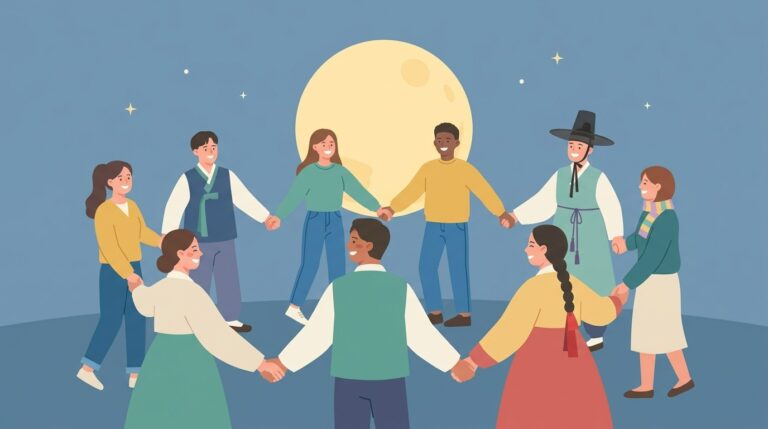
Imagine this: You are watching a historical K-Drama. It is the night of a full moon. Suddenly, women from all walks of life—from noble ladies to commoners—gather in the courtyard, hold hands, and begin to run in a massive, dizzying circle while singing. Fast forward to 2024 at a K-Pop concert. The artist shouts, and thousands of fans instantly sync their lightsticks, chanting in perfect harmony like a single organism.
What connects these two scenes? It is the spirit of Ganggangsullae (강강술래).
Recognized as a UNESCO Intangible Cultural Heritage, Ganggangsullae is an ancient Korean circle dance. But it is far more than just a historical performance. The vocabulary and cultural nuances born from this tradition—holding hands, moving in sync, keeping the rhythm—are deeply embedded in modern Korean society. Whether you are trying to survive an intense team dinner (회식) or just trying to vibe with your Korean friends, understanding the language of ‘collective harmony’ is your ultimate C1-level cheat code.
This guide is crafted from the real experiences of advanced learners who realized that mastering Korean is not just about conjugating verbs—it is about knowing how to ‘dance in a circle’ with locals. Let us dive in!
Phase 2: Core Expressions Deep Dive
To navigate the Korean collective mindset, you need to understand the idioms born from traditional communal activities.
1. 장단을 맞추다 (jang-dan-eul mat-chu-da)
- Pronunciation: jang-dan-eul mat-chu-da [Jang-dan sounds like the beat of a drum, mat-chu-da means to match.]
- Meaning:
- Literal: To keep the rhythm/beat.
- Real Nuance: To play along, to humor someone, to sync with the group’s mood even if you do not entirely agree.
- K-Culture Moment: You are at a company dinner (회식). Your boss starts making terrible dad jokes. Everyone laughs enthusiastically. They are not genuinely amused; they are jang-dan-eul mat-chu-da. It is the ultimate survival skill in K-Dramas featuring office politics.
- Editor’s Insight: This phrase perfectly captures the essence of Korean social harmony. It is less about being fake and more about preserving the ‘Heung’ (흥, joyous energy) of the group.
- Situation Spectrum:
- Casual (Friends hyping each other up): ✅
- Semi-formal (Co-workers agreeing with a client): ✅
- Formal (Directly telling a boss “I am humoring you”): 🚫 (Use the action, not the phrase itself!)
- 🤔 Think About It: Why does Korean have a specific musical idiom for social agreement? How does this reflect the importance of maintaining group harmony over individual dissent in Korean society?
2. 손발이 맞다 (son-bal-i mat-da)
- Pronunciation: son-bal-i mat-da [Son is hand, bal is foot.]
- Meaning:
- Literal: Hands and feet match.
- Real Nuance: To have great teamwork, to be perfectly in sync with someone.
- K-Culture Moment: In K-Pop survival shows, when a newly formed idol group dances with perfect synchronization and zero mistakes, the judges will nod and say, “Wow, son-bal-i cham jal manne-yo.”
- Editor’s Insight: In Ganggangsullae, if your hands and feet do not match the person next to you, the whole circle collapses. This phrase is heavily used in business and sports to praise seamless collaboration.
- Situation Spectrum:
- Casual: ✅
- Semi-formal: ✅
- Formal: ✅
- 🤔 Think About It: Does your native language use body parts to describe teamwork? What does the imagery of “hands and feet matching” imply about individuality versus the collective?
3. 분위기를 띄우다 (bun-wi-gi-reul tti-u-da)
- Pronunciation: bun-wi-gi-reul tti-u-da [Tti-u-da sounds like floating a balloon in the air.]
- Meaning:
- Literal: To float the atmosphere.
- Real Nuance: To liven up the mood, to break the ice and bring energy to the group.
- K-Culture Moment: The “variety show MVP.” In shows like Running Man, there is always that one member who starts a random dance or a chant just when everyone is tired. They are the ones “floating the mood.”
- Editor’s Insight: Koreans take the ‘vibe’ of a gathering very seriously. If the mood drops, someone will inevitably take on the responsibility of bunwigireul ttiuda to ensure the collective experience is a success.
- Situation Spectrum:
- Casual: ✅
- Semi-formal: ✅
- Formal: ⚠️ (Usually done by younger staff, not the executives)
- 🤔 Think About It: In your culture, who is responsible for ensuring everyone has a good time at a party? In Korea, it is often seen as a shared responsibility.
Phase 3: Textbook vs Real Korean
Let us look at how these collective concepts shift from formal textbooks to the vibrant streets of Seoul.
[Situation 1: Expressing great teamwork]
* 📖 Textbook Korean: 우리는 팀워크가 아주 좋습니다. (Our teamwork is very good.)
* 🗣️ Real Korean: 우리 완전 찰떡궁합이에요! (We are a perfect match/like sticky rice cake!) OR 우리 손발 장난 아니게 잘 맞아요. (Our synchronization is no joke.)
* 💡 Why the difference?: Koreans love using food metaphors (찰떡 – sticky rice cake) or physical metaphors to express abstract concepts like harmony. It feels much more visceral and intimate.
[Situation 2: Telling someone to play along]
* 📖 Textbook Korean: 다른 사람들의 의견에 동의해 주세요. (Please agree with other people’s opinions.)
* 🗣️ Real Korean: 눈치껏 장단 좀 맞춰 줘~ (Just read the room and play along~)
* 💡 Why the difference?: The word Nunchi (눈치 – situational awareness) is the unspoken rule of Korean society. Adding it makes the request culturally authentic rather than sounding like a robot.
Phase 4: Cultural Context — K-Culture Deep Dive
4-1. Non-Verbal Cues: The Art of the Circle
In Western cultures, staring at someone or holding a stranger’s hand can feel intrusive. However, in the context of Korean traditional festivals (and by extension, modern collective gatherings), the ‘circle’ makes everyone equal. When you join a communal activity, physical proximity is a sign of Jeong (정 – deep connection). If you are pulled into a group dance or a shared meal, leaning away or crossing your arms physically breaks the ‘circle’ and disrupts the harmony.
4-2. K-Culture Connection: The K-Pop “Ocean”
While Ganggangsullae originated as a harvest ritual and a tactical military dance under the moonlight, where does that energy go today? Look at a K-Pop concert. The synchronized fan chants, the coordinated lightsticks creating an ocean of color, the way fans move as one entity—this is the modern manifestation of Ganggangsullae. It is the desire to erase the boundaries between ‘you’ and ‘I’ to create ‘us’ (우리). The Korean language heavily favors “our” (우리 나라, 우리 엄마) over “my” (내), and understanding this communal joy is key to reaching C1 fluency.
Phase 5: Real-Life Roleplay Scenario
Setting: Chuseok (Korean Thanksgiving) night at the Korean Folk Village (한국민속촌). Lanterns are glowing under the full moon. The rhythmic beat of the Janggu (traditional drum) fills the air. A massive Ganggangsullae circle is forming in the central plaza, and performers are pulling tourists in.
Characters:
– YOU (The Reader): An expat living in Seoul, possessing a C1 level in Korean but still slightly shy about public dancing.
– Minji (28): Your energetic Korean friend who drags you to every cultural event.
– Event MC: A charismatic performer hyping up the crowd.
Dialogue:
Minji: 우와, 강강술래 시작한다! 우리도 빨리 가자! 🌕
(U-wa, gang-gang-sul-lae si-jak-han-da! U-ri-do ppal-li ga-ja!)
[Wow, Ganggangsullae is starting! Let’s go quickly!]
YOU: 어? 구경만 하는 거 아니었어? 사람들이 다 뛰어나가네.
(Eo? Gu-gyeong-man ha-neun geo a-ni-eoss-eo? Sa-ram-deul-i da ttwi-eo-na-ga-ne.)
[Huh? Weren’t we just going to watch? Everyone is running out there.]
MC: 자, 여러분! 부끄러워하지 마시고 다 같이 둥글게 원을 만들어 주세요!
(Ja, yeo-reo-bun! Bu-kkeu-reo-wo-ha-ji ma-si-go da gat-i dung-geul-ge won-eul man-deul-eo ju-se-yo!)
[Alright, everyone! Don’t be shy, let’s all make a circle together!]
Minji: 야, 이런 데서는 눈치 보지 말고 장단을 맞춰 줘야지! 빨리 와!
(Ya, i-reon de-seo-neun nun-chi bo-ji mal-go jang-dan-eul mat-chu-eo jwo-ya-ji! Ppal-li wa!)
[Hey, in places like this, you shouldn’t worry about what others think and just play along! Come quickly!]
(🎭 Stage Direction: Minji grabs your wrist and pulls you toward the massive circle of people)
YOU: 잠깐만, 나 춤 하나도 모르는데? 발 밟으면 어떡해!
(Jam-kkan-man, na chum ha-na-do mo-reu-neun-de? Bal balb-eu-myeon eo-tteok-hae!)
[Wait a minute, I don’t know the dance at all! What if I step on someone’s foot!]
MC: 옆 사람과 손을 꽉 맞잡으세요! 손발이 안 맞아도 괜찮습니다. 흥만 띄워주세요!
(Yeop sa-ram-gwa son-eul kkwak mat-jab-eu-se-yo! Son-bal-i an maj-a-do gwaen-chan-seum-ni-da. Heung-man tti-wo-ju-se-yo!)
[Hold hands tightly with the person next to you! It’s okay if your hands and feet aren’t perfectly in sync. Just bring the energy!]
Minji: 거봐, 괜찮다잖아. 그냥 내 손잡고 뛰기만 해!
(Geo-bwa, gwaen-chan-ta-ja-na. Geu-nyang nae son-jap-go ttwi-gi-man hae!)
[See, he says it’s fine. Just hold my hand and run!]
🔀 Your Turn! How do you respond?
– A) “아, 전 진짜 못해요. 여기서 사진이나 찍어줄게.” (Ah, I really can’t. I’ll just take pictures for you here.)
– B) “그래, 까짓거 한 번 해보자! 장단 한 번 제대로 맞춰주지!” (Alright, why not let’s try it! I’ll play along properly!)
– C) “저기요, 이거 안전한 거 맞나요?” (Excuse me, is this safe?)✅ Best Choice: B — Reason: At C1 level, saying “까짓거” (why not/what the heck) and confidently using the idiom “장단을 맞추다” makes you sound like a true local who understands the cultural expectation of participating in the group’s joy.
⚠️ Choice A Analysis: Grammatically flawless, but culturally it breaks the Heung. In Korea, refusing to participate in a lighthearted group activity can be seen as slightly cold or aloof.
Minji: 오~ 역시 우리 C1 실력자! 가자!
(O~ yeok-si u-ri C1 sil-lyeok-ja! Ga-ja!)
[Oh~ as expected of our C1 expert! Let’s go!]
YOU: 근데 이거 생각보다 엄청 빠르잖아! 아악!
(Geun-de i-geo saeng-gak-bo-da eom-cheong ppa-reu-ja-na! A-ak!)
[But this is way faster than I thought! Aah!]
[Bonus Scenario: The Post-Festival K-Food Run]
(After dancing, you go to a traditional market to eat Jeon and Makgeolli)
Vendor Auntie: 아이고, 외국인 청년이 강강술래를 아주 기가 막히게 하던데?
[Oh my, the foreign youngster did the Ganggangsullae incredibly well?]
YOU: 하하, 친구가 하도 띄워줘서 그냥 장단만 맞췄어요. 이모님, 여기 파전 하나 주이소!
[Haha, my friend hyped it up so much I just played along. Auntie, one green onion pancake here please!]
Phase 6: 10-Second Shadowing Drill
Let us practice capturing the lively, encouraging tone of a festival MC or a team leader. Pay attention to the pauses!
😊 자, 여러분! / 눈치 보지 말고 / 다 같이 / 장단을 맞춰 볼까요?
(Ja, yeo-reo-bun! / nun-chi bo-ji mal-go / da gat-i / jang-dan-eul mat-chwo bol-kka-yo?)
Phase 7: K-Culture Mini Dictionary
1. 흥 (Heung)
* Romanization: heung
* English: Collective joy / Innate upbeat energy
* Context: A uniquely Korean concept of joyful energy that builds up and overflows, especially when shared with others.
2. 눈치 (Nunchi)
* Romanization: nunchi
* English: Situational awareness / Reading the room
* Context: The crucial social sense of gauging others’ moods. Essential for knowing when to jangdan-eul matchuda (play along).
3. 대동단결 (Daedong-dangyeol)
* Romanization: dae-dong-dan-gyeol
* English: Grand unity / Coming together as one
* Context: A slightly dramatic but frequently used term when a group of people unite for a single purpose, often used playfully when friends all agree on what to eat.
4. 찰떡궁합 (Chaltteok-gunghap)
* Romanization: chal-tteok-gung-hap
* English: Perfect match / Perfect chemistry
* Context: Derived from sticky rice cake (chaltteok), meaning two people or a group that stick together perfectly, exhibiting great teamwork.
Phase 8: Traveler’s Survival Kit
If you visit a Korean Folk Village, a Hanok village, or a regional cultural festival, you might find yourself surrounded by immersive performances. Here is how to navigate them.
🆘 Survival Expressions for Cultural Festivals
– 🇰🇷 “공연에 직접 참여해도 되나요?” (gong-yeon-e jik-jeop cham-yeo-hae-do doe-na-yo?)
– 🗣️ English Guide: Can I participate in the performance directly?
– 📍 Where to use: Asking staff before jumping into a dance circle or traditional game.
– 💡 Pro Tip: Look for signs that say ‘체험’ (Experience) – this means public participation is highly encouraged!🆘 Survival Expression #2
– 🇰🇷 “혹시 영어 오디오 가이드나 팸플릿이 있나요?” (hok-si yeong-eo o-di-o ga-i-deu-na paem-peul-lit-i it-na-yo?)
– 🗣️ English Guide: Do you happen to have an English audio guide or pamphlet?
– 📍 Where to use: Ticket booths at UNESCO sites or museums.📌 Editor’s Travel Note
– Navigating Festivals: Use Naver Map and search for ‘축제’ (Festival). Google Maps will not give you the hyper-local festival schedules.
– Personal Space: During traditional crowd games like Ganggangsullae, personal space bubbles shrink significantly. Holding hands with the elderly stranger next to you is part of the magic.
– Hydration: Festivals involve a lot of walking and sudden physical exertion (like being pulled into a dance!). Always carry bottled water.
Phase 9: Critical Thinking — “One Step Deeper”
Language & Power: The Egalitarian Circle in a Hierarchical Society
🧠 Think Deeper:
Korean society is famously built on vertical hierarchies dictated by age, job titles, and social status. This is deeply embedded in the complex system of honorifics (존댓말). However, Ganggangsullae forces everyone into a circle. In a circle, there is no head of the table (상석) and no back row. Holding hands links the youngest commoner with the oldest noble. The idioms born from these communal traditions—like “손발을 맞추다” (hands and feet matching)—remind us of a parallel Korean value: an intense, egalitarian community spirit that temporarily suspends social rank to achieve pure collective joy (Heung). When Koreans say “Let’s play along (장단을 맞추다),” they are inviting you to step into that circle where harmony outranks hierarchy.💬 Your Turn: Does your culture have a tradition or a specific moment where social hierarchies are completely ignored for the sake of unity? Share it in the comments!
Phase 10: FAQ & Avoiding Misunderstandings
Q: “If ‘장단을 맞추다’ means to humor someone, is it insulting to say it to my boss?”
A: YES. Never say “제가 부장님 장단 맞춰드렸잖아요” (I humored you, Boss). The phrase implies you are lowering yourself to tolerate their antics. It is great for describing the situation to a friend later, but never say it directly to a superior.
Q: “If a stranger grabs my hand at a festival, is that normal?”
A: In the specific context of a traditional festival or a communal game, yes! Older Koreans (이모님, 아버님) might grab your hand to pull you into the fun. It is platonic and meant to be inclusive.
❌ Common Mistake #1: Translating “teamwork” literally in social situations.
✅ Do This Instead: While 팀워크 (teamwork) is used in corporate settings, using “손발이 잘 맞다” makes you sound incredibly fluent and culturally integrated.
Phase 11: Summary & Action Items
- One-Liner Summary: Mastering advanced Korean means learning how to ‘match the rhythm’ (장단을 맞추다) of the collective ‘Heung’ in social situations.
-
Action Mission 3 Steps:
- 🥉 Bronze (Solo): Stand in front of a mirror and enthusiastically say “까짓거 장단 한 번 맞춰주지!”
- 🥈 Silver (Online): Go to a K-Pop MV on YouTube and comment about the group’s synchronization: “이 그룹 손발이 장난 아니게 잘 맞네요!”
- 🥇 Gold (Real Life): The next time your Korean friends suggest a group activity or karaoke, do not hesitate. Jump in, be the one to ‘분위기를 띄우다’, and experience the circle!
- K-Culture Mission: Watch a clip of a K-Pop concert crowd doing a “wave” or a fanchant. Can you feel the modern ‘Ganggangsullae’ energy? Notice how the MC or idol uses phrases to unite the crowd.
Engagement: Have you ever been pulled into a group activity in Korea? How did you handle it? Let us know below!
Phase 12: Quiz — Interactive Challenge
1. Situational Judgment: Your Korean study group is tired, so one member suddenly starts singing a silly song to cheer everyone up. What are they doing?
– A) 분위기를 가라앉히다
– B) 장단을 맞추다
– C) 분위기를 띄우다
– Hint: They are floating the balloon of energy!
2. True or False — K-Culture Edition: “Holding hands with a stranger in Korea is always inappropriate, even during a traditional festival like Ganggangsullae.”
– Answer: False! While generally true on the subway, during communal dances, the ‘circle’ breaks personal boundaries for the sake of unity.
3. Fill in the Blank:
“저희 팀은 진짜 완벽해요. 완전 ( ____ )이/가 잘 맞아요!”
– Answer: 손발 (Hands and feet)
4. Roleplay Consequence: In Phase 5, if you chose Option A (refusing to dance and just taking pictures), what is the most likely cultural result?
– Answer: The mood (분위기) might slightly drop. Koreans highly value shared experiences (우리), and stepping outside the circle makes you an observer, not a participant in the ‘Heung’.
Frequently Asked Questions (FAQ)
Q: What does "장단을 맞추다 (jang-dan-eul mat-chu-da)" mean in Korean and how do you pronounce it?
A: In Korean, "장단을 맞추다 (jang-dan-eul mat-chu-da)" is pronounced [jang-dan-eul mat-chu-da [Jang-dan sounds like the beat of a drum, mat-chu-da means to match.] and means: Literal: To keep the rhythm/beat.
Q: What does "손발이 맞다 (son-bal-i mat-da)" mean in Korean and how do you pronounce it?
A: In Korean, "손발이 맞다 (son-bal-i mat-da)" is pronounced [son-bal-i mat-da [Son is hand, bal is foot.] and means: Literal: Hands and feet match.
Q: What does "분위기를 띄우다 (bun-wi-gi-reul tti-u-da)" mean in Korean and how do you pronounce it?
A: In Korean, "분위기를 띄우다 (bun-wi-gi-reul tti-u-da)" is pronounced [bun-wi-gi-reul tti-u-da [Tti-u-da sounds like floating a balloon in the air.] and means: Literal: To float the atmosphere.






