

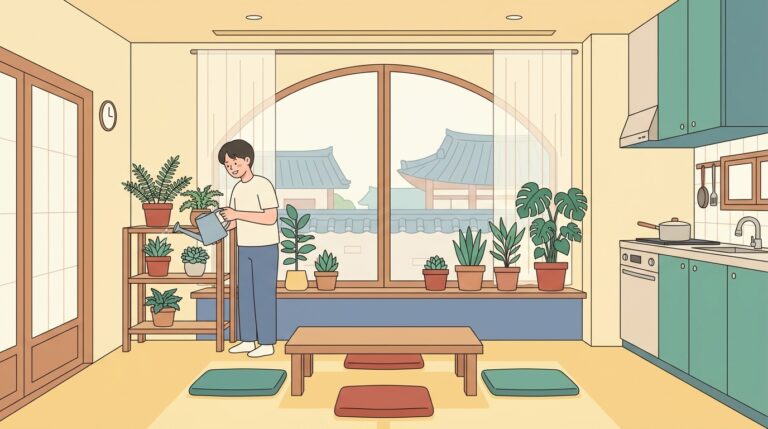
Hello! I am the Lead Editor of Daily Hangul. Have you ever watched a K-Drama where the exhausted protagonist comes home to a tiny Seoul apartment, walks past their bed, and softly says, “잘 잤어?” (Did you sleep well?)—not to a person, not to a dog, but to a small potted Monstera plant by the window?
Or perhaps you’ve seen K-Pop idols like BTS’s RM lovingly showing off his bonsai tree collection on social media?
In Korea, home gardening isn’t just about putting a plant on a desk. It’s a deeply emotional hobby. If you simply say “I raise plants” in textbook Korean, it’s fine. But if you use the cultural expressions we are going to learn today, native Koreans will widen their eyes and say, “Whoa, you really know Korea!”
Welcome to the world of Korean home gardening. Let’s dive into how to talk about your green friends like a true local!
Phase 2: Core Expressions Deep Dive
Here are the top three expressions you absolutely need to know to sound like a native when talking about plants.
1. 반려 식물 (Companion Plant)
- Pronunciation: [ban-ryeo sing-mul] + ‘Ban’ sounds like ‘barn’ without the r, ‘ryeo’ rhymes with ‘yo’ but with an r sound, ‘sing’ like singing, ‘mul’ like mule without the e.
- Meaning: Literal: Companion plant. Real nuance: A plant that is part of your family.
- K-Culture Moment: You’ll see this word all over Korean Instagram (
#반려식물). Just as a dog is a ‘companion animal’ (반려동물), a plant you care for deeply is a ‘companion plant’.- Editor’s Insight: This isn’t just a trendy word; it shows respect for the plant’s life. When someone says this, they don’t see the plant as interior decor, but as a roommate.
- Situation Spectrum:
- Casual (Friends): ✅
- Semi-formal (Co-workers): ✅
- Formal (Boss/Elders): ✅ (It’s a widely accepted social term now!)
- 🤔 Think About It: Why did Koreans start calling plants “companions”? In a hyper-competitive society with a high number of single-person households (원룸), could it be that people are seeking emotional connection without the heavy responsibility of a pet?
2. 식집사 (Plant Butler)
- Pronunciation: [sik-jip-sa] + ‘Sik’ sounds like ‘seek’ but shorter, ‘jip’ like ‘jeep’, ‘sa’ like the start of ‘safari’.
- Meaning: Literal: Plant Butler. Real nuance: A devoted plant parent.
- K-Culture Moment: Cat owners call themselves “butlers” (집사) because cats act like royalty. Koreans extended this humor to plants. If you constantly check soil moisture and buy expensive fertilizers, you are a loyal ‘Plant Butler’.
- Editor’s Insight: Use this to instantly sound like an insider. Instead of saying “My hobby is gardening,” say “I am a Sikjipsa.”
- Situation Spectrum:
- Casual (Friends): ✅
- Semi-formal (Co-workers): ✅ (Great icebreaker!)
- Formal (Boss/Elders): ⚠️ (Older folks might not know this slang.)
- 🤔 Think About It: Elevating a plant to the status of a “master” you serve is a very self-deprecating, humorous Korean way of expressing affection. Do you have a similar slang in your language?
3. 바람을 쐬어주다 (To give it some fresh air)
- Pronunciation: [ba-ram-eul ssoe-eo-ju-da] + ‘Ba-ram’ sounds like ‘bah-rahm’. ‘ssoe’ sounds like ‘sweh’.
- Meaning: Literal: To expose it to the wind. Real nuance: Ventilating the plant so it doesn’t get stressed.
- K-Culture Moment: In Korea, ventilation (환기) is a big deal for health. Just as a stressed office worker needs to “get some fresh air” (바람 좀 쐬고 올게), Koreans believe plants also need to “breathe” to prevent root rot in humid Korean summers.
- Editor’s Insight: If your friend’s plant looks droopy, don’t just tell them to water it. Tell them to “give it some wind.” It shows advanced knowledge of both plant care and Korean phrasing.
- Situation Spectrum:
- Casual (Friends): ✅
- Semi-formal (Co-workers): ✅
- Formal (Boss/Elders): ✅
- 🤔 Think About It: Korean language often anthropomorphizes nature. Treating a plant like it’s “stressed” and “needs a breather” reflects a deeply ingrained animistic view of the world.
Phase 3: Textbook vs. Real Korean
Let’s upgrade your B2 textbook Korean to Seoul-street-level Korean.
[Introducing Your Hobby]
* 📖 Textbook Korean: 제 취미는 식물 키우기입니다. (My hobby is raising plants.)
* 🗣️ Real Korean: 저 요즘 식집사 다 됐어요. (I’ve completely become a plant butler lately.)
* 💡 Why the difference?: Koreans love using trendy role-play terms (like ‘butler’) to make conversations wittier and more engaging.
[When a Plant Dies]
* 📖 Textbook Korean: 제 식물이 죽었습니다. (My plant died.)
* 🗣️ Real Korean: ㅠㅠ 제 몬스테라가 초록별로 갔어요… (T_T My monstera went to the green star…)
* 💡 Why the difference?: To soften the sadness of losing a pet or a plant, Koreans say it went to a “star” (rainbow bridge for pets, green star for plants).
[Caring for the Plant]
* 📖 Textbook Korean: 식물에 물을 주었습니다. (I gave water to the plant.)
* 🗣️ Real Korean: 아침에 물 챙겨주고 왔어요. (I took care of its water this morning.)
* 💡 Why the difference?: The verb 챙기다 (to take care of, to provide for) implies a warm, affectionate action, much more than just the mechanical act of “giving” (주다).
Phase 4: Cultural Context — K-Culture Deep Dive
4-1. Non-verbal Elements: Plant “Nunchi” (눈치)
Even with plants, Koreans use Nunchi (the art of reading the room). You don’t just water a plant on a strict schedule; you “read” its condition. You touch the soil (겉흙 확인), check if the leaves are drooping, and sense its mood.
4-2. K-Culture Connection: The “Planterior” Trend
Have you noticed how every trendy cafe in Seongsu-dong or Yeonnam-dong is filled with lush greenery? This is called Planterior (플랜테리어 – Plant + Interior). Because many young Koreans live in dense urban areas in small studio apartments (원룸), bringing nature indoors isn’t just about aesthetics; it’s a psychological escape. In dramas, you’ll often see the hardworking female lead staring at her single, well-kept pot on her windowsill while drinking a beer—it symbolizes her resilience and hope.
Phase 5: Real-Life Roleplay Scenario
Setting: Saturday afternoon at a trendy plant boutique in Seongsu-dong. The shop smells like damp earth and eucalyptus. You want to buy your very first companion plant.
Characters:
– YOU: An expat living in a small Seoul apartment, wanting to become a ‘Sikjipsa’.
– Owner (지훈, 30s): A passionate, hipster shop owner wearing an apron.
(Dialogue begins!)
YOU: 안녕하세요, 혹시 키우기 쉬운 식물 있을까요?
(Annyeonghaseyo, hoksi kiugi swiun singmul isseulkkayo?)
[Hello, by any chance do you have a plant that is easy to raise?]
Owner: 아, 초보 식집사님이시구나! 방에 볕은 잘 드나요?
(A, chobo sikjipsanimsiguna! Bange byeoteun jal deunayo?)
[Ah, you must be a beginner plant butler! Does your room get good sunlight?]
YOU: 음… 원룸이라서 햇빛이 많이 안 들어와요.
(Eum… wonrumiraseo haetbichi mani an deureowayo.)
[Hmm… it’s a one-room (studio), so a lot of sunlight doesn’t come in.]
Owner: 그럼 이 ‘스킨답서스’ 추천할게요. 생명력이 엄청 강해요.
(Geureom i ‘seukindapseoseu’ chucheonhalgeyo. Saengmyeongnyeogi eomcheong ganghaeyo.)
[Then I recommend this ‘Scindapsus’. Its vitality is incredibly strong.]
YOU: 오, 예쁘네요! 물은 자주 줘야 하나요?
(O, yeppeuneyo! Mureun jaju jwoya hanayo?)
[Oh, it’s pretty! Do I have to water it often?]
Owner: 겉흙이 마르면 흠뻑 주시고요, 가끔 바람도 좀 쐬어주세요.
(Geotheulgi mareumyeon heumppeok jusigoyo, gakkeum baramdo jom ssoeeojuseyo.)
[When the topsoil dries, give it a soaking, and give it some fresh air sometimes.]
🔀 Your Turn! How will you respond?
– A) 네, 알겠습니다. 감사합니다. (Yes, understood. Thank you.)
– B) 바람이요? 선풍기 틀어줄까요? (Wind? Should I turn on the electric fan for it?)
– C) 와, 오늘부터 저도 식집사네요! 잘 키워볼게요.✅ Best Choice: C — It uses the trendy cultural word (식집사) you just learned! It shows enthusiasm and connects you with the owner.
⚠️ Choice B Analysis: This is actually a very funny and witty response! The owner will definitely laugh and say, “No, no, just opening the window is fine.” It’s a great choice if you want to make a local friend.
Phase 6: 10-Second Shadowing Drill
Speak out loud! Follow the pacing (/) and the emotion.
😊 우와! / 오늘부터 저도 / 식집사네요! / 예쁘게 / 잘 키워볼게요!
(Uwa! / Oneulbuteo jeodo / sikjipsaneyo! / Yeppeuge / jal kiwobolgeyo!)
[Wow! / From today, I am also / a plant butler! / Prettily / I will raise it well!]
Phase 7: K-Culture Mini Dictionary
Here are 4 keywords related to Korean plant hobbies!
1. 식집사 (Sikjipsa)
* Romanization: sik-jip-sa
* English: Plant Butler
* Context: A slang term for someone devoted to caring for their indoor plants.
2. 플랜테리어 (Planterior)
* Romanization: peul-laen-te-ri-eo
* English: Planterior (Plant + Interior)
* Context: The trend of using lush greenery for home and cafe interior design, highly popular in Korea.
3. 초록별 (Chorok-byeol)
* Romanization: cho-rok-byeol
* English: Green Star
* Context: A poetic way to say a plant has died (e.g., “It went to the green star”).
4. 겉흙 (Geot-heuk)
* Romanization: geot-heuk
* English: Topsoil
* Context: You will hear this 100% of the time when buying a plant in Korea. The golden rule: “Water it when the topsoil dries.”
Phase 8: Traveler Survival Kit
Even if you are just visiting Korea, you might want to visit a beautiful flower market like Yangjae Flower Market, or buy small seeds as a souvenir at a local Daiso.
🆘 Survival Expression #1: Asking for Recommendations
– 🇰🇷 “키우기 쉬운 걸로 추천해 주세요.” (Kiugi swiun geollo chucheonhae juseyo.)
– 🗣️ English pronunciation: Kee-woo-gee shwee-un gul-lo choo-chun-hae joo-se-yo.
– 📍 Where to use: Plant shops, flower markets.
– 💡 Pro Tip: Koreans love it when you ask for their expert recommendation. They will find you the sturdiest plant!📌 Editor’s Travel Note
– Customs Warning: Be careful! You generally cannot bring live plants or soil on an airplane back to your home country due to agricultural laws.
– Alternative: Buy cute gardening tools, pots, or packaged seeds (check your country’s seed import laws) from Korean lifestyle shops like Daiso or Modern House!
Phase 9: Critical Thinking Corner — “A Step Deeper”
Global Era & Modern Life: Why the Sudden Plant Boom?
In recent years, the obsession with banryeo singmul (companion plants) has skyrocketed in Korea. Why? Korea is a highly urbanized country where most people live in apartments, disconnected from nature. Coupled with the intense, fast-paced Pali-Pali (hurry-hurry) work culture, young adults are experiencing burnout. A quiet, green plant that slowly grows and never talks back provides a profound sense of healing (힐링). It’s a tiny, manageable piece of nature inside a small studio apartment.
🧠 Think Deeper:
The language we use shapes our reality. By naming a hobby “being a plant butler” rather than “gardening,” Koreans have turned a solitary activity into a relationship.💬 Your Turn: Are houseplants popular among young people in your culture? Do you treat them like decorations, or like roommates? Share your thoughts in the comments!
Phase 10: FAQ & Common Mistakes
Q: Can I use “식집사” with older people?
Maybe. While it’s very popular on the internet and TV, someone in their 70s might be confused and wonder why you are working as a butler! Stick to “식물 키우는 걸 좋아해요” (I like raising plants) with older generations.
Q: In Korea, can I touch the plants outside cafes?
No! Unless it’s a shop selling plants, avoid touching the planterior at cafes. They are carefully curated, and touching them is considered bad manners.
❌ Common Mistake #1: Saying “제 식물이 죽었어요” (My plant died) to a fellow plant lover.
✅ Do this instead: Say “초록별로 갔어요” (It went to the green star). It shows empathy and emotional intelligence (Nunchi) towards the hobby.
Phase 11: Summary & Action Items
One-Liner Summary: In Korea, you aren’t just gardening; you are a proud Sikjipsa (Plant Butler) caring for your Banryeo Singmul (Companion Plant)!
Action Mission:
– 🥉 Bronze (Solo): Look at a plant in your house (or outside) and say, “바람 좀 쐬어줄까?” (Shall I give you some fresh air?)
– 🥈 Silver (Online): Go to Instagram, search the hashtag #식집사 or #반려식물, and leave a heart on a Korean’s post.
– 🥇 Gold (Real Life): Next time you visit a Korean cafe with nice planterior, say to the barista: “플랜테리어가 너무 예뻐요!” (The planterior is so pretty!)
K-Culture Mission:
Search YouTube for “RM 반려식물” (RM Companion Plant) and see how global superstars treat their green roommates!
Engagement: What is your favorite companion plant? I am currently raising a Monstera! Let me know your plant’s name below! 👇
Phase 12: Quiz — Interactive Challenge
1. Situational Judgment:
Your Korean co-worker looks sad. They tell you, “My beloved Monstera went to the green star…” What should you NOT say?
– A) 아… 너무 속상하시겠어요. (Oh… you must be so upset.)
– B) 초록별이요? 우주로 갔나요? (Green star? Did it go to space?)
– C) 다음엔 더 잘 키우실 수 있을 거예요. (You’ll be able to raise one better next time.)
Answer: B! (Don’t take “Green Star” literally! It’s a polite way of saying it died.)
2. Fill in the Blank:
When buying a plant, the shop owner will likely tell you: “이/가 마르면 물을 듬뿍 주세요.” (When the [] dries, give it plenty of water.)
– A) 나뭇잎 (Leaf)
– B) 겉흙 (Topsoil)
– C) 뿌리 (Root)
Answer: B! (Checking the topsoil is the #1 rule of a Korean Sikjipsa!)
3. True or False — K-Culture Edition:
“It is legal to buy a cute potted plant in Seoul and bring it back home on an airplane in your carry-on bag.”
Answer: False! (Due to agricultural customs, soil and live plants are strictly regulated internationally. Buy cute gardening tools instead!)
Frequently Asked Questions (FAQ)
Q: What does "반려 식물 (Companion Plant)" mean in Korean and how do you pronounce it?
A: In Korean, "반려 식물 (Companion Plant)" is pronounced [ban-ryeo sing-mul] and means: Literal: Companion plant. Real nuance: A plant that is part of your family.
Q: What does "식집사 (Plant Butler)" mean in Korean and how do you pronounce it?
A: In Korean, "식집사 (Plant Butler)" is pronounced [sik-jip-sa] and means: Literal: Plant Butler. Real nuance: A devoted plant parent.
Q: What does "바람을 쐬어주다 (To give it some fresh air)" mean in Korean and how do you pronounce it?
A: In Korean, "바람을 쐬어주다 (To give it some fresh air)" is pronounced [ba-ram-eul ssoe-eo-ju-da] and means: Literal: To expose it to the wind. Real nuance: Ventilating the plant so it doesn't get stressed.







