

Hello! I am the Senior Editor at Daily Hangul. Welcome back to another deep dive into Korean language and culture.
Phase 1: The K-Culture Cold Open
Picture this: You are walking down the vibrant, red-brick streets of Seongsu-dong (often dubbed the ‘Brooklyn of Seoul’). The aroma of freshly roasted coffee beans wafts through the air, pulling you into a sleek, minimalist roastery cafe. You step up to the counter to order your usual, but instead of a simple menu, the barista presents you with a curated card of single-origin beans, asking, “어떤 원두로 준비해 드릴까요? (Which beans should I prepare for you?)”
In K-dramas, the aloof male lead might just slide his black card across the counter and say, “Make it dark.” But in reality, Seoul’s specialty coffee scene is incredibly sophisticated. If you’ve reached a C1 level in Korean, ordering an ‘Americano’ is no longer enough. You want to articulate your taste preferences, discuss roasting profiles, and truly engage with Korea’s passionate cafe culture.
Today, we are moving beyond textbook coffee orders. I will teach you how to speak like a true Seoulite coffee connoisseur.
Phase 2: Core Expressions for the Coffee Connoisseur
Let’s break down the essential vocabulary you need when discussing coffee bean origins and roasting profiles.
1. 산미 (Acidity)
- Pronunciation: [sanmi] – Sounds like ‘san-mee’.
- Meaning: Literal: Acidic taste. Real nuance: The bright, fruity, or floral acidity found in lighter roasts and specialty coffee.
- K-Culture Moment: This is the great divider in Korean coffee culture. When ordering at a nice cafe, the most common question you will hear is, “산미 있는 원두 좋아하세요?” (Do you like beans with acidity?). For a long time, Koreans preferred dark, bitter coffee, but the ‘third wave’ of coffee has made sanmi a trendy buzzword.
- Editor’s Insight: Do not confuse this with 신맛 (sinmat – sour taste). Sinmat sounds like the coffee has gone bad. Sanmi implies a complex, desirable flavor profile.
- Situation Spectrum:
- Specialty Cafe Barista: ✅
- Casual conversation with friends: ✅
- Describing instant coffee: 🚫 (It just doesn’t fit the vibe)
- 🤔 Think About It: Why did it take so long for fruity, acidic coffee to become popular in Korea? Could it be related to the traditional Korean palate, which favors savory (sungnyung – roasted rice tea) and fermented flavors over sour beverages?
2. 고소하다 (Nutty / Savory)
- Pronunciation: [gosohada] – Sounds like ‘go-so-ha-da’.
- Meaning: Literal: To be nutty/savory. Real nuance: The rich, roasted, comforting flavor profile typical of dark roasts or Brazilian/Colombian blends.
- K-Culture Moment: If you hate acidity, this is your magic word. “산미 없는 고소한 원두로 주세요” (Please give me the nutty beans without acidity) is probably the most frequently spoken sentence in Korean cafes after lunch.
- Editor’s Insight: Gosohada is a profoundly Korean sensory word. We use it for sesame oil, roasted grains, and dark-roasted coffee. It evokes a sense of comfort and familiarity.
- Situation Spectrum:
- Everyday cafes: ✅
- High-end Roasteries: ✅
- Describing food/drinks to elders: ✅
- 🤔 Think About It: English lacks a perfect, single-word translation for gosohada when applied to coffee (we usually say nutty, chocolaty, or roasted). How does having a specific cultural word shape the way Koreans perceive the taste of coffee?
3. 바디감 (Body / Mouthfeel)
- Pronunciation: [badigam] – Sounds like ‘bah-dee-gahm’.
- Meaning: The ‘body’ or weight/texture of the coffee in your mouth.
- K-Culture Moment: You will see this written on the little ‘cupping notes’ (tasting cards) they give you with your drip coffee. You’ll often see “묵직한 바디감” (heavy body) or “가벼운 바디감” (light body).
- Editor’s Insight: This is a perfect example of modern Korean. We took the English word ‘body’ and added the Korean suffix ‘-감’ (gam), which means ‘feeling’ or ‘sense’ (like in jasingam – self-confidence).
- Situation Spectrum:
- Coffee enthusiasts/Cafes: ✅
- Professional cupping sessions: ✅
- Casual chat with someone who doesn’t care about coffee: ⚠️ (They might think you are being pretentious)
- 🤔 Think About It: Notice how English loanwords are heavily utilized in modern Korean gastronomy. Does this make the language feel more global, or does it create a barrier for older generations?
Phase 3: Textbook vs. Real Korean
[Situation 1: Asking for a Recommendation at a Roastery]
* 📖 Textbook Korean: 어떤 커피가 맛있습니까? (Which coffee is delicious?)
* 🗣️ Real Korean: 여기 시그니처 블렌드는 어떤 특징이 있어요? (What are the characteristics of your signature blend?) OR 산미 적고 고소한 걸로 추천해 주시겠어요? (Could you recommend something nutty with low acidity?)
* 💡 Why it’s different: At a C1 level, you want to show that you understand their craft. Using terms like ‘시그니처’ (signature) and specifying your taste preferences yields a much better recommendation than simply asking what is “delicious.”
[Situation 2: Describing the Taste of Single Origin]
* 📖 Textbook Korean: 이 커피는 과일 맛이 납니다. (This coffee tastes like fruit.)
* 🗣️ Real Korean: 베리류의 화사한 향이 은은하게 올라오네요. (A bright, berry-like aroma gently comes through.)
* 💡 Why it’s different: Gastronomic language in Korea is highly poetic. Words like 화사하다 (bright/radiant) and 은은하다 (subtle/gentle) are frequently used by food critics and coffee lovers to describe complex flavor notes.
Phase 4: Cultural Context — K-Culture Deep Dive
4-1. The Non-Verbal ‘Cafe Nunchi’
In Korea, reading the room (Nunchi) applies even in a cafe. When a barista passionately explains the origin of the Geisha beans you just ordered, make eye contact, nod slightly, and give a quiet “아, 네~” (Ah, yes~). It shows respect for their craft. Also, when they hand you the tray, it is customary to accept it with a slight bow of the head, or by receiving it with both hands if handed directly to you.
4-2. The ‘Cafe Tour’ (카페 투어) Phenomenon
In Korea, coffee is rarely just about caffeine; it is a spatial experience. ‘Cafe Hopping’ or Cafe Tour (카페 투어) is a legitimate weekend hobby. People travel across the country to visit specific roasteries, not just for the beans, but for the architecture, the branding, and the perfect Instagram aesthetic. When discussing coffee origins, you are participating in a highly curated cultural ritual.
Critical View: Sometimes, the aesthetic overshadows the actual roasting quality. You might find a visually stunning cafe where the coffee is mediocre. As a C1 speaker, you can critique this! (“분위기는 좋은데, 로스팅이 너무 강해서 탄 맛이 나네요.” – The vibe is good, but the roast is too dark and it tastes burnt.)
Phase 5: Real-Life Roleplay Scenario
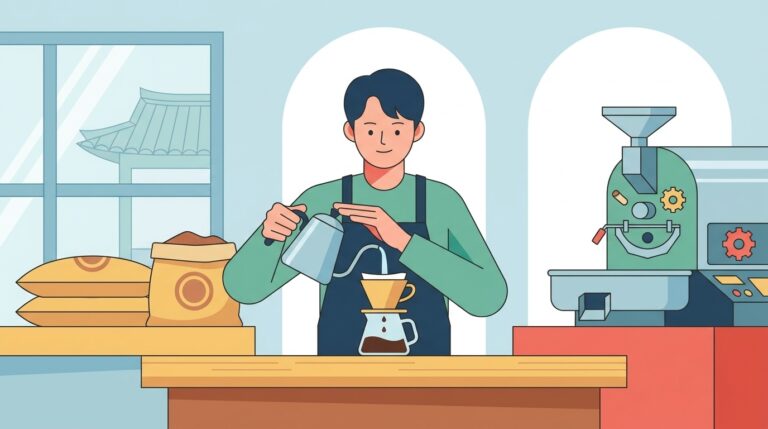
Setting: A quiet, dimly lit drip coffee bar in Yeonnam-dong. You are sitting at the bar counter. The barista is meticulously pouring hot water from a gooseneck kettle over a fresh bed of grounds.
Characters:
– YOU: A coffee enthusiast exploring Seoul’s roasteries.
– Barista Ji-hoon: (28, passionate about single-origin beans, speaks in a polite, gentle tone).
Dialogue:
Ji-hoon: 손님, 평소에 즐겨 드시는 원두 스타일이 있으신가요? ☕
(Sonnim, pyeongsoe jeulgyeo deusineun wondu seutairi isseusingayo?)
[Customer, do you have a style of beans you usually enjoy?]
YOU: 저는 아프리카 쪽 원두를 좋아해요. 특히 에티오피아 시다모 같은 스타일이요.
(Jeoneun apeurika jjok wondureul joahaeyo. Teuki etiopia sidamo gateun seutairiyo.)
[I like African beans. Especially styles like Ethiopia Sidamo.]
Ji-hoon: 아, 산미가 화사하고 꽃 향이 나는 걸 선호하시는군요!
(A, sanmiga hwasahago kkot hyangi naneun geol seonhohasineungunyo!)
[Ah, you prefer something with bright acidity and floral notes!]
YOU: 맞아요. 오늘 준비된 필터 커피 중에 추천해 주실 만한 게 있을까요?
(Majayo. Oneul junbidoen pilteo keopi junge chucheonhae jusil manhan ge isseulkkayo?)
[That’s right. Are there any filter coffees prepared today that you could recommend?]
Ji-hoon: 마침 어제 로스팅한 ‘에티오피아 예가체프 코케 허니’가 있습니다. 단맛과 산미의 밸런스가 아주 좋습니다.
(Machim eoje roseutinghan ‘etiopia yegachepeu koke heoni’ga itseumnida. Danmatgwa sanmiui baelleonseuga aju joseumnida.)
[I happen to have an ‘Ethiopia Yirgacheffe Koke Honey’ that I roasted yesterday. The balance of sweetness and acidity is excellent.]
🔀 Your Turn! How do you respond?
– A) “그럼 그걸로 한 잔 주세요.” (Then please give me a cup of that.) – Safe and standard.
– B) “오, 컵 노트가 어떻게 되나요?” (Oh, what are the cupping notes?) – Shows deep interest and high-level vocabulary.
– C) “아니요, 너무 셔서 싫어요.” (No, I hate it because it’s too sour.) – Too blunt, ignores his careful recommendation.✅ Best Choice: B. Asking about the ‘Cup Notes’ (컵 노트) is exactly what a true coffee lover would do, and the barista will be thrilled to explain the flavor profile (e.g., jasmine, peach, honey) to you.
YOU: (Choosing B) 오, 컵 노트가 어떻게 되나요? 기대되네요.
(O, keop noteuga eotteoke doenayo? Gidaedoeneyo.)
[Oh, what are the cupping notes? I’m looking forward to it.]
Ji-hoon: (Smiling brightly) 복숭아 같은 은은한 단맛에, 재스민 향이 끝에 남을 거예요. 따뜻하게 준비해 드릴까요?
(Boksunga gateun euneunhan danmase, jaeseumin hyangi kkeute nameul geoyeyo. Ttatteutage junbihae deurilkkayo?)
[It has a subtle sweetness like peach, and a jasmine scent will linger at the end. Shall I prepare it hot?]
YOU: 네, 따뜻하게 부탁드립니다.
(Ne, ttatteutage butakdeurimnida.)
[Yes, hot, please.]
(🎭 Stage Direction: The barista carefully begins to grind the beans, and the rich floral aroma fills the air.)
Phase 6: 10-Second Shadowing Drill
Let’s practice ordering your exact preference smoothly. Pay attention to the pauses!
😊 저는 / 산미가 너무 튀지 않고, / 묵직한 바디감의 원두로 / 부탁드릴게요.
(jeo-neun / sanmi-ga neomu twiji anko, / mukjik-han badigam-ui wondu-ro / butak-deurilgeyo.)
“I would like beans where the acidity isn’t too overpowering, with a heavy body, please.”
Phase 7: K-Culture Mini-Dictionary
1. 얼죽아 (Eol-juk-a)
* Romanization: eol-juk-a
* English: Iced Americano even if I freeze to death.
* Context: An acronym for “얼어 죽어도 아이스 아메리카노”. It highlights Koreans’ fierce loyalty to iced coffee, regardless of the freezing winter weather. Even at specialty roasteries, many still ask for their pour-overs over ice.
2. 로스터리 카페 (Roastery Cafe)
* Romanization: roseuteori kape
* English: A cafe that roasts its own beans.
* Context: A sign of quality in Korea. If a cafe says it’s a “Roastery,” they usually sell their own bagged beans and take pride in their specific roasting profiles.
3. 커핑 노트 (Cupping Note) / 테이스팅 노트 (Tasting Note)
* Romanization: keoping noteu / teiseuting noteu
* English: Tasting Notes card.
* Context: A small, aesthetically pleasing card served alongside specialty coffee detailing the origin, farm, processing method, and flavor descriptors.
4. 디카페인 (Decaffeine)
* Romanization: dikapein
* English: Decaf.
* Context: Previously rare in Korea, decaf options are now booming. Many specialty shops now offer a ‘Swiss Water Process’ decaf bean alongside their standard offerings.
Phase 8: Traveler Survival Kit
Even if you aren’t discussing roasting profiles, you need to survive the cafe line!
🆘 Survival Expressions for Cafes
– 🇰🇷 “이 원두는 산미가 있나요?” (i wonduneun sanmiga innayo?) – Does this bean have acidity?
– 🇰🇷 “디카페인으로 변경 가능한가요?” (dikapeineuro byeonggyeong ganeunhangayo?) – Is it possible to change to decaf?
– 🇰🇷 “드립백도 판매하시나요?” (deuripbaekdo panmaehasinayo?) – Do you also sell drip bags? (Great souvenirs!)📌 Editor’s Travel Note
– Kiosks: Many cafes (even mid-tier roasteries) use touch-screen kiosks. Look for the ‘원두 선택’ (Select Bean) button after choosing your Americano or Latte.
– To-Go Culture: “테이크아웃 (Take-out)” or “포장 (Pojang)” is the standard term. In Korea, if you order in a reusable mug to drink inside, you cannot legally take that same plastic/glass cup outside due to environmental laws. You must ask them to transfer it to a paper/plastic to-go cup.
Phase 9: Critical Thinking Corner — “Going Deeper”
🧠 Think Deeper: Global Era Korean (English loanwords in Coffee)
Take a close look at how we talk about coffee in Korea: We use Roasting (로스팅), Body (바디감), and Cupping (커핑). However, we describe the taste using deeply traditional Korean sensory words like Gosohada (고소하다 – nutty/savory) or Hwasahada (화사하다 – bright/radiant). This linguistic blend perfectly illustrates how Korea absorbs global culture. Rather than outright replacing Korean, English terminology acts as a structural framework, while Korean adjectives provide the emotional and sensory soul. It is a true linguistic “blend.”
💬 Your Turn: How does your culture describe coffee? Do you use traditional culinary words, or have you adopted Italian/English terminology completely? Let me know in the comments!
Phase 10: FAQ & Avoiding Mistakes
Q: “Can I ask the cafe to grind beans I bought somewhere else?”
No. Unless you are a regular and it’s a very friendly neighborhood shop, it is considered bad manners (jin-sang behavior) to ask a cafe to use their expensive commercial grinders for beans you didn’t buy from them.
Q: “Should I leave a tip if the barista gives me a great coffee consultation?”
No. There is absolutely no tipping culture in South Korea. If you want to show appreciation, simply say, “커피가 정말 맛있네요. 잘 마셨습니다!” (The coffee is really delicious. I enjoyed it!) on your way out.
❌ Common Mistake #1: Saying “커피가 셔요” (The coffee is sour) to complain about a light roast.
✅ Do this instead: To a barista, ‘sour’ means it was extracted poorly. If you mean it has fruity acidity, use “산미가 강하네요” (The acidity is strong). If you don’t like it, next time specify “고소한 원두로 주세요” (Nutty beans, please).
Phase 11: Summary & Action Items
One-Liner Summary: To order coffee like a local in Seoul, master the balance of Sanmi (acidity) and Gosohada (nuttiness) while respecting the roaster’s craft.
Action Mission 3 Steps:
– 🥉 Bronze (Solo): Look at a bag of coffee beans in your kitchen and try to describe its roast and body in Korean out loud.
– 🥈 Silver (Online): Find a Korean cafe vlog on YouTube and listen for the words 산미 or 로스팅.
– 🥇 Gold (Real World): Next time you are in a Korean cafe, ask the barista: “여기서 가장 인기 있는 원두는 어떤 특징이 있어요?” (What are the characteristics of your most popular bean here?)
K-Culture Mission:
Search for “성수동 로스터리 카페” (Seongsu-dong Roastery Cafe) on Instagram. Look at the photos of the menus and cupping notes. How many Korean descriptors can you translate?
Phase 12: Interactive Quiz Challenge
1. Situational Judgment:
You are at a business meeting at a cafe with an older Korean client. You want to order Americanos for both of you, but you don’t know their preference. What is the safest bean to order for them?
* A) The floral, highly acidic Ethiopian light roast.
* B) The dark-roasted, ‘Gosohada’ (nutty) house blend.
* C) Decaf espresso.
(Answer: B. Statistically, older generations in Korea heavily prefer dark, nutty, and traditional coffee flavors over bright acidity.)
2. Fill in the Blank:
“저는 신맛 나는 커피를 안 좋아해요. 산미 없고 묵직한 [ ________ ] 의 원두로 주세요.”
(I don’t like sour coffee. Please give me beans with no acidity and a heavy _________.)
(Answer: 바디감 – badigam / body)
3. True or False – K-Culture Edition:
In Korea, it is considered rude to drink iced coffee in the middle of winter. (T / F)
(Answer: False. Remember ‘Eol-juk-a’! Koreans will drink iced Americanos even in a blizzard.)
Until next time, keep your coffee warm and your Korean skills sharp!
Frequently Asked Questions (FAQ)
Q: What does "산미 (Acidity)" mean in Korean and how do you pronounce it?
A: In Korean, "산미 (Acidity)" is pronounced [sanmi] and means: Literal: Acidic taste. Real nuance: The bright, fruity, or floral acidity found in lighter roasts and specialty coffee.
Q: What does "고소하다 (Nutty / Savory)" mean in Korean and how do you pronounce it?
A: In Korean, "고소하다 (Nutty / Savory)" is pronounced [gosohada] and means: Literal: To be nutty/savory. Real nuance: The rich, roasted, comforting flavor profile typical of dark roasts or Brazilian/Colombian blends.
Q: What does "바디감 (Body / Mouthfeel)" mean in Korean and how do you pronounce it?
A: In Korean, "바디감 (Body / Mouthfeel)" is pronounced [badigam] and means: The 'body' or weight/texture of the coffee in your mouth.







