

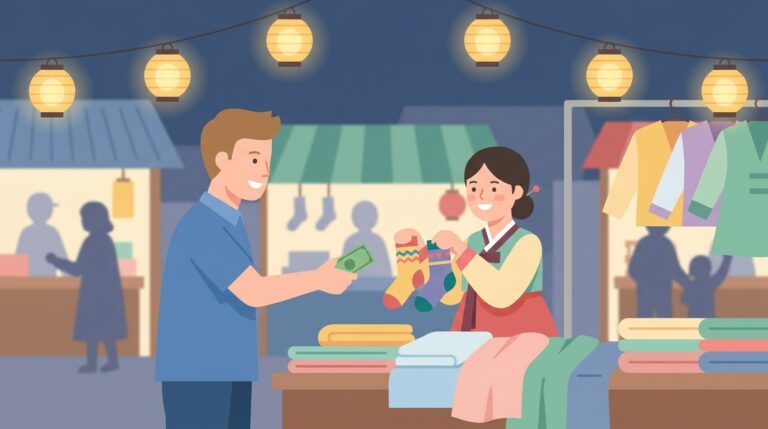
Phase 1: The Namdaemun Night Market Staredown
Hello! I’m your Daily Hangul Editor. Imagine this: You are wandering through the neon-lit aisles of Dongdaemun or the bustling alleys of Namdaemun Market. You spot the perfect vintage leather jacket or that cute K-Pop merch you’ve been hunting for. The vendor says, “50,000 won.” You have 45,000 won in your pocket.
In a K-Drama, the spunky protagonist would flash a brilliant smile, say a magic word, and suddenly get the jacket and a free pair of socks. But when you look at the vendor, you freeze. You remember your textbook taught you “Har-in-hae ju-si-get-seum-ni-kka?” (Could you please apply a discount?), but uttering that sounds like a robot reading a legal document.
Don’t worry. I’ve spent years watching my students either overpay out of politeness or accidentally offend a vendor by being too aggressive. Haggling in Korea isn’t a battle to the death; it’s a playful dance built on connection. Today, we are going to learn the art of persuasion and negotiation in Korea—specifically, how to ask for a small discount like a true local.
Let’s dive into the secret language of the Korean marketplace!
Phase 2: Core Expressions Deep Dive
Let’s break down the most essential phrases you need to master the art of the Korean deal.
1. 조금만 깎아주세요 (Please give me a small discount)
- Pronunciation: jogeumman kkakkajuseyo [jo-geum-man kkah-kkah-ju-se-yo]
- Sound-alike guide: ‘깎’ (kkak) sounds like the sharp, short sound a crow makes. Make it punchy!
- Meaning: Literal: “Please cut it a little bit.” / Real nuance: “Can you do a little better on the price?”
- K-Culture Moment: This is the ultimate classic. You’ll see this in K-Dramas when the main character is shopping at a traditional market and gives the vendor a slight, charming pout. It’s not a demand; it’s a friendly request.
- Editor’s Insight: The key word here is 조금만 (jogeumman – just a little). By emphasizing that you only want a small favor, you soften the blow and make it much easier for the vendor to say yes.
- Situation Spectrum:
- Traditional Market/Street Vendors (Casual): ✅
- Underground Shopping Malls (Semi-formal): ⚠️ (Only if you buy multiple items)
- Department Stores/Franchises (Formal): 🚫 (Prices are strictly fixed!)
- 🤔 Think About It: Why do Koreans use the verb “깎다” (to peel/cut/shave) for prices? It implies taking something off the surface, rather than fundamentally changing the value of the item.
2. 현금으로 할게요. 얼마예요? (I’ll pay in cash. How much is it?)
- Pronunciation: hyeongeumeuro halgeyo. eolmayeyo? [hyuhn-geum-eu-ro hal-ge-yo. uhl-ma-ye-yo?]
- Sound-alike guide: ‘현’ sounds like ‘hyuhn’ (rhymes with ‘fun’).
- Meaning: Literal: “I will do it with cash. How much?” / Real nuance: “I’m paying cash, so give me the ‘cash discount’ price.”
- K-Culture Moment: In places like the Goto Mall (Gangnam Express Bus Terminal Underground Shopping Center), you will actually see two prices written on tags: one for card, one for cash.
- Editor’s Insight: This is the magic bullet. Market vendors pay fees for credit card transactions. Offering cash is a mutual favor. Even if they initially said no to a discount, this phrase often changes their mind.
- Situation Spectrum:
- Small independent clothing shops: ✅
- Tech markets (Yongsan): ✅
- Corporate stores (Olive Young, Zara): 🚫
- 🤔 Think About It: In an increasingly cashless society like Korea, why do cash discounts still thrive in certain micro-economies?
3. 서비스 많이 주세요~ (Please give me a lot of ‘service’ / freebies)
- Pronunciation: seobiseu mani juseyo [suh-bi-seu ma-ni ju-se-yo]
- Sound-alike guide: ‘많이’ is pronounced [ma-ni], like the English word “money”, but meaning “a lot.”
- Meaning: Literal: “Please give me a lot of service.” / Real nuance: “If you can’t drop the price, throw in some extra free stuff!”
- K-Culture Moment: You order late-night fried chicken on a delivery app, and the restaurant includes a free bottle of Coke or cheese balls. The sticker on it says “사장님이 쏘는 서비스!” (Service on the boss!).
- Editor’s Insight: In Korea, “Service” (서비스) rarely means customer service; it almost always means free stuff. If you are buying a phone case and the price is fixed, use this phrase with a smile, and you might walk away with a free screen protector.
- Situation Spectrum:
- Buying food/makeup in bulk: ✅
- Mobile phone accessories shops: ✅
- High-end boutiques: 🚫
- 🤔 Think About It: Does getting “free stuff” feel more satisfying to you than getting a 5% discount? Why does the Korean marketplace rely so heavily on the concept of ‘덤’ (deom – giving extras)?
Phase 3: Textbook vs Real Korean
When bargaining, textbook Korean sounds too rigid. It makes you sound like a tax auditor rather than a friendly customer.
[Asking for a Discount]
* 📖 Textbook Korean: 할인이 가능합니까? (Is a discount possible?)
* 🗣️ Real Korean: 사장님~ 조금만 빼주세요~ (Boss~ please take off a little bit~)
* 💡 Why the difference?: “할인” (Discount) is a formal, commercial term used in department stores. “빼주세요” (Please subtract/take off) builds a much more conversational, human-to-human vibe.
[When the price is too high]
* 📖 Textbook Korean: 가격이 너무 비쌉니다. (The price is too expensive.)
* 🗣️ Real Korean: 헉, 생각보다 비싸네요… (Gasp, it’s more expensive than I thought…)
* 💡 Why the difference?: Calling something “too expensive” directly can put the vendor on the defensive. Saying “it’s more than I expected” shifts the blame to your own wallet, saving face for the seller while signaling them to lower the price.
Phase 4: Cultural Context — K-Culture Deep Dive
4-1. Non-verbal Cues: The Art of Nunchi
When you ask for a discount, do not cross your arms or maintain a hard, unwavering stare. That’s considered aggressive in Korea. Instead, tilt your head slightly, smile warmly, and maybe even use a slightly higher pitch (a subtle form of Aegyo). Korean negotiation is about creating a temporary bond, not winning a war.
4-2. K-Travel Link: The Dongdaemun / Danggeun Market Ecosystem
Haggling isn’t dead in modern Korea; it just lives in specific zones.
If you travel to Gwangjang Market for street food, you generally don’t haggle over a 3,000 won Bindaetteok (mung bean pancake)—it’s cheap enough! But if you’re buying three pairs of shoes in Dongdaemun, haggling is expected.
Recently, haggling has moved online to Karrot (Danggeun Market), Korea’s mega-popular second-hand app. You will often see the phrase “네고 가능” (Nego ganeung – Negotiation possible) or “네고 불가” (Nego bulga – No negotiations). The slang Nego comes directly from the English “negotiation.”
Phase 5: Interactive Roleplay Scenario
Setting: It’s 11 PM on a Saturday. You are at an underground shopping mall in Hongdae. You are holding a beautiful oversized knit sweater. You really want it, but the price tag is empty.
Characters:
– YOU: A savvy foreigner who just learned some Korean bargaining skills.
– Sajangnim (사장님): A lively female shop owner in her 50s. Friendly but a tough businesswoman.
Dialogue:
YOU: 사장님, 이거 얼마예요?
(sajangnim, igeo eolmayeyo?)
[Boss, how much is this?]
(🎭 Stage Direction: You hold up the sweater with a hopeful look)
Sajangnim: 아, 그거 신상이에요! 오만 원.
(a, geugeo sinsangieyo! oman won.)
[Ah, that’s a new arrival! 50,000 won.]
YOU: 오만 원이요? 우와, 예쁘긴 한데…
(oman woniyo? uwa, yeppeugin hande…)
[50,000 won? Wow, it’s pretty, but…]
Sajangnim: 원단이 진짜 좋아요. 한번 입어봐요.
(wondani jinjja joayo. hanbeon ibeobwayo.)
[The fabric is really good. Try it on.]
YOU: (Looking at your wallet) 생각보다 좀 비싸네요.
(saenggakboda jom bissaneyo.)
[It’s a bit more expensive than I thought.]
Sajangnim: 아이구, 학생이니까 내가 이천 원 빼줄게. 사만 팔천 원!
(aigu, haksaenginikka naega icheon won ppaejulge. saman palcheon won!)
[Oh my, since you’re a student, I’ll take off 2,000 won. 48,000 won!]
🔀 Your Turn! How do you respond?
– A) “아, 감사합니다! 카드로 할게요.” (Ah, thank you! I’ll pay by card.)
– B) “사장님~ 현금으로 할게요! 조금만 더 깎아주세요~” (Boss~ I’ll pay in cash! Please discount it just a little more~)
– C) “너무 비싸요. 안 살게요.” (Too expensive. I won’t buy it.)✅ Best Choice: B — By offering cash, you give her a reason to lower the price further. It’s the ultimate trump card in the Korean underground mall scene!
⚠️ Choice A Analysis: If you agree to a discount and then hand over a credit card, the vendor might look annoyed, as card fees eat into the discount she just gave you.
⚠️ Choice C Analysis: Walking away works sometimes, but saying it so bluntly (“안 살게요”) can sour the mood.
Sajangnim (If you chose B): 현금? 알았어요. 그럼 사만 오천 원만 줘요. 진짜 안 남는 거야~
(hyeongeum? arasseoyo. geureom saman ocheon wonman jwoyo. jinjja an namneun geoya~)
[Cash? Okay. Then just give me 45,000 won. I’m really making no profit on this~]
Phase 6: 10-Second Shadowing Drill
Practice this out loud. Pay attention to the pauses (/) and the intonation!
🥺 사/장/님/ (pause) 이거 / 쪼~금만 / 깎아주시면 / 안 돼요?
(sajangnim / igeo / jjo~geumman / kkakkajusimyeon / an dwaeyo?)
Voice tip: Stretch the “쪼” (jjo) a little bit to sound more pleading and cute. Finish the sentence with a rising, hopeful tone.
Phase 7: K-Culture Mini Dictionary
Here are 4 cultural keywords related to shopping and bargaining in Korea:
1. 눈치 (Nunchi)
* Romanization: nunchi
* English: Emotional intelligence / reading the room
* Context: Knowing exactly when to ask for a discount and when to back off based on the vendor’s mood and the crowd in the shop.
2. 정 (Jeong)
* Romanization: jeong
* English: Warm feeling of attachment/connection
* Context: The unspoken bond between people. Vendors often give discounts or freebies because of ‘Jeong’, turning a simple transaction into a human connection.
3. 덤 (Deom)
* Romanization: deom
* English: Extra / freebie
* Context: You buy 10 pairs of socks, and the vendor throws in an 11th pair for free. That 11th pair is the ‘Deom’.
4. 단골 (Dangol)
* Romanization: dangol
* English: Regular customer
* Context: If you visit a shop often, you become a ‘Dangol’. Dangols get the best discounts and the most ‘Deom’. “저 단골 할게요!” (I’ll become a regular!) is a great line to use when negotiating.
Phase 8: Traveler’s Survival Kit
Keep these phrases handy for your next shopping spree in Seoul.
🆘 Survival Phrase #1: The Price Check
– 🇰🇷 “이거 얼마예요?” (igeo eolmayeyo? – How much is this?)
– 📍 Used at: Literally everywhere. Markets, food stalls, boutiques.
– 💡 Pro Tip: If you don’t understand the Korean numbers they say in response, just open the calculator app on your phone and hand it to them. They will type the price!🆘 Survival Phrase #2: Asking for a bag
– 🇰🇷 “봉투 하나 주세요.” (bongtu hana juseyo – Please give me a bag.)
– 📍 Used at: Convenience stores, clothing shops.
– 💡 Pro Tip: In Korea, plastic bags are not free by law. They usually cost 50 to 100 won.🆘 Survival Phrase #3: The Polite Exit
– 🇰🇷 “조금 더 둘러보고 올게요.” (jogeum deo dulleobogo olgeyo – I’ll look around a bit more and come back.)
– 📍 Used at: When you want to escape a shop without buying anything.📌 Editor’s Travel Note
– Card vs Cash: Korea is a card-centric country. You can pay for a 1,000 won water bottle with a card. HOWEVER, at traditional markets and underground malls, cash will unlock secret discounts.
– Tipping: There is absolutely NO tipping culture in Korea. Do not try to leave a tip; the staff will likely chase you down the street thinking you forgot your change!
Phase 9: Critical Thinking Corner — “One Step Deeper”
🧠 Think Deeper: Language & Pseudo-Kinship
Have you noticed that in Korean markets, people don’t say “Excuse me, vendor”? They yell, “사장님!” (Sajangnim – Boss), “이모님!” (Imonim – Aunt), or “언니!” (Eonni – Older sister, even used by older female vendors to younger female customers).Why does the Korean language use family and corporate titles for total strangers in a market? It reflects the deeply rooted culture of Jeong (정). By calling a vendor “Auntie” or “Boss,” you are instantly breaking the cold, transactional wall of capitalism. You are creating a momentary pseudo-family relationship. It’s much harder to overcharge an “Aunt” or deny a discount to a “Nephew.” Language shapes the relationship, which in turn shapes the economy of the market.
💬 Your Turn: Do you have a similar culture in your home country? Do you call street vendors “Brother,” “Boss,” or “Auntie”? Let me know in the comments!
Phase 10: FAQ & Avoiding Common Mistakes
Q: Can I haggle at Olive Young, CU (Convenience Store), or a Department Store?
A: ABSOLUTELY NOT. Prices in corporate franchises and department stores are scanned by barcodes and fixed. If you try to negotiate there, the part-time worker will just stare at you in panic.
Q: Can I ask for a discount if I’m only buying one cheap item?
A: It’s generally frowned upon. If you are buying a 5,000 won t-shirt, don’t ask for a discount. Haggling is reserved for higher-priced items or when you are buying in bulk (e.g., “I’m buying 5 of these, can you take a little off?”).
❌ Common Mistake #1: Saying “너~무 비싸요!” (It’s TOOOOO expensive!) loudly.
✅ Do this instead: Use a quiet, slightly disappointed voice. “생각보다 조금 비싸네요…” (It’s a little more expensive than I thought…) This protects the vendor’s pride.❌ Common Mistake #2: Promising to pay by cash, getting the discount, and then handing over a credit card.
✅ Do this instead: Always confirm your payment method first. If you don’t have cash, ask if you can do a bank transfer (계좌이체 – gyejwa-iche). Most vendors accept instant bank transfers via mobile apps!
Phase 11: Summary & Action Items
One-Liner Summary: To get a discount in a Korean market, combine a polite smile with “조금만 깎아주세요” (jogeumman kkakkajuseyo), and always offer cash for maximum success.
🎯 Your Action Missions:
– 🥉 Bronze (Solo): Stand in front of your mirror and practice the 10-second shadowing drill. Make sure your face looks friendly, not aggressive!
– 🥈 Silver (Online): Browse a Korean shopping site or app, pick an item, and write down the exact Korean phrase you would use to ask for a discount if you were buying it in person.
– 🥇 Gold (Real World): Next time you visit a Korean traditional market or an underground shopping mall, try buying two items and politely ask for a “Service” (덤) or a small cash discount!
🎬 K-Culture Mission: Watch any episode of a Korean variety show featuring traditional markets (like Running Man or Amazing Saturday). Can you catch the celebrities using the word “사장님” or “깎아주세요”?
Phase 12: Interactive Challenge — Mini Quiz
Let’s test what you’ve learned today!
1. Situational Judgment: You are at the Gangnam Underground Shopping Mall. You want to buy 3 pairs of pants. What is the most culturally savvy way to ask for a deal?
– A) “이거 세 개 살게요. 할인이 가능합니까?”
– B) “사장님~ 저 이거 세 개 현금으로 할게요. 조금만 빼주세요!”
– C) “너무 비싸요. 깎아줘.”
2. True or False – K-Culture Edition:
“If you buy a lot of skin care products at an independent cosmetics stall, it is culturally acceptable to ask for a few extra sheet masks as ‘서비스’ (Service).”
3. Fill in the Blank:
When an item is too pricey, instead of saying “It’s too expensive!”, you should say: “생각보다 좀 ________네요.” (It is a bit more expensive than I thought.)
(Scroll down for answers!)
(Answers: 1: B – Offers cash, uses polite but natural phrasing. / 2: True – Freebies are a huge part of Korean beauty shopping! / 3: 비싸 – bissa)
Frequently Asked Questions (FAQ)
Q: What does "조금만 깎아주세요 (Please give me a small discount)" mean in Korean and how do you pronounce it?
A: In Korean, "조금만 깎아주세요 (Please give me a small discount)" is pronounced [jogeumman kkakkajuseyo [jo-geum-man kkah-kkah-ju-se-yo] and means: Literal: "Please cut it a little bit." / Real nuance: "Can you do a little better on the price?"
Q: What does "현금으로 할게요. 얼마예요? (I'll pay in cash. How much is it?)" mean in Korean and how do you pronounce it?
A: In Korean, "현금으로 할게요. 얼마예요? (I'll pay in cash. How much is it?)" is pronounced [hyeongeumeuro halgeyo. eolmayeyo? [hyuhn-geum-eu-ro hal-ge-yo. uhl-ma-ye-yo?] and means: Literal: "I will do it with cash. How much?" / Real nuance: "I'm paying cash, so give me the 'cash discount' price."
Q: What does "서비스 많이 주세요~ (Please give me a lot of 'service' / freebies)" mean in Korean and how do you pronounce it?
A: In Korean, "서비스 많이 주세요~ (Please give me a lot of 'service' / freebies)" is pronounced [seobiseu mani juseyo [suh-bi-seu ma-ni ju-se-yo] and means: Literal: "Please give me a lot of service." / Real nuance: "If you can't drop the price, throw in some extra free stuff!"







