

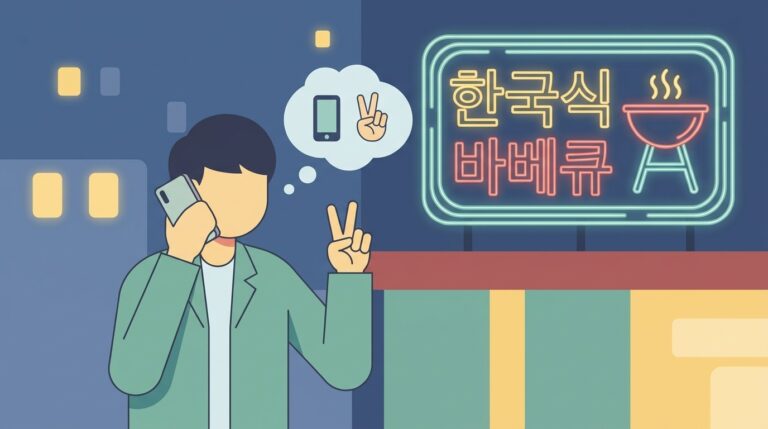
Phase 1: Empathy (The K-Culture Cold Open)
Hello! I’m your Daily Hangul Editor, your local Korean friend and veteran tutor.
Picture this: You’re wandering the neon-lit streets of Hongdae. You spot that famous Korean BBQ place you saw in your favorite K-Drama. The one where the main characters bond over sizzling pork belly and soju. You walk up, stomach rumbling, only to see a sign: “Reservations Only” or a tablet asking for your phone number to join a 2-hour waitlist.
Your heart drops. Making a phone call in a foreign language? Trying to explain how many people are in your group while the staff is shouting over loud background music? It’s enough to make anyone just go to the convenience store instead.
But don’t worry! I’ve seen hundreds of my students panic in this exact scenario. Today, we are going to learn exactly what to say to secure that table like a true local. No textbook robotic phrases—just the real, practical Korean you need to survive and thrive. Let’s dive in!
Phase 2: Core Expressions Deep Dive
Let’s look at the top 3 phrases you absolutely need to make a reservation.
1. 오늘 저녁 7시에 2명 예약되나요?
- Pronunciation: [oneul jeonyeok ilgopsie dumyeong yeyakdoenayo?]
- Sound-alike: oh-neul juh-nyuk il-gop-she-ae doo-myung ye-yak-dwe-na-yo?
- Meaning: (Literal) Today evening at 7, 2 people, is reservation possible? / (Real Nuance) Can I book a table for two tonight at 7?
- K-Culture Moment: You’ll hear this exactly like this in K-Dramas when the office intern is desperately trying to book a place for the team’s Hoesik (company dinner) at the last minute.
- Editor’s Insight: This phrase is pure magic because it has everything the staff needs in one breath: When (Tonight 7 PM) + Who (2 people) + What (Reservation). It sounds incredibly natural and polite.
- Situation Spectrum:
- Casual (Friends): ✅ (You can say this to the staff)
- Semi-formal (Colleagues): ✅
- Formal (Boss): 🚫 (You wouldn’t say this to your boss, but you use it to book for them)
- 🤔 Think About It: Notice how we don’t say “I want to make a reservation.” Korean language focuses on the situation rather than the ego (I). We ask “Is it possible?” instead of “I want.” How does your native language handle this?
2. 창가 자리로 부탁드려요.
- Pronunciation: [changga jariro butakdeuryeoyo]
- Sound-alike: chang-ga ja-ri-ro boo-tak-deu-ryuh-yo
- Meaning: (Literal) Toward the window seat, I beg you. / (Real Nuance) A window seat, please.
- K-Culture Moment: Picture a romantic K-Drama scene overlooking the Han River or Namsan Tower. The male lead definitely used this phrase to get that perfect view!
- Editor’s Insight: “~부탁드려요” (Please do this for me) is your best friend in Korea. You can attach it to almost anything! Want a quiet seat? “조용한 자리로 부탁드려요” (A quiet seat, please).
- Situation Spectrum:
- Casual: ✅
- Semi-formal: ✅
- Formal: ✅
- 🤔 Think About It: Why do Koreans use “부탁드려요” (I humbly request) instead of a direct “Give me”? It reflects the deep respect for the service worker’s effort.
3. 예약 취소할게요.
- Pronunciation: [yeyak chwisohalgeyo]
- Sound-alike: ye-yak chwee-so-hal-ge-yo
- Meaning: (Literal) I will cancel the reservation. / (Real Nuance) I’d like to cancel my reservation.
- K-Culture Moment: Life happens! Maybe you missed your subway, or you got distracted shopping in Myeongdong.
- Editor’s Insight: Canceling might feel awkward, but in Korea’s fast-paced restaurant scene, calling to cancel is considered highly polite. It prevents “No-shows” and lets another hungry group get the table!
- Situation Spectrum:
- Casual: ✅
- Semi-formal: ✅
- Formal: ✅
- 🤔 Think About It: The “No-show” culture is heavily criticized in Korea because it breaks the unspoken social trust (눈치). Have you ever had to cancel a reservation last minute?
Phase 3: Textbook vs. Real Korean
Forget what the heavy grammar books tell you. Here is how people actually speak on the streets of Seoul.
[Making the Request]
* 📖 Textbook Korean: 예약을 하고 싶습니다. (I would like to make a reservation.)
* 🗣️ Real Korean: 예약되나요? (Is a reservation possible?)
* 💡 Why the difference?: Koreans love efficiency (Bbali-bbali culture). Asking if it’s possible directly saves time for both you and the busy staff.
[Asking About Availability]
* 📖 Textbook Korean: 자리가 있습니까? (Are there any seats?)
* 🗣️ Real Korean: 지금 가면 웨이팅 있나요? (If I go now, is there a wait?)
* 💡 Why the difference?: Famous places in Korea always have a wait. Asking about the “waiting” (using the English loanword) is much more realistic than asking if it’s completely empty.
Phase 4: Cultural Context — K-Culture Deep Dive
4-1. Non-Verbal Tips: The Art of “Nunchi” on the Phone
When you call a Korean restaurant, don’t be offended if they sound rushed. Korean dining culture is incredibly fast-paced during peak hours (12 PM – 1 PM, 6 PM – 8 PM).
– Keep it brief: Have your time and party size ready before they answer.
– Listen for the pause: If they pause, they are likely checking their reservation book. Don’t keep talking; just wait for their “네 (Yes)” or “아, 어떡하죠… (Ah, what should we do…).”
4-2. K-Food Connection: The “Break Time” Trap
If you take away one thing from this blog, let it be this: 브레이크 타임 (Break Time).
Unlike in some countries where restaurants are open all day, 90% of Korean restaurants close between 3:00 PM and 5:00 PM to prep for dinner and let the staff rest. If you try to book a table for 4:00 PM, you will hear a very confused “네? 브레이크 타임인데요…” (Excuse me? It’s break time…). Plan your K-BBQ cravings accordingly!
Phase 5: Real-Life Roleplay Scenario
Setting: It’s 4:30 PM. You want to eat at “Pork Belly Paradise” in Gangnam tonight at 7 PM. You muster up your courage and dial the number.
Characters:
– YOU: A hungry traveler who wants to impress your friends.
– Staff (NPC): A very busy, but polite Korean restaurant worker.
📞 Ring, ring!
Staff: 네, 삼겹살 파라다이스입니다! 🥩
(ne, samgyeopsal paradaiseu-imnida!)
(Yes, this is Pork Belly Paradise!)YOU: 안녕하세요, 오늘 저녁 7시에 3명 예약되나요?
(annyeonghaseyo, oneul jeonyeok ilgopsie semyeong yeyakdoenayo?)
(Hello, can I reserve for 3 people tonight at 7 PM?)Staff: 아, 죄송합니다. 7시는 예약이 꽉 찼어요. 8시는 어떠세요?
(a, joesonghamnida. ilgopsineun yeyagi kkwak chaseoyo. yeodeolsineun eotteoseyo?)
(Ah, I’m sorry. 7 PM is fully booked. How about 8 PM?)YOU: 아… 네, 8시 괜찮아요.
(a… ne, yeodeolsi gwaenchanayo.)
(Ah… yes, 8 PM is fine.)Staff: 네, 알겠습니다. 성함이 어떻게 되세요?
(ne, algetseumnida. seonghami eotteoke doeseyo?)
(Yes, understood. What is your name?)🔀 YOUR TURN! How should you answer?
– A) “제 이름은 크리스토퍼 알렉산더입니다.” (My name is Christopher Alexander.)
– B) “크리스요.” (Chris.)
– C) “비밀입니다.” (It’s a secret.)✅ Best Choice: B — Why? Korean staff are writing this down quickly. A long foreign name can be hard to spell in Hangul on the spot. Giving a short, 2-3 syllable nickname (like Tom, Chris, Sam) is a pro-traveler move!
⚠️ Choice C Analysis: Only say this if you want the staff to hang up on you! 😅Staff: 네, 크리스 님. 8시 3명 예약 도와드렸습니다!
(ne, keuriseu nim. yeodeolsi semyeong yeyak dowadeuryeotseumnida!)
(Yes, Chris. I’ve booked 3 people for 8 PM!)YOU: 감사합니다!
(gamsahamnida!)
(Thank you!)
Phase 6: 10-Second Shadowing Drill
Time to train those mouth muscles! Read out loud, follow the pauses (/), and act out the emotion.
😊 안녕하세요! / 오늘 저녁 / 일곱 시에 / 세 명 / 예약되나요?
(annyeonghaseyo! / oneul jeonyeok / ilgopsie / semyeong / yeyakdoenayo?)
Pro tip: Smile while saying it! It naturally raises your pitch, making you sound friendly and polite, just like a native speaker.
Phase 7: K-Culture Mini Dictionary
1. 맛집 (Matjib)
* Romanization: matjib
* English: Famous/Delicious restaurant
* Context: A combination of ‘맛’ (taste) and ‘집’ (house). You will see this word EVERYWHERE on Korean Instagram and blogs.
2. 브레이크 타임 (Break Time)
* Romanization: beureikeu taim
* English: Break time (usually 3 PM – 5 PM)
* Context: The sacred hours where restaurant staff rest and prep. Do not try to enter a restaurant during this time!
3. 웨이팅 (Waiting)
* Romanization: weiting
* English: Waiting in line
* Context: Koreans use the English word “waiting” as a noun. Apps like “Catch Table” manage this digital “waiting” list.
4. 노쇼 (No-show)
* Romanization: nosyo
* English: No-show
* Context: Making a reservation and not showing up without calling. It’s considered very bad manners in Korea.
Phase 8: Traveler Survival Kit
Many trendy restaurants in Korea don’t even take phone reservations anymore. You have to walk up and use a digital tablet. Here are your survival phrases:
🆘 Survival Phrases for Walk-ins
– 🇰🇷 “지금 자리 있나요?” (jigeum jari innayo?)
– 🗣️ Meaning: Are there any seats right now?
– 🇰🇷 “얼마나 기다려야 돼요?” (eolmana gidaryeoya dwaeyo?)
– 🗣️ Meaning: How long do I have to wait?📌 Editor’s Travel Note
– The Holy Grail App: Download ‘Catch Table’ (캐치테이블). It has an English version and lets you book restaurants or join virtual queues without a Korean phone number!
– Naver Maps: Always check Naver Maps for the exact “Break Time” and “Last Order” times before heading out.
– Tipping: Do NOT tip! There is absolutely no tipping culture in Korea. The staff might chase you down the street thinking you forgot your change.
Phase 9: Critical Thinking Corner — “Going Deeper”
🧠 Think Deeper: Food & Identity (The Culture of Sharing)
Have you ever tried to book a K-BBQ restaurant for just one person? You might have been rejected. Why? Because Korean food culture is fundamentally rooted in communal eating. The word for ‘family’ in Korean is 식구 (Sikgu), which literally means “mouths that eat together.” Meals like stews (Jjigae) and grilled meats are designed to be shared from the center of the table, reinforcing the “Uri” (Us/We) identity over the individual. That’s why many reservations and menus require a “2-person minimum” (2인 이상).
💬 Your Turn: Does your culture have a “communal eating” tradition, or is it more common to order individual plates? Let me know in the comments!
Phase 10: FAQ & Avoiding Misunderstandings
Q: Can I just speak English on the phone?
Maybe in touristy areas like Itaewon, but in local neighborhoods (like Euljiro or Seongsu), speaking basic Korean will save you from getting hung up on out of panic!
Q: Do I need to pay a deposit?
Lately, for high-end omakase or fine dining, yes! They might ask for an 예약금 (yeyakgeum – deposit). But for standard BBQ joints, usually no.
❌ Common Mistake #1: Saying “밤 7시” (Night 7 o’clock).
✅ Do this instead: Say “저녁 7시” (Evening 7 o’clock). In Korean, 7 PM is still considered evening (저녁), not night (밤).❌ Common Mistake #2: Assuming the restaurant is open all day.
✅ Do this instead: Always check for the dreaded “브레이크 타임” (Break Time) between 3-5 PM.
Phase 11: Summary & Action Items
One-Liner Summary: Remember “[Time] + [Number of people] + 예약되나요?” and you can book any table in Korea!
Action Mission 3 Steps:
– 🥉 Bronze (Solo): Stand in front of your mirror and practice saying “오늘 저녁 7시에 2명 예약되나요?” three times smoothly.
– 🥈 Silver (Online): Go to Naver Maps, find a Korean restaurant you want to visit, and check their “Break Time.”
– 🥇 Gold (Real Life): Use the Catch Table app (or call!) to book a restaurant during your next trip to Korea using your new short Korean nickname!
🎭 K-Culture Mission:
The next time you watch a K-Drama and see the characters eating at a restaurant, look closely at the table. Are they sharing one big pot, or eating separate dishes? Notice the communal vibe!
Phase 12: Interactive Quiz
Let’s test what you’ve learned!
1. You want to book a table for 3 people at 6 PM. Which is the correct phrase?
A) 저녁 6시에 3명 예약되나요?
B) 밤 6시에 2명 예약되나요?
C) 아침 6시에 3명 웨이팅 있나요?
(Answer: A. 6 PM is ‘저녁’ (evening), and you are asking for 3 people ‘3명’.)
2. Fill in the blank: If you want a nice view, you should say “______ 자리로 부탁드려요.”
(Answer: 창가 – window)
3. True or False: If you get great service at a Korean restaurant, you should leave a 15% tip.
(Answer: False! Tipping is not practiced in Korea and will cause confusion.)
4. Why might the restaurant not answer the phone at 4:00 PM?
(Answer: It’s likely their 브레이크 타임 (Break Time)!)
Great job today! Let me know in the comments what your favorite Korean food is. See you in the next lesson! 🥢
Frequently Asked Questions (FAQ)
Q: What does "오늘 저녁 7시에 2명 예약되나요?" mean in Korean and how do you pronounce it?
A: In Korean, "오늘 저녁 7시에 2명 예약되나요?" is pronounced [oneul jeonyeok ilgopsie dumyeong yeyakdoenayo?] and means: (Literal) Today evening at 7, 2 people, is reservation possible? / (Real Nuance) Can I book a table for two tonight at 7?
Q: What does "창가 자리로 부탁드려요." mean in Korean and how do you pronounce it?
A: In Korean, "창가 자리로 부탁드려요." is pronounced [changga jariro butakdeuryeoyo] and means: (Literal) Toward the window seat, I beg you. / (Real Nuance) A window seat, please.
Q: What does "예약 취소할게요." mean in Korean and how do you pronounce it?
A: In Korean, "예약 취소할게요." is pronounced [yeyak chwisohalgeyo] and means: (Literal) I will cancel the reservation. / (Real Nuance) I'd like to cancel my reservation.







