

Phase 1: Empathy & The “K-Culture” Moment
Hello! I’m the Chief Editor of Daily Hangul.
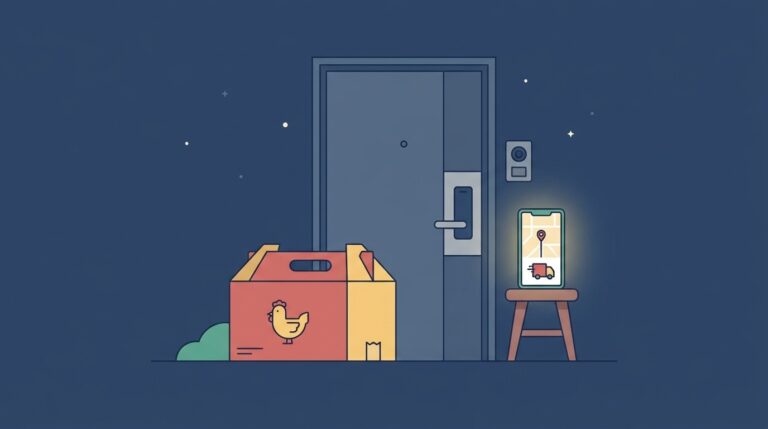
Imagine this: It’s 11 PM in Seoul. You’re watching your favorite K-Drama, and the characters start eating crispy fried chicken and drinking beer (Chimaek). Suddenly, your stomach growls. You decide to order delivery. You tap a few buttons on an app, and 30 minutes later, the food magically appears outside your door. You didn’t even have to change out of your pajamas or speak to anyone. How is this possible?
Welcome to the magic of Korea’s contactless delivery culture!
As a foreigner or a traveler in Korea, ordering delivery (Baedal) is a rite of passage. But there’s a problem: What if the delivery driver rings the bell while your roommate is sleeping? What if you’re not fully dressed? Today, we’re going to learn the absolute lifesaver phrase for introverts, late-night snackers, and peace-lovers alike.
I’ve seen so many beginner students panic when the delivery driver calls them. Don’t worry! By the end of this guide, you’ll be ordering midnight snacks like a true Seoul local.
Phase 2: Core Expressions Deep Dive
1. 문 앞에 놔주세요.
- Pronunciation: mun ape nwajuseyo. [moon ah-peh nwa-joo-seh-yo]
- Meaning: Literal: Please put it in front of the door. / Real nuance: Just leave it at the door (I’ll get it myself).
- K-Culture Moment: If you use delivery apps like Baemin (배달의민족) or Yogiyo (요기요), you’ll see this phrase as a default checkbox. It became the ultimate standard during the pandemic and has stayed because Koreans love efficiency (and not making small talk when they’re hungry).
- Editor’s Insight: The word ‘놔’ (nwa) is a combination of ‘놓아’ (to let go / put down). It sounds like saying “No” + “Ah” really fast. It’s polite but firm.
- Situation Spectrum:
- Delivery Driver (Service): ✅ Perfect!
- Coworkers (Semi-formal): ⚠️ Only if they are dropping off documents at your desk.
- Boss/Elders (Formal): 🚫 Too direct.
- 🤔 Think About It: Why are Koreans so comfortable leaving food and packages outside their doors? (Hint: The theft rate in Korea is incredibly low, thanks to CCTV and a high-trust society!)
2. 초인종 누르지 마세요.
- Pronunciation: choinjong nureuji maseyo. [cho-in-jong noo-reu-jee mah-seh-yo]
- Tip: ‘으’ (eu) sounds like the disgusted sound you make when you step in wet gum! ‘eu-gh!’
- Meaning: Literal/Real: Please don’t ring the doorbell.
- K-Culture Moment: Korean apartments are often densely packed. Ringing a bell at 1 AM might wake up not just you, but the neighbor’s dog. This phrase is a lifesaver if you share an Airbnb or have a sleeping baby.
- Situation Spectrum:
- Delivery Driver / Strangers: ✅
- 🤔 Think About It: In your country, do delivery drivers always ring the bell to hand you the food directly? How does it feel to not interact with the person bringing your food?
3. 도착하면 전화해 주세요.
- Pronunciation: dochakhamyeon jeonhwahae juseyo. [do-chak-ha-myun jeon-hwa-hae joo-seh-yo]
- Meaning: Literal: If you arrive, please do a phone call. / Real nuance: Please call me when you arrive.
- K-Culture Moment: You order delivery to a Han River park (yes, they deliver to parks!). The driver needs to find you among hundreds of picnic tents. You’ll definitely need this phrase!
Phase 3: Textbook vs. Real Korean
[Writing a Note to the Delivery Driver]
* 📖 Textbook Korean: 음식을 문 앞에 두십시오. (Put the food in front of the door.) -> Too stiff and militaristic!
* 🗣️ Real Korean: 문 앞에 놔주세요~ (Please leave it at the door~)
* 💡 Why the difference?: Adding a tilde (~) at the end of text messages in Korea makes the sentence sound much softer and friendlier. It’s the text equivalent of a polite smile!
[When the driver hands you the food directly]
* 📖 Textbook Korean: 음식을 주셔서 감사합니다. (Thank you for giving me the food.)
* 🗣️ Real Korean: 수고하세요~ (Thank you for your hard work~ / Take care~)
* 💡 Why the difference?: Koreans acknowledge the effort of service workers rather than just the transaction. “수고하세요” is the ultimate polite sign-off!
(Bottom Note: Since you are at an A1 level, don’t worry about complex grammar. Just memorize “놔주세요” (please leave it) like a magic spell!)
Phase 4: Cultural Context — K-Culture Deep Dive
4-1. Non-verbal Cue: The Art of Ghost Delivery
In Korea, “leave it at the door” truly means zero contact. You don’t need to stand by the window and wave. You don’t open the door right away. You wait until you hear their footsteps fade down the hallway, or until the elevator dings, and then you quietly retrieve your food. It’s almost like a secret mission. Opening the door while they are walking away can actually make both of you feel awkward! This is a modern form of Nunchi (reading the room/situation).
4-2. K-Food & Baedal (Delivery) Synergy
The delivery culture in Korea is on another level. From iced Americanos to live sashimi, everything can be delivered. When you order K-Food through apps, there is a specific text box called “요청사항” (Requests). Here, you can type 문 앞에 놔주세요. But remember, because there is NO tipping culture in Korea (yes, no tipping!), the delivery fee is already included. You don’t need to leave cash under the mat.
Phase 5: Real-Life Roleplay Scenario
Setting: It’s a rainy Friday night. You are relaxing in your Airbnb in Hongdae wearing your oldest, most comfortable pajamas. You ordered spicy Tteokbokki. Suddenly, your phone rings.
Characters:
* YOU: A hungry traveler who cannot speak much Korean but knows a few survival phrases.
* Delivery Driver (기사님 – Gisanim): Fast-paced, busy, but polite.
Dialogue:
Driver: 여보세요? 배달입니다!
(yeoboseyo? baedarimnida!)
[Hello? It’s the delivery!]
YOU: 아, 네! 안녕하세요.
(ah, ne! annyeonghaseyo.)
[Ah, yes! Hello.]
Driver: 손님, 지금 1층 문 앞인데요.
(sonnim, jigeum il-cheung mun apindeyo.)
[Customer, I’m in front of the first-floor door right now.]
YOU: 아, 비밀번호 1234 별표입니다.
(ah, b밀beonho il-i-sam-sa byeolpyo-imnida.)
[Ah, the password is 1234 star.]
Driver: 네, 알겠습니다. 올라갑니다.
(ne, algetseumnida. ollagamnida.)
[Okay, understood. I’m going up.]
(🎭 Stage Direction: 1 minute passes. You hear the elevator.)
Driver: 손님, 문 앞입니다. 음식 어디에 둘까요?
(sonnim, mun apimnida. eumsik eodie dulkkayo?)
[Customer, I’m at your door. Where should I put the food?]
🔀 YOUR TURN! How should you respond?
* A) “문 열게요!” (I’ll open the door!)
* B) “문 앞에 놔주세요!” (Please leave it at the door!)
* C) “저한테 주세요.” (Please give it to me.)✅ Best Choice: B — Reason: You are in your messy pajamas! “문 앞에 놔주세요” saves you from an awkward encounter.
⚠️ Choice A & C Analysis: They are grammatically correct, but then you have to scramble to make yourself look presentable in 3 seconds.
YOU: 문 앞에 놔주세요! 감사합니다.
(mun ape nwajuseyo! gamsahamnida.)
[Please leave it at the door! Thank you.]
Driver: 네, 맛있게 드세요!
(ne, masitge deuseyo!)
[Okay, enjoy your meal!]
YOU: 수고하세요~
(sugohaseyo~)
[Thank you for your hard work~]
Phase 6: 10-Second Shadowing Drill
Practice this sentence out loud. Focus on the intonation and pauses!
- 😊 Polite but firm request over the phone:
기사님, / 문 앞에 / 놔주세요!
(gi-sa-nim, / mun ah-peh / nwa-joo-seh-yo!)
(Driver, / in front of the door / please leave it!)
Phase 7: K-Culture Mini Dictionary
Here are some keywords related to ordering food you must know:
1. 배달 (Baedal)
* Romanization: baedal
* English: Delivery
* Context: Korea is famously known as “The Nation of Baedal.” It’s not just a service; it’s a cultural identity representing speed and convenience.
2. 배달앱 (Baedal-app)
* Romanization: baedar-aep
* English: Delivery App
* Context: The main apps are Baedal Minjok (Baemin), Yogiyo, and Coupang Eats. They are essential for survival in Korea.
3. 치맥 (Chimaek)
* Romanization: chimaek
* English: Chicken and Beer
* Context: The holy grail of Korean midnight delivery food. Made famous globally by K-Dramas.
4. 요청사항 (Yocheongsahang)
* Romanization: yocheongsahang
* English: Requests / Special Instructions
* Context: The text box in the app where you type today’s magic phrase, “문 앞에 놔주세요.”
Phase 8: Traveler Survival Kit
If you are traveling in Korea, ordering delivery to a hotel or outside is a unique experience.
🆘 Survival Phrases for Delivery
* 🇰🇷 “로비에 놔주세요.” (robie nwajuseyo)
* 🗣️ English: Please leave it at the lobby.
* 📍 Where to use: Hotels! Many Korean hotels do not allow delivery drivers to go up to the guest rooms for security reasons. You usually have to meet them in the lobby or ask them to leave it at the front desk.📌 Editor’s Travel Note
* Tourist Apps: Yogiyo and Shuttle Delivery are more foreigner-friendly because they accept overseas credit cards.
* No Tipping!: Seriously, do not try to tip the delivery driver. They might get confused and try to return your “change”!
Phase 9: Critical Thinking — “One Step Deeper”
🧠 Think Deeper: Media vs Reality (The High-Trust Society)
In Western media or internet videos, you might see people stealing packages from porches. But in Korea, you can leave a box of expensive electronics or a steaming hot pizza outside your apartment door for hours, and nobody will touch it. This isn’t just movie magic; it’s a reality rooted in Korea’s high-density living, widespread CCTV networks, and a strong cultural taboo against touching others’ belongings in residential spaces. The phrase “문 앞에 놔주세요” only works because there is immense social trust.
💬 Your Turn: Would you feel safe leaving a food delivery outside your door in your home country? Share your thoughts in the comments!
Phase 10: FAQ & Avoiding Mistakes
Q: Can I use this phrase to my Korean friend if they bring me a gift?
No! If a friend comes over, telling them “문 앞에 놔주세요” (Leave it at the door) sounds like you are angry at them and refusing to see their face! It is strictly for service deliveries.
Q: Do I need to say “Hello” and “Thank you” through the door?
Nope. Ghost delivery is the standard. Silence is golden!
❌ Common Mistake #1: Opening the door while the delivery person is still putting the food down.
✅ Do this instead: Wait 10 seconds after you hear the rustling stop. Give them time to take a confirmation photo for the app and walk away.
Phase 11: Summary & Action Items
- One-Liner Summary: To enjoy Korean delivery food without awkward face-to-face interactions, just say or type “문 앞에 놔주세요” (Leave it at the door).
-
Action Mission:
- 🥉 Bronze (Solo): Write “문 앞에 놔주세요” in your phone’s notepad so you can copy and paste it later.
- 🥈 Silver (Online): Find a Korean food mukbang video on YouTube and comment “저는 치킨을 배달하고 싶어요!” (I want to order chicken delivery!)
- 🥇 Gold (Real Life): If you are in Korea, download a delivery app and successfully receive a meal without seeing the driver!
- K-Culture Mission: Watch an episode of a modern K-Drama today. Look closely at the doors in apartment hallways—you will probably see a delivery bag or a Coupang box sitting peacefully in front of someone’s door!
Phase 12: Quiz — Interactive Challenge
Q1. You are staying in a big hotel in Seoul. You ordered pizza. The driver calls you. What is the most appropriate response?
1. 문 앞에 놔주세요! (Leave it at the door!)
2. 로비에 놔주세요! (Leave it at the lobby!)
3. 초인종 누르지 마세요! (Don’t ring the bell!)
(Answer: 2. Hotels usually restrict drivers from going to guest floors!)
Q2. True or False: You should add a 15% tip to the app when you request contactless delivery in Korea.
(Answer: False! Korea is a no-tipping culture. The delivery fee you pay in the app is all you need!)
Frequently Asked Questions (FAQ)
Q: What does "문 앞에 놔주세요." mean in Korean and how do you pronounce it?
A: In Korean, "문 앞에 놔주세요." is pronounced [mun ape nwajuseyo. [moon ah-peh nwa-joo-seh-yo] and means: Literal: Please put it in front of the door. / Real nuance: Just leave it at the door (I'll get it myself).
Q: What does "초인종 누르지 마세요." mean in Korean and how do you pronounce it?
A: In Korean, "초인종 누르지 마세요." is pronounced [choinjong nureuji maseyo. [cho-in-jong noo-reu-jee mah-seh-yo] and means: a key conversational Korean expression covered in this lesson.
Q: What does "도착하면 전화해 주세요." mean in Korean and how do you pronounce it?
A: In Korean, "도착하면 전화해 주세요." is pronounced [dochakhamyeon jeonhwahae juseyo. [do-chak-ha-myun jeon-hwa-hae joo-seh-yo] and means: Literal: If you arrive, please do a phone call. / Real nuance: Please call me when you arrive.







