

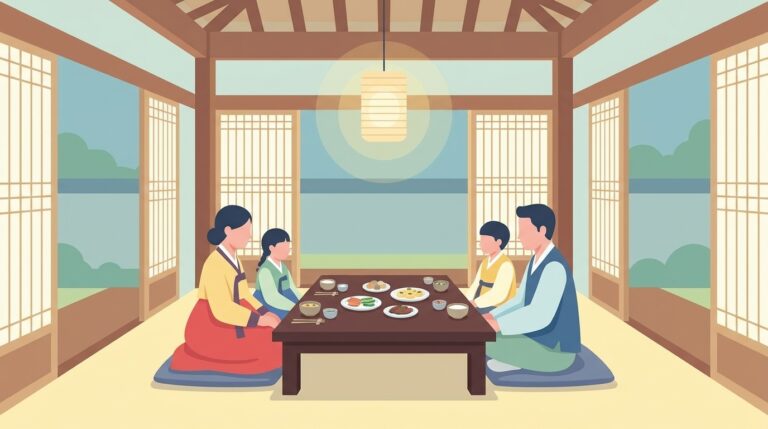
Hello! I am the Lead Editor at Daily Hangul. Have you ever watched a K-Drama where two families sit across from each other in a meticulously decorated private room of a traditional Korean restaurant? The silence is deafening, broken only by the quiet clinking of brass spoons. The mothers exchange polite but piercing smiles. The fathers clear their throats. This is Sanggyeollye (상견례)—the official ‘Meet the Parents’ event before a Korean wedding. If you are preparing to marry a Korean partner, this is your final boss battle. It’s not just a dinner; it’s a diplomatic summit.
At the C2 level, you already know basic polite Korean. But Sanggyeollye requires something deeper: pumgyeok (품격, elegance) and an acute reading of the room. A single misstep in seating arrangements or bringing up the wrong topic can set a chilly tone for your entire marriage preparation. Today, we are going to navigate the treacherous but rewarding waters of Sanggyeollye, learning the sophisticated language and cultural nunchi required to win your future in-laws’ hearts.
Phase 2: Core Expression Deep Dive
1. 저희가 많이 부족하지만, 예쁘게 봐주십시오.
- Pronunciation: jeohuiga mani bujokhajiman, yeppeuge bwajusipsio. (The ‘jok’ sounds like the ‘jok’ in ‘joke’ but cut short; ‘bwajusipsio’ flows smoothly like water.)
- Meaning: Literal: ‘We lack a lot, but please look at us prettily.’ / Real nuance: ‘We are still young and learning, but we hope you will guide us with affection.’
- K-Culture Moment: This is the ultimate ice-breaker usually said by the parents to each other, but as a foreign son/daughter-in-law, saying this to your partner’s parents shows an incredibly deep understanding of Korean humility. It instantly disarms any tension.
- Editor’s Insight: Western culture values confidence (‘I will make her happy!’). Korean culture values humility. Acknowledging that you are ‘lacking’ isn’t a sign of weakness; it’s a profound sign of respect and willingness to grow together.
- Situation Spectrum:
- Casual friends: 🚫 (Too formal and weird)
- Semi-formal: ⚠️ (A bit heavy)
- Formal/Elders: ✅ (Absolute perfection)
- 🤔 Think About It: Why does Korean culture emphasize ‘lacking’ (부족하다) in formal introductions? How does this compare to the emphasis on ‘self-selling’ in Western cultures?
2. 아버님, 어머님. 안쪽 상석으로 모시겠습니다.
- Pronunciation: abeonim, eomeonim. anjjok sangseogeuro mosigetseumnida. (‘sang’ sounds like ‘sung’, ‘seok’ sounds like ‘suck’ but with an ‘o’ sound).
- Meaning: Literal: ‘Father, Mother. I will escort you to the inner seat of honor.’ / Real nuance: ‘Please, take the best seats in the room.’
- K-Culture Moment: Before anyone sits, the seating hierarchy must be established. The seat furthest from the door is the sangseok (상석, seat of honor). Directing the elders there before taking your own seat proves you have impeccable manners.
- Editor’s Insight: Using the verb 모시다 (to escort/serve) instead of 안내하다 (to guide) elevates your Korean from ‘fluent foreigner’ to ‘educated family member.’
- Situation Spectrum:
- Casual friends: 🚫
- Business VIPs: ✅
- Formal/Elders: ✅
- 🤔 Think About It: Does spatial hierarchy exist in your culture’s dining etiquette? Who sits at the ‘head of the table’?
3. 워낙 배려심이 깊어서 제가 늘 고맙게 생각하고 있습니다.
- Pronunciation: wonak baeryeosimi gipeoseo jega neul gomapge saenggakhago itseumnida.
- Meaning: Literal: ‘Because [they] are so deeply considerate, I am always thinking thankfully.’ / Real nuance: ‘They are so thoughtful, and I am truly grateful for them.’
- K-Culture Moment: When your future mother-in-law modestly downplays her child’s achievements (‘My son/daughter is so stubborn…’), you swoop in with this high-level compliment. It deflects the self-deprecation and elevates your partner elegantly.
- Editor’s Insight: Never brag about your partner’s looks or money in front of their parents. Praise their character (배려심 – thoughtfulness, 성실함 – diligence).
- Situation Spectrum:
- Casual friends: ⚠️ (A bit stiff)
- Semi-formal: ✅
- Formal/Elders: ✅
Phase 3: Textbook vs. Real Korean
[Praising your Partner to their Parents]
* 📖 Textbook Korean: 제 여자친구는 참 착합니다. (My girlfriend is very nice.)
* 🗣️ Real Korean: ㅇㅇ씨가 워낙 지혜로워서 제가 많이 배우고 있습니다. (OO is so wise; I am learning a lot from her.)
* 💡 Why the difference?: At the C2 level, avoiding basic adjectives like ‘착하다’ (nice/good) and using ‘지혜롭다’ (wise) or ‘배려심이 깊다’ (considerate) shows emotional intelligence and maturity.
[Deflecting Sensitive Questions (e.g., Finances)]
* 📖 Textbook Korean: 저는 돈을 많이 모았습니다. (I saved a lot of money.)
* 🗣️ Real Korean: 아직 부족한 점이 많지만, 둘이 힘을 합쳐 성실하게 꾸려나가겠습니다. (We still have a lot of lacking points, but we will combine our strengths and manage diligently.)
* 💡 Why the difference?: Direct talk about numbers at a Sanggyeollye is considered gauche. Vague but determined promises of ‘diligence’ (성실) are the golden standard.
Phase 4: Cultural Context — K-Culture Deep Dive
4-1. Non-verbal Nuances at the Table
- The Battle for the Bill: Do NOT try to split the bill at Sanggyeollye. Traditionally, the groom’s side or the couple themselves preemptively pays the bill before the dessert is even served. Excuse yourself to the restroom near the end of the meal and settle it discreetly.
- Drinking Etiquette: If alcohol (like traditional Baekseju) is served, wait for the eldest to lift their glass. Turn your head slightly away when drinking. This spatial respect is deeply ingrained in Korean dining.
4-2. K-Drama Connections: The ‘Envelope’ Trope vs. Reality
In K-Dramas, family meetings often feature a dramatic moment where a wealthy parent slides a water-spilling envelope of cash across the table, demanding you leave their child. In reality, Sanggyeollye is hyper-polite. The tension doesn’t come from yelling; it comes from the heavy use of high-level honorifics and indirect speech. The weather, the food, and hometowns are the safest topics. Politics, exact salaries, and past relationships are absolute taboos.
Phase 5: Real-life Roleplay Scenario
Setting: Saturday, 1 PM. A high-end Hanjeongsik (Korean traditional course meal) restaurant in Bukchon Hanok Village. You are sitting next to your fiancé, Ji-won. Across from you are Ji-won’s parents. The atmosphere is polite but undeniably tense.
Characters:
– YOU: A C2-level Korean speaker, deeply in love and ready to impress.
– Father-in-law (아버님): 60s, a retired executive. Stern appearance but loves his daughter.
– Mother-in-law (어머님): 50s, elegant, observing every detail.
Dialogue:
아버님: 외국에서 와서 한국 생활이 쉽지 않을 텐데… 우리 지원이가 고집이 좀 세서 걱정이네.
(oegugeseo waseo hanguk saenghwari swipji aneul tende… uri jiwoniga gojibi jom seseo geokjeongine.)
[It must not be easy living in Korea as a foreigner… I’m worried because our Ji-won is quite stubborn.]
(🎭 Stage Direction: He takes a slow sip of his tea, looking directly at you.)
YOU: 아버님, 걱정하지 않으셔도 됩니다. 오히려 타지 생활에 지원 씨가 큰 의지가 되었습니다.
(abeonim, geokjeonghaji aneuseyodo doemnida. ohiryeo taji saenghware jiwon ssiga keun uijiga doe-eotseumnida.)
[Father, you don’t need to worry. Actually, in my life abroad here, Ji-won has been a huge source of support.]
어머님: 어머, 말을 참 예쁘게 하시네요. 두 사람이 앞으로 어떻게 살 계획인지 궁금한데…
(eomeo, mareul cham yeppeuge hasineyo. du sarami apeuro eotteoke sal gyehoeginji gunggeumhande…)
[Oh my, you speak so beautifully. I’m curious about how you two plan to live in the future…]
🔀 Your Turn! How do you answer this subtly loaded question?
– A) “제가 연봉이 높아서 집을 살 수 있습니다!” (I have a high salary, so I can buy a house!)
– B) “저희 둘이서 알아서 잘 살겠습니다.” (The two of us will figure it out and live well on our own.)
– C) “아직 부족하지만, 둘이서 지혜롭게 잘 상의하며 맞춰가겠습니다. 많이 가르쳐 주십시오.”✅ Best Choice: C — Reason: It uses the magic words ‘부족하지만’ (lacking but), promises teamwork (‘상의하며’ – consulting each other), and asks for their guidance (‘가르쳐 주십시오’). It respects their authority while showing responsibility.
⚠️ Choice A & B Analysis: A is too arrogant and materialistic for this setting. B sounds dismissive, almost like ‘mind your own business.’
Phase 6: 10-Second Shadowing Drill
Let’s practice the pacing. Formal Korean should be spoken slowly and clearly, not rushed.
😊 아버님, 어머님. / 안쪽 편한 자리로 / 모시겠습니다.
(abeonim, eomeonim. / anjjok pyeonhan jariro / mosigetseumnida.)
Feel the warmth and respect in your tone. Pause slightly at the slashes to show composure.
🥺 저희가 / 많이 부족하지만, / 예쁘게 봐주십시오.
(jeohuiga / mani bujokhajiman, / yeppeuge bwajusipsio.)
Slightly lower your head and smile warmly at the end. Deliver this with genuine humility.
Phase 7: K-Culture Mini Dictionary
1. 상견례 (Sanggyeollye)
* Romanization: sanggyeollye
* English: Formal meeting between families of the bride and groom.
* Context: The most critical step in Korean wedding prep. It determines whether the marriage proceeds smoothly.
2. 상석 (Sangseok)
* Romanization: sangseok
* English: Seat of honor.
* Context: Typically the seat furthest from the entrance, facing the door. Always offered to the elders or highest-ranking individuals.
3. 한정식 (Hanjeongsik)
* Romanization: hanjeongsik
* English: Korean traditional full-course meal.
* Context: The standard menu for Sanggyeollye because it’s served in courses by staff, minimizing awkward cooking (like K-BBQ) and providing conversation breaks.
4. 예단 / 예물 (Yedan / Yemul)
* Romanization: yedan / yemul
* English: Traditional wedding gifts exchanged between families.
* Context: A highly sensitive topic that is usually discussed after the Sanggyeollye, but the general vibe at this dinner sets the tone for these negotiations.
Phase 8: Traveler’s Survival Kit (High-End Dining & Transit)
Even if you live in Korea, getting to the Sanggyeollye location smoothly is crucial. You cannot be late!
🆘 Survival Phrases for the Big Day
– 🇰🇷 “기사님, 예약 시간이 촉박해서 그러는데 조금만 서둘러 주실 수 있을까요?” (gisanim, yeyak sigani chokbakhaeseo geureoneunde jogeumman seodulleo jusil su isseulkkayo?)
– 🗣️ Meaning: Driver, we are pressed for time with our reservation, could you please hurry a little bit?
– 📍 Where to use: In a taxi when running late.
– 💡 Pro Tip: Never just say “빨리빨리” (Hurry!) to a taxi driver on a formal day. Using “시간이 촉박해서” (pressed for time) explains the why politely.📌 Editor’s Transit Note
– App Tip: Use KakaoT (Blue or Venti) to ensure a comfortable, clean ride to the venue so your clothes don’t get wrinkled.
– Arrival: Arrive at least 15-20 minutes early. It is a massive faux pas for the groom/bride to arrive later than the parents.
Phase 9: Critical Thinking Corner — “A Step Deeper”
🧠 Think Deeper: Language & Power in the Korean Family
The concept of Apjonbeop (압존법, relative honorifics) reveals the complex power dynamics in traditional Korean society. If you are speaking to your grandfather about your father, you must NOT use honorifics for your father, because the grandfather is higher in the hierarchy. While strict Apjonbeop is fading in modern corporate settings, Sanggyeollye is where these Neo-Confucian linguistic roots suddenly resurface. By mastering spatial hierarchy (Sangseok) and relative humility (lowering oneself to elevate the partner), you aren’t just speaking Korean; you are participating in a centuries-old social choreography.💬 Your Turn: How do families negotiate hierarchy and respect in your culture when merging two families? Share in the comments!
Phase 10: FAQ & Avoiding Misunderstandings
- Q: Can I use humor or jokes to break the ice during the silence?
- A: NO. Unlike Western cultures where a well-timed joke relieves tension, in a Korean Sanggyeollye, ‘lightness’ can be mistaken for ‘frivolity.’ Stick to warm smiles, compliments about the food, and agreeing with the elders.
- Q: The parents keep asking about my home country’s wedding traditions. How deep should I go?
- A: Keep it light. They are mostly making polite conversation. Highlight beautiful traditions, but avoid explaining anything that implies a massive financial burden or stark cultural clash right away.
❌ Common Mistake #1: Calling your partner’s parents “당신” (You) or just “아저씨/아줌마” (Mister/Ma’am).
✅ Do This Instead: Always use “아버님” (Abeonim, Honored Father) and “어머님” (Eomeonim, Honored Mother), even before the wedding.
Phase 11: Summary & Action Items
- One-Liner Summary: At a Sanggyeollye, your superpower isn’t showing off how great you are; it’s using elegant language to show humility, respect, and deep gratitude for your partner’s family.
-
Action Mission 3 Steps:
- 🥉 Bronze: Practice saying “아버님, 어머님. 안쪽 상석으로 모시겠습니다.” out loud 3 times with perfect, slow pacing.
- 🥈 Silver: Write down 3 elegant compliments about your partner in C2 Korean that you could safely share with their parents.
- 🥇 Gold: Roleplay the Sanggyeollye greeting with your Korean partner, focusing on your tone and spatial awareness!
- K-Culture Mission: Watch a clip of a K-Drama Sanggyeollye scene on YouTube (search: 드라마 상견례 장면). Notice where the elders sit and who speaks first!
Phase 12: Quiz — Interactive Challenge
1. Situational Judgment:
The check arrives at the end of the Sanggyeollye. Your future father-in-law reaches for his wallet. What is the most appropriate C2-level response if you have already paid?
* A) “제가 냈습니다!” (I paid!)
* B) “돈 내지 마세요, 제가 계산했어요.” (Don’t pay, I calculated it.)
* C) “아버님, 식대는 저희가 미리 약소하게나마 대접해 드렸습니다. 편히 일어나시지요.”
2. True or False – K-Culture Edition:
* At a Sanggyeollye, it is highly recommended to debate current political events to show you are an educated, global citizen. (T/F)
(Answers: 1: C – It uses humble terms like ‘약소하게나마’ (though it is a small gesture) and ‘대접해 드렸습니다’ (we treated you). 2: False – Politics is an absolute taboo at Sanggyeollye!)
Frequently Asked Questions (FAQ)
Q: What does "저희가 많이 부족하지만, 예쁘게 봐주십시오." mean in Korean and how do you pronounce it?
A: In Korean, "저희가 많이 부족하지만, 예쁘게 봐주십시오." is pronounced [jeohuiga mani bujokhajiman, yeppeuge bwajusipsio. (The 'jok' sounds like the 'jok' in 'joke' but cut short; 'bwajusipsio' flows smoothly like water.] and means: Literal: 'We lack a lot, but please look at us prettily.' / Real nuance: 'We are still young and learning, but we hope you will guide us with affection.'
Q: What does "아버님, 어머님. 안쪽 상석으로 모시겠습니다." mean in Korean and how do you pronounce it?
A: In Korean, "아버님, 어머님. 안쪽 상석으로 모시겠습니다." is pronounced [abeonim, eomeonim. anjjok sangseogeuro mosigetseumnida. ('sang' sounds like 'sung', 'seok' sounds like 'suck' but with an 'o' sound] and means: Literal: 'Father, Mother. I will escort you to the inner seat of honor.' / Real nuance: 'Please, take the best seats in the room.'
Q: What does "워낙 배려심이 깊어서 제가 늘 고맙게 생각하고 있습니다." mean in Korean and how do you pronounce it?
A: In Korean, "워낙 배려심이 깊어서 제가 늘 고맙게 생각하고 있습니다." is pronounced [wonak baeryeosimi gipeoseo jega neul gomapge saenggakhago itseumnida.] and means: Literal: 'Because [they] are so deeply considerate, I am always thinking thankfully.' / Real nuance: 'They are so thoughtful, and I am truly grateful for them.'







