

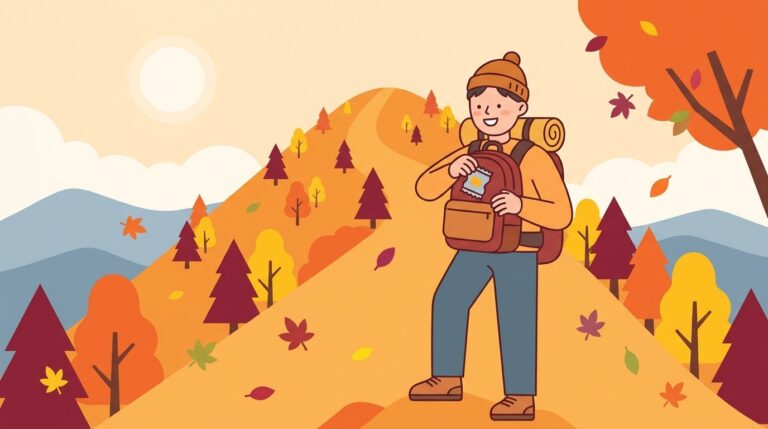
Phase 1: Empathy & K-Culture Cold Open
Hello! I’m your Daily Hangul Editor.
Picture this: It’s a crisp Saturday morning, and you’re hiking up Bukhansan, one of Seoul’s most famous mountains. You’re out of breath, taking a quick break, when suddenly, a friendly Korean hiker in bright, neon hiking gear (a true K-Culture icon!) hands you a small, sweet cherry tomato. You smile, say “Thank you,” and eat it. But wait… you have a tiny green stem left in your hand. You look around left, right, and center. There’s no trash can. You start walking towards a bush, and suddenly, the hiker waves their arms in a giant ‘X’ shape.
What did you do wrong?
Welcome to Korean hiking culture! If you love K-Dramas or K-Pop, you know Koreans love nature and outdoor activities. But there is a very strict, unspoken rule on Korean mountains: “Leave No Trace.” Knowing how to talk about taking your trash with you will not only save you from embarrassing moments but will instantly earn you the respect of local hikers. Let’s dive into this essential A1 survival skill!
(Note: This guide is based on real panicked questions from my beginner students who found themselves holding banana peels on top of Namsan!)
Phase 2: Core Expressions Deep Dive
Let’s look at the absolute must-know phrases for handling trash in Korea.
1. 쓰레기
- Pronunciation: sseuregi [ssuh-reh-gee]
- Meaning: Literal = Trash / Real nuance = Any garbage, wrapper, or food waste.
- K-Culture Moment: If you watch K-Variety shows, you’ll often see cast members playing games to decide who has to take out the sseuregi. It’s a universal chore!
- Editor’s Insight: The double ‘ㅆ’ sound can be tricky. Make a sharp, hissing snake sound. Think of it as hissing at the trash because we don’t want it on the mountain!
- Situation Spectrum:
- Casual (Friends): ✅
- Semi-formal (Colleagues): ✅
- Formal (Elders/Bosses): ✅ (It’s just a noun!)
- 🤔 Think About It: Why is waste separation so strict in Korea? Does your country have strict rules about recycling?
2. 가져가세요
- Pronunciation: gajeogaseyo [gah-jyuh-gah-seh-yo]
- Meaning: Literal = Please take it / Real nuance = Please take it with you (away from here).
- K-Culture Moment: You’ll hear this at cafes too! When you order takeout, the barista might ask if you will gajeogaseyo (take it to go).
- Editor’s Insight: ‘가’ (ga) sounds like ‘Go’. You are telling the trash to GO away with you. Adding ‘세요’ (seyo) makes it polite.
- Situation Spectrum:
- Casual (Friends): ⚠️ (Use ‘가져가’ instead)
- Semi-formal (Strangers/Colleagues): ✅
- Formal (Elders/Bosses): ✅
- 🤔 Think About It: Koreans use ‘세요’ (seyo) to show respect. Why is polite language so important even when giving a command?
3. 버리지 마세요
- Pronunciation: beoriji maseyo [buh-ree-jee mah-seh-yo]
- Meaning: Literal = Please don’t throw it away / Real nuance = Do not litter here.
- K-Culture Moment: In K-Dramas, when a character is crying in the rain and holding onto their lover, they might say “나를 버리지 마” (Don’t throw me away / Don’t abandon me). Yes, it’s the exact same verb!
- Editor’s Insight: ‘마세요’ (maseyo) is the magic word for “Please don’t do [X].” It’s firm but polite.
- Situation Spectrum:
- Casual (Friends): ⚠️ (Use ‘버리지 마’)
- Semi-formal (Strangers/Colleagues): ✅
- Formal (Elders/Bosses): ✅
- 🤔 Think About It: When reminding someone not to litter, why do we frame it as a polite request rather than a harsh order?
Phase 3: Textbook vs. Real Korean
[Seeing a sign on the hiking trail]
* 📖 Textbook Korean: 쓰레기를 버리지 마십시오. (sseuregireul beoriji masipsio.)
* 🗣️ Real Korean: 쓰레기 가져가세요~ (sseuregi gajeogaseyo~)
* 💡 Why the difference?: The textbook version is formal written language (often seen on official government signs). Real hikers will just politely tell you to “take it with you” using a softer, spoken tone.
[Telling a friend not to leave their empty water bottle]
* 📖 Textbook Korean: 그것을 산에 버리면 안 됩니다. (geugeoseul sane beorimyeon an doemnida.)
* 🗣️ Real Korean: 야, 쓰레기 챙겨! (ya, sseuregi chaeng-gyeo!)
* 💡 Why the difference?: Between close friends, Koreans use short, direct phrases. ‘챙겨’ means “pack it up” or “take care of it,” which sounds much more natural and affectionate than “do not throw it away.”
(Bottom Note: As an A1 beginner, stick to the ‘-seyo’ forms when talking to strangers to sound polite and respectful!)
Phase 4: K-Culture Deep Dive
4-1. Non-Verbal Cues
When a Korean wants to communicate “No” or “Don’t do that” (like throwing away trash), they often use a specific hand gesture. They will cross their forearms or index fingers to make an ‘X’ shape. If a hiker makes an ‘X’ with their arms while looking at your trash, it’s a silent, urgent “Please don’t put that there!” Read the room (Nunchi), smile, and put the trash back in your bag.
4-2. K-Travel & Hiking Connection
If you hike mountains like Seoraksan or Hallasan, you will quickly notice something strange: There are zero trash cans. Why? It’s part of the national “Leave No Trace” campaign. In the past, overflowing trash cans on mountains attracted wild animals (like boars) and ruined the environment. Now, hikers are expected to bring a small plastic bag from home to carry their own wrappers, fruit peels, and tissues back down to the city.
Phase 5: Interactive Roleplay Scenario
Setting: Saturday afternoon, halfway up Gwanaksan Mountain in Seoul. You are sitting on a wooden bench, enjoying the view. An older Korean hiker (Ajussi) with a colorful windbreaker is sitting next to you.
Characters:
– YOU: An excited foreign traveler hiking in Korea for the first time.
– Ajussi (Mr. Kim): A friendly local hiker who loves chatting with foreigners.
Dialogue:
Ajussi: 학생! 이거 좀 먹어봐요. 한국 오이에요. 🥒
(haksaeng! igeo jom meogeobwayo. hanguk oiyeyo.)
[Student! Try eating this. It’s a Korean cucumber.]
(🎭 Stage Direction: Mr. Kim smiles warmly and hands you a piece of cucumber wrapped in plastic wrap)
YOU: 아, 감사합니다! 맛있어요.
(a, gamsahamnida! masisseoyo.)
[Ah, thank you! It’s delicious.]
Ajussi: (Nods happily) 산에서는 오이가 최고지!
(saneseoneun oiga choegoji!)
[On the mountain, cucumbers are the best!]
(🎭 Stage Direction: You finish the cucumber and are left with the plastic wrap. You look around for a bin.)
YOU: 저기… 쓰레기통 어디 있어요?
(jeogi… sseuregitong eodi isseoyo?)
[Excuse me… where is the trash can?]
Ajussi: (Making an ‘X’ with his hands) 산에 쓰레기통 없어요.
(sane sseuregitong eopseoyo.)
[There are no trash cans on the mountain.]
🔀 YOUR TURN! How do you reply?
– A) “네? 그럼 버리지 마세요?” (What? Then please don’t throw it away?)
– B) “아, 쓰레기 가져가세요?” (Ah, please take the trash?)
– C) “아, 알겠습니다. 제가 챙길게요.” (Ah, understood. I’ll take care of it/pack it.)✅ Best Choice: C — Reason: You are talking about your own action. A and B are commands directed at the Ajussi! If you use A or B, you are telling the older man what to do! C is natural: “I will pack it.”
⚠️ Choice B Analysis: If you say “gajeogaseyo” here, you are literally telling the Ajussi to take YOUR trash! He might laugh, but it’s a bit cheeky!
Ajussi: 맞아, 가방에 쏙 넣어 가요.
(maja, gabange ssok neoeo gayo.)
[That’s right, just pop it into your bag.]
Phase 6: 10-Second Shadowing Drill
Let’s practice reading with the right feeling. Pay attention to the slashes for pauses!
- 😤 Firmly but politely: 산에는 / 쓰레기통이 / 없어요.
(saneneun / sseuregitongi / eopseoyo.)
There are no trash cans on the mountain. - 😊 Smiling and friendly: 쓰레기는 / 꼭 / 가져가세요~!
(sseuregineun / kkok / gajeogaseyo~!)
Please make sure to take your trash with you!
Phase 7: K-Culture Mini Dictionary
1. 눈치
* Romanization: nunchi
* English: Social awareness / Reading the room
* Context: The core social sense in Korea. Knowing you should put your trash away without anyone telling you is having “good nunchi.”
2. 등산복
* Romanization: deungsanbok
* English: Hiking clothes
* Context: A massive fashion industry in Korea. Older Koreans love bright, neon-colored, high-tech gear even for short, easy trails!
3. 오이
* Romanization: oi
* English: Cucumber
* Context: The ultimate Korean hiking snack. It hydrates you and has no strong smell. If you hike in Korea, someone will likely offer you an oi!
4. 쓰레기통
* Romanization: sseuregitong
* English: Trash can
* Context: Hard to find on streets and impossible to find on mountains. Always carry a small plastic bag in your pocket just in case.
Phase 8: Traveler’s Survival Kit
Since finding a trash can is like a treasure hunt in Korea, you need these phrases!
🆘 Survival Phrases TOP 3
– 🇰🇷 “쓰레기통 어디 있어요?” (sseuregitong eodi isseoyo?)
– 🗣️ English: Where is the trash can?
– 📍 Where to use: Convenience stores, subway stations, parks.
- 🇰🇷 “이거 버려주실 수 있나요?” (igeo beoryeojusil su innayo?)
- 🗣️ English: Could you throw this away for me?
- 📍 Where to use: Cafes, when handing an empty cup back to the barista.
🇰🇷 “종량제 봉투 하나 주세요.” (jongnyangje bongtu hana juseyo.)
- 🗣️ English: Please give me one standard plastic garbage bag.
- 📍 Where to use: Convenience stores (if you need a bag to throw away trash at your Airbnb).
📌 Editor’s Travel Note
– No Bins? No Problem: Convenience stores (CU, GS25, 7-Eleven) always have bins inside or right outside. If you buy a drink there, you can throw the wrapper away there.
– Bathroom Bins: In older Korean public restrooms, you might see a bin next to the toilet. This is for toilet paper (a habit from older plumbing days), but modern restrooms usually say “휴지는 변기에” (Flush the toilet paper).
Phase 9: Critical Thinking Corner — “Think Deeper”
Food, Identity, and Communal Responsibility
🧠 Think Deeper:
Hiking in Korea perfectly showcases a unique cultural paradox. On the trail, you will experience the warmth of Korean Jeong (정) as strangers freely share their food, water, and makgeolli with you. It’s a highly communal culture where “we” eat together. However, when it comes to trash, the responsibility instantly shifts to the individual. By strictly enforcing “Leave No Trace” without providing trash cans, Korean society emphasizes that preserving the community’s beautiful nature requires strict individual accountability. Sharing the joy is communal, but cleaning up the mess is personal.💬 Your Turn: In your culture, do people share food with strangers while hiking? How does your country handle trash in national parks? Let me know in the comments!
Phase 10: FAQ & Avoiding Common Mistakes
Q: “Can I just throw a banana peel or apple core into the bushes? It’s natural!”
No! This is a huge misconception. Korean mountains have distinct ecosystems, and foreign fruit seeds or peels can harm local wildlife and take months to decompose. Always pack it out!
Q: “Is it polite to ask a cafe worker to throw away trash from another store?”
It’s bad manners. Only ask them to throw away the cup you bought from their specific cafe.
❌ Common Mistake #1: Saying “쓰레기 주세요” (sseuregi juseyo).
✅ Do this instead: This means “Please give me trash!” If you want to offer to throw away your friend’s trash, say “쓰레기 나한테 줘” (Give the trash to me).❌ Common Mistake #2: Assuming public bins take all trash.
✅ Do this instead: Korean bins are strictly separated into “일반쓰레기” (General waste) and “재활용” (Recycling: plastic, cans, paper). Look at the pictures on the bin before tossing!
Phase 11: Summary & Action Items
One-Liner Summary: On Korean mountains, always take your trash with you by remembering: “쓰레기는 가져가세요!” (Take your trash with you!)
Action Mission:
– 🥉 Bronze (Solo): Say “쓰레기 가져가세요!” out loud 3 times right now with a bright smile.
– 🥈 Silver (Online): Comment below using the word “쓰레기통” (trash can) in a sentence!
– 🥇 Gold (Real World): Next time you are at a Korean cafe or convenience store, ask “쓰레기통 어디 있어요?” to practice finding the bin!
🌲 K-Culture Mission:
Go on Google Street View and drop yourself at the entrance of Bukhansan National Park. Look around and see if you can spot anyone wearing bright deungsanbok (hiking clothes), and try to find a trash can (spoiler: you won’t!).
Phase 12: Interactive Quiz
Let’s test your K-Hiking survival skills!
1. Situational Judgment:
You just finished drinking a bottle of water on top of Namsan. A Korean hiker points to your bottle. What is the BEST thing to say?
– A) 버리지 마세요! (beoriji maseyo!)
– B) 제 가방에 가져갈게요. (je gabange gajeogalgeyo. – I will take it in my bag.)
– C) 쓰레기 주세요! (sseuregi juseyo!)
2. True or False — K-Culture Edition:
“It is acceptable to throw fruit peels on the mountain because wild animals will eat them.”
– [ True / False ]
3. Fill in the Blank:
Excuse me, where is the trash can?
저기요, __________ 어디 있어요?
(Answers: 1. B – A is telling the hiker not to litter, C is asking for trash! / 2. False – Always pack it out! / 3. 쓰레기통)
Frequently Asked Questions (FAQ)
Q: What does "쓰레기" mean in Korean and how do you pronounce it?
A: In Korean, "쓰레기" is pronounced [sseuregi [ssuh-reh-gee] and means: Literal = Trash / Real nuance = Any garbage, wrapper, or food waste.
Q: What does "가져가세요" mean in Korean and how do you pronounce it?
A: In Korean, "가져가세요" is pronounced [gajeogaseyo [gah-jyuh-gah-seh-yo] and means: Literal = Please take it / Real nuance = Please take it with you (away from here).
Q: What does "버리지 마세요" mean in Korean and how do you pronounce it?
A: In Korean, "버리지 마세요" is pronounced [beoriji maseyo [buh-ree-jee mah-seh-yo] and means: Literal = Please don't throw it away / Real nuance = Do not litter here.







