

Phase 1: The Heart-Pounding Countdown
Hello! I’m the Lead Editor of Daily Hangul.
Have you ever tried getting tickets to your favorite K-Pop idol’s concert? The sweaty palms, the ticking clock, the sudden server crash… What if I told you that applying for the TOPIK (Test of Proficiency in Korean) in South Korea feels exactly like that?
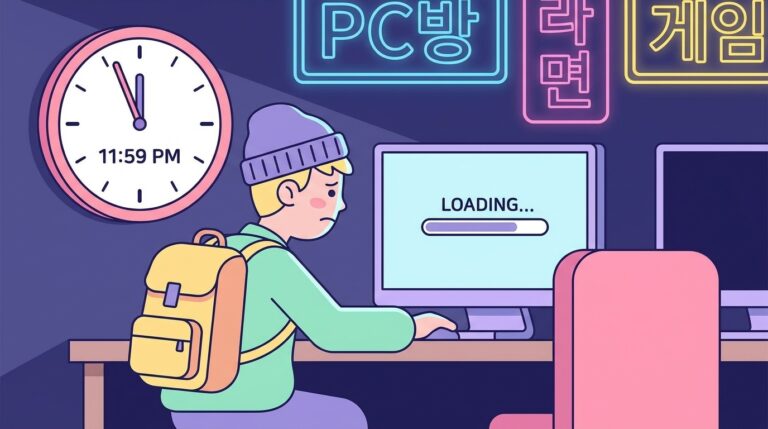
In Korea, TOPIK spots fill up in literal minutes. Many foreign students sit in a PC Bang (Korean internet cafe) with two monitors, three browsers open, chanting a quick prayer before registration opens. If you don’t know the right Korean expressions for this high-stress situation, you might end up panicking when your Korean friend shouts, “The server is down!”
Today, we are going to learn the essential A2-level phrases you need to survive the TOPIK registration battlefield, straight from the real-life experiences of international students in Seoul!
Phase 2: Core Expressions Deep Dive
1. 시험 신청하고 싶어요 (I want to apply for the exam)
- Pronunciation: siheom sincheonghago sipeoyo [she-hum sheen-chong-ha-go shee-po-yo]
- Sound-alike Guide: ‘si’ like ‘she’, ‘heom’ like humming ‘hum’, ‘cheong’ rhymes with ‘song’.
- Meaning: Literal: I want to apply for the test. / Real nuance: I need to register for the exam!
- K-Culture Moment: You walk into a university office or talk to a language exchange partner. It’s the standard, polite way to declare your mission.
- Editor’s Insight: ‘신청 (sincheong)’ means ‘application’ or ‘request’. You’ll also use this word a lot when requesting songs at a karaoke (노래 신청) or applying for a gym membership!
- Situation Spectrum:
- Close Friends (Casual): ⚠️ (Too formal, use 신청할래 instead)
- Coworkers/Acquaintances (Semi-formal): ✅
- Boss/Elders (Formal): ✅
- 🤔 Think About It: In Korean, we use the verb ‘하다’ (to do) with many nouns (like 신청 + 하다). Why do you think Korean relies so heavily on ‘noun + to do’ structures compared to your native language?
2. 자리가 없어요 (There are no spots/seats)
- Pronunciation: jariga eopseoyo [jah-ree-ga up-so-yo]
- Sound-alike Guide: ‘eo’ sounds like the ‘u’ in ‘up’.
- Meaning: Literal: There is no seat. / Real nuance: It’s fully booked! We failed!
- K-Culture Moment: The moment the clock strikes 9:00 AM, you click ‘Seoul’, and a red pop-up appears. Your Korean friend looks over your shoulder and sighs, “Ah… jariga eopseoyo.”
- Editor’s Insight: ‘자리’ (jari) means ‘seat’ or ‘space’. You can use this everywhere in Korea! In a crowded cafe? “자리가 없어요.” On a busy subway? “자리가 없어요.”
- Situation Spectrum:
- Close Friends (Casual): ⚠️ (Say ‘자리 없어’ instead)
- Coworkers/Acquaintances (Semi-formal): ✅
- Boss/Elders (Formal): ✅
- 🤔 Think About It: Space (자리) is very precious in a crowded city like Seoul. Can you think of other situations where finding a ‘자리’ is highly competitive in your country?
3. 새로고침 하세요! (Please refresh!)
- Pronunciation: saerogochim haseyo! [sae-ro-go-cheem ha-se-yo!]
- Sound-alike Guide: ‘sae’ like ‘say’, ‘go’ like the English word ‘go’, ‘chim’ like ‘chimney’.
- Meaning: Literal: Do a new fix! / Real nuance: Hit F5! Refresh the page right now!
- K-Culture Moment: The website is frozen. A white screen of death. The PC Bang guy yells this out to his friends playing online games.
- Editor’s Insight: ‘새로’ means ‘newly’, and ‘고침’ comes from the verb ‘to fix/change’. Together, it’s the computer term for ‘Refresh’.
- Situation Spectrum:
- Close Friends (Casual): ⚠️ (Say ‘새로고침 해!’ instead)
- Coworkers/Acquaintances (Semi-formal): ✅
- Boss/Elders (Formal): ⚠️ (A bit too direct, better to say 새로고침 해보세요)
- 🤔 Think About It: Korea is known for its “Pali-Pali” (hurry hurry) culture. Waiting for a webpage to load is a test of patience. How long do people in your culture wait before hitting refresh?
Phase 3: Textbook vs. Real Korean
[When the Registration Fails]
* 📖 Textbook Korean: 접수가 마감되었습니다. (Registration has been closed.)
* 🗣️ Real Korean: 다 찼어! / 망했어! (It’s all full! / I’m doomed!)
* 💡 Why the difference?: Textbooks teach administrative, formal announcements. Real life is fueled by emotion and the “Pali-pali” speed of internet slang.
[When You Need to Click Fast]
* 📖 Textbook Korean: 마우스를 빨리 누르세요. (Please press the mouse quickly.)
* 🗣️ Real Korean: 광클해!!! (Click like a madman!)
* 💡 Why the difference?: ‘광클’ is a compound of 광 (Crazy) + 클릭 (Click). Korean internet culture loves shortening words for maximum efficiency!
Bottom Note: For A2 level, saying “다 찼어요” (It’s all full) is the perfect balance between sounding natural and remaining polite.
Phase 4: Cultural Context — K-Culture Deep Dive
4-1. Non-Verbal Communication: The Art of Hovering
When you ask a Korean friend to help you register for TOPIK, notice their posture. They will likely lean entirely into the monitor, right hand gripping the mouse, left hand hovering over ‘F5’. Do not interrupt them during this sacred 60 seconds! This requires immense Nunchi (reading the room). If they are staring intensely at a loading bar, stay completely silent.
4-2. The “Ticketing” Trope in Real Life
Registering for TOPIK in Korea uses the exact same strategy as buying K-Pop concert tickets or booking KTX train tickets during national holidays (Chuseok). We call this 피켓팅 (Blood Ticketing).
Because of Korea’s hyper-fast internet infrastructure, things sell out in seconds. The cultural rule here is: Do not do this on your phone’s Wi-Fi! You must go to a PC Bang (Internet Cafe) where the LAN cables are practically injected with adrenaline.
Critical View: While Korea boasts the fastest internet, this “first-come-first-served in 3 seconds” system creates immense anxiety. It’s a harsh reality check compared to the relaxed cafe studying scenes you see in K-Dramas.
Phase 5: Interactive Roleplay Scenario
- Setting: Tuesday, 8:55 AM. A dimly lit PC Bang near Sinchon. Neon keyboards are glowing. You and your Korean buddy are staring at the TOPIK registration countdown.
- Characters:
- YOU: A nervous foreign student who needs this TOPIK score for a university application.
- Min-su (24): Your Korean friend. A veteran of BTS ticketing and League of Legends.
Min-su: 자, 5분 남았어. 준비됐지?
(ja, obun namasseo. junbidwaetji?)
[Alright, 5 minutes left. You ready?]
(🎭 Stage Direction: Min-su cracks his knuckles and adjusts his gaming headset)
YOU: 너무 떨려요. 만약 자리가 없으면 어떡해요?
(neomu tteollyeoyo. manyak jariga eopseumeyeon eotteokaeyo?)
[I’m so nervous. What if there are no spots?]
Min-su: 걱정 마! 내 손가락을 믿어.
(geokjeong ma! nae songarageul mideo.)
[Don’t worry! Trust my fingers.]
YOU: 서울 시험장은 빨리 마감되죠?
(seoul siheomjangeun ppalli magamdwejyo?)
[The Seoul test centers close quickly, right?]
Min-su: 어, 완전 피켓팅이야. 10초 남았다!
(eo, wanjeon pikettingiya. sipcho namatda!)
[Yeah, it’s total blood-ticketing. 10 seconds left!]
(The clock hits 9:00:00. Min-su clicks fiercely. The screen turns white and a little circle starts spinning.)
Min-su: 아… 서버 다운됐나 봐. 화면이 안 넘어가!
(a… seobeo daun-dwaenna bwa. hwamyeoni an neomeoga!)
[Ah… I think the server is down. The screen isn’t changing!]
🔀 Your Turn! How do you react?
– A) “아, 그럼 내일 다시 할까요?” (Oh, should we try again tomorrow?)
– B) “새로고침 빨리 하세요!” (Refresh it quickly!)
– C) “기다려 봐요. 절대 클릭하지 마세요!” (Wait. Do NOT click anything!)✅ Best Choice: C — Reason: In Korean ticketing culture, if you refresh (F5) while a payment or queue page is loading, you lose your spot in line and go to the very back! Just wait!
⚠️ Choice A Analysis: There is no “tomorrow” in TOPIK registration! If you don’t get it today, you have to wait months for the next test.
YOU: 기다려 봐요. 절대 클릭하지 마세요!
(gidalyeo bwayo. jeoldae keullikhaji maseyo!)
[Wait. Do NOT click anything!]
Min-su: 오, 너 한국 사람 다 됐네! 기다리자.
(o, neo hanguk saram da dwaenne! gidarija.)
[Oh, you’ve totally become a Korean! Let’s wait.]
(Suddenly, the screen changes. The ‘Seoul’ option turns gray.)
Min-su: 헉… 서울 다 찼어!
(heok… seoul da chasseo!)
[Gasp… Seoul is all full!]
YOU: 헐… 그럼 경기도로 신청해 주세요!
(heol… geureom gyeonggido-ro sincheonghae juseyo!)
[OMG… Then please apply for Gyeonggi-do!]
Phase 6: 10-Second Shadowing Drill
Practice reading these out loud, focusing on the pauses (/) and the emotion!
- 🥺 Nervous: 저 / 이번에 / 토픽 신청해야 돼요…
(jeo / ibeone / topik sincheonghaeya dwaeyo…)
[I have to apply for TOPIK this time…] -
😤 Urgent: 빨리요! / 새로고침 / 하세요!
(ppalliyo! / saerogochim / haseyo!)
[Quickly! / Please refresh!] -
😭 Sad: 아… / 서울은 / 자리가 없어요.
(a… / seoureun / jariga eopseoyo.)
[Ah… / Seoul has no spots.]
Phase 7: K-Culture Mini Dictionary
1. 피켓팅
* Romanization: piketting
* English: Blood Ticketing
* Context: A blend of 피 (Blood) and Ticketing. It describes the fierce, competitive nature of reserving tickets or exam spots in Korea.
2. 광클
* Romanization: gwang-keul
* English: Mad Clicking
* Context: Used when you need to click a button as fast as humanly possible to secure a spot.
3. 서버 다운
* Romanization: seobeo daun
* English: Server Down
* Context: The dreaded moment when too many people access a website, causing it to crash. A common tragedy on TOPIK day.
4. PC방
* Romanization: pisi-bang
* English: PC Room (Internet Cafe)
* Context: The holy grail of fast internet in Korea. It’s not just for gaming; it’s a strategic location for course registration, ticketing, and TOPIK applications.
Phase 8: Traveler Survival Kit (PC Bang Edition)
Since you must go to a PC Bang for the best chance at TOPIK registration, here are the survival phrases you need when entering!
🆘 Survival Phrases TOP 3
– 🇰🇷 “시간 충전해 주세요.” (sigan chungjeonhae juseyo.)
– 🗣️ English: Please charge my time.
– 📍 Where to use: At the PC Bang kiosk or counter.
- 🇰🇷 “자리 있어요?” (jari isseoyo?)
- 🗣️ English: Are there any seats?
- 📍 Where to use: When the PC Bang looks completely full of gamers.
🇰🇷 “와이파이 비밀번호가 뭐예요?” (waipai b밀beonhoga mwoyeyo?)
- 🗣️ English: What is the Wi-Fi password?
- 📍 Where to use: If you need your phone while waiting.
📌 Editor’s Travel Note
– Signing up: Most PC Bangs require a Korean phone number to make an account. If you don’t have one, look for the ‘비회원’ (Non-member) card at the kiosk to pay with a credit card!
– Food: PC Bangs double as incredible restaurants. You can order hotdogs, ramen, and iced coffee directly from your computer monitor while waiting for the TOPIK server to load!
Phase 9: Critical Thinking Corner — “한 발 더 깊이”
Global Era: Why is TOPIK a Battlefield?
🧠 Think Deeper:
Ten years ago, TOPIK registration was quite relaxing. But today, the Korean language is exploding globally! With the rise of K-Pop, K-Dramas, and Korea’s expanding job market, thousands of international students and workers need this certification. The “server crash” isn’t just an IT issue; it’s a direct reflection of Korea’s new status in the global era. The language has outgrown the system designed to test it!💬 Your Turn: Is there a language exam or an official certification in your country that is extremely difficult to register for? Share your experience in the comments!
Phase 10: FAQ & Avoiding Common Mistakes
- Q: Can I just apply on my mobile phone over 5G?
- A: MAYBE, but highly unrecommended. The TOPIK website often struggles with mobile formatting and pop-ups. Stick to a desktop PC, preferably on Windows!
- Q: If I see a loading screen, should I refresh immediately?
- A: NO! In Korean waiting systems (like Naver ticketing or TOPIK), refreshing pushes you to the back of the queue. Be patient.
❌ Common Mistake #1: Saying “신청해요” vs “시험 봐요”.
✅ How to fix it:
“시험을 신청해요” means “I am applying/registering for the exam.”
“시험을 봐요” means “I am taking the exam (sitting in the room with a pencil).” Don’t mix them up!
Phase 11: Summary & Action Items
One-Liner Summary: Registering for TOPIK in Korea is a fierce battle, but with “자리 없어요” and a trip to the PC Bang, you will survive!
Action Mission 3 Steps:
– 🥉 Bronze (Solo): Stand in front of a mirror and dramatically say “아… 자리가 없어요!” with a sad face.
– 🥈 Silver (Online): Go to a Korean learning forum (like Reddit or Discord) and type: “Has anyone done TOPIK 신청 (sincheong) yet?”
– 🥇 Gold (Real World): Next time you enter a busy cafe, ask the barista, “자리 있어요?” (Are there seats?)
🎯 K-Culture Mission:
Go to YouTube and search “Kpop Ticketing Vlog”. Watch the speed at which Korean fans click. That is exactly the energy you need for your next TOPIK registration!
Phase 12: Interactive Quiz
1. You are at a PC Bang to apply for TOPIK. The clock hits 9:00 AM, but the screen turns white and says “대기 중 (Waiting)”. What should you do? (Situational Judgment)
– A) Scream and hit F5 (Refresh).
– B) Stare at it intensely and touch nothing.
– C) Turn off the computer.
2. Fill in the blank:
“Ah… Seoul is completely full! ________ 없어요!”
– A) 신청
– B) 서버
– C) 자리
3. True or False — K-Culture Edition:
“It is culturally acceptable to yell out loud in frustration at a PC Bang when a server crashes.” (T / F)
(Answers: 1. B – Never refresh during a queue! 2. C – 자리. 3. True – But maybe keep it to a dramatic sigh so you don’t startle the gamers too much!)
Frequently Asked Questions (FAQ)
Q: What does "시험 신청하고 싶어요 (I want to apply for the exam)" mean in Korean and how do you pronounce it?
A: In Korean, "시험 신청하고 싶어요 (I want to apply for the exam)" is pronounced [siheom sincheonghago sipeoyo [she-hum sheen-chong-ha-go shee-po-yo] and means: Literal: I want to apply for the test. / Real nuance: I need to register for the exam!
Q: What does "자리가 없어요 (There are no spots/seats)" mean in Korean and how do you pronounce it?
A: In Korean, "자리가 없어요 (There are no spots/seats)" is pronounced [jariga eopseoyo [jah-ree-ga up-so-yo] and means: Literal: There is no seat. / Real nuance: It's fully booked! We failed!
Q: What does "새로고침 하세요! (Please refresh!)" mean in Korean and how do you pronounce it?
A: In Korean, "새로고침 하세요! (Please refresh!)" is pronounced [saerogochim haseyo! [sae-ro-go-cheem ha-se-yo!] and means: Literal: Do a new fix! / Real nuance: Hit F5! Refresh the page right now!







