

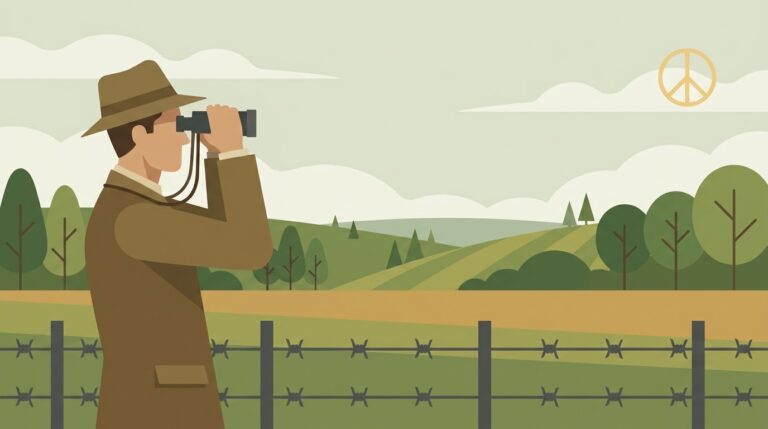
Phase 1: Empathy & K-Culture Cold Open
Hello, learners! I am the Lead Editor of Daily Hangul.
Imagine this: You are on a bus leaving the vibrant, neon-lit streets of Seoul. Less than an hour later, the skyscrapers vanish, replaced by quiet farmlands, military checkpoints, and endless stretches of barbed wire. You have arrived at the DMZ (Demilitarized Zone).
If you’ve watched the K-Drama Crash Landing on You, you might think of the border as a dramatic setting for a forbidden romance. Or perhaps you’ve seen photos of your favorite K-Pop idols serving their mandatory military duties near these northern borders. But standing there in person? The air feels completely different. It’s a surreal mix of a bustling tourist attraction and an active military zone.
At a C1 level, you are no longer just asking “Where is the bathroom?” You want to understand the historical weight, the formal instructions given by the soldiers, and the subtle cultural tensions surrounding this space. If you don’t understand the strict regulations spoken over the PA system, you might accidentally break a security rule—and trust me, this is the one place in Korea where you do not want to ignore the rules!
This guide is crafted from the actual experiences of my advanced students who visited the DMZ and realized that military and security Korean is a whole different beast. Let’s dive into the language of Korea’s most unique geographical travel destination.
Phase 2: Core Expressions Deep Dive
When visiting the DMZ, Dora Observatory, or the JSA, the Korean you hear will be highly formal (격식체) and filled with Sino-Korean (Hanja) vocabulary.
1. 사진 촬영이 금지된 구역입니다. (Photography is prohibited in this area.)
- Pronunciation: sa-jin chwal-yeong-i geum-ji-doen gu-yeok-im-ni-da.
(Sound analogy: ‘chwal’ sounds like you’re about to say ‘swallow’ but with a ‘ch’. ‘geum’ rhymes with ‘room’ but starting with a hard ‘g’.)- Meaning: Literal: It is an area where photo filming is forbidden. / Real nuance: Do not take out your camera here, under any circumstances.
- K-Culture Moment: You’ll hear this exactly like a strict soldier from a K-Drama. While tourist spots in Seoul encourage endless selfies, the DMZ strictly controls what you can photograph to prevent military secrets from leaking.
- Editor’s Insight: Notice the use of ‘촬영’ (filming/photography) instead of just ‘사진을 찍다’, and ‘금지’ (prohibition) instead of ‘안 돼요’. This elevates the sentence to official, legal language.
- Situation Spectrum:
- Casual with friends: 🚫 (Too formal)
- Professional/Official settings: ✅
- Military/Security announcements: ✅
- 🤔 Think About It: Why does Korean have completely different sets of vocabulary for casual actions (찍다) vs. official actions (촬영하다)? How does the use of Sino-Korean words create psychological distance and authority?
2. 신분증을 반드시 지참해 주십시오. (Please make sure to carry your ID.)
- Pronunciation: sin-bun-jeung-eul ban-deu-si ji-cham-hae ju-sip-si-o.
(Sound analogy: ‘jeung’ sounds like the ‘jung’ in jungle. ‘cham’ rhymes with ‘mom’.)- Meaning: Literal: Please certainly carry your identification card. / Real nuance: No passport, no entry. Period.
- K-Culture Moment: At the ticket booth at Imjingak before boarding the DMZ tour bus, the staff will repeatedly announce this. Without your ‘신분증’ (ID/Passport), the tour ends before it begins.
- Editor’s Insight: ‘지참하다’ is a formal word for ‘to bring’ or ‘to carry with oneself’ (가지고 오다). It is almost exclusively used in written notices or formal announcements. The ending ‘-십시오’ is the highest level of formal command.
- Situation Spectrum:
- Casual with friends: 🚫
- Semi-formal: ⚠️ (A bit too stiff for regular office talk)
- Official Guidelines: ✅
- 🤔 Think About It: Does your language have a specific command form that is only used for public announcements or military contexts?
3. 민간인 통제선 (Civilian Control Line – CCL)
- Pronunciation: min-gan-in tong-je-seon.
(Sound analogy: ‘seon’ sounds like ‘sun’.)- Meaning: Literal: Civilian control line. / Real nuance: The absolute boundary where regular civilian access is restricted by the military.
- K-Culture Moment: You will see red signs reading ‘민통선’ (abbreviation for 민간인 통제선) on barbed wire fences. It’s the physical realization that Korea is still technically in a state of ceasefire, a stark contrast to the K-Pop glamour.
- Editor’s Insight: ‘민간인’ means civilian. ‘통제’ means control or restriction. You will hear ‘통제’ a lot in Korea—not just in the military, but also traffic control (교통 통제) or crowd control during big K-Pop concerts!
- Situation Spectrum:
- News/Documentaries: ✅
- Tour Guide Briefings: ✅
- Daily life: ⚠️ (Only used metaphorically, e.g., “My mom is restricting my allowance: 용돈 통제”)
- 🤔 Think About It: South Koreans live just an hour away from this highly restricted military line, yet everyday life in Seoul is incredibly safe and peaceful. How do you think this proximity to a “control line” affects the national psyche?
Phase 3: Textbook vs. Real Korean
When you visit the DMZ, the official announcements and what the tourists actually say to each other are vastly different. Here is the C1-level breakdown.
[Situation 1: Being told you can’t enter a certain area]
* 📖 Textbook/Official Korean: 출입이 철저히 통제됩니다. (chul-ib-i cheol-jeo-hi tong-je-doem-ni-da – Access is strictly restricted.)
* 🗣️ Real Korean (Among friends): 여기 못 들어간대. (yeo-gi mot deu-reo-gan-dae – They say we can’t go in here.)
* 💡 Why the difference?: Official language uses passive verbs and Hanja to sound objective, whereas everyday spoken Korean uses quoted speech (-대) to simply pass along the information.
[Situation 2: Reacting to the tense atmosphere of the JSA]
* 📖 Textbook/Official Korean: 긴장감이 고조되고 있습니다. (gin-jang-gam-i go-jo-doe-go it-seum-ni-da – Tension is escalating.)
* 🗣️ Real Korean (Among friends): 와, 분위기 살벌하다. (wa, bun-wi-gi sal-beol-ha-da – Wow, the atmosphere is intense/brutal.)
* 💡 Why the difference?: ‘살벌하다’ literally means bloody and brutal, but modern Koreans use it to describe any highly tense, intimidating, or fiercely competitive atmosphere (even at work!).
Bottom Note: At a C1 level, your goal is to comprehend the textbook/official announcements but use the “Real Korean” when whispering to your travel companions!
Phase 4: Cultural Context — K-Culture Deep Dive
4-1. Non-Verbal Elements at the DMZ
At the DMZ, body language is just as heavily regulated as spoken language.
* Do not point: If you are at the JSA (Joint Security Area), you will be strictly instructed not to point your fingers at the North Korean soldiers. This can be interpreted as a provocation.
* The ‘Nunchi’ of Silence: While taking the bus past military checkpoints, a sudden silence often falls over Korean tourists. The collective Nunchi (눈치) dictates that loud chatter is inappropriate when armed soldiers are stepping onto the bus to check IDs. Read the room and lower your voice.
4-2. K-Culture Connection: The Shadow behind the Spotlight
For advanced learners, the DMZ isn’t just a tourist spot; it’s the anchor of modern Korean history that shapes K-Culture.
Why do K-Pop groups suddenly go on hiatus? Because of the military service (군대) requirement, a direct result of the division marked by the DMZ.
When you look out from the Dora Observatory, you are looking at the reality that grounds the dramatic plots of movies like JSA (Joint Security Area) or the blockbuster film Escape from Mogadishu (which deals with South and North Korean diplomats). Understanding the vocabulary of the DMZ—words like 통제 (control), 안보 (security), and 분단 (division)—gives you the critical context needed to truly understand Korean literature, cinema, and the lyrics of socially conscious K-Hip Hop.
Phase 5: Real-life Roleplay Scenario
Setting: Tuesday morning, 10:30 AM. You are on a guided DMZ tour at the Dora Observatory. You are looking through binoculars at the North Korean landscape. A young ROK (Republic of Korea) soldier is standing nearby, enforcing regulations.
Characters:
* YOU: An advanced Korean learner who loves photography.
* Ji-hoon (29): Your Korean friend who booked the tour.
* Soldier: A polite but firm military personnel.
Dialogue:
YOU: 지훈아, 저기 마을 보이는 거 진짜 신기하다. 사진 찍어도 돼? 📸
(ji-hun-a, jeo-gi ma-eul bo-i-neun geo jin-jja sin-gi-ha-da. sa-jin jji-geo-do dwae?)
[Translation: Ji-hoon, it’s so fascinating that we can see the village over there. Can I take a picture?]
(🎭 Stage Direction: You lift your professional DSLR camera towards the glass.)
Ji-hoon: 어… 잠깐만. 저기 노란 선 보이지? 거기를 넘어가면 안 될걸?
(eo… jam-kkan-man. jeo-gi no-ran seon bo-i-ji? geo-gi-reul neo-meo-ga-myeon an doel-geol?)
[Translation: Uh… wait a minute. You see that yellow line over there? I don’t think you’re allowed to cross it.]
Soldier: (Approaching quickly) 관광객 여러분, 안내 말씀 드립니다.
(gwan-gwang-gaek yeo-reo-bun, an-nae mal-sseum deu-rim-ni-da.)
[Translation: Tourists, I have an announcement.]
Soldier: 포토존(노란 선) 밖에서는 사진 촬영이 엄격히 금지되어 있습니다.
(po-to-jon (no-ran seon) ba-kke-seo-neun sa-jin chwal-yeong-i eom-gyeok-hi geum-ji-doe-eo it-seum-ni-da.)
[Translation: Photography outside the photo zone (yellow line) is strictly prohibited.]
YOU: 아, 죄송합니다. 여기까지인 줄 몰랐어요.
(a, joe-song-ham-ni-da. yeo-gi-kka-ji-in jul mol-lat-seo-yo.)
[Translation: Oh, I’m sorry. I didn’t realize it was only up to here.]
Soldier: 협조해 주셔서 감사합니다. 카메라 렌즈 방향도 주의해 주십시오.
(hyeop-jo-hae ju-syeo-seo gam-sa-ham-ni-da. ka-me-ra ren-jeu bang-hyang-do ju-ui-hae ju-sip-si-o.)
[Translation: Thank you for your cooperation. Please also be mindful of the direction of your camera lens.]
Ji-hoon: 야, 너 그러다 군인 아저씨한테 끌려간다. 조심해! (Whispering)
(ya, neo geu-reo-da gu-nin a-jeo-ssi-han-te kkeul-lyeo-gan-da. jo-sim-hae!)
[Translation: Hey, you’re gonna get dragged away by the soldier at this rate. Be careful!]
🔀 Your Turn! How do you respond to Ji-hoon?
– A) (Loudly) “군인 아저씨가 뭐가 무서워!” (Why would I be scared of the soldier!)
– B) (Whispering) “휴, 깜짝 놀랐네. 안보 투어라더니 진짜 살벌하구나.”
– C) “내가 살게요!”✅ Best Choice: B — “Phew, that startled me. They call it a security tour, and it really is intense.” This shows C1-level contextual awareness, utilizing the advanced vocabulary ‘안보’ (security) and the slang ‘살벌하다’ (intense/scary) accurately.
⚠️ Choice A Analysis: NEVER joke like this near active military personnel. It lacks Nunchi.
⚠️ Choice C Analysis: “I’ll pay for it!” is completely irrelevant to the situation. Did you memorize your restaurant phrases too well? 😂
Phase 6: 10-Second Shadowing Drill
Practice these sentences to master the intonation of official Korean vs. conversational Korean.
- 😤 (Strictly / Formal)
사진 촬영은 / 노란 선 / 안에서만 / 가능합니다.
(sa-jin chwal-yeong-eun / no-ran seon / a-ne-seo-man / ga-neung-ham-ni-da.)
Photography is only possible inside the yellow line. -
🥺 (Slightly nervous / Conversational)
여기 / 신분증 안 가져오면 / 아예 / 못 들어간대.
(yeo-gi / sin-bun-jeung an ga-jyeo-o-myeon / a-ye / mot deu-reo-gan-dae.)
They say if you don’t bring your ID here, you can’t go in at all.
Phase 7: K-Culture Mini Dictionary (Security & History Edition)
1. 안보 (Security)
* Romanization: an-bo
* English: National Security
* Context: You will see this everywhere on DMZ tours (안보 관광). It refers to the defense of the nation. It’s a heavy, politically charged word in South Korea.
2. 분단 (Division)
* Romanization: bun-dan
* English: Division (of a country)
* Context: Used to describe the tragic splitting of the Korean peninsula (남북 분단). It is the root cause of the DMZ’s existence.
3. 군대 / 군인 (Military / Soldier)
* Romanization: gun-dae / gu-nin
* English: Military / Soldier
* Context: Mandatory for South Korean men. When K-Pop idols “go to the army,” this is the reality they are preparing to defend.
4. 통제 (Control/Restriction)
* Romanization: tong-je
* English: Control / Restriction
* Context: A crucial word for travel safety. If you see ‘출입 통제’ (Access Restricted), do not enter.
Phase 8: Traveler’s Survival Kit (DMZ Full Edition)
Visiting a restricted military zone requires preparation. Here are the survival phrases you need.
🆘 Survival Phrases at the Border
– 🇰🇷 “신분증 여기 있습니다.” (sin-bun-jeung yeo-gi it-seum-ni-da)
– 🗣️ Meaning: “Here is my ID.”
– 📍 Where to use: When soldiers board the bus at the Civilian Control Line checkpoint.
- 🇰🇷 “이 배경으로 사진 찍어도 되나요?” (i bae-gyeong-eu-ro sa-jin jji-geo-do doe-na-yo?)
- 🗣️ Meaning: “Can I take a picture with this background?”
- 📍 Where to use: Before taking selfies near checkpoints or fences.
🇰🇷 “기념품 숍은 몇 시에 닫나요?” (gi-nyeom-pum syob-eun myeot si-e dan-na-yo?)
- 🗣️ Meaning: “What time does the souvenir shop close?”
- 📍 Where to use: At Imjingak or Dora Observatory to buy North Korean currency or DMZ shirts.
📌 Editor’s Travel Note
– Dress Code: Depending on the specific tour (especially the JSA), there is a strict dress code. Ripped jeans, shorts, sandals, and military-style camouflage clothing are often strictly prohibited.
– Punctuality: DMZ tours operate on strict military schedules. If you are late, the bus leaves. “Korean Time” (being 5 minutes late) does not apply to the military!
Phase 9: Critical Thinking Corner — “A Step Deeper”
🧠 Think Deeper: The Irony of “Peace Tourism” (Media vs. Reality)
The DMZ is often marketed globally as a “Peace Tour” (평화 관광). You can buy adorable DMZ-branded chocolates shaped like barbed wire, or purchase pieces of actual rusted border fences as souvenirs. Yet, just meters away, heavily armed soldiers stand guard in one of the most heavily militarized borders in the world.For advanced learners, this juxtaposition offers a profound look into the modern Korean identity: commercializing the tragedy of division while hoping for peace, living a highly modernized, safe lifestyle while technically remaining at war. The language used here—mixing words like ‘평화’ (peace) with ‘엄격한 통제’ (strict control)—perfectly encapsulates this paradox.
💬 Your Turn: Does your country have ‘Dark Tourism’ sites where tragedy meets commercial tourism? How do people feel about it? Share your thoughts in the comments!
Phase 10: FAQ & Avoiding Misunderstandings
Q: Can I use casual language (반말) with the young soldiers if they look younger than me?
Strictly NO. They are on official duty representing national security. Always use polite, formal language (존댓말), even if the soldier looks 20 years old.
Q: What happens if I accidentally point my camera at a restricted zone?
A soldier will likely approach you and ask to check your camera or phone gallery. They will supervise you as you delete the photos. Do not argue. Just politely say “죄송합니다” and delete them.
❌ Common Mistake #1: Assuming “안내 방송” (Announcements) are just suggestions.
✅ How to fix it: In the DMZ, announcements regarding time limits and geographical boundaries are military orders. Always follow the guide’s timeline strictly.
Phase 11: Summary & Action Items
One-Liner Summary: Navigating the DMZ requires understanding formal security vocabulary (Hanja-based) and adhering to strict non-verbal rules like Nunchi and camera discipline.
Action Mission 3 Steps:
* 🥉 Bronze (Solo): Read the 3 core expressions aloud using the formal “-입니다/십시오” tone.
* 🥈 Silver (Online): Find a YouTube vlog of a DMZ tour. Listen carefully to the PA announcements in the background and try to catch the word “통제” or “금지”.
* 🥇 Gold (Real World): The next time you visit a formal exhibition or government building in Korea, look for the signs that say “사진 촬영 금지”. Take a mental note of how formal the language is!
K-Culture Mission:
Watch the classic Korean film JSA (Joint Security Area) or an episode of Crash Landing on You. Notice how the soldiers speak to each other (military jargon) versus how civilians speak.
Phase 12: Quiz — Interactive Challenge
1. Situational Judgment: You are at the Dora Observatory. You want to take a picture, but you aren’t sure if the angle includes a military facility. What is the most C1-appropriate, polite way to ask a nearby soldier?
A) 저기요, 이거 찍을까요?
B) 아저씨, 사진 한 장만요!
C) 실례하지만, 이 방향으로 사진 촬영이 가능한가요?
2. True or False – K-Culture Edition:
A) It is perfectly fine to wear full military camouflage clothing to the DMZ to show respect to the soldiers. (T/F)
B) You must carry your physical ID (passport or ARC) to enter the civilian control line. A photo on your phone is usually not accepted. (T/F)
(Answers below)
Click to reveal answers!
1. Answer: C. “Excuse me, is photography permitted in this direction?” It uses formal vocabulary (촬영, 가능) suitable for addressing military personnel. A is too casual, and B is borderline rude to a soldier on duty.
2. Answers:
– A) False. Wearing camouflage or military-style clothing is often strictly prohibited as it can cause confusion in a high-security zone.
– B) True. Always bring your physical, original passport or Alien Registration Card (ARC).
Frequently Asked Questions (FAQ)
Q: What does "사진 촬영이 금지된 구역입니다. (Photography is prohibited in this area.)" mean in Korean and how do you pronounce it?
A: In Korean, "사진 촬영이 금지된 구역입니다. (Photography is prohibited in this area.)" is pronounced [sa-jin chwal-yeong-i geum-ji-doen gu-yeok-im-ni-da.] and means: Literal: It is an area where photo filming is forbidden. / Real nuance: Do not take out your camera here, under any circumstances.
Q: What does "신분증을 반드시 지참해 주십시오. (Please make sure to carry your ID.)" mean in Korean and how do you pronounce it?
A: In Korean, "신분증을 반드시 지참해 주십시오. (Please make sure to carry your ID.)" is pronounced [sin-bun-jeung-eul ban-deu-si ji-cham-hae ju-sip-si-o.] and means: Literal: Please certainly carry your identification card. / Real nuance: No passport, no entry. Period.
Q: What does "민간인 통제선 (Civilian Control Line - CCL)" mean in Korean and how do you pronounce it?
A: In Korean, "민간인 통제선 (Civilian Control Line - CCL)" is pronounced [min-gan-in tong-je-seon.] and means: Literal: Civilian control line. / Real nuance: The absolute boundary where regular civilian access is restricted by the military.







