

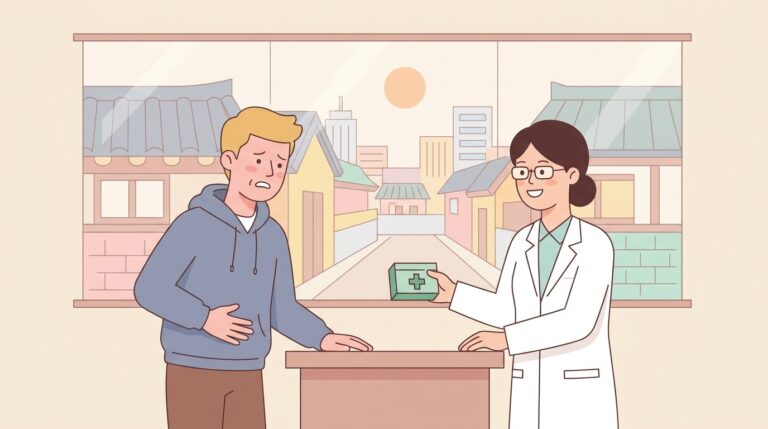
Phase 1: Empathy (Immersive Open)
안녕하세요! 매일한글 에디터입니다. (Hello! I’m your Daily Hangul Editor.)
Picture this: It’s your third day in Seoul. You’ve successfully navigated the subway, shopped in Myeongdong, and finally conquered that famously spicy Buldak or authentic Tteokbokki you saw in your favorite K-Drama. But at 2 AM, disaster strikes. Your stomach is in knots, your head is pounding, and the next morning, you find yourself standing in front of a pharmacist (약사님) who looks at you expectantly.
You panic and say, “배가 아파요” (My stomach hurts). The pharmacist tilts their head. Where does it hurt? How does it hurt? Is it a sharp pain, a burning sensation, or indigestion?
In Korea’s fast-paced “Ppalli Ppalli” (hurry, hurry) medical system, simply saying “It hurts” (아파요) is like telling a mechanic “My car is broken.” It doesn’t give them enough to go on. Knowing how to describe your symptoms specifically at a B2 level doesn’t just get you the right medicine faster—it earns you instant respect and that coveted Insider nod from locals.
As a veteran tutor who has seen countless students struggle with Korean pharmacies, I’ve tailored this guide based on real experiences. Let’s dive into the nuances of Korean pain!
Phase 2: Deep Dive into Core Expressions
Here are the top expressions you need when “아파요” just isn’t enough.
1. 속이 쓰려요 (My stomach burns/feels sour)
- Pronunciation: sogi sseuryeoyo [so-gi sseu-ryeo-yo]
(Sound Analogy: The ‘으’ (eu) in ‘쓰’ sounds like the noise of disgust you make when stepping in wet gum!)- Meaning: Literal: My inside is sore. / Real nuance: I have heartburn, acid reflux, or a burning sensation in my stomach.
- K-Culture Moment: This is the classic line every K-Drama office worker groans after a heavy Hoesik (company dinner) involving too much Soju and spicy pork. They stumble into the pharmacy holding their stomach, asking for a hangover cure.
- Editor’s Insight: We don’t use the word ‘배’ (outer stomach/belly) here; we use ‘속’ (inside). It conveys a deep, internal discomfort. If you ate too much spicy K-food, this is the exact phrase you need.
- Situation Spectrum:
- Casual with friends: ✅ (속 쓰려…)
- Semi-formal (Pharmacy/Doctor): ✅ (속이 쓰립니다)
- Formal (Boss): ⚠️ (Usually okay, but maybe TMI for the boardroom!)
- 🤔 Think About It: Why does Korean differentiate between ‘배’ (the physical belly) and ‘속’ (the deep inside)? How does this reflect the Korean tendency to distinguish between outward appearance and internal feelings?
2. 으슬으슬 춥고 몸살 기운이 있어요 (I have chills and feel a body ache coming on)
- Pronunciation: euseul-euseul chupgo momsal giuni isseoyo [eu-seul-eu-seul chup-go mom-sal gi-un-i is-seo-yo]
- Meaning: Literal: I am chillingly cold and have body ache energy. / Real nuance: I’m getting the chills and feel the flu/fatigue hitting me.
- K-Culture Moment: When a K-Pop idol overworks during a comeback season, fans will say, “우리 오빠 몸살 났어 ㅠㅠ” (Our oppa got momsal).
- Editor’s Insight: Momsal is a uniquely Korean cultural illness. It’s not just a cold; it’s the physical breakdown of the body from overwork, stress, or exhaustion. ‘으슬으슬’ is a mimetic word (mimicking a state) that perfectly captures that shivering-to-the-bone feeling.
- Situation Spectrum:
- Casual with friends: ✅
- Semi-formal (Pharmacy/Doctor): ✅
- Formal (Boss/Elders): ✅ (A very valid reason to take a sick day!)
- 🤔 Think About It: In your culture, is there a specific word for getting sick specifically from working too hard? What does the existence of the word Momsal tell us about Korean work culture?
3. 머리가 지끈거려요 / 깨질 것 같아요 (My head is throbbing / feels like it’s going to break)
- Pronunciation: meoriga jikkeungeoryeoyo / kkaejil geot gatayo [meo-ri-ga jik-keun-geo-ryeo-yo / kkae-jil geot ga-ta-yo]
- Meaning: Literal: My head throbs / My head seems like it will break. / Real nuance: I have a splitting migraine.
- K-Culture Moment: Picture a K-Drama mother-in-law wrapping a white cloth tightly around her head and lying in bed after hearing shocking news about her son’s marriage. She will dramatically sigh, “아이고, 골치야, 머리가 깨질 것 같네” (Oh my, what a headache, my head is splitting).
- Editor’s Insight: ‘아파요’ is just a mild ache. ‘지끈거려요’ implies a pulsing, throbbing pain (migraine). ‘깨질 것 같아요’ is the ultimate dramatic (yet common) exaggeration for a severe headache or terrible hangover.
- Situation Spectrum:
- Casual with friends: ✅
- Semi-formal (Pharmacy/Doctor): ✅ (Using 지끈거려요 is highly accurate for doctors)
- Formal (Boss/Elders): 🚫 (Too dramatic. Stick to ‘두통이 심합니다’ – I have a severe headache).
- 🤔 Think About It: Koreans love using “~할 것 같다” (seems like/feels like) even for their own pain. Why do you think Korean prefers this indirect phrasing rather than stating “My head is breaking” as an absolute fact?
Phase 3: Textbook vs. Real Korean
Let’s compare what you learned in standard language classes with what actual Koreans say on the streets of Hongdae.
[Situation 1: Having Indigestion]
* 📖 Textbook Korean: 소화가 안 됩니다. (Sohwaga an doemnida. – My digestion is not working.)
* 🗣️ Real Korean: 저 체한 것 같아요. (Jeo chehan geot gatayo. – I think I have indigestion / food is stuck.)
* 💡 Why the difference?: ‘체하다’ is a cultural concept of food “getting stuck” due to eating too fast or under stress. Standard classes teach the medical term (소화 불량), but locals always say ‘체하다’.
[Situation 2: Feeling Nauseous]
* 📖 Textbook Korean: 구역질이 납니다. (Guyeokjiri namnida. – I am producing nausea.)
* 🗣️ Real Korean: 속이 미식거려요 / 토할 것 같아요. (Sogi misikgeoryeoyo / Tohal geot gatayo. – My stomach feels queasy / I feel like throwing up.)
* 💡 Why the difference?: ‘미식거리다’ is a highly descriptive sensory verb that doctors and pharmacists immediately understand as motion sickness or stomach upset.
[Situation 3: Explaining a Hangover]
* 📖 Textbook Korean: 술을 너무 많이 마셔서 머리가 아픕니다. (Sureul neomu mani masyeoseo meoriga apeumnida.)
* 🗣️ Real Korean: 숙취 때문에 죽을 것 같아요. (Sukchwi ttaemune jugeul geot gatayo. – I feel like I’m going to die from a hangover.)
* 💡 Why the difference?: Exaggeration! In Korean culture, playfully adding “~아/어 죽겠다” (to death) emphasizes the severity of the condition.
Bottom Note: At the B2 level, graduating from simple “아파요” to specific mimetic words (지끈지끈, 으슬으슬, 미식미식) is the fastest way to sound completely fluent.
Phase 4: Cultural Context — K-Culture Deep Dive
4-1. Non-Verbal Elements
When at a Korean clinic or pharmacy, body language is crucial. Koreans often use their hands to physically press or rub the exact spot while describing the pain. Also, read the room (Nunchi): Korean pharmacies can be incredibly fast-paced. Don’t take it personally if the pharmacist asks rapid-fire questions; it’s the Ppalli Ppalli (hurry) culture aiming for efficiency, not rudeness!
4-2. K-Food Connection: The “Che-ham” (체함) Ritual
If you tell a Korean friend “저 체한 것 같아요” (I think I have indigestion), prepare yourself for a traditional remedy. Instead of just giving you a pill, a Korean friend might grab a needle (바늘), sterilize it, tie your thumb with a thread, and prick the tip of your thumb to let a drop of dark blood out (손 따기 – Son ttaki).
- Critical View: Why does this exist? Traditional Korean medicine (한의학) views the body’s energy (Ki) as something that can get “blocked” by stress or eating incorrectly. Pricking the finger is believed to release that bad, blocked energy. While modern medicine relies on pills, this traditional folk remedy is still deeply embedded in everyday Korean life!
Phase 5: Real-life Roleplay Scenario
Setting: A bright green-cross pharmacy (약국) in Gangnam. It’s 1 PM. You just had a massive, spicy Jjamppong (spicy seafood noodle soup) for lunch. Now, your stomach is rebelling.
Characters:
– YOU: A foreign professional working in Seoul. You love K-food but sometimes your stomach disagrees.
– Pharmacist (약사님): A busy but kind pharmacist in her 50s.
Dialogue:
약사님: 어떻게 오셨어요? 💊
(eotteoke osyeosseoyo?)
[How may I help you? / Lit: How did you come here?]
YOU: 약사님, 제가 점심에 매운 걸 먹었는데…
(yaksanim, jega jeomsime maeun geol meogeonneunde…)
[Pharmacist, I ate something spicy for lunch and…]
약사님: 배가 아프신가요? 설사도 하세요?
(baega apeusingayo? seolsado haseyo?)
[Does your stomach hurt? Do you have diarrhea too?]
🔀 Your Turn! How should you respond to accurately describe heartburn?
– A) 네, 그냥 배가 진짜 아파요. (Yes, my stomach just really hurts.)
– B) 아니요, 속이 엄청 쓰리고 미식거려요. (No, my stomach is burning intensely and feels queasy.)
– C) 죽을 것 같아요. 살려주세요. (I feel like I’m dying. Save me.)✅ Best Choice: B — Reason: It perfectly corrects the pharmacist’s assumption (it’s not lower intestine pain/diarrhea, but upper stomach burning) using B2-level descriptive words.
⚠️ Choice C Analysis: While funny and great for close friends, doing this to a busy pharmacist might just confuse them!
(Continuing with Choice B)
YOU: 아니요, 속이 엄청 쓰리고 미식거려요.
(aniyo, sogi eomcheong sseurigo misikgeoryeoyo.)
[No, my stomach is burning intensely and feels queasy.]
약사님: 아, 위산이 많이 나왔나 보네요. 짜 먹는 위장약 드릴게요.
(a, wisani mani nawatna boneyo. jja meongneun wijangnyak deurilgeyo.)
[Ah, looks like you produced a lot of stomach acid. I’ll give you a liquid stomach medicine you squeeze and eat.]
YOU: 이거 어떻게 먹으면 되나요?
(igeo eotteoke meogeumyeon doenayo?)
[How should I take this?]
약사님: 식후 30분에 한 포씩 드세요. 매운 음식 당분간 피하시고요!
(sikhu samsipbune han possik deuseyo. maeun eumsik dangbungan pihasigoyo!)
[Take one packet 30 minutes after meals. And avoid spicy food for a while!]
YOU: 네, 감사합니다. 얼마예요?
(ne, gamsahamnida. eolmayeyo?)
[Yes, thank you. How much is it?]
Bonus Scenario: Texting your coworker
Coworker: 오늘 오후 회의 준비 다 하셨어요? (Are you ready for the afternoon meeting?)
You: 민수 씨, 저 완전 체한 것 같아요. 머리도 지끈거려요. ㅠㅠ (Minsu, I think I have terrible indigestion. My head is throbbing too. T.T)
Coworker: 헐! 휴게실 가서 좀 쉬세요. 약 사다 드릴까요? (OMG! Go rest in the lounge. Should I buy you medicine?)
Phase 6: 10-Second Shadowing Drill
Practice reading this aloud. Pay attention to the pauses (/) and the emotional tags!
🥺 약사님, / 제가 어제부터 / 속이 너무 쓰리고 / 으슬으슬 추워요.
(yaksanim, / jega eojebuteo / sogi neomu sseurigo / euseul-euseul chuwoyo.)
Tip: Drag out the “너무” (neo~mu) slightly to emphasize your discomfort, and hunch your shoulders a bit when saying “으슬으슬” for that authentic sick feeling!
Phase 7: K-Culture Mini Dictionary
1. 눈치 (Nunchi)
* Romanization: nunchi
* English: Social situational awareness; emotional intelligence.
* Context: The ability to “read the room.” Crucial in a busy Korean clinic to know when to explain quickly and when to ask more questions.
2. 몸살 (Momsal)
* Romanization: momsal
* English: Severe body ache/fatigue from overwork.
* Context: A culturally accepted form of being sick that signifies you’ve been working extremely hard. Often treated with rest and warm herbal medicine.
3. 회식 (Hoesik)
* Romanization: hoesik
* English: Company dining/drinking event.
* Context: The primary cause of next-day pharmacy visits for “속이 쓰려요” (heartburn) due to heavy Soju consumption!
4. 식후 30분 (Sikhu 30-bun)
* Romanization: sikhu samsip-bun
* English: 30 minutes after a meal.
* Context: The golden rule of Korean medicine. Almost all Korean pharmacists will tell you to take your pills exactly 30 minutes after eating to protect your stomach lining.
Phase 8: Traveler’s Survival Kit
Getting sick while traveling is a nightmare. Keep these phrases screenshotted!
🆘 Survival Expression #1: Finding the Pharmacy
– 🇰🇷 “근처에 약국이나 병원 있어요?”
– 🗣️ Pronunciation: geuncheoe yakgugina byeong-won isseoyo?
– 📍 Where to use: Asking hotel concierges, convenience store clerks, or passersby.
– 💡 Pro Tip: Look for a bright green cross (+). Also, use Naver Map or KakaoMap and type “약국” or “내과” (Internal medicine). Google Maps doesn’t work well for walking directions in Korea!🆘 Survival Expression #2: Prescriptions
– 🇰🇷 “처방전 여기 있습니다.”
– 🗣️ Pronunciation: cheobangjeon yeogi itseumnida.
– 📍 Where to use: At the pharmacy counter after visiting a doctor.
– 💡 Pro Tip: In Korea, pharmacies cannot give you strong medicines (like antibiotics) without a doctor’s “처방전” (prescription).
📌 Editor’s Travel Note:
– Weekend Sickness: If you get sick on a Sunday, search for “휴일지킴이약국” (Holiday open pharmacies) or look for pharmacies near large subway stations.
– Convenience Stores: If pharmacies are closed, you can buy basic medicine (Tylenol, basic cold medicine, digestive drinks like Gas Whal Myung Su) at CU, GS25, or 7-Eleven!
Phase 9: Critical Thinking Corner — “One Step Deeper”
🧠 Think Deeper: Language & Body Awareness
Why does the Korean language have such a vast, highly specific vocabulary for physical pain? Words like 쓰리다 (burning/sore), 뻐근하다 (stiff), 욱신거리다 (throbbing), and 시리다 (bone-chillingly cold) have no direct, single-word translations in English.
Historically, Korea’s agrarian lifestyle and the strong influence of traditional medicine (한의학) created a culture deeply attuned to the subtle changes in the body’s energy and temperature. Instead of treating the body as a separate mechanical object, Koreans view it holistically. Describing exactly how a symptom feels using sensory words helps doctors pinpoint which energy flow is disrupted.
💬 Your Turn: Does your native language have highly specific words for types of pain, or do you rely on modifying words (e.g., “a sharp pain”)? Let us know in the comments!
Phase 10: FAQ & Avoiding Misunderstandings
Q: Can I tell an older doctor “머리가 깨질 것 같아요” (My head feels like it’s breaking)?
No! While it’s okay for the pharmacist, for an older, formal doctor (의사 선생님), it sounds a bit too dramatic and informal. Stick to standard, respectful terms: “두통이 아주 심합니다” (My headache is very severe).
Q: Are pharmacy pills the same as clinic pills in Korea?
No. Over-the-counter medicine in Korea is relatively mild. If your symptoms are severe, Koreans will tell you “병원 가봐” (Go to the hospital/clinic). Clinic visits are incredibly cheap (usually under $5-10 USD with insurance, or around $20 without), and the prescribed medicine is much stronger.
❌ Common Mistake #1: Using “배가 아파요” for everything stomach-related.
✅ Do this instead: Differentiate! If it’s your upper stomach/heartburn, use “속이 쓰려요”. If you feel nauseous, use “속이 미식거려요”. If it’s your lower stomach/cramping, use “배가 아파요”.
Phase 11: Summary & Action Items
💡 One-Liner Summary: To get the best care in Korea, upgrade from “아파요” to descriptive symptom verbs like 쓰리다, 지끈거리다, and 으슬으슬하다.
🎯 Action Mission:
– 🥉 Bronze (Solo): Stand in front of a mirror, clutch your stomach, and say “속이 너무 쓰려요” 3 times with a pained expression.
– 🥈 Silver (Online): Write a short diary entry in Korean describing a time you had a bad “몸살” (momsal) and post it in a language learning community.
– 🥇 Gold (Real World): Visit a Korean pharmacy (or a convenience store medicine aisle) and identify the digestive medicines (소화제) versus headache medicines (두통약)!
📺 K-Culture Mission:
Watch one episode of a K-Drama set in a hospital (like Hospital Playlist or Doctor Cha). Listen closely for the patients describing their symptoms. Can you catch someone saying “체한 것 같아요” or “지끈거려요”?
How do you usually cure a stomachache in your home country? Share your cultural remedies in the comments below! 👇
Phase 12: Interactive Quiz
Test your B2 symptom knowledge!
1. Situational Judgment: You went to a K-BBQ place, ate way too much pork belly very quickly, and now you feel like the food is stuck in your chest. What do you say?
– A) 속이 쓰려요.
– B) 으슬으슬 추워요.
– C) 체한 것 같아요.
2. Fill in the Blank:
“어제 야근을 너무 많이 했더니, ________ 기운이 있어요. 좀 쉬어야겠어요.”
(Hint: That Korean word for exhaustion illness!)
3. True or False – K-Culture Edition:
If you have a mild headache in Korea, you must go to a large university hospital to get medicine. (T/F)
(Answers: 1: C – A is for burning/spicy, B is for chills. 2: 몸살 (momsal). 3: False! You can buy basic painkillers at a convenience store or a local Yakguk!)
Frequently Asked Questions (FAQ)
Q: What does "속이 쓰려요 (My stomach burns/feels sour)" mean in Korean and how do you pronounce it?
A: In Korean, "속이 쓰려요 (My stomach burns/feels sour)" is pronounced [sogi sseuryeoyo [so-gi sseu-ryeo-yo] and means: Literal: My inside is sore. / Real nuance: I have heartburn, acid reflux, or a burning sensation in my stomach.
Q: What does "으슬으슬 춥고 몸살 기운이 있어요 (I have chills and feel a body ache coming on)" mean in Korean and how do you pronounce it?
A: In Korean, "으슬으슬 춥고 몸살 기운이 있어요 (I have chills and feel a body ache coming on)" is pronounced [euseul-euseul chupgo momsal giuni isseoyo [eu-seul-eu-seul chup-go mom-sal gi-un-i is-seo-yo] and means: Literal: I am chillingly cold and have body ache energy. / Real nuance: I'm getting the chills and feel the flu/fatigue hitting me.
Q: What does "머리가 지끈거려요 / 깨질 것 같아요 (My head is throbbing / feels like it's going to break)" mean in Korean and how do you pronounce it?
A: In Korean, "머리가 지끈거려요 / 깨질 것 같아요 (My head is throbbing / feels like it's going to break)" is pronounced [meoriga jikkeungeoryeoyo / kkaejil geot gatayo [meo-ri-ga jik-keun-geo-ryeo-yo / kkae-jil geot ga-ta-yo] and means: Literal: My head throbs / My head seems like it will break. / Real nuance: I have a splitting migraine.







