

Phase 1: Empathy (The Immersive Opening)
Hello! This is your editor from Daily Hangul.
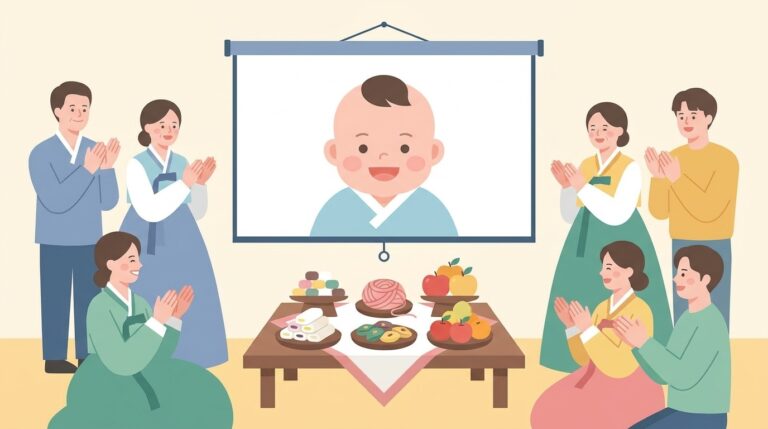
Picture this: You are at a beautiful banquet hall in Seoul. The lights suddenly dim. The cheerful chatter fades, and a projector screen drops down at the front of the room. Gentle, acoustic music starts playing, and a video flashes on the screen—it’s a montage of a baby’s first year of life. You hear a collective “Aww…” from the crowd. Some of the older relatives are wiping away tears. The parents standing at the front look incredibly emotional.
You’ve just been invited to your first Doljanchi (돌잔치), a Korean baby’s first birthday party. You want to walk up to your Korean friend (the proud parent) and say something deeply touching. But your mind goes blank, and all you can muster is, “Cute!”
Don’t worry, we’ve all been there. While “cute” is fine, knowing exactly what to say in this highly emotional and culturally significant moment will instantly elevate you from a “polite foreign guest” to an “insider friend who truly gets it.” Today, we are going to learn the authentic, heart-warming phrases Koreans use during the baby’s growth video.
—
## Phase 2: Core Expressions Deep Dive
> ### 1. 정말 많이 컸네요
>
> – Pronunciation: [jeongmal mani keonneyo] + [jung-mal mahn-ee kun-ne-yo] (The ‘eo’ in ‘keonneyo’ sounds like the ‘u’ in ‘run’ or the disgusted sound you make when stepping in gum!)
> – Meaning: Literal: (They) have really grown a lot. / Real nuance: They grew up so fast!
> – K-Culture Moment: You’ll hear this exactly as the video transitions from a tiny newborn in a hospital crib to a chubby-cheeked baby trying to walk. It’s the standard, universal reaction of awe.
> – Editor’s Insight: This phrase isn’t just about physical height. It carries a sense of nostalgia and emotional weight. It’s a way of acknowledging the passage of time.
> – Situation Spectrum:
> – Casual friends: ✅ (정말 많이 컸다!)
> – Coworkers: ✅ (정말 많이 컸네요)
> – Elders: ✅ (정말 많이 컸네요)
> – 🤔 Think About It: Why do you think Koreans focus so much on the concept of “growing up” (크다) rather than just saying “they are beautiful”? Could it be related to historically wishing for a child’s health and survival?
> ### 2. 아빠랑 똑같이 생겼어요
>
> – Pronunciation: [apparang ttokgachi saenggyeosseoyo] + [ah-ppa-rang ttok-gah-chi sang-gyuh-ssuh-yo] (For ‘tt’, tense your tongue like you are saying ‘stop’).
> – Meaning: Literal: Looks exactly the same as dad. / Real nuance: They are the spitting image of their dad! (You can swap ‘아빠/appa’ with ‘엄마/eomma’ for mom).
> – K-Culture Moment: In K-Dramas, whenever family members gather around a newborn, this is the ultimate compliment. Pointing out family resemblance is a warm way to show you are paying attention.
> – Editor’s Insight: It’s almost a reflex for Koreans to find who the baby looks like. Saying this makes the parents feel incredibly proud.
> – Situation Spectrum:
> – Casual friends: ✅
> – Coworkers: ✅
> – Elders: ⚠️ (Make sure you actually know what the parents look like!)
> – 🤔 Think About It: Family lineage is deeply valued in Korean society. How is pointing out physical resemblance a way of confirming family bonds?
> ### 3. 1년 동안 정말 고생 많으셨어요
>
> – Pronunciation: [il-nyeon dongan jeongmal gosaeng maneusyeosseoyo] + [eel-nyun dong-ahn jung-mal go-sang mahn-eu-shuh-ssuh-yo].
> – Meaning: Literal: You had a lot of hardship for 1 year. / Real nuance: You’ve worked so hard raising the baby this past year.
> – K-Culture Moment: After the video ends, the parents usually take the microphone. This is when you approach them and say this phrase. It’s the ultimate show of empathy.
> – Editor’s Insight: ‘고생’ (gosaeng) means hardship or suffering, but in Korean, acknowledging someone’s hardship is the highest form of respect and empathy. You are validating their sleepless nights.
> – Situation Spectrum:
> – Casual friends: ✅ (1년 동안 고생 많았어!)
> – Coworkers/Acquaintances: ✅ (고생 많으셨어요)
> – Bosses/Elders: ✅ (Very appropriate and respectful)
> – 🤔 Think About It: Why is acknowledging “suffering” considered a compliment and a comfort in Korean culture? Does your native language have a phrase that validates someone’s hard work in this way?
—
## Phase 3: Textbook vs. Real Korean
[Situation 1: Reacting when the baby smiles on screen]
* 📖 Textbook Korean: 아기가 참 귀엽습니다. (The baby is very cute. – a bit too stiff and robotic)
* 🗣️ Real Korean: 아~ 너무 예쁘다! (Ah~ so pretty/cute! – said softly to yourself, but loud enough for others to hear)
* 💡 Why the difference?: Koreans frequently use exclamations directed at “the air” rather than speaking directly to someone to express genuine, unfiltered emotion.
[Situation 2: Seeing the mother cry during the video]
* 📖 Textbook Korean: 울지 마십시오. (Do not cry. – sounds like a military command)
* 🗣️ Real Korean: 어떡해… 나도 눈물 나. (Oh no… I’m tearing up too.)
* 💡 Why the difference?: Shared empathy is much more comforting than telling someone to stop their emotions. Sharing the emotional burden is very “Korean.”
> Bottom Note: For B1 learners, mastering these empathetic, slight-exclamation phrases will make your Korean sound incredibly natural and less like a translation app!
—
## Phase 4: Cultural Context — K-Culture Deep Dive
### 4-1. Non-verbal Nuances: The Art of Nunchi
When watching the growth video, Nunchi (눈치) is crucial. Nunchi is the subtle art of reading the room. If the music is slow and the video shows the mother looking exhausted but happy, it’s a quiet, reflective moment. Don’t cheer loudly here. However, when the video shows a funny blooper of the baby eating cake, that’s your cue to laugh heartily. Also, when handing over your congratulatory envelope (축의금), always use two hands!
### 4-2. The K-Pop Connection: Idol “Growth Videos”
Did you know you can use these exact same phrases in K-Pop fandoms? For a K-Pop group’s 1st or 5th debut anniversary, agencies often release a “growth video” (성장 동영상) showing their trainee days. Fans flood the comments with:
– “우리 애들 정말 많이 컸다 ㅠㅠ” (Our kids grew up so much TT)
– “그동안 고생 많았어!” (You’ve worked so hard all this time!)
The emotional dynamic of watching a baby grow is surprisingly similar to a fan watching their favorite idol debut and succeed!
—
## Phase 5: Real-Life Roleplay Scenario
Setting: Saturday afternoon at a fancy buffet restaurant in Gangnam. The Doljanchi growth video just finished playing. You are sitting at a round table with your Korean coworker, Ji-hoon, who is the father of the baby. He looks a bit teary-eyed as he sits back down next to you.
Characters:
– YOU: A foreign professional working in Korea, attending your first Doljanchi.
– Ji-hoon (35): Your supportive Korean coworker, the proud but exhausted dad.
Dialogue:
Ji-hoon: 아휴, 영상 보니까 또 눈물이 나네요. 😅
(Ahyu, yeongsang bonikka tto nunmuri naneyo.)
[Sigh, watching the video makes me tear up again.]
(🎭 Stage Direction: Ji-hoon wipes his eyes with a napkin and chuckles awkwardly.)
YOU: 지훈 대리님, 영상 정말 감동적이었어요. 아기가 정말 많이 컸네요.
(Ji-hoon daerinim, yeongsang jeongmal gamdongjeogieosseoyo. Agiga jeongmal mani keonneyo.)
[Ji-hoon, the video was so touching. The baby has really grown so much.]
Ji-hoon: 그렇죠? 처음엔 너무 작아서 안기도 무서웠는데 말이에요.
(Geureochyo? Cheoumen neomu jagaseo angido museowonneunde marieyo.)
[Right? At first, he was so small I was scared to even hold him.]
YOU: 웃는 모습이 아빠랑 똑같이 생겼어요!
(Unneun moseubi apparang ttokgachi saenggyeosseoyo!)
[His smile looks exactly like you!]
Ji-hoon: 하하, 다들 그 말 하더라고요. 근데 밤마다 안 자고 울어서 와이프가 고생을 많이 했어요.
(Haha, dadeul geu mal hadeoragoyo. Geunde bammada an jago ureoseo waipeuga gosaengeul mani haesseoyo.)
[Haha, everyone says that. But he cries every night without sleeping, so my wife had a really hard time.]
> 🔀 Your Turn! How should you reply?
> – A) “아, 아기가 나쁘네요!” (Ah, the baby is bad!)
> – B) “네, 피곤해 보이시네요.” (Yes, you look tired.)
> – C) “지훈 님도, 아내분도 1년 동안 정말 고생 많으셨어요.” (Ji-hoon, and your wife too, have worked so hard this past year.)
>
> ✅ Best Choice: C — Acknowledging their hard work is the most empathetic and culturally accurate response.
> ⚠️ Choice B Analysis: While honest, pointing out someone looks tired at their celebratory event is a bit of a faux pas!
—
## Phase 6: 10-Second Shadowing Drill
Let’s practice the intonation! Follow the slashes for pauses, and match the emotion tag.
🥺 감동적으로 (Emotionally):
와~ / 아기가 / 정말 / 많~~~이 / 컸네요!
(wa~ / agiga / jeongmal / mah~~~ni / keonneyo!)
😊 따뜻하게 (Warmly):
두 분 다 / 1년 동안 / 정말 / 고생 많으셨어요. mal / gosaeng maneusyeosseoyo.)
(du bun da / il-nyeon dongan / jung
—
## Phase 7: K-Culture Mini Dictionary
1. 돌잔치 (Doljanchi)
* Romanization: dol-janchi
* English: First birthday party
* Context: ‘Dol’ means exactly one year, and ‘Janchi’ means banquet/party. It’s one of the biggest milestones in a Korean’s life.
2. 돌잡이 (Doljabi)
* Romanization: dol-jabi
* English: The fortune-telling grab
* Context: The highlight of the party! The baby is placed in front of items (money, a stethoscope, a microphone, etc.). Whatever they grab “predicts” their future career.
3. 축의금 (Chuguigeum)
* Romanization: chug-ui-geum
* English: Congratulatory money
* Context: In Korea, instead of buying toys, guests usually bring crisp cash in a white envelope to help the parents with the party costs and baby expenses.
4. 고생하다 (Gosaenghada)
* Romanization: go-saeng-ha-da
* English: To go through hardship / to work hard
* Context: A highly valued concept in Korea. Recognizing someone’s ‘gosaeng’ is a profound way to show respect and build deep bonds.
—
## Phase 8: Traveler Survival Kit
Even if you are just visiting Korea, you might be invited to a family event by a Korean friend, or you might need to buy a baby gift! Here are your survival phrases.
> 🆘 Survival Phrase #1
> – 🇰🇷 “선물용으로 포장해 주세요.” (seonmuryongeuro pojanghae juseyo.)
> – 🗣️ English guide: [sun-mool-yong-eu-ro po-jahng-hae joo-se-yo]
> – 📍 Where to use: Department stores, baby boutiques.
> – 💡 Pro Tip: Need it gift-wrapped? This phrase is magic. Korean department stores offer beautiful, free or low-cost gift wrapping!
> 🆘 Survival Phrase #2
> – 🇰🇷 “몇 개월이에요?” (myeot gaeworieyo?)
> – 🗣️ English guide: [myut gae-wol-ee-e-yo?]
> – 📍 Where to use: Talking to any parent.
> – 💡 Pro Tip: Asking “How many months old are they?” is a great icebreaker when you meet a Korean parent and baby.
> 📌 Editor’s Travel Note
> – Money Envelopes: You can buy beautifully decorated congratulatory envelopes (축의금 봉투) at any convenience store or Daiso in Korea! Don’t hand over bare cash.
—
## Phase 9: Critical Thinking — “One Step Deeper”
🧠 Think Deeper: History, Health, and the Importance of the First Year
Have you ever wondered why the first birthday is celebrated with a massive banquet hall, professional MCs, and gold rings, while the second or third birthdays are just small family cakes? Historically in Korea, harsh winters and a lack of medical resources meant infant mortality rates were incredibly high. Surviving the first year (making it to the first ‘Dol’) was a massive victory. It meant the baby was likely going to survive into adulthood. Therefore, the village would gather to celebrate life and share food. While modern Korea has world-class healthcare, this deep-rooted cultural trauma turned into a beautiful tradition of community celebration and expressing deep gratitude to the parents (“고생하셨어요”).
💬 Your Turn: Does your culture have a massive celebration for a baby’s first year? Or is there another age that is considered a major milestone? Let us know in the comments!
—
## Phase 10: FAQ & Avoiding Misunderstandings
Q: Can I joke and say the baby is “ugly” just to be funny with my close friend?
A: NO. Even with close friends, Doljanchi is a semi-formal family event with grandparents present. Keep the comments overwhelmingly positive. In Korean culture, speaking negatively about a baby is considered very bad luck.
Q: How much money should I put in the envelope (축의금)?
A: For a regular friend/coworker, 50,000 KRW is standard. If you are close, or if you are eating a very expensive hotel buffet, 100,000 KRW is appropriate. Always use crisp, new bills if possible!
> ❌ Common Mistake #1: Saying “수고하셨어요” (sugohasyeosseoyo) to older relatives or bosses to mean “good job.”
> ✅ Do This Instead: Use “고생 많으셨어요” (gosaeng maneusyeosseoyo) when talking to elders or your boss. “수고하셨어요” can sound like a boss talking down to a subordinate!
—
## Phase 11: Summary & Action Items
One-Liner Summary: At a Korean first birthday, compliment the baby’s growth and validate the parents’ hard work!
Action Mission:
– 🥉 Bronze (Solo): Stand in front of a mirror and practice saying “정말 많이 컸네요” with a warm, surprised facial expression 3 times.
– 🥈 Silver (Online): Find a YouTube video of a baby or a K-Pop idol’s debut anniversary and leave a comment: “1년 동안 고생 많으셨어요!”
– 🥇 Gold (Real Life): The next time you see a Korean friend with their child, ask them, “몇 개월이에요? 아빠/엄마랑 똑같이 생겼어요!”
K-Culture Mission:
Watch an episode of the famous Korean variety show “The Return of Superman” (슈퍼맨이 돌아왔다). Pay attention to how the narrators and guests react when they show the babies growing up over the months!
—
## Phase 12: Interactive Quiz
1. Situational Judgment:
The Doljanchi video finishes, and the mother is wiping away tears. What is the most culturally appropriate thing to say to her?
A) 울지 마세요. (Please don’t cry.)
B) 1년 동안 정말 고생 많으셨어요. (You’ve worked so hard for the past year.)
C) 아기가 참 작네요. (The baby is quite small.)
2. Fill in the Blank:
To say the baby is the spitting image of their mom:
“( )랑 똑같이 생겼어요!”
3. True or False — K-Culture Edition:
You should hand your congratulatory envelope (축의금) to the parents using only your right hand to look cool and casual. (T/F)
(Answers: 1. B, 2. 엄마 / eomma, 3. False – Always use two hands!)







