

Phase 1: Empathy (Immersive Opening)
Hello! This is your Daily Hangul Editor.
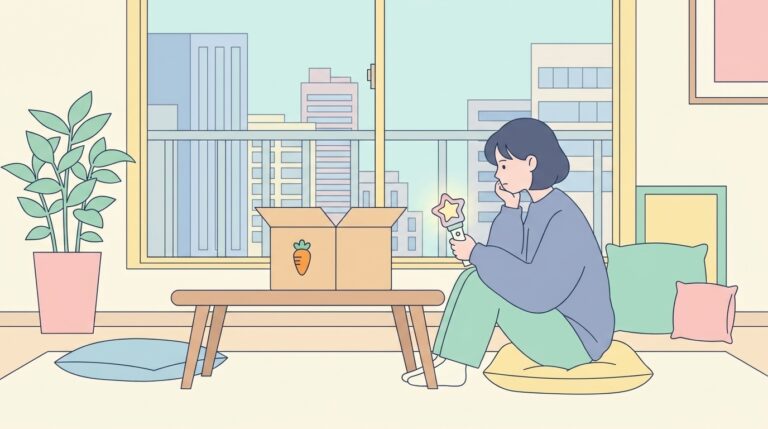
Picture this: You are standing in the middle of your tiny Seoul One-room (원룸, studio apartment). Your lease is up, and it’s time to pack. You open your closet, and an avalanche of K-pop merch, skincare samples you got for free in Myeongdong, and clothes you haven’t worn since 2021 falls out. You sit on the floor, exhausted. In a K-drama, this is the exact moment the heroine dramatically sighs, looks at an old stuffed animal her ex gave her, and tosses it into a trash bag.
We all know Marie Kondo’s famous phrase, “Does it spark joy?” But how do Koreans talk about decluttering, minimalism, and letting go of things? As an advanced (C1) Korean learner, saying “저는 이것을 버립니다” (I throw this away) sounds like a robotic textbook. Real Koreans talk about attachment, waste, and their favorite second-hand app.
This guide is based on real experiences of my students who struggled with moving out of Korea or simply wanted to embrace a 미니멀 라이프 (Minimal Life) in Korean. Let’s dive into the vocabulary of letting go!
Phase 2: Core Expression Deep Dive
1. 설레지 않으면 버려라
- Pronunciation: [seolleji aneumyeon beoryeora] / Sounds like: soul-lay-jee ah-neu-myun bur-yuh-ra
- Meaning: Literal: If your heart doesn’t flutter, throw it away. / Real nuance: If it doesn’t spark joy, let it go (The KonMari method in Korean).
- K-Culture Moment: You’ll hear this exact phrase parodied in Korean variety shows when cast members visit a celebrity’s horribly messy house to help them clean up.
- Editor’s Insight: The verb 설레다 (to flutter/to be excited) is usually reserved for romantic moments or big trips. Applying this romantic word to objects is what makes this translation of Marie Kondo’s philosophy so poetic and impactful in Korean.
- Situation Spectrum:
- Friends (Casual): ✅ (Perfect for giving advice)
- Co-workers (Semi-formal): ⚠️ (Use polite form: 버리세요)
- Elders/Bosses (Formal): 🚫 (Do not tell your boss to throw their stuff away!)
- 🤔 Think About It: Why do we use a word meant for romance (설레다) for objects? Doesn’t this imply that we view our possessions as having a ‘relationship’ with us? How does your native language translate the concept of “sparking joy”?
2. 아까워서 못 버리겠어요
- Pronunciation: [akkawoseo mot beorigesseoyo] / Sounds like: ah-gap-woh-seo moht bur-ee-gess-uh-yo
- Meaning: Literal: It’s a waste, so I can’t throw it away. / Real nuance: I feel too guilty/wasteful to toss it.
- K-Culture Moment: This is the universal catchphrase of Korean mothers and grandmothers. You’ll see K-drama moms keeping empty cookie tins to store sewing kits, mumbling this exact phrase.
- Editor’s Insight: 아깝다 is one of those untranslatable Korean words. It’s a mix of “it’s a waste of money/resources,” “it’s a shame,” and “I feel bad for the object.” If you master this word, your Korean will instantly sound native.
- Situation Spectrum:
- Friends (Casual): ✅ (아까워서 못 버리겠어)
- Co-workers (Semi-formal): ✅
- Elders/Bosses (Formal): ✅ (Perfectly acceptable to express frugality)
- 🤔 Think About It: Does the concept of ‘아깝다’ stem from a history of scarcity? How does this historical context shape the way different generations view minimalism?
3. 당근할게요 / 당근에 올릴게요
- Pronunciation: [danggeunhalgeyo / danggeune ollilgeyo] / Sounds like: dang-geun-hal-gae-yo / dang-geun-eh ohl-lil-gae-yo
- Meaning: Literal: I will carrot / I will put it on Carrot. / Real nuance: I’ll sell it on Karrot (the Korean second-hand marketplace app).
- K-Culture Moment: You’re at a cafe, and someone suddenly walks in, looks around awkwardly, and asks, “혹시… 당근이세요?” (By any chance… are you Karrot?). This is the modern Korean way of letting things go without the guilt of throwing them away!
- Editor’s Insight: ‘당근마켓’ (Karrot Market) became so huge that it turned into a verb: 당근하다 (to Karrot something). It’s the ultimate MZ generation compromise between minimalism and ‘아깝다’.
- Situation Spectrum:
- Friends (Casual): ✅
- Co-workers (Semi-formal): ✅
- Elders/Bosses (Formal): ⚠️ (Better to say 중고마켓에 팔게요 – I’ll sell it on a second-hand market)
- 🤔 Think About It: Why did a second-hand app become a verb in Korea, much like “Googling”? What does this say about modern Korean consumption habits?
Phase 3: Textbook vs. Real Korean
[Situation 1: Giving away things you don’t need]
* 📖 Textbook Korean: 저는 필요 없는 물건을 다른 사람에게 줍니다. (I give unnecessary things to other people.)
* 🗣️ Real Korean: 이거 그냥 무료나눔(무나) 하려고요. (I’m just going to do a free-share for this.)
* 💡 Why the difference?: 무료나눔 (free sharing), often shortened to ‘무나’ online, is a huge part of Korean internet and fandom culture (e.g., sharing fan-made goods at concerts).
[Situation 2: Explaining your clean room]
* 📖 Textbook Korean: 저는 물건을 많이 사지 않고 깨끗하게 삽니다. (I don’t buy many things and live cleanly.)
* 🗣️ Real Korean: 저 요즘 미니멀 라이프 실천 중이에요. 싹 다 비웠어요. (I’m practicing minimal life these days. I emptied everything out.)
* 💡 Why the difference?: Koreans love using the English loan word ‘미니멀 라이프’ (Minimal Life) as a trendy lifestyle marker. Also, the verb 비우다 (to empty) is used metaphorically for clearing one’s mind and physical space.
Phase 4: Cultural Context — K-Culture Deep Dive
4-1. Non-Verbal Cues (The Art of Letting Go)
In Korea, physically throwing away items is often accompanied by a deep sigh and the phrase “아휴, 아까워라” (Oh, what a waste). Even if you are practicing minimalism, showing a slight hesitation or respect for the object’s past usefulness is a cultural norm. Throwing things away too cheerfully might make older Koreans feel you are wasteful (낭비가 심하다).
4-2. The “Karrot” Culture (당근마켓)
The minimalist movement in Korea wouldn’t be complete without discussing Karrot (당근마켓). For the MZ generation, decluttering isn’t just about throwing things away into the void. It’s about hyper-local community sharing.
In K-Dramas, you’ll often see chaebol (conglomerate) heirs disguised in cheap tracksuits making a Karrot deal in a neighborhood playground to understand ‘ordinary life’.
Critical Viewpoint: While ‘Minimal Life’ is trending, the ease of buying and selling on Karrot sometimes leads to more consumption. People buy things thinking, “If it doesn’t spark joy, I can just ‘Karrot’ it later!” Is it true minimalism, or just a rotating closet?
Phase 5: Real-Life Roleplay Scenario
Scenario A: The Moving Out Crisis
- Setting: Sunday afternoon, your studio apartment in Hongdae. There are 4 open suitcases on the floor. You’re exhausted.
- Characters:
- YOU: An expat moving back home after 2 years in Korea. You have severe attachment issues to your stuff.
- Ji-woo (28): Your practical, no-nonsense Korean friend who came to help you pack.
Ji-woo: 너 이 옷은 언제 마지막으로 입었어? 먼지 쌓인 것 봐. 👗
(Neo i oseun eonje majimageuro ibeosseo? Meonji ssain geot bwa.)
[Translation: When did you last wear this dress? Look at the dust.]
(🎭 Stage Direction: Ji-woo holds up a dress you bought in Dongdaemun but never wore.)
YOU: 아, 그거… 살 빼면 입으려고 아껴둔 건데.
(A, geugeo… sal ppaemyeon ibeuryeogo akkyeodun geonde.)
[Translation: Ah, that… I was saving it to wear when I lose weight.]
Ji-woo: 안 돼. 곤마리 알지? 설레지 않으면 버려라! 당장 쓰레기봉투에 넣어.
(An dwae. Gonmari alji? Seolleji aneumyeon beoryeora! Dangjang sseuregibongtue neoeo.)
[Translation: No way. You know KonMari, right? If it doesn’t spark joy, throw it away! Put it in the trash bag right now.]
🔀 Your Turn! How do you respond?
– A) “알았어, 버릴게…” (Okay, I’ll throw it away…)
– B) “아, 진짜 아까운데! 이거 당근에 올리면 안 될까?”
– C) “내 물건에 손대지 마!”✅ Best Choice: B — “Ah, it’s such a waste though! Can’t I put it on Karrot?” This is the most natural, C1-level native response. It uses ‘아깝다’ to show appropriate hesitation and suggests a culturally relevant compromise (당근).
⚠️ Choice A & C Analysis: A is too passive and a bit textbook. C is too aggressive and rude to a friend helping you out!
Scenario B: The Karrot Meetup (Bonus)
- Setting: Outside Exit 3 of Hongdae Station. You are selling your K-pop album.
- Buyer: 혹시… 당근이세요?
- YOU: 네! 여기 방탄소년단 앨범이요. 상태 아주 깨끗해요.
- Buyer: 우와, 감사합니다! 계좌이체 해드릴게요.
- YOU: 네, 예쁘게 쓰세요~ (Yes, please use it well~ / A warm Korean sign-off when handing over an item!).
Phase 6: 10-Second Shadowing Drill
Repeat after me! Focus on the pauses (/) and the emotional tones.
- 🥺 아쉽게 (Regretfully): 아, 이거 / 진짜 아까운데… / 그냥 / 당근할까?
(Ah, igeo / jinjja akkaunde… / geunyang / danggeunhalkka?) -
😤 단호하게 (Firmly): 나 이제 / 미니멀 라이프 / 실천할 거야. / 설레지 않으면 / 다 버릴 거야!
(Na ije / minimeol raipeu / silcheonhal geoya. / seolleji aneumyeon / da beoril geoya!)
Phase 7: K-Culture Mini Dictionary
1. 미니멀 라이프 (Minimal Life)
* Romanization: minimeol raipeu
* English: Minimalism
* Context: The Korean buzzword for minimalism. It represents a backlash against the high-stress, high-consumption modern Korean society.
2. 당근하다 (Danggeunhada)
* Romanization: danggeunhada
* English: To sell/buy on Karrot
* Context: Derived from ‘당근마켓’ (Karrot Market), the location-based second-hand app that dominates Korea.
3. 아나바다 (Anabada)
* Romanization: anabada
* English: Conserve, Share, Exchange, Reuse
* Context: A famous 1990s Korean national campaign during the IMF financial crisis (아껴쓰고 나눠쓰고 바꿔쓰고 다시쓰자). It’s the “grandparent” of today’s minimal life and recycling trends.
4. 정 (Jeong)
* Romanization: jeong
* English: Deep emotional attachment/bond
* Context: Koreans don’t just feel ‘Jeong’ towards people, but also towards objects (물건에 정이 들다). This makes decluttering emotionally taxing in Korean culture.
Phase 8: Traveler Survival Kit
As a traveler or expat, “letting go” usually means dealing with trash and recycling. Korea’s recycling system (분리수거 – bunnisugeo) is notoriously strict!
🆘 Survival Phrases for Disposing Items
– 🇰🇷 “이거 분리수거 어떻게 해요?” (igeo bunnisugeo eotteoke haeyo?)
– 🗣️ Pronunciation: ee-guh boon-nee-soo-guh uh-dduh-kae hae-yo?
– 📍 Meaning: How do I recycle this?
– 💡 Pro Tip: When leaving your Airbnb, ask your host this question. They will love you for it!
- 🇰🇷 “일반 쓰레기봉투 하나 주세요.” (ilban sseuregibongtu hana juseyo.)
- 📍 Meaning: Please give me one general waste bag. (You must buy specific district trash bags at convenience stores!)
📌 Editor’s Travel Note:
You cannot throw away large items (like suitcases or blankets) in regular trash or public bins. You must buy a special sticker (대형폐기물 스티커) from the local district office or convenience store. If your suitcase breaks on your trip, ask your hotel front desk for help: “캐리어를 버리고 싶은데, 스티커를 어디서 사나요?”
Phase 9: Critical Thinking Corner — “One Step Deeper”
🧠 Think Deeper: Generation Gap in Frugality (언어와 권력 & 사회)
The concept of “Minimal Life” is deeply generational in Korea. Older generations survived the Korean War and the intense poverty that followed. To them, throwing away perfectly usable items is almost a sin—which is why they constantly say “아깝다” (It’s a waste).Conversely, the MZ generation in Korea suffers from a lack of physical space (tiny, expensive apartments in Seoul) and mental burnout. For them, “미니멀 라이프” and saying “설레지 않으면 버려라” is a psychological survival mechanism to regain control over their cramped lives. It’s not just about aesthetics; it’s about claiming space.
💬 Your Turn: Does your culture have a generational divide when it comes to hoarding versus minimalism? Share in the comments!
Phase 10: FAQ & Avoiding Misunderstandings
Q: Can I say “버려라” (throw it away) to anyone?
No! “버려라” is an imperative command form. Only use it with yourself (as a mantra) or close friends. To a shop owner, stranger, or elder, you must use polite forms: “이거 버려주실 수 있나요?” (Could you throw this away for me?).
Q: What if an elder gives me something, but it doesn’t ‘spark joy’? Can I reject it?
It requires intense 눈치 (Nunchi – situational awareness). Outright rejecting a gift by saying “I’m a minimalist” can be seen as rejecting their 정 (affection). Accept it gracefully, and later… well, that’s what Karrot is for!
❌ Common Mistake #1: Translating “I threw it away” literally as “저는 그것을 던졌어요” (던지다 = to physically throw a ball).
✅ Do this instead: Always use 버리다 (to discard) for trash or unneeded items.
Phase 11: Summary & Action Items
One-Liner Summary: To master Korean minimalism, you must balance the modern desire to 비우다 (empty) with the cultural guilt of 아깝다 (wastefulness), often resolving it by 당근하다 (Karroting).
Action Mission 3 Steps:
– 🥉 Bronze (Solo): Look at an old item on your desk. Point at it and say loudly: “설레지 않으면 버려라!”
– 🥈 Silver (Online): Go to a Korean language forum or your SNS and write: “요즘 미니멀 라이프 실천 중이에요.” (I’m practicing minimal life lately.)
– 🥇 Gold (Real World): Next time you are in Korea or at a Korean store/cafe, politely ask them to throw away your receipt: “영수증은 버려주세요!”
K-Culture Mission:
Download the app “Karrot” (당근) if you are in Korea, or search for “당근마켓 브이로그” (Karrot Market Vlog) on YouTube. Observe the polite, slightly awkward, but warm interactions Koreans have when trading second-hand goods!
Phase 12: Quiz — Interactive Challenge
1. Situational Judgment:
You are helping your older Korean coworker clean their desk. They pick up a broken stapler and sigh, not wanting to throw it away. What is the most culturally appropriate thing for you to say?
– A) “당장 버리세요. 설레지 않잖아요.” (Throw it away now. It doesn’t spark joy.)
– B) “아유, 진짜 아깝네요. 그래도 고장 났으니 버릴까요?” (Oh, what a waste. But since it’s broken, shall we throw it away?)
– C) “이거 당근에 파세요.” (Sell this on Karrot.)
2. True or False — K-Culture Edition:
In Korea, you can leave large items like furniture or broken suitcases next to the street trash cans for free.
– (True / False)
(Answers: 1. B – You validate their feeling of ‘아깝다’ while politely suggesting discarding it. A is too rude for a coworker, C is impractical for a broken stapler. / 2. False – You will get fined! You must buy a disposal sticker.)
Good luck decluttering your Korean vocabulary today! See you in the next Daily Hangul post.
Frequently Asked Questions (FAQ)
Q: What does "설레지 않으면 버려라" mean in Korean and how do you pronounce it?
A: In Korean, "설레지 않으면 버려라" is pronounced [seolleji aneumyeon beoryeora] and means: Literal: If your heart doesn't flutter, throw it away. / Real nuance: If it doesn't spark joy, let it go (The KonMari method in Korean).
Q: What does "아까워서 못 버리겠어요" mean in Korean and how do you pronounce it?
A: In Korean, "아까워서 못 버리겠어요" is pronounced [akkawoseo mot beorigesseoyo] and means: Literal: It's a waste, so I can't throw it away. / Real nuance: I feel too guilty/wasteful to toss it.
Q: What does "당근할게요 / 당근에 올릴게요" mean in Korean and how do you pronounce it?
A: In Korean, "당근할게요 / 당근에 올릴게요" is pronounced [danggeunhalgeyo / danggeune ollilgeyo] and means: Literal: I will carrot / I will put it on Carrot. / Real nuance: I'll sell it on Karrot (the Korean second-hand marketplace app).







