

Phase 1: Empathy
Hello! I’m your Senior Editor at Daily Hangul.
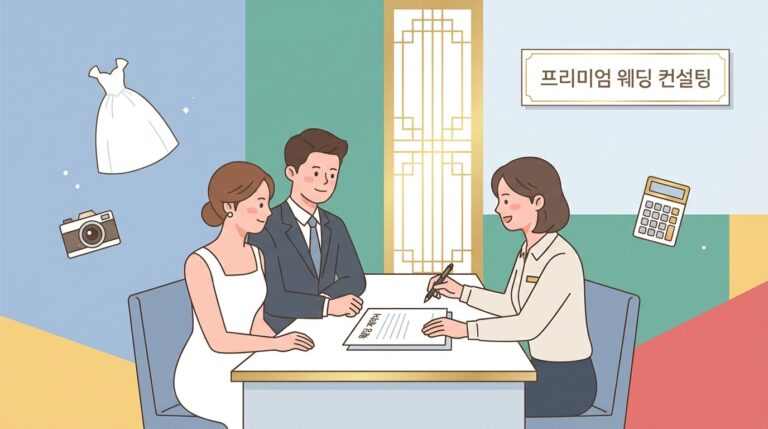
Imagine this: You are sitting in a pristine, marble-floored consulting office in Cheongdam-dong. You’ve binge-watched K-Dramas like Queen of Tears and dreamed of that perfect, cinematic K-Wedding. The wedding planner hands you a beautifully bound folder. You open it, and instead of just one clear price, you see a labyrinth of numbers, options, and asterisks. Welcome to the world of 스드메 (Seu-deu-me)—the holy trinity of Korean wedding preparation: Studio, Dress, and Makeup.
For advanced learners (C2), navigating a Korean wedding contract isn’t just about asking ‘How much?’ It’s a high-stakes game of cultural 눈치 (Nunchi), polite negotiation, and dodging the infamous ‘추가금 파티’ (Additional Fee Party). If you don’t know the exact phrasing, you might end up paying thousands of dollars for ‘raw photo files’ or ‘premium dress labels’ you didn’t even know were optional.
This guide is crafted from real tears and triumphs of expats who have walked down the Korean aisle. Let’s master the art of high-end wedding negotiation!
Phase 2: In-Depth Analysis of Core Expressions
1. 혹시 기본 견적 외에 필수적으로 발생하는 추가금이 있나요?
- Pronunciation: Hoksi gibon gyeonjeok oe-e pilsujeogeuro balsaenghaneun chugageumi innayo? + [Hok-shee gi-bon gyuhn-juhk weh-eh peel-soo-juhg-eu-ro bal-saeng-ha-neun choo-ga-geum-ee in-na-yo?]
- Meaning: (Literal) Are there mandatory additional fees occurring outside the basic quote? / (Real nuance) Cut to the chase: what are the hidden fees I HAVE to pay?
- K-Culture Moment: You will use this when the planner gives you the ‘base package’ price. In the Korean wedding industry, the base price almost never includes the bridal helper fee, hair-piece rentals, or the fee to simply receive your original studio photos.
- Editor’s Insight: The word ‘필수적으로’ (mandatorily) is your shield here. It forces the vendor to distinguish between what is an optional upsell and what is a hidden mandatory cost. It sounds highly educated and firm, yet polite.
- Situation Spectrum:
- Friends (Casual): 🚫 (Too formal)
- Wedding Planner/Vendors (Formal/Business): ✅
- 🤔 Think About It: Why does the Korean wedding industry rely so heavily on a ‘base price + hidden fees’ model rather than an all-inclusive package? How does this reflect the highly customized, yet intensely competitive nature of Korean consumerism?
2. 원본 데이터 구매 조건이나 위약금 규정은 어떻게 되나요?
- Pronunciation: Wonbon deiteo gumae jogeonina wiyakgeum gyujeong-eun eotteoke doenayo? + [Won-bon day-toh goo-may jo-guhn-ee-na wee-yak-geum gyoo-juhng-eun uh-ttuh-keh dweh-na-yo?]
- Meaning: (Literal) How are the original data purchase conditions or penalty regulations? / (Real nuance) What are the terms for buying the raw photos, and what’s the cancellation policy?
- K-Culture Moment: The biggest shock for foreigners is that paying for a wedding photoshoot doesn’t give you the right to all the photos. You must ‘buy the originals’ (원본 구매). Asking this upfront prevents a hostage situation with your wedding photos later.
- Editor’s Insight: Using nouns like ‘규정’ (regulations) and ‘조건’ (conditions) elevates your Korean from a standard conversational level to a fluent, contract-ready C2 level.
- Situation Spectrum:
- Friends (Casual): 🚫
- Wedding Planner/Vendors (Formal/Business): ✅
- 🤔 Think About It: In many Western cultures, a photographer’s fee includes the digital files. In Korea, the ‘service’ of shooting and the ‘product’ of the files are separated. Does your culture separate intellectual property differently?
3. 예산이 좀 타이트한데, 혹시 서비스로 챙겨주실 수 있는 혜택이 있을까요?
- Pronunciation: Yesani jom taiteuhande, hoksi seobiseuro chaenggyeojusil su inneun hyetaegi isseulkkayo? + [Yeh-san-ee jom tie-teu-han-deh, hok-shee suh-bee-seu-ro chaeng-gyuh-joo-shil soo in-neun hyeh-taeg-ee is-seul-kka-yo?]
- Meaning: (Literal) The budget is a bit tight, by any chance are there benefits you can take care of as a service? / (Real nuance) We’re stretching our budget here; can you throw in some freebies?
- K-Culture Moment: Korean negotiation isn’t about aggressively demanding a lower price. It’s about asking for ‘서비스’ (service/freebies)—maybe an extra acrylic photo frame, a free bouquet, or an upgrade in the makeup tier.
- Editor’s Insight: Notice the softening phrases: ‘좀’ (a little), ‘혹시’ (by any chance), ‘챙겨주실 수 있는’ (can take care of). It appeals to the vendor’s generosity rather than attacking their pricing.
- Situation Spectrum:
- Friends (Casual): 🚫
- Wedding Planner/Vendors (Formal/Business): ✅
- 🤔 Think About It: The concept of ‘정 (Jeong)’ extends even to capitalism. Throwing in a ‘service’ makes the transaction feel more like a relationship. Have you ever received ‘서비스’ at a Korean restaurant?
Phase 3: Textbook vs. Real Korean
[Asking for a Discount/Perk]
* 📖 Textbook Korean: 가격을 할인해 주십시오. (Please discount the price.)
* 🗣️ Real Korean: 플래너님, 혹시 혜택 좀 더 당겨주실 수 있어요? (Planner-nim, could you perhaps pull a bit more benefits for us?)
* 💡 Why the difference?: Asking directly for a price cut in the premium wedding market can be seen as crass. ‘당겨주다’ (to pull) is an advanced slang implying the planner is using their insider power to ‘pull’ special perks from the vendors for you.
[Inquiring about Extra Costs]
* 📖 Textbook Korean: 다른 돈을 내야 합니까? (Do I have to pay other money?)
* 🗣️ Real Korean: 추가금 방어하기 좋은 패키지로 추천해 주세요. (Please recommend a package that is good for ‘defending against additional fees’.)
* 💡 Why the difference?: ‘추가금 방어’ (Defending against additional fees) is actual K-Wedding jargon. It acknowledges that extra fees are an attack you must strategically defend against.
Bottom Note: At the C2 level, adopting specific industry jargon like ‘추가금 방어’ shows native-like cultural integration. It instantly commands respect from vendors.
Phase 4: Cultural Context — K-Culture Deep Dive
4-1. Non-Verbal Elements
When reviewing a quote, avoid pointing sharply at a number with your index finger. Instead, use an open hand to gesture toward the section of the contract you are questioning. When negotiating, maintain a soft, slightly hesitant tone rather than a demanding one. The Nunchi here is crucial: you must show that you trust the planner’s expertise, but you are also financially savvy.
4-2. K-Drama Connection: The Chaebol Wedding Fantasy vs. Reality
In K-Dramas, we often see the wealthy mother-in-law picking out a $50,000 dress for the heroine while classical music plays in the background. What the drama edits out is the grueling reality of ‘Ga-bong’ (fitting). In reality, every time a bride tries on a dress at a premium shop just to see if she likes it, she must pay a ‘fitting fee’ (피팅비) of around 50,000 KRW, cash in a pretty envelope.
- Critical Viewpoint: Dramas create an illusion of effortless luxury. In reality, the K-Wedding industry is hyper-structured. Understanding this gap helps you stay grounded when vendors use aggressive upselling tactics masked as ‘making you look like a drama protagonist.’
Phase 5: Real-Life Roleplay Scenario
- Setting: A Friday afternoon at a chic, minimalist wedding consulting agency in Gangnam. You are sipping iced Americanos provided by the agency. You have just been presented with a 3,000,000 KRW Seu-deu-me package.
- Characters:
- YOU (Reader): An expat navigating your Korean wedding, well-researched and careful with your budget.
- Director Lee (35): Your wedding planner. Polished, friendly, but definitely a skilled salesperson.
Dialogue:
Director Lee: 신부님, 이 스튜디오가 요즘 제일 인기 많아요. 딱 원하시는 분위기죠?
(Shinbunim, i seudioga yojeum jeil ingi manayo. Ttak wonhasineun bunwigijo?)
[Bride-to-be (lit. Bride), this studio is the most popular these days. It’s exactly the vibe you wanted, right?]
YOU: 네, 너무 예쁘네요. 근데 혹시 이건 기본 견적이고, 촬영 날 헬퍼 이모님 비용은 따로인가요?
(Ne, neomu yeppeuneyo. Geunde hoksi igeon gibon gyeonjeogigo, chwaryeong nal helpeo imonim biyong-eun ttaro-ingayo?)
[Yes, it’s very pretty. But by any chance, is this the base quote, and is the helper auntie’s fee separate on the shoot day?]
Director Lee: 아, 네! 헬퍼 이모님은 당일 현금으로 20만 원 따로 챙겨주시면 되고요. 원본 데이터 구매 비용 33만 원도 스튜디오에 직접 결제하셔야 해요.
(A, ne! Helpeo imonim-eun dang-il hyeongeum-euro isimman won ttaro chaenggyeojusimyeon doegoyo. Wonbon deiteo gumae biyong samsipsamman wondo seudiue jikjeop gyeoljehahasyeoya haeyo.)
[Ah, yes! You just need to prepare 200,000 won in cash for the helper auntie on the day. And the 330,000 won for purchasing the original data must be paid directly to the studio.]
🔀 Your Turn! How should you respond?
– A) “아, 네 알겠습니다. 그렇게 할게요.” (Ah, okay. I will do that.) – Too submissive! You lose negotiation power.
– B) “너무 비싸네요! 깎아주세요!” (Too expensive! Discount it!) – Too blunt, might offend the planner.
– C) “아, 역시 추가금이 꽤 발생하네요. 예산을 조금 초과하는데, 혹시 액자 업그레이드라도 서비스로 넣어주실 수 있을까요?”
(Ah, yeoksi chugageumi kkwae balsaenghaneyo. Yesaneul jogeum chogwahaneunde, hoksi aekja eopgeureideurado seobiseuro neoeojusil su isseulkkayo?)
[Ah, as expected, quite a few additional fees arise. It exceeds our budget a bit, but could you perhaps throw in a frame upgrade as a complimentary service?]✅ Best Choice: C — You calmly acknowledge the hidden fees, state your budgetary boundaries professionally, and ask for a realistic ‘service’ (perk) to offset your dissatisfaction.
Phase 6: 10-Second Shadowing Drill
Read this aloud to practice the smooth, persuasive intonation of an advanced speaker.
🥺 예산이 / 조금 타이트한데~ (Rising slightly) / 😊 혹시 / 혜택을 좀 더 / 챙겨주실 수 / 있을까요~? (Soft, upward inflection at the end)
(Yesani / jogeum taiteuhande~ / hoksi / hyetaegeul jom deo / chaenggyeojusil su / isseulkkayo~?)
Phase 7: K-Culture Mini Dictionary
1. 스드메
* Romanization: Seu-deu-me
* English: Studio, Dress, Makeup
* Context: An acronym for the core wedding package in Korea. You don’t book them separately; usually, a planner bundles them.
2. 헬퍼 이모님
* Romanization: Helpeo Imo-nim
* English: Helper Auntie (Bridal Assistant)
* Context: The professional assistant from the dress shop who helps you change dresses, fixes your posture, and carries the heavy gown. They are strictly paid in cash on the day of the event.
3. 추가금 파티
* Romanization: Chugageum Pati
* English: Additional Fee Party
* Context: A cynical slang term used by Korean couples to describe how the wedding industry constantly demands extra fees for every minor upgrade.
4. 가봉
* Romanization: Gabong
* English: Dress/Suit Fitting
* Context: The process of trying on and adjusting the wedding attire. There are ‘tour fittings’ (to choose a shop) and ‘main fittings’ (to adjust the actual dress).
Phase 8: Traveler / Expat Survival Kit
Even if you aren’t planning a wedding, negotiating contracts or dealing with premium services (like high-end photo studios or dermatologists in Gangnam) requires similar survival skills.
🆘 Survival Expressions TOP 3
– 🇰🇷 “기본금액에 다 포함된 건가요?” (Gibon geumaege da pohamdoen geongayo? / Is everything included in the base price?)
– 🇰🇷 “취소 수수료는 어떻게 되나요?” (Chwiso susuryoneun eotteoke doenayo? / What is the cancellation fee?)
– 🇰🇷 “현금영수증 해 주세요.” (Hyeongeum yeongsujeung hae juseyo. / Please issue a cash receipt.)
– 💡 Pro Tip: In the wedding and beauty industry, vendors sometimes offer a ‘Cash Discount’ (현금할인). However, legally, you should still request a Cash Receipt (현금영수증) for tax deduction purposes!📌 Editor’s Note: The Culture of ‘ 봉투 (Bong-tu)’
When tipping a Helper Imo-nim or giving a monetary gift (축의금) at a Korean wedding, NEVER hand over bare cash. It is considered extremely rude. Always place crisp, clean bills inside a white envelope (bong-tu). You can buy these envelopes at any convenience store!
Phase 9: Critical Thinking — A Step Deeper
🧠 Think Deeper: Language & Power in Contracts
Notice how the vocabulary shifts drastically when you sit down for a wedding consultation. Everyday Korean vanishes, replaced by legalistic Sino-Korean words (Hanja) like ‘규정’ (regulations), ‘위약금’ (penalty), and ‘견적’ (quote). This linguistic shift establishes a power dynamic where the vendor acts as the authority. By mastering these advanced C2 terms, you reclaim your power as a consumer. You signal that you cannot be easily swayed by emotional upselling (‘But bride, this dress is a once-in-a-lifetime choice!’).
💬 Your Turn: Does the wedding industry in your home country also use confusing jargon to justify high prices? Share your experiences in the comments!
Phase 10: FAQ & Mistake Prevention
Q: Can I negotiate the price of a designer wedding dress?
A: No. In Korea, you rarely negotiate the literal price of a premium dress. Instead, you negotiate the ‘package benefits’ (e.g., getting a free 2nd-tier dress for the after-party, or waiving the fitting fees).
Q: Should I tip the wedding planner?
A: No! Tipping is not a part of Korean culture. However, giving a small physical gift (like a nice box of cookies or coffee) during the final meeting is a common gesture of ‘Jeong’.
❌ Common Mistake #1: Saying “너무 비싸요” (It’s too expensive) to a high-end planner.
✅ Do This Instead: Use “예산을 초과하네요” (It exceeds the budget). It sounds much more professional and objective.
Phase 11: Summary & Action Items
- One-Liner Summary: To master Korean wedding contracts, look past the base quote, politely inquire about the ‘mandatory extra fees’ (필수 추가금), and gracefully ask for ‘service perks’ (서비스 혜택).
-
Action Mission 3 Stages:
- 🥉 Bronze (Solo): Read the 3 core expressions aloud while practicing a polite, professional smile in the mirror.
- 🥈 Silver (Online): Go to a Korean wedding forum (like Naver Cafe ‘Make My Wedding’) and try to spot the word ‘추가금’ in the posts!
- 🥇 Gold (Real-world): Next time you sign up for a gym membership or buy a high-end service in Korea, ask: “기본 견적 외에 추가금이 있나요?”
- K-Culture Mission: Watch an episode of a K-Drama with a wedding scene. Look closely at the ‘Helper Imo-nim’ (the woman usually kneeling to fix the dress). Now you know she’s paid 200,000 KRW in a cash envelope!
Phase 12: Quiz — Interactive Challenge
1. Situational Judgment: The planner suggests adding an expensive floral arch for 1,000,000 KRW. You don’t want it. What is the most C2-appropriate response?
– A) 안 사요. (I won’t buy it.)
– B) 돈 없어요. (I have no money.)
– C) 저희는 이 옵션은 빼고 진행할게요. (We will proceed without this option.)
(Answer: C. It is clear, polite, and uses standard business contracting language.)
2. Fill in the Blank:
“플래너님, 혹시 앨범 사이즈 업그레이드 __________로 챙겨주실 수 있나요?”
(Answer: 서비스 / seobiseu. Because in Korea, asking for a ‘service’ is the polite way to ask for a free perk.)
3. True or False:
When you pay the ‘Seu-deu-me’ package, you automatically get all the digital files of your photoshoot sent to your email.
(Answer: FALSE. Welcome to the ‘추가금 파티’. You usually have to pay extra to purchase the original files [원본 구매].)
Frequently Asked Questions (FAQ)
Q: What does "혹시 기본 견적 외에 필수적으로 발생하는 추가금이 있나요?" mean in Korean and how do you pronounce it?
A: In Korean, "혹시 기본 견적 외에 필수적으로 발생하는 추가금이 있나요?" is pronounced [Hoksi gibon gyeonjeok oe-e pilsujeogeuro balsaenghaneun chugageumi innayo? + [Hok-shee gi-bon gyuhn-juhk weh-eh peel-soo-juhg-eu-ro bal-saeng-ha-neun choo-ga-geum-ee in-na-yo?] and means: (Literal) Are there mandatory additional fees occurring outside the basic quote? / (Real nuance) Cut to the chase: what are the hidden fees I HAVE to pay?
Q: What does "원본 데이터 구매 조건이나 위약금 규정은 어떻게 되나요?" mean in Korean and how do you pronounce it?
A: In Korean, "원본 데이터 구매 조건이나 위약금 규정은 어떻게 되나요?" is pronounced [Wonbon deiteo gumae jogeonina wiyakgeum gyujeong-eun eotteoke doenayo? + [Won-bon day-toh goo-may jo-guhn-ee-na wee-yak-geum gyoo-juhng-eun uh-ttuh-keh dweh-na-yo?] and means: (Literal) How are the original data purchase conditions or penalty regulations? / (Real nuance) What are the terms for buying the raw photos, and what's the cancellation policy?
Q: What does "예산이 좀 타이트한데, 혹시 서비스로 챙겨주실 수 있는 혜택이 있을까요?" mean in Korean and how do you pronounce it?
A: In Korean, "예산이 좀 타이트한데, 혹시 서비스로 챙겨주실 수 있는 혜택이 있을까요?" is pronounced [Yesani jom taiteuhande, hoksi seobiseuro chaenggyeojusil su inneun hyetaegi isseulkkayo? + [Yeh-san-ee jom tie-teu-han-deh, hok-shee suh-bee-seu-ro chaeng-gyuh-joo-shil soo in-neun hyeh-taeg-ee is-seul-kka-yo?] and means: (Literal) The budget is a bit tight, by any chance are there benefits you can take care of as a service? / (Real nuance) We're stretching our budget here; can you throw in some freebies?







