

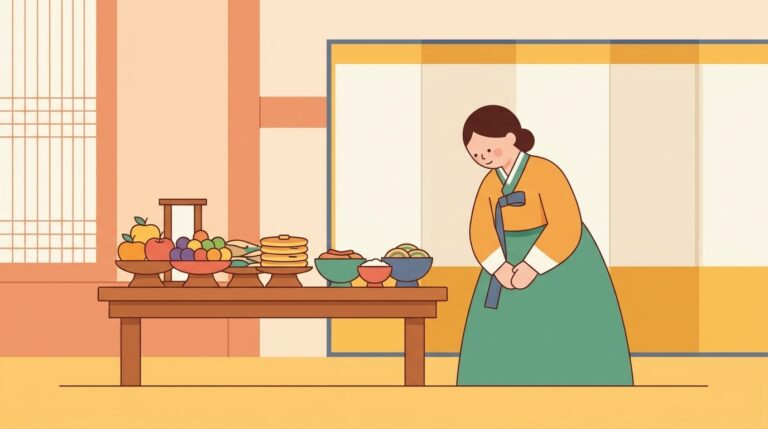
Hello! I am the Lead Editor of Daily Hangul. Have you ever watched a K-Drama and suddenly seen the entire family, dressed in beautiful Hanbok, line up and drop to the floor at the exact same time in front of a table full of food? What looks like a synchronized dance is actually one of the most important Korean traditions: Charye (Ancestor Memorial Service) and Sebae (New Year’s Bow).
If you ever spend Seollal (Lunar New Year) in Korea, or with a Korean family, knowing how to navigate this moment will instantly make you part of the family. Let’s dive into the fascinating world of Korean ancestor greetings!
Phase 2: Core Expressions Deep Dive
1. 차례 (Ancestor Memorial Service)
* Pronunciation: [charye] (Sounds like cha-ryeh)
* Meaning: Ancestor memorial rite/service.
* K-Culture Moment: Think of dramas where the mother-in-law is stressing out over frying hundreds of pancakes (Jeon). They are preparing the food for the Charye table!
* Editor’s Insight: This word has a heavy, respectful vibe. It is all about remembering your family roots.
* Situation Spectrum:
* Casual (Friends): ✅ (Talking about doing it)
* Semi-formal (Coworkers): ✅
* Formal (Elders): ✅
* 🤔 Think About It: Why do Koreans offer food to ancestors? Does your culture have a way to include those who passed away in family celebrations?
2. 절 (Deep Bow)
* Pronunciation: [jeol] (Sounds like juhl, rhymes with dull)
* Meaning: A formal, kneeling bow.
* K-Culture Moment: K-Pop idols often do a big Jeol to their fans at New Year’s concerts to show immense gratitude.
* Editor’s Insight: A standard nod is an insa, but jeol means getting your knees and forehead on the floor. It is the ultimate sign of respect.
* Situation Spectrum:
* Casual (Friends): 🚫 (Never do this to friends!)
* Semi-formal (Coworkers): ⚠️
* Formal (Elders/Ancestors): ✅
* 🤔 Think About It: In many Western cultures, bowing is rare. In Korea, bowing lowers your physical position to elevate the other person.
3. 새해 복 많이 받으세요 (Happy New Year)
* Pronunciation: [saehae bok mani badeuseyo] (Sae-hae bok mahn-ee bah-deu-seh-yo)
* Meaning: Literal: Please receive a lot of New Year’s luck. Real: Happy New Year!
* K-Culture Moment: Every Korean celebrity posts this exact phrase on their Instagram on January 1st and Lunar New Year!
* Editor’s Insight: We say this BEFORE and AFTER the holiday. It is the magic greeting for the entire season.
* Situation Spectrum:
* Casual (Friends): ✅
* Semi-formal (Coworkers): ✅
* Formal (Elders): ✅
Phase 3: Textbook vs. Real Korean
Talking About Holiday Food
* 📖 Textbook Korean: 저는 떡국을 먹습니다. (I eat rice cake soup.)
* 🗣️ Real Korean: 떡국 먹고 한 살 더 먹었어요! (I ate Tteokguk and gained another year of age!)
* 💡 Why it’s different: In Korea, eating the New Year soup (Tteokguk) is culturally tied to turning one year older. It is a very common joke!
Receiving Lucky Money (Sebaetdon)
* 📖 Textbook Korean: 돈을 주셔서 감사합니다. (Thank you for giving me money.)
* 🗣️ Real Korean: 감사합니다! 잘 쓰겠습니다! (Thank you! I will use it well!)
* 💡 Why it’s different: Pointing out the money directly sounds a bit transactional. Saying I will use it well is much more polite and natural.
Phase 4: Cultural Context — K-Culture Deep Dive
Non-verbal cues: Hand Placement (Gongsu)
When standing before the ancestor table, you don’t just let your arms hang! You must fold your hands over your belly button. For happy events (like New Year), men put their LEFT hand over the RIGHT, and women put their RIGHT hand over the LEFT.
The K-Drama Connection
Have you seen the chaotic holiday prep in dramas like Reply 1988? The women are usually frying food, while the men are arranging the table. Modern Korea is slowly changing this to be more equal, but the specific layout of the ancestor table (red fruits on the East, white on the West) remains a strict tradition!
Phase 5: Roleplay Scenario
Setting: Seollal morning. You are invited to your Korean friend Minji’s grandmother’s house. You are wearing a Hanbok, and the ancestor table is fully set.
Characters:
* YOU: An absolute beginner in Korean, nervous but excited.
* Minji (28): Your Korean friend, very encouraging.
Dialogue:
Minji: 우와, 한복 정말 잘 어울려요!
(uwa, hanbok jeongmal jal eoullyeoyo!)
[English] Wow, the Hanbok looks great on you!
YOU: 고마워요. 그런데 저 지금 너무 떨려요.
(gomawoyo. geureonde jeo jigeum neomu tteollyeoyo.)
[English] Thank you. But I am so nervous right now.
Minji: 걱정 마세요. 저만 따라 하세요.
(geokjeong maseyo. jeoman ttara haseyo.)
[English] Don’t worry. Just follow my lead.
YOU: 할머니께 언제 인사해요?
(halmeonikke eonje insahaeyo?)
[English] When do we greet grandmother?
Minji: 차례 끝나고 세배할 거예요.
(charye kkeunnago sebaehal geoyeyo.)
[English] After the ancestor rite, we will do the New Year’s bow.
YOU: 아하, 두 번 절하는 거 맞죠?
(aha, du beon jeolhaneun geo matjyo?)
[English] Ah, we bow twice, right?
Minji: 안 돼요! 조상님께는 두 번, 할머니께는 한 번이에요!
(an dwaeyo! josangnimkkeneun du beon, halmeonikkeneun han beonieyo!)
[English] No! Twice for ancestors, only once for grandmother!
YOU: 휴, 큰일 날 뻔했네요.
(hyu, keunil nal ppeonhaenneyo.)
[English] Phew, I almost made a huge mistake.
Minji: 자, 이제 할머니께 가요!
(ja, ije halmeonikke gayo!)
[English] Now, let’s go to grandmother!
🔀 Your Turn! After bowing to Grandmother, she hands you an envelope of money (Sebaetdon). What do you say?
* A) 돈 안 주셔도 돼요! (You don’t have to give me money!)
* B) 새해 복 많이 받으세요! 감사합니다! (Happy New Year! Thank you!)
* C) 대박! 얼마예요? (Awesome! How much is it?)
✅ Best Choice: B — Always accept Sebaetdon with two hands, say thank you, and offer the New Year greeting.
⚠️ Choice C Analysis: Asking how much it is in front of the elder is incredibly rude!
Phase 6: 10-Second Shadowing Drill
😊 밝고 기분 좋게 (Brightly and cheerfully)
새해 / 복 / 많~~~이 / 받으세요!
(saehae / bok / man~~~i / badeuseyo!)
Phase 7: K-Culture Mini Dictionary
1. 세배 (sebae)
* English: New Year’s bow
* Context: The specific act of bowing to living elders on New Year’s Day.
2. 세뱃돈 (sebaetdon)
* English: New Year’s lucky money
* Context: Given by elders to younger people after the bow. Usually in crisp, new bills!
3. 떡국 (tteokguk)
* English: Rice cake soup
* Context: The soul food of Seollal. You must eat this to officially turn a year older.
4. 전 (jeon)
* English: Korean savory pancakes
* Context: The ultimate holiday food, and the reason many Korean houses smell like delicious oil during Seollal!
Phase 8: Traveler’s Survival Kit
If you are traveling in Korea during Seollal, you need to know these survival phrases because many places close down!
🆘 Survival Phrases
* 🇰🇷 오늘 문 열어요? (oneul mun yeoreoyo?)
* 🗣️ English: Are you open today?
* 📍 Where to use: Cafes, restaurants, shops.
- 🇰🇷 포장해 주세요. (pojanghae juseyo.)
- 🗣️ English: Please pack it to go.
- 📍 Where to use: Holiday food stalls, markets.
📌 Editor’s Travel Note
Seoul becomes a ghost town during Seollal because everyone goes to their hometowns. This is actually the BEST time to visit grand palaces like Gyeongbokgung! They are wide open, often free, and run special traditional holiday events.
Phase 9: Critical Thinking Corner — A Step Deeper
Food & Identity: The Charye Table
Have you ever wondered why Koreans prepare so much beautiful food for ancestors who cannot physically eat it? In Korean culture, food is the ultimate expression of love and connection (Jeong). By sharing the best fruits, meats, and freshly harvested foods with the ancestors first, the family reaffirms their roots. After the rite, the living family members eat the food together (called Eumbok), symbolizing receiving blessings from the ancestors.
💬 Your Turn: How does your culture remember and honor family members who have passed away? Share in the comments!
Phase 10: FAQ & Common Mistakes
Q: I am not Korean. Can I still do the deep bow (Jeol) to my Korean partner’s parents?
Yes! Koreans will be deeply touched and impressed by your respect for their culture.
Q: Do Christians in Korea bow to the ancestor table?
Many do not! Due to religious beliefs, some families replace bowing to the table with a family prayer, but they still gather to eat the holiday food together.
❌ Common Mistake #1: Bowing TWICE to a living person.
✅ How to fix: One bow is for the living (elders). Two bows are ONLY for the deceased (ancestors at funerals or Charye). Doing two bows to your friend’s grandfather is a massive taboo!
Phase 11: Summary & Action Items
One-Liner Summary: To survive Seollal, remember to bow twice to ancestors, once to elders, and loudly say Saehae bok mani badeuseyo!
Action Missions:
* 🥉 Bronze: Stand up and practice folding your hands (Gongsu) correctly over your stomach!
* 🥈 Silver: Write 새해 복 많이 받으세요 in your Korean notebook.
* 🥇 Gold: Send a voice message to a Korean friend saying the New Year greeting!
K-Culture Mission: Search for Idol Sebae on YouTube and watch how your favorite K-Pop stars do the traditional bow for their fans!
Phase 12: Interactive Quiz
1. True or False: You should bow twice to your Korean boss to show extra respect.
(Answer: FALSE! Two bows mean they are dead. You will cause a huge misunderstanding!)
2. Situational Judgment: You just finished a delicious bowl of Tteokguk. What is the classic Korean joke to say?
* A) I am full.
* B) I am one year older!
* C) I need coffee.
(Answer: B! Eating Tteokguk means gaining one year of age!)







